PurpleGo’s 15-slide deck from 2018 presents a focused vertical SaaS solution for optical retailers. The narrative centers on the 'Retail 3.0' trend, where online and offline experiences merge to drive massive efficiency gains. The company uses Warby Parker as a primary benchmark, noting a revenue difference of $350 per square foot for traditional stores versus $3,000 for digitally-enabled ones (Slide 4). With 8 locations already active and a $4k annual contract value (Slide 13), the deck demonstrates early product-market fit. However, it lacks a formal 'Ask' slide, financial projections, or a…
Key takeaways
- The deck identifies a massive revenue gap, citing $350/sq ft for traditional optical vs $3,000/sq ft for Warby Parker on slide 4.
- PurpleGo positions itself as an 'In-Store iPad App for Optical Retailers' to bridge the digital-physical divide (slide 7).
- Product features include cutting time-to-sale in half and enabling browsing of expanded frame inventories (slides 8-9).
- Early traction is defined by 8 active locations and a short 2-week sales cycle (slide 13).
- The business model is based on a $4k annual contract value per location (slide 13).
- A single pilot store saw a revenue increase of $150k after implementing the software (slide 12).
- The team slide features two co-founders with experience at Cisco, Microsoft, and IBM, but lacks specific optical industry backgrounds (slide 15).
- The deck completely omits a funding ask, specific use of proceeds, or a roadmap for future product development.
PurpleGo: The Vertical SaaS Play for Optical Retail
PurpleGo’s 2018 pitch deck is a study in minimalism and vertical focus. The company positions itself as the technological bridge for traditional optical retailers who are struggling to compete with modern, digitally-native brands. By focusing exclusively on the optical niche, PurpleGo attempts to solve specific pain points like lens customization and inventory management that general Point of Sale (POS) systems often overlook.
The Vision and Market Context (Slides 1-4)
The deck opens with a bold declaration of 'Retail 3.0,' which they define as the merging of online and offline experiences (Slide 2). This is a classic 'macro trend' opening, setting the stage for why the company needs to exist right now. Slide 3 lists successful mobile-connected brands like Bonobos, Warby Parker, Indochino, and Everlane to validate the model.
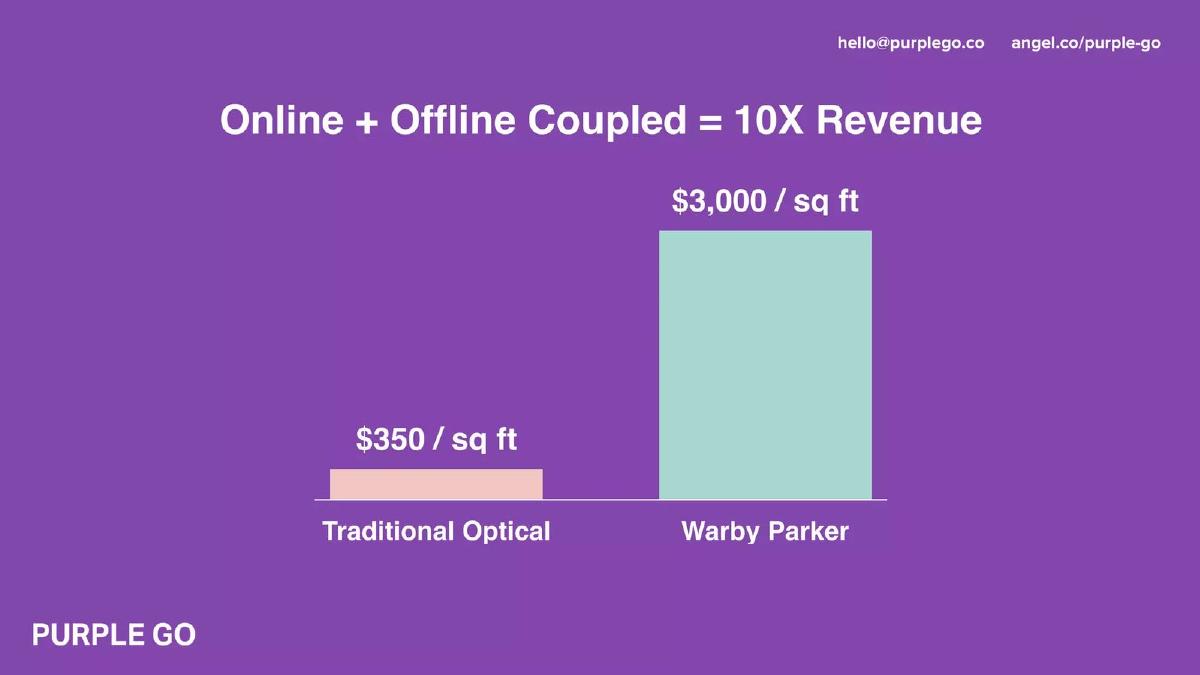
The most compelling slide in this section is Slide 4, which provides a stark comparison of revenue efficiency. It claims traditional optical stores generate $350 per square foot, while Warby Parker generates $3,000 per square foot. This '10x' delta is the core hook of the entire pitch, suggesting that PurpleGo’s technology can help traditional retailers close this massive gap.
The Problem and Solution (Slides 5-7)
Slide 5 uses a visceral image of a cluttered, disorganized shoe store to represent the 'terror' traditional retailers feel about keeping up. This leads directly into the solution on Slide 6: 'Tech to Get Traditional Retailers to 10X.' The specific product is revealed on Slide 7 as an 'In-Store iPad App for Optical Retailers.'
By narrowing the focus to optical retailers specifically, PurpleGo avoids the trap of trying to be a general retail POS. This verticalization is a common strategy for startups looking to displace incumbents by offering deeper, industry-specific functionality.
Product Deep Dive (Slides 8-10)
The deck uses three slides to show the interface and core value propositions of the app. Slide 8 claims the software can 'Cut Time to Sale in Half' by streamlining the selection of frames, lens types, materials, and coatings. The screenshot shows a clean interface for selecting high-index lenses and scratch-resistant coatings, which are specific to the optical industry.
Slide 9 focuses on 'Browse Tons More Frames,' addressing the physical limitation of store shelves. This 'endless aisle' concept allows a small boutique to sell as many products as a flagship store. Slide 10 shows the checkout process, highlighting the ability to 'Enable Online Sales' and 'Pick up in store,' further reinforcing the omnichannel 'Retail 3.0' theme.
Traction and Business Model (Slides 11-14)
The traction section is concise but data-rich. Slide 12 highlights a single pilot store that saw a $150,000 increase in annual revenue. For a small business owner, this ROI is easy to understand and justify. Slide 13 provides the broader metrics: 8 locations, a 2-week sales cycle, and a $4,000 annual contract value (ACV).
The $4k ACV suggests a SaaS pricing model of roughly $333 per month per location. Combined with the 2-week sales cycle, this points toward a high-velocity sales model. Slide 14 attempts to show scale by stating there are '100,000’s of Stores,' though it lacks a breakdown of how many of those are independent versus large chains.
The Team (Slide 15)
The deck concludes with the team slide. Co-Founders Jeremy Huff (CEO) and Samantha Tran (CTO) are presented with a list of impressive corporate logos: Cisco, Flip Video, Microsoft, Panasonic, and IBM. While these logos suggest technical and operational competence, the deck does not explicitly state if the founders have prior experience in the optical industry or retail management, which could be a point of friction for specialized investors.
What Works in the PurpleGo Deck
The 10x Hook: Comparing traditional retail revenue per square foot to Warby Parker (Slide 4) creates an immediate, quantifiable reason for the product to exist. · Vertical Focus: By showing optical-specific screenshots (Slide 8), the founders prove they understand the unique complexities of selling prescription eyewear. · Speed of Sale: Highlighting a 2-week sales cycle (Slide 13) is a very strong signal for a B2B SaaS company, suggesting the product is easy to demo and the pain point is acute. · Clear ROI: The $150k revenue increase in a pilot store (Slide 12) makes the $4k annual cost (Slide 13) look like a negligible expense.
What is Missing from the PurpleGo Deck
The Ask: There is no slide indicating how much capital the company is seeking or what milestones that capital will help them achieve. · Competition: The deck ignores other POS systems or optical-specific software like MyVisionExpress or OfficeMate. Investors want to know why a store wouldn't just use a generic system like Square. · Go-to-Market Strategy: While they have 8 locations, there is no plan for how they will reach the '100,000’s of stores' mentioned on Slide 14. Will they use direct sales, partnerships with frame manufacturers, or digital marketing? · Financial Projections: There is no mention of current Monthly Recurring Revenue (MRR) or a forecast for the next 18-24 months.
What a Founder Should Copy
The 'Before and After' Comparison: Use a high-performing industry leader (like Warby Parker) to show the potential upside for your target customers if they adopt your tech. · Minimalist Design: The deck uses a consistent purple color palette and very little text, making it easy to digest in under three minutes. · Specific Screenshots: Don't just say what the product does; show the actual interface performing a specific, high-value task (like configuring a complex lens order). · Traction Icons: Slide 13 is an excellent template for a quick-hit traction slide. It uses simple icons and clear numbers to communicate three different types of progress (footprint, sales velocity, and pricing).
Frequently asked questions
- What is the core problem PurpleGo is solving?
- PurpleGo addresses the inefficiency of traditional optical retail. According to slide 5, traditional retailers are 'terrified' of falling behind mobile-connected brands. The deck highlights that traditional stores generate significantly less revenue per square foot ($350) compared to digitally integrated competitors like Warby Parker ($3,000), suggesting that a lack of technology is the primary bottleneck for growth and customer experience.
- How does the product actually work for a store owner?
- The product is an in-store iPad application. As shown on slides 8 through 10, it allows staff to manage product options (lenses, coatings, and frames), browse a larger digital inventory than what is physically on the shelves, and facilitate online sales or in-store pickups. The goal is to reduce the time it takes to complete a sale by 50% while expanding the available product selection.
- What evidence of traction does the deck provide?
- PurpleGo reports having 8 active locations as of the 2018 deck (slide 13). They also cite a very fast sales cycle of just 2 weeks. Most importantly, slide 12 claims a pilot store experienced a $150,000 increase in annual revenue after adopting the platform, which serves as a powerful proof of concept for their value proposition.
- What is the market size according to the deck?
- The deck is relatively vague on specific Total Addressable Market (TAM) dollar figures. Slide 14 simply states there are '100,000’s of Stores' that could potentially use the software. While this indicates a large volume of potential customers, it lacks the rigorous bottom-up or top-down market analysis typically expected in a seed-stage venture deck.
- What is missing from this pitch deck?
- The deck is missing several critical components for a fundraising round. There is no 'Ask' slide detailing how much money they are raising or the valuation. It also lacks a slide on competition, a detailed go-to-market strategy beyond the current 8 locations, and any financial projections or unit economics beyond the $4k annual contract value.