Publishizer’s 20-slide deck is a masterclass in visual storytelling and traction-first pitching. Operating in the 'Other' industry category, the company successfully raised $600,000 in 2014 by positioning itself as the solution to the 'good luck' barrier of traditional publishing. The deck highlights a significant market opportunity, noting that 1,052,803 new books were published in the U.S. in 2014 alone. By showcasing $392,000+ in sales and a 22% month-over-month growth rate, the founders demonstrated that authors are willing to pay for a platform that bypasses the manual slog of editing, d…
Key takeaways
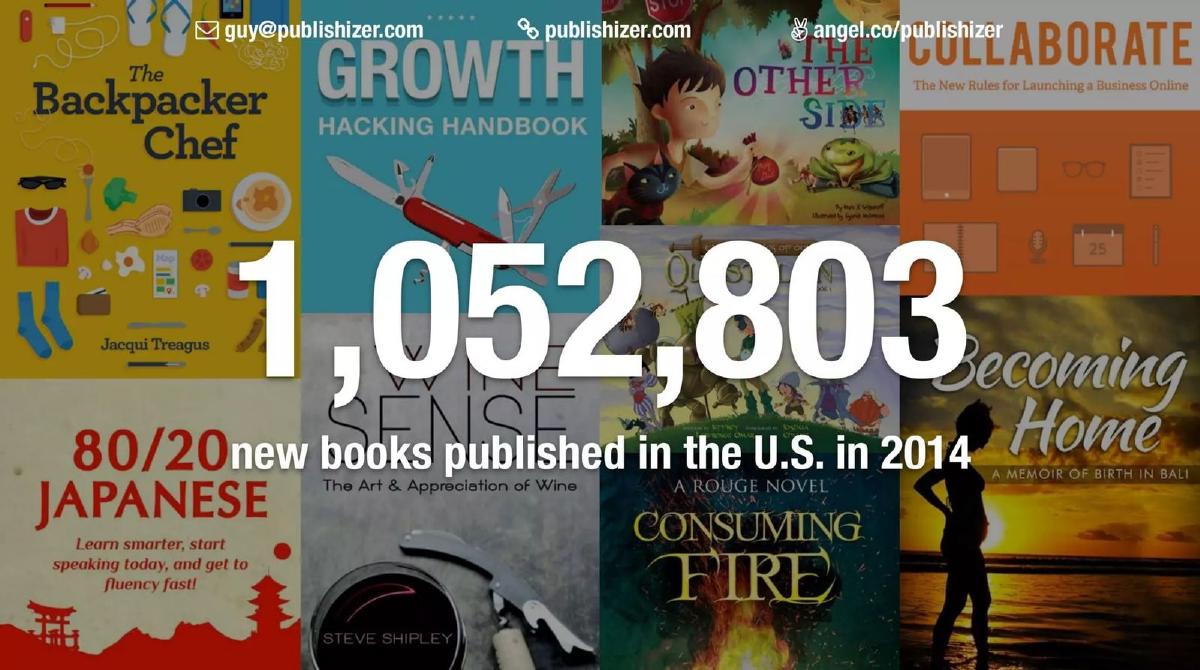
- The deck identifies a massive volume of 1,052,803 new books published in the U.S. in 2014 (Slide 4).
- It highlights the extreme difficulty of traditional publishing by overlaying 'good luck' on a wall of major publisher logos (Slide 6).
- The platform simplifies the process into three steps: a 1,000-word proposal, 45 days of pre-orders, and access to 1,000+ publishers (Slide 12).
- Publishizer reports $392,000+ in total sales at the time of the pitch (Slide 15).
- The business model operates on a $535 average fee per author across 110 authors (Slide 15).
- Traction is strong, showing a 22% month-over-month growth rate (Slide 20).
- The company maintains a 15% margin on its $392,000 sales figure (Slide 20).
- The deck completely omits a specific funding request or 'Ask' slide.
Introduction: The Gatekeepers of Literature
Publishizer’s 2014 seed deck is a study in minimalist, high-impact design. At a time when the publishing industry was bifurcated between the 'Big Five' publishers and the 'wild west' of self-publishing, Publishizer pitched a third way. By the time this deck was circulated, the company had already achieved significant traction, which they used as the primary lever to secure $600,000 in seed funding. The deck consists of 20 slides that move quickly from the emotional pain of the industry to the hard data of their success.
Slides 1-4: The Market Reality
The deck opens with a high-resolution cover slide (Slide 1) featuring a cluttered desk—a visual metaphor for the author's workspace. It immediately moves to a stark image of a closed Borders bookstore (Slide 2), signaling the decline of traditional retail. Slide 3 introduces the product through a collage of book covers, including titles like 'The Backpacker Chef' and '80/20 Japanese.' This establishes that the platform is already functional and diverse. Slide 4 provides the 'Big Number': 1,052,803 new books published in the U.S. in 2014 . This sets the scale of the market opportunity, suggesting that even a small slice of this volume represents a massive business.
Slides 5-8: The Problem Statement
Slides 5 and 6 tackle the traditional publishing route. A grid of prestigious logos—Penguin Random House, Simon & Schuster, Harper Collins—is shown, followed by the words 'good luck' (Slide 6). This effectively communicates the near-impossibility of getting a traditional deal without an existing platform. Slides 7 and 8 pivot to the alternative: self-publishing. A list of 20 arduous tasks, from 'interior layout' to 'metadata' and 'returns,' is presented, followed by the phrase 'kill me now' (Slide 8). The deck successfully frames the author's dilemma: traditional publishing is impossible to enter, and self-publishing is a logistical nightmare.
Slides 9-13: The Solution and Process
The solution is introduced through a clean, three-step process. Slide 10 starts with a 'Proposal 1000 words' . Slide 11 adds 'Preorders 45 days' . Slide 12 completes the loop with 'Publish 1000+ publishers' . This is the core value proposition: Publishizer uses the 45-day pre-order window to generate the data necessary to attract the 1,000+ publishers in their network. Slide 13 gives this category a name: 'crowd-publishing' , positioning the company as the definitive leader in a new market segment.
Slides 14-15: Traction and Unit Economics
Slide 14 is a growth chart showing a steep upward trajectory from Q1 2013 to Q2 2015. While the Y-axis is labeled in increments of 22.5K, it doesn't explicitly state if this is revenue or users, though subsequent slides clarify the financial picture. Slide 15 is perhaps the most important slide in the deck, listing three key figures: $392K+ sales , a $535 avg fee , and 110 authors . This proves the model works and that authors are willing to pay for the service.
Slides 16-18: Social Proof and Case Studies
To humanize the data, Slide 16 and 17 show a successful author holding his book, 'Mobile Ready,' with a callout of $29,230 in revenue generated. Slide 18 shows three more titles—'The Lean Brand,' 'Growth Hacking Handbook,' and 'Ayahuasca'—with their respective earnings of $23,727 , $12,775 , and $18,555 . This demonstrates that the platform works for various genres, from business to memoirs.
Slides 19-20: The Team and The Growth
Slide 19 introduces the founders: Guy Vincent (CEO) , Martin Brochhaus (Engineering) , and Tobias Lorenz (Design) . The slide is minimalist, providing only names, roles, and contact info. The deck concludes on Slide 20 with a final summary of their momentum: $392K sales , a 15% margin , and 22% MoM growth . Ending on growth is a classic fundraising tactic designed to leave investors with a sense of urgency.
What Works in the Publishizer Deck
The most effective element of this deck is its emotional resonance . By using phrases like 'good luck' and 'kill me now,' the founders tap into the genuine frustration of their target customer (authors). This makes the solution feel like a relief rather than just another software tool. Furthermore, the clarity of the three-step process (Proposal, Pre-orders, Publish) demystifies a complex industry. Finally, the hard traction data on Slide 20 is undeniable. A 22% month-over-month growth rate at a 15% margin is a very healthy signal for a seed-stage company in 2014.
What is Missing from the Publishizer Deck
The most glaring omission is the Ask Slide . There is no mention of how much money they are looking for, the valuation they are targeting, or what the funds will be used for (e.g., hiring, marketing, geographic expansion). Additionally, the Team Slide is very thin. While it shows the founders, it doesn't list their backgrounds. Did they come from the publishing industry? Have they built successful startups before? Investors usually want to know why this specific team is the one to win. There is also a lack of Competitive Analysis . In 2014, platforms like Kickstarter and Amazon's CreateSpace were already active; explaining how Publishizer differs from these giants would have strengthened the case.
What a Founder Should Copy
Founders should emulate the visual storytelling used here. Instead of dense bullet points, Publishizer uses large-format photography and bold, centered text. This ensures the audience is listening to the presenter rather than reading the slides. The 'Traction as Validation' approach is also worth copying. By showing specific dollar amounts earned by specific authors (Slide 18), they move the conversation from 'what if' to 'what is.' Finally, the simplicity of the business model presentation—breaking it down into sales, average fee, and number of customers—is a great way to communicate unit economics without getting bogged down in a complex spreadsheet.
Conclusion
Publishizer’s deck is a lean, mean fundraising machine. It identifies a massive, broken market and presents a data-driven solution that was already showing significant month-over-month growth. While it skips over some traditional requirements like a detailed 'Ask' or founder bios, the strength of the $392,000 in sales and the 22% growth rate clearly carried the day, leading to a successful $600,000 seed round.
Frequently asked questions
- What is the core problem Publishizer is solving?
- Publishizer addresses the high barrier to entry in traditional publishing. Slide 6 illustrates this by showing a wall of major publisher logos like Penguin Random House and Simon & Schuster with the text 'good luck' superimposed. It also highlights the 'kill me now' complexity of self-publishing tasks like ISBNs, barcodes, and distribution (Slide 8), positioning Publishizer as a streamlined middle ground.
- How does the 'crowd-publishing' model work according to the deck?
- The model, termed 'crowd-publishing' on Slide 13, uses pre-order data to validate a book's market potential. Authors write a 1,000-word proposal and run a 45-day pre-order campaign. If successful, this data is used to connect them with a network of over 1,000 publishers (Slide 12), essentially using crowdfunding as a de-risking mechanism for traditional editors.
- What are the key financial metrics presented?
- The deck emphasizes three main figures on Slide 20: $392,000 in total sales, a 15% margin, and 22% month-over-month growth. Additionally, Slide 15 breaks down the unit economics, showing an average fee of $535 collected from 110 authors. This indicates a mix of transactional revenue and platform fees.
- Who are the founders and what are their roles?
- The team consists of three members shown on Slide 19: Guy Vincent (CEO), Martin Brochhaus (Engineering), and Tobias Lorenz (Design). The slide provides their photos and email contact information but lacks a traditional 'bio' section detailing their previous experience or specific industry credentials in the publishing world.
- What is missing from this pitch deck?
- The deck is notably missing an 'Ask' slide, which would typically specify how much capital is being raised and how it will be deployed. It also lacks a detailed competitor analysis, a roadmap for future product features, and long-term financial projections beyond the current growth rate. The 'Team' slide is also light on professional history.