Prynt’s 2014 pitch deck is a masterclass in brevity, using just seven slides to secure $9.2 million in funding. The core of the pitch relies on reframing a physical smartphone camera case as a 'social company enabled by hardware.' Instead of focusing solely on the gadget, the deck emphasizes high-margin consumables (80% margin) and user engagement metrics, such as 5 minutes and 25 seconds spent daily in the app. By showcasing significant retail traction with partners like Target and Best Buy alongside a 'Trojan Horse' strategy for augmented reality, Prynt successfully pivoted the conversation…
Key takeaways
- The deck positions the physical camera case as a 'Trojan Horse' to build a digital platform connecting physical and digital worlds (Slide 4).
- Prynt reports significant early traction with 35,000 units shipped at the time of the presentation (Slide 4).
- The business model relies heavily on consumables, which boast a high 80% margin (Slide 4).
- Engagement metrics are used to prove social viability, citing 5'25" minutes spent on the app per day (Slide 3).
- The company claims a viral coefficient through its hardware, stating there are 4 app users for every 1 case sold (Slide 3).
- Retail distribution is a core strength, featuring logos from Target, Urban Outfitters, Bloomingdale's, Best Buy, and T-Mobile (Slide 4).
- The deck highlights a 50% long-term retention rate for users with 5 or more friends (Slide 3).
- The 'Next Steps' are focused on geographic expansion, specifically targeting Asia and seeking new partners (Slide 7).
The 7-Slide Strategy: How Prynt Reframed Hardware
Prynt’s pitch deck is an exercise in extreme minimalism. In an era where decks often stretch to 20 or 30 slides, Prynt secured $9.2 million using just seven. The company, founded in 2014, entered a crowded market of smartphone accessories but managed to stand out by pitching a vision that was larger than the device itself. The deck does not dwell on technical specifications; instead, it focuses on the intersection of physical memories and digital engagement.
Slide 1: The Hook
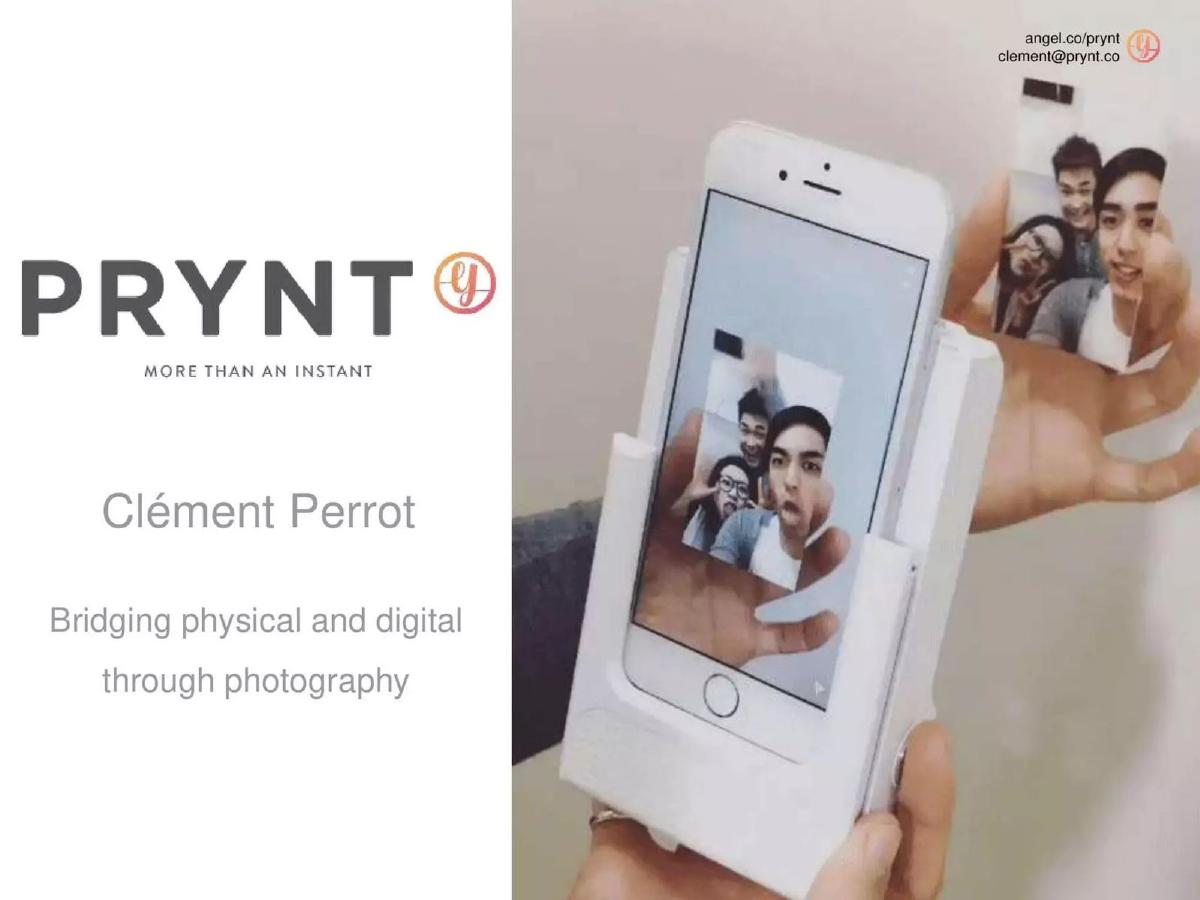
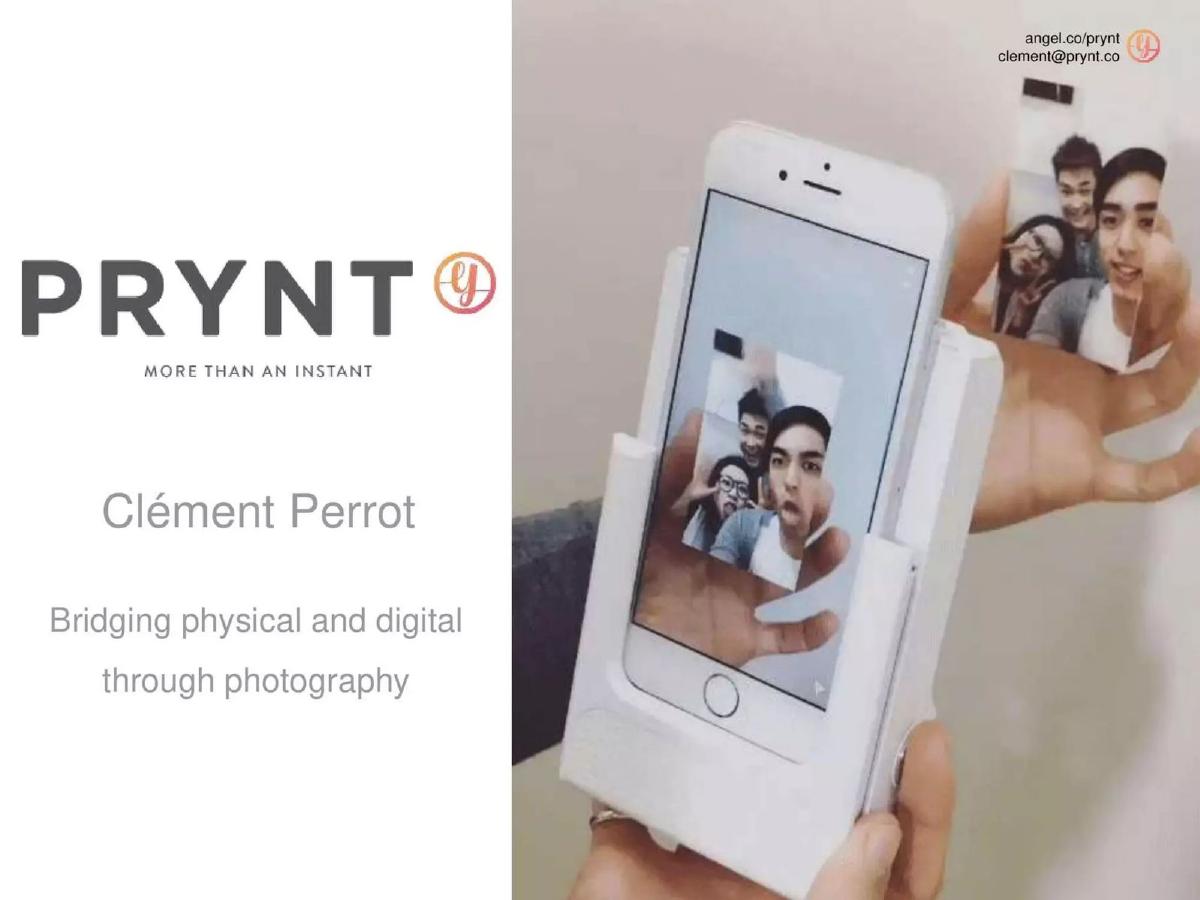
The title slide features the Prynt logo and the tagline "More than an instant." It introduces Clément Perrot and uses the mission statement: "Bridging physical and digital through photography." The visual is a high-quality photo of the device in action, showing a smartphone docked into the white camera case with a printed photo emerging. This immediately answers the 'what is it' question without requiring a single bullet point of text.
Slide 2: The User Experience
Slide 2 is purely visual, split into two halves labeled "Virality" and "More Communication." The left side shows a user interacting with a physical print, while the right side shows a smartphone screen with an 'Add story' button and a video playing over a photo. This slide introduces the concept of Augmented Reality (AR) without using the jargon. It implies that the physical photo is a gateway to a digital story, setting the stage for the 'social' argument that follows.
Slide 3: The Social Proof
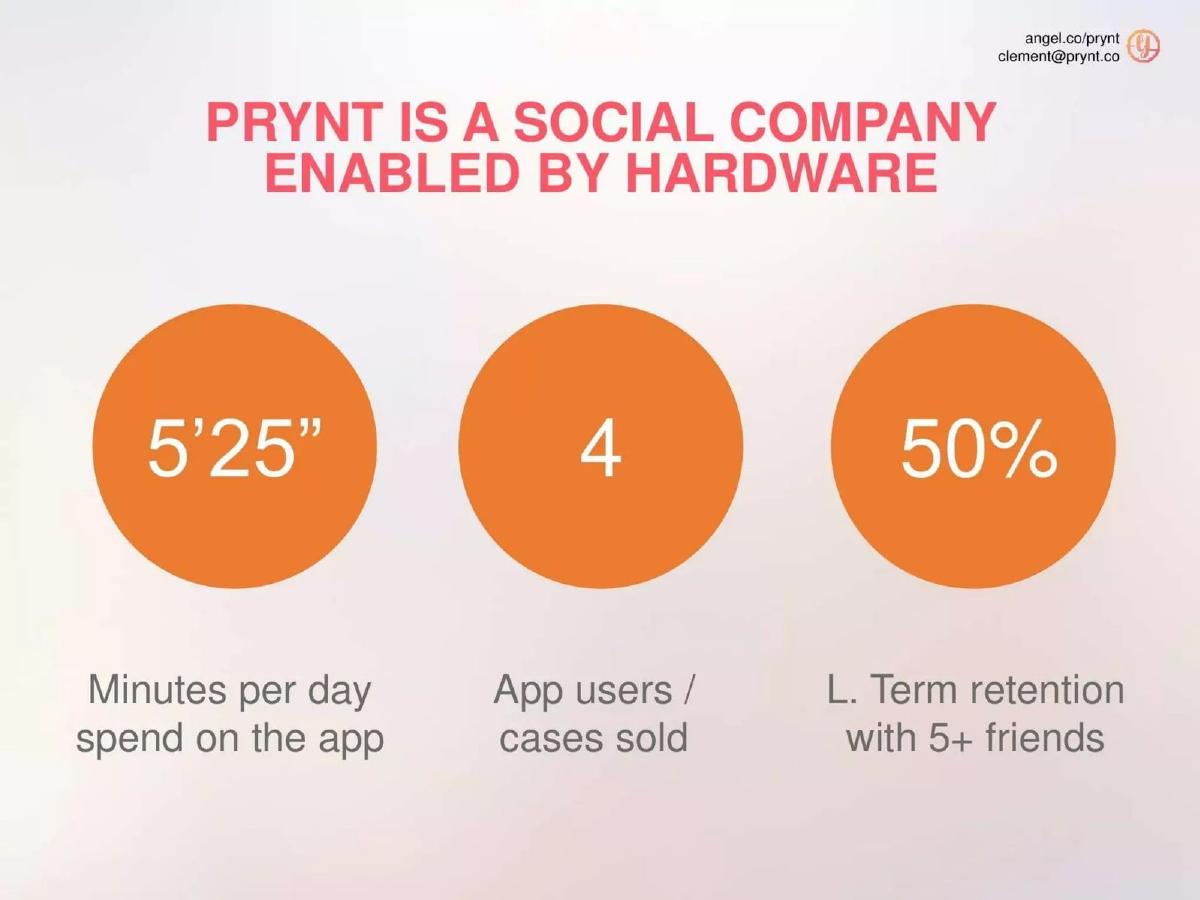
This is arguably the most important slide in the deck. Titled "Prynt is a social company enabled by hardware," it attempts to move the company out of the 'low-multiple hardware' bucket and into the 'high-multiple social' bucket. It lists three key metrics: 5'25" minutes per day spent on the app , 4 app users per case sold , and 50% long-term retention with 5+ friends . By showing that four people use the app for every one person who owns the hardware, Prynt demonstrates a viral loop where the physical product acts as a marketing tool for the digital platform.
Slide 4: The Trojan Horse and Retail Traction
Slide 4 reveals the business model and the scale of the operation. It explicitly calls the hardware a "Trojan Horse" for a platform connecting physical and digital. The slide lists 35,000 units shipped , which provides significant proof of concept. More importantly, it lists an 80% margin on consumables . This is the 'razor-and-blade' model: sell the hardware to get the platform in place, then reap high-margin recurring revenue from the photo paper. The inclusion of logos like Target, Urban Outfitters, Bloomingdale's, Best Buy, and T-Mobile shows that the company has already cleared the massive hurdle of retail distribution.
Slide 5: The Value Chain
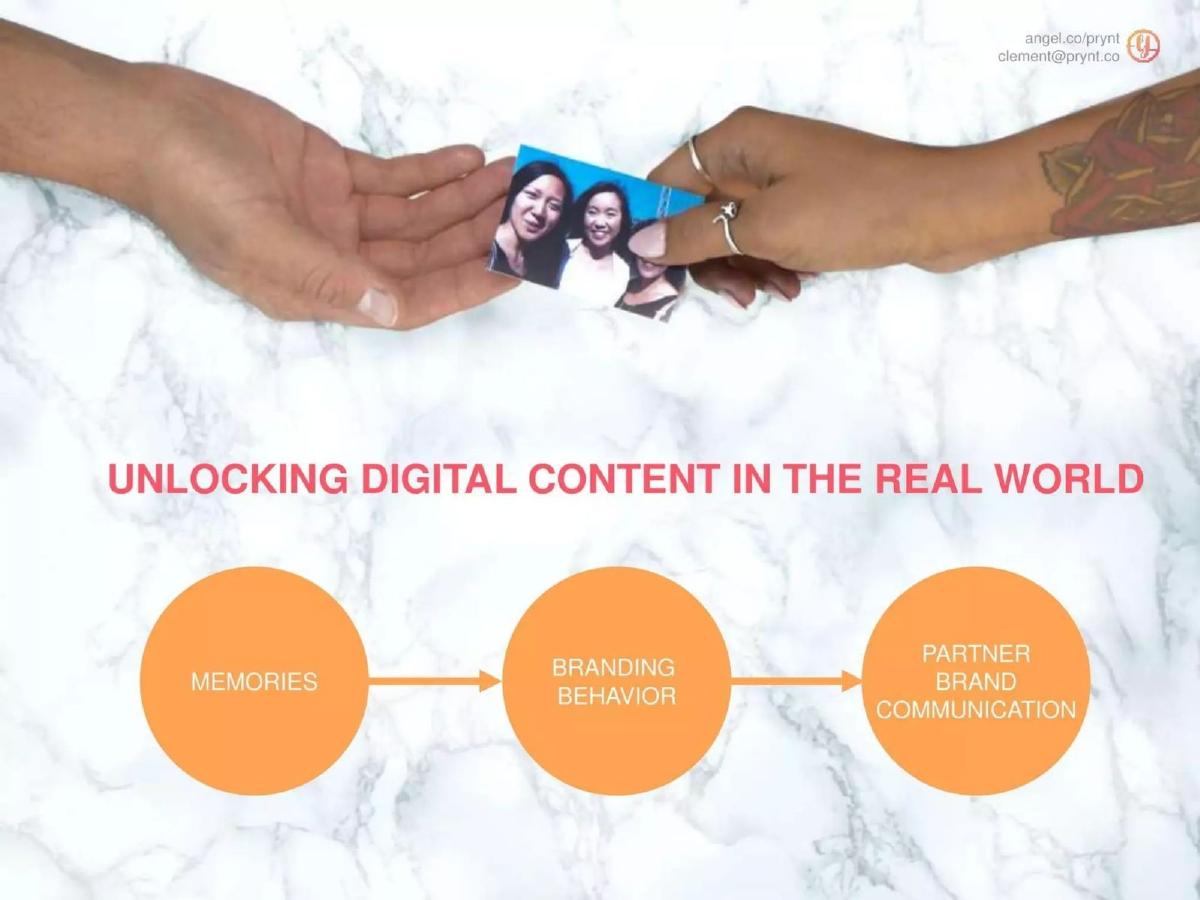
Slide 5, titled "Unlocking digital content in the real world," uses a simple flow chart: Memories -> Branding Behavior -> Partner Brand Communication . This slide hints at the long-term monetization strategy beyond just selling paper. It suggests that the AR platform can be used for B2B purposes, allowing brands to embed digital content into physical objects, though the deck does not elaborate on specific brand partnerships already in place.
Slide 6: The Team
The team slide is a single group photo of approximately 25 people in an office setting with the Prynt logo on the wall. Notably, there are no names, titles, or prior experience listed for the leadership team or key hires. While this conveys a sense of scale and culture, it is a significant departure from standard decks that usually highlight the pedigree of the founders. In this case, the company relies on the momentum of their metrics rather than the resumes of their staff.
Slide 7: The Investors and The Ask
The final slide lists their current investors, including SOSV, Binary Capital, 500 Startups, GGV Capital, Greycroft, and Root Ventures . Having these names on the deck provides a high level of institutional credibility. The 'Next Steps' section is vague, stating they are "targeting Asia and looking for potential partners." There is no specific dollar amount for the 'ask,' which suggests this deck may have been used as a general teaser or for a round where terms were already being discussed.
What Works in the Prynt Deck
The most successful element of this deck is its reframing of the business model . Hardware is notoriously difficult to fund because of inventory risks and low margins. Prynt bypasses this by focusing on the 80% margin of the consumables and the digital engagement time. By showing that the app usage is over five minutes a day, they compete for attention metrics usually reserved for social networks like Instagram or Snapchat.
The retail logos are also a massive strength. For a hardware startup, getting into Target and Best Buy is a validation of the product's mass-market appeal. It proves that the 'Trojan Horse' is actually being deployed into the wild, not just sitting in a warehouse. The 35,000 units shipped figure provides a concrete anchor for their growth claims.
What is Missing from the Prynt Deck
The deck is missing several critical components typically required for a fundraise. There is no competitive analysis . Companies like Polaroid and Fujifilm (Instax) were already dominant in the instant photography space, and the deck does not explain how Prynt defends its territory against these giants. There is also no mention of intellectual property or patents, which is vital for a hardware-software hybrid.
Furthermore, the lack of financial transparency is notable. While an 80% margin on paper is great, the deck says nothing about the burn rate, the cost to acquire a customer (CAC), or the lifetime value (LTV) of a user. The team slide is also unusually anonymous, providing no insight into whether the founders have the technical or operational background to scale a global hardware brand.
What a Founder Should Copy
Founders should emulate the clarity of the 'Trojan Horse' concept . If you are building a product in a 'boring' or 'difficult' sector, find the angle that connects it to a high-growth sector. Prynt didn't just sell a camera; they sold a 'social company enabled by hardware.'
The use of simple ratios is another takeaway. The stat "4 app users / cases sold" is a brilliant way to quantify virality without a complex spreadsheet. It tells a story of organic growth and network effects that is easy for an investor to remember and repeat to their partners. Finally, the visual-first approach ensures that the investor spends their time looking at the product and the results, rather than squinting at dense blocks of text.
Frequently asked questions
- How does Prynt justify being a 'social company' rather than a hardware company?
- Prynt uses Slide 3 to show that their hardware drives digital engagement. They cite a ratio of 4 app users for every 1 case sold, suggesting that the physical photos act as a social bridge. By focusing on the 5'25" daily app usage and long-term retention of users with friends, they argue the hardware is merely the entry point for a social network.
- What is the 'Trojan Horse' strategy mentioned in the deck?
- On Slide 4, Prynt describes their hardware as a 'Trojan Horse.' This means the camera case is a way to get their software and augmented reality (AR) technology into users' hands. Once the physical photos are printed, the app 'unlocks' digital content (videos) hidden within the print, creating a recurring digital interaction that outlasts the initial hardware purchase.
- Does the deck provide information on the manufacturing or unit costs of the case?
- No. The deck completely omits the Cost of Goods Sold (COGS) or the retail price of the camera case itself. It only mentions the 80% margin on 'consumables' (the photo paper). This is a common tactic to steer investors away from the low margins typically associated with consumer electronics hardware and toward the 'razor-and-blade' model.
- What is missing from this pitch deck that a typical Series A deck would include?
- This deck is exceptionally lean at only 7 slides. It lacks a formal 'Problem' slide, a detailed 'Solution' breakdown, a competitive landscape, and any financial projections. It also does not specify the exact amount of capital being raised, simply stating they are looking for partners and targeting Asia as their next step.
- How does Prynt demonstrate market validation?
- Prynt demonstrates validation through two primary channels: volume and retail partnerships. Slide 4 notes they have shipped 35,000 units and lists major global retailers like Target and Best Buy. This proves that there is both consumer demand and professional retail interest, reducing the perceived risk of a new hardware product.