Pulley’s Series B deck is a study in focused execution. Founded in 2019, the company raised $50.2 million by positioning itself as the high-velocity alternative to Carta. The deck leans heavily on social proof, specifically citing that 62% of the last Y Combinator batch chose Pulley (Slide 6). Rather than complex financial engineering, the narrative centers on 'Our Not So Secret Strategy': listening to customers and being 10x faster than competitors (Slide 7). The deck effectively uses product screenshots to demonstrate a superior UI, while the appendix provides a sobering look at a $2.3 bill…
Key takeaways
- Pulley claims a dominant market share within the YC ecosystem, stating 62% of the last batch picked their platform (Slide 6).
- The company positions speed as its primary competitive moat, offering onboarding in 15 minutes compared to weeks for competitors (Slide 7).
- A transparent pricing model is presented, ranging from a free tier for under 20 stakeholders to a $20/stakeholder/month growth tier (Slide 10).
- The product roadmap is structured around the company lifecycle: Inception, Raise, Hire, and Build (Slide 11).
- Pulley highlights 'Scenario Modeling' as a key feature to help founders understand dilution post-seed (Slide 15).
- Expansion opportunities include high-margin financial services like equity-backed loans and secondary markets (Slide 19).
- The market analysis suggests a massive $2.3 billion total market size with 90.43% of the share still available (Slide 22).
- The team slide emphasizes deep technical roots, including a CEO who sold a previous company to Microsoft and engineers from Docker and Pebble (Slide 5).
Introduction: The High-Velocity Cap Table
Pulley’s pitch deck is a masterclass in positioning. In a market dominated by a massive incumbent, Pulley doesn't try to out-feature their competition; they try to out-pace them. The deck, used for their $50.2 million Series B, focuses on the friction of existing tools and how Pulley’s focus on speed and 'founder-first' design has allowed them to capture the most valuable segment of the market: the newest, highest-growth startups.
Section 1: The Mission and the Team
Slide 1: Title Slide The deck opens with a minimalist title: "PULLEY: Cap Table Management for Hyper-Growing Startups." The subtitle immediately identifies their target audience—not just any company, but those scaling rapidly.
Slide 3: Pulley's Mission The mission is stated as "to help founders start more companies." The vision expands this to a world where a company can be created with a "push of a button" and where employees and investors share in the value easily. This frames the product not as a ledger, but as an engine for entrepreneurship.
Slide 4: The Core Asset This slide defines the problem space. Pulley is the platform for managing "their most valuable asset: THEIR EQUITY." It’s a simple, high-stakes framing that justifies why a specialized platform is necessary.
Slide 5: About Us (The Team) The team slide is a powerhouse of Silicon Valley pedigree. CEO Yin is noted for selling Android Systems Application to Microsoft and being a YC Alum with a Stanford CS degree. The engineering team features veterans from Docker, Crowdflower, Pebble, and Radius Intelligence. The slide also lists heavy-hitter backers: Stripe, Y Combinator, 8VC, General Catalyst, and Caffeinated Capital. This provides immediate institutional credibility.
Section 2: Traction and Strategy
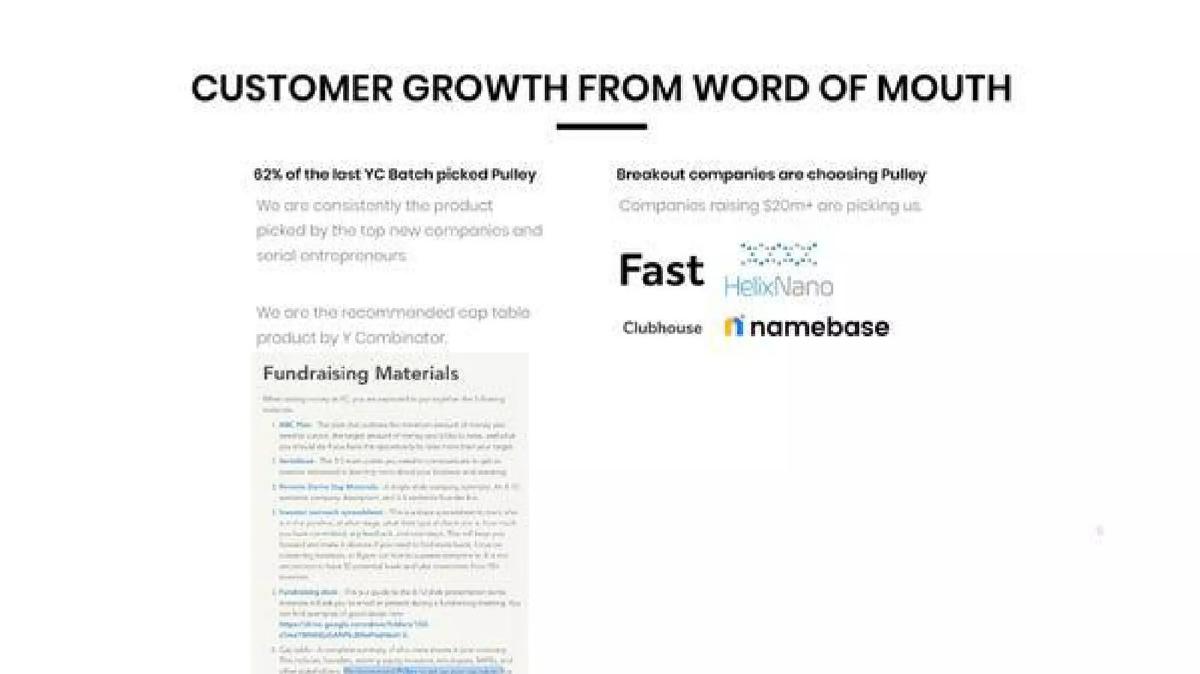
Slide 6: Customer Growth from Word of Mouth This is the most important slide in the deck for establishing product-market fit. It claims that "62% of the last YC Batch picked Pulley" and that they are the "recommended cap table product by Y Combinator." It lists breakout logos like Fast, Clubhouse, HelixNano, and Namebase. By showing they own the 'cool kids' of the startup world, they signal that they are the future standard.
Slide 7: Our Not So Secret Strategy Pulley explicitly defines their competitive advantage here. They list three pillars: 1) Listen to customers (shipping features in 1 week), 2) 10x more effective (self-serve interactions), and 3) Aim for 10x faster. The specific metric provided is "onboarding in 15 minutes vs. weeks" and "409A in five days vs. a month." This is a direct attack on the slow turnaround times of legacy competitors.
Section 3: Product and Pricing
Slide 9: Feature Parity To move past the 'newcomer' label, Slide 9 asserts, "We already offer all of the features of our competitors." It lists standard tools like scenario modeling, digital certificates, and Rule 701 analysis across Starter, Growth, and Enterprise tiers. This is a 'check the box' slide to reassure investors that there are no functional gaps.
Slide 10: Pricing The pricing is transparent and aggressive. A free tier for startups with under 20 stakeholders ensures they capture companies at the earliest stage. The $10 and $20 per stakeholder/month tiers provide a clear path to scaling revenue as those startups grow. This is a classic SaaS 'land and expand' model.
Slide 11: The Lifecycle Pulley maps its product to the four stages of a company: Inception (onboarding), Raise (certificates), Hire (equity plans), and Build (job-specific tools). This structure is used to organize the following product deep-dive slides.
Section 4: Product Deep Dive (The Walkthrough)
Slides 12-14: Inception These slides focus on the user experience. Slide 12 highlights "Fast Onboarding" via spreadsheets. Slide 13 shows an "Intuitive and Easy to Use" dashboard with a clean UI. Slide 14 demonstrates "Manage Equity Grants," showing how easy it is for employees to log in and exercise options. The screenshots are crisp and modern, contrasting with the often-clunky interfaces of older fintech tools.
Slides 15-16: Raise Slide 15 showcases "Scenario Modeling," a critical tool for founders to visualize dilution before they sign a term sheet. Slide 16 shows an "Export to Excel" feature, acknowledging that while they want users in the platform, the reality of venture capital still requires shareable pro-formas.
Slide 17: Hire (409A Valuation) This slide addresses a major pain point: the 409A valuation. Pulley highlights partnerships with third-party firms and a "Safe Harbor Provision," positioning themselves as a one-stop shop for compliance during the hiring phase.
Section 5: Forward Looking and Market Opportunity
Slide 19: Expansion Opportunities Pulley outlines how they will grow into a multi-billion dollar business. They identify four paths: 1) Core cap table growth (citing Computershare as a $10B company), 2) Financial services for employees (equity-backed loans), 3) Secondary markets (Forge Global), and 4) Legal tooling (DocuSign). This shows the founders are thinking about the platform as a financial ecosystem, not just a database.
Slide 22: Private Company Market Opportunity In the appendix, Pulley provides the 'Why Now' data. They estimate the total market size at $2.3 billion. Crucially, they state that incumbents like Carta and Shareworks only have a combined revenue of $220 million, or 9.57% market share. This suggests that 90.43% of the market is still up for grabs, countering the argument that the category is already 'won.'
What Works in This Deck
Social Proof: The 62% YC batch statistic is a devastatingly effective metric. It proves that among the most sophisticated new founders, Pulley is the default choice. · Speed as a Feature: By quantifying speed (15 minutes vs. weeks), Pulley turns a subjective 'better UI' argument into an objective 'faster ROI' argument. · The Incumbent Gap: Slide 22 is brilliant. It reframes a market with a dominant player as a market that is actually 90% underserved. This is a key narrative shift for a Series B. · Pedigree: The team slide doesn't just list names; it lists specific exits and technical roles at high-growth companies, signaling they have the 'builder' DNA required to ship fast.
What is Missing
Financial Specifics: There is no mention of Pulley’s actual revenue, growth rate (MoM or YoY), or Net Revenue Retention (NRR). While the YC percentage is a great proxy, Series B investors usually want to see the hard numbers. · Churn and Retention: There is no data on how many companies stay with Pulley after their first year or after a major exit. · Unit Economics: The deck doesn't touch on Customer Acquisition Cost (CAC) or Lifetime Value (LTV), which are standard for a Series B teardown.
What a Founder Should Copy
The 'Strategy' Slide: Every deck should have a slide like Slide 7 that explains how you win. Don't just list features; list the cultural or operational advantages that allow you to build those features better than anyone else. · Lifecycle Mapping: Slide 11 is a great way to show that your product isn't just a tool, but a partner that grows with the customer. It makes the 'Enterprise' tier feel like an inevitable destination rather than an upsell. · Clean Product Shots: Pulley uses minimal text on their product slides, letting the clean UI speak for itself. If your value prop is 'ease of use,' your slides must be easy to look at. · The 'Available Market' Calculation: Instead of just showing a massive TAM, show how little of it the 'giants' actually own. It makes the opportunity feel much more attainable.
Frequently asked questions
- What is Pulley's primary value proposition?
- Pulley focuses on speed and user experience. According to Slide 7, they aim to be 10x faster than competitors, specifically citing 15-minute onboarding versus the weeks required by legacy players. They also emphasize being '10x more effective' by automating interactions to be as self-serve as possible, reducing the need for founders to contact support or lawyers frequently.
- How does Pulley differentiate itself from Carta?
- While the deck doesn't name Carta on every slide, Slide 22 explicitly lists them as an incumbent. Pulley differentiates through its 'Not So Secret Strategy' of shipping features in one week and providing a more intuitive UI. They also highlight their deep integration with the Y Combinator ecosystem as a primary customer acquisition channel, positioning themselves as the 'founder-friendly' choice.
- What is Pulley's pricing strategy?
- Pulley uses a tiered SaaS model. As shown on Slide 10, they offer a 'Startup' tier that is free for companies with fewer than 20 stakeholders. Paid tiers include 'Standard' at $10 per stakeholder/month and 'Growth' at $20 per stakeholder/month. This 'land and expand' strategy allows them to capture startups at inception and grow revenue as the customer scales their headcount.
- What are the future growth levers for the business?
- Beyond cap table management, Slide 19 outlines four expansion areas: growing the core management business to compete with $10B incumbents, offering financial services for employees (like equity-backed loans), creating secondary market products to solve adverse selection, and moving into contract management/legal tooling to compete with players like DocuSign.
- Does the deck provide financial performance metrics?
- No. This deck is notably absent of specific ARR, MRR, or churn figures. Instead, it relies on 'proxy metrics' for growth, such as the percentage of YC companies using the platform and logos of high-profile 'breakout' companies like Fast, Clubhouse, and HelixNano (Slide 6). This is common in Series B decks where the 'land grab' narrative is more important than exact EBITDA.