Protecto's 15-slide pitch deck successfully secured a $4M Seed round in 2023 by addressing a critical bottleneck in enterprise AI adoption: data privacy. The deck moves quickly from the systemic failures of traditional security to a technical explanation of how Protecto preserves data utility while masking sensitive information. By highlighting a team with deep pedigree from Apple and Microsoft, and showcasing specific case studies with large telcos and tech firms, the founders proved they weren't just building a wrapper, but a fundamental infrastructure layer. The deck is notable for its cle…
Key takeaways
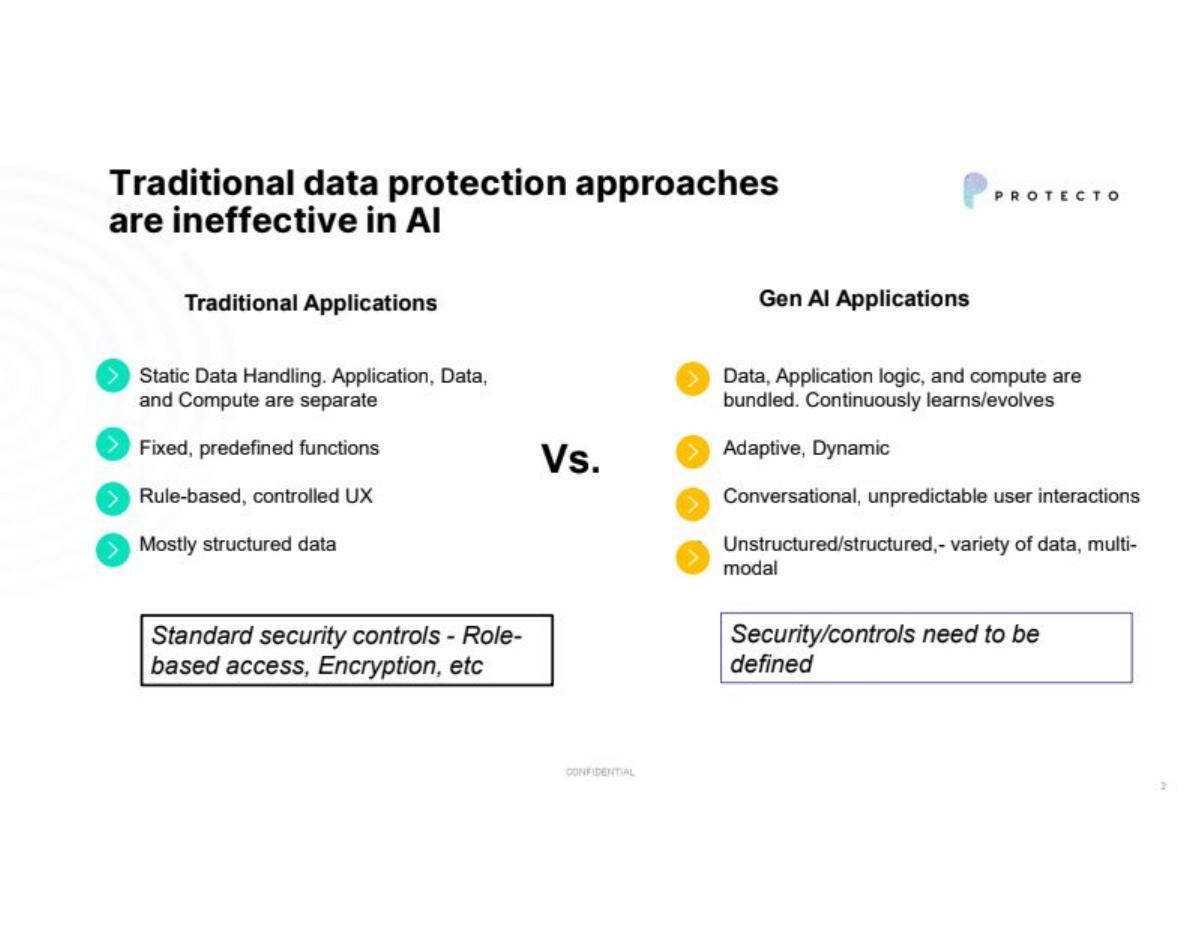
- The deck identifies a shift from static data handling in traditional apps to bundled, conversational data in Gen AI (Slide 2).
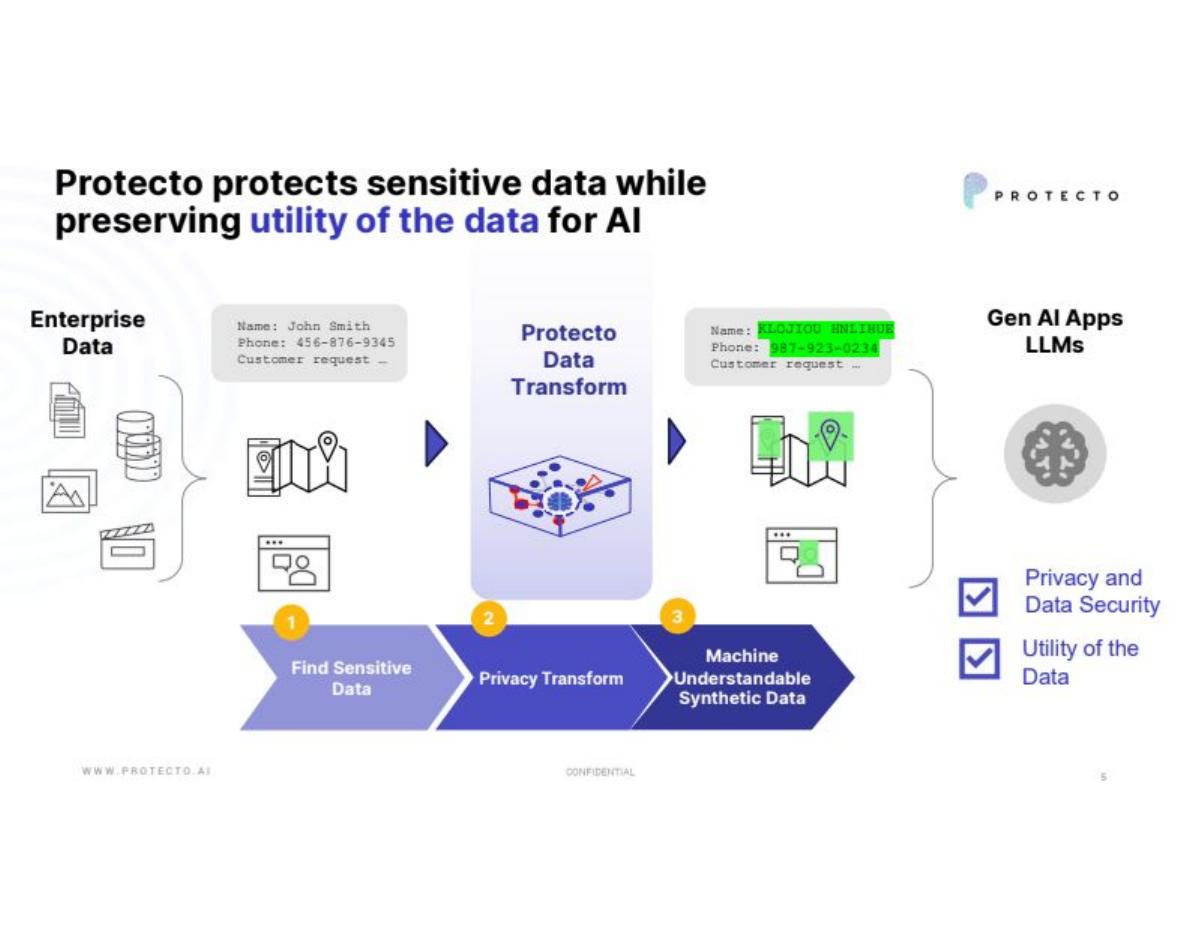
- Protecto uses a three-step 'Data Transform' process: Find Sensitive Data, Privacy Transform, and Machine Understandable Synthetic Data (Slide 5).
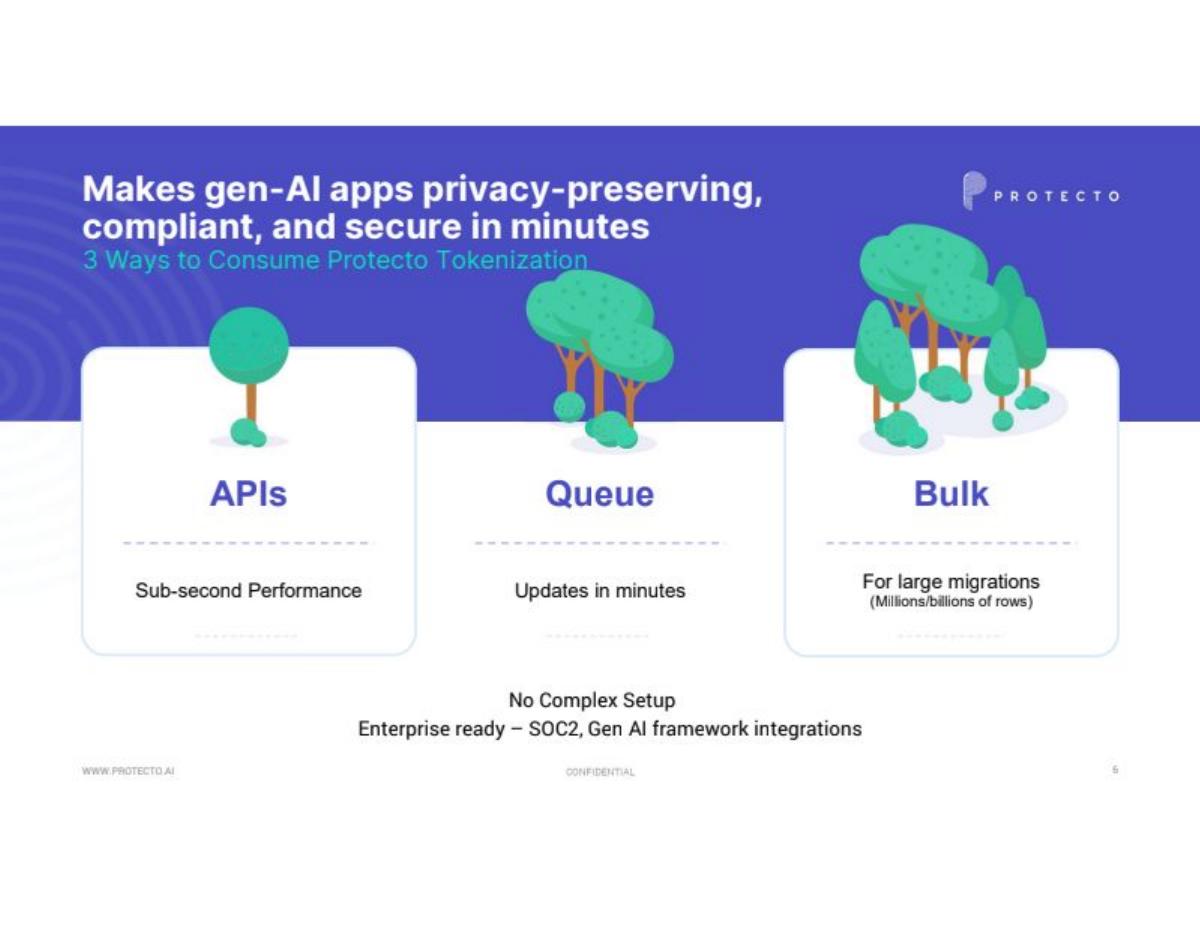
- The platform offers three consumption models: APIs for sub-second performance, Queue for updates, and Bulk for large migrations (Slide 6).
- The solution covers the entire AI lifecycle, including Build/Train, Tune/RAG, Deploy, and Use (Slide 7).
- Real-world utility is demonstrated through case studies involving Retrieval-Augmented Generation (RAG) and data residency (Slides 8-9).
- The competitive matrix emphasizes 'Masked Data Comprehension' and 'Multimodal' support as key differentiators (Slide 10).
- The founding team brings significant enterprise experience, including 18+ years at Apple and scaling a previous startup to $10M ARR (Slide 11).
- The GTM strategy is developer-centric, focusing on integrations with LangChain, LlamaIndex, and AWS Bedrock (Slide 12).
The Problem: Traditional Security Fails in the AI Era
Slides 1-3: Context and Market Urgency
Protecto opens with a clear title slide: "Privacy and Data Protection for Modern AI World." This immediately positions the company within the high-growth AI infrastructure sector. Slide 2 is the most critical conceptual slide in the deck. It contrasts "Traditional Applications" with "Gen AI Applications." It argues that while traditional apps have separate data and compute with fixed functions, Gen AI apps bundle data and logic, are conversational, and use unpredictable unstructured data. The conclusion is stark: "Security/controls need to be defined" because standard role-based access and encryption are no longer sufficient.
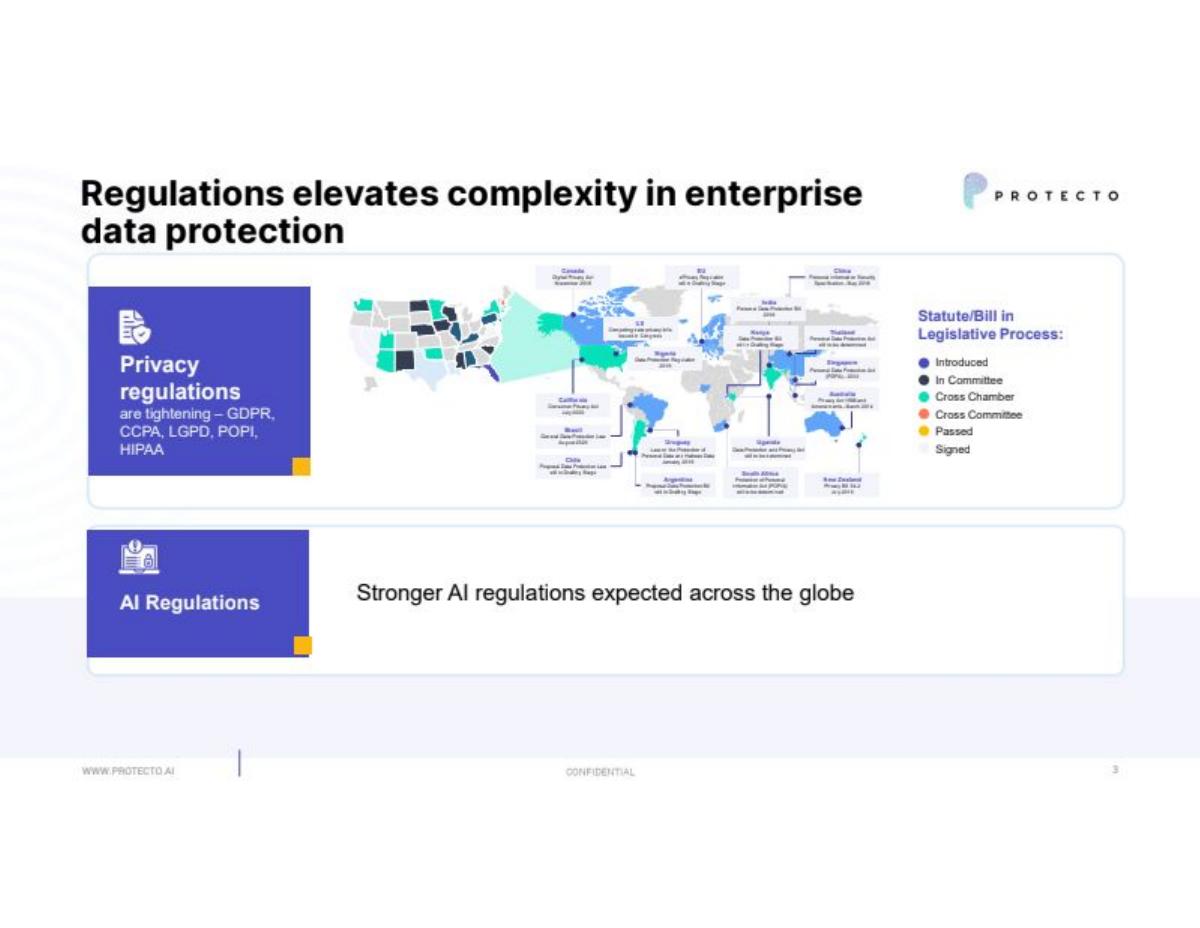
Slide 3 adds the regulatory layer. It displays a global map of tightening privacy regulations (GDPR, CCPA, HIPAA) and notes that "Stronger AI regulations [are] expected across the globe." By combining technical shifts with legal necessity, Protecto establishes a high-stakes problem that enterprises cannot ignore.
The Solution: The Protecto Platform
Slides 4-7: Technical Architecture and Lifecycle
Slide 4 is a simple transition to the platform, followed by Slide 5, which explains the core value proposition: "Protecto protects sensitive data while preserving utility of the data for AI." This is the "holy grail" of data privacy. The slide illustrates a three-step process: 1. Find Sensitive Data, 2. Privacy Transform, and 3. Machine Understandable Synthetic Data. The visual shows a name like "John Smith" being transformed into a string that the LLM can still process effectively without knowing the identity.
Slide 6 addresses the "how" of implementation. Protecto offers three consumption methods: APIs (for sub-second performance), Queue (for updates in minutes), and Bulk (for migrations of millions/billions of rows). This slide aims to reduce friction for developers by promising "No Complex Setup" and stating they are "Enterprise ready – SOC2."
Slide 7 maps the solution to the "AI Lifecycle." It shows Protecto intervening at every stage: Scan & De-identify during Build/Train and Tune/RAG; Response controls during Deploy; and Prompt filtering during Use. This positioning suggests that Protecto is not just a point solution but a comprehensive security layer for the entire stack, integrating with tools like OpenAI, Hugging Face, LangChain, and AWS Bedrock.
Proof of Value: Case Studies and Competition
Slides 8-10: Real-World Application and Differentiation
Slides 8 and 9 provide concrete case studies. Case Study 1 involves a "Large Telco" using a RAG-based contract review bot. Protecto solved the challenge of the AI agent exposing confidential data from historic contracts. Case Study 2 features a "Large Consumer Tech" company needing to process driver history and criminal records via OpenAI while maintaining data residency. Protecto acted as the gateway, stripping PII before the data crossed geographic boundaries.
Slide 10 is the competitive matrix. It compares Protecto against "Previous-Gen Data Masking" and "Data Masking for PCI." Protecto claims superiority in deployment options (On-Premises, Private Cloud, SaaS), accuracy (using LLMs and Heuristic models rather than just Regex), and multimodal support. The standout feature listed is "Masked Data Comprehension," which allows the model to understand the context of masked data better than traditional encryption-based methods.
The Team and Execution Strategy
Slides 11-13: Pedigree and GTM
Slide 11 highlights the founders' "deep data experience." CEO Amar Kanagaraj is a second-time entrepreneur who scaled his previous startup to $10M ARR and worked at Microsoft. CTO Baskaran Alagarsamy spent 18+ years at Apple leading privacy engineering. The slide also lists 15+ full-time engineers and early customers including Nokia, Belcorp, and Brookfield. This level of experience is a major de-risking factor for a Seed-stage investment.
Slide 12 outlines a "Developer centric" GTM strategy. It focuses on Product-Led Growth (PLG) through integrations with LangChain and LlamaIndex, presence in marketplaces like Snowflake and Databricks, and partnerships with solution integrators. Slide 13 provides a "Near Term Roadmap," including "GPTGuard" for secure enterprise ChatGPT use and vertical-specific transformations for finance and healthcare.
The Ask and Conclusion
Slides 14-15: The Fundraise
Slide 14 presents the "Fund Raise" details. At the time of the deck, the target was $3M for the Seed round. The funds were earmarked for expanding engineering, executing GTM (inbound/outbound marketing), driving developer evangelism, and defining the category. According to catalogue facts, the company actually raised $4M , suggesting strong investor interest that allowed them to oversubscribe the round. The final slide is a standard closing/contact page.
What Works in This Deck
The "Utility" Argument: Most privacy decks focus only on security. Protecto focuses on the tension between security and utility, which is the primary pain point for AI developers. · Lifecycle Coverage: By showing they protect data from training through to the end-user prompt, they position themselves as a platform rather than a feature. · Founder-Market Fit: The CTO’s 18 years at Apple in privacy engineering is a perfect match for the product being built. · Clear Case Studies: Using specific examples like RAG and data residency makes the abstract concept of "data transformation" tangible.
What is Missing or Could Be Improved
Pricing Model: The deck mentions a SaaS customer model and PLG strategy, but it does not detail the pricing tiers or how they charge (e.g., per token, per row, or per user). · Unit Economics: As a Seed deck, it focuses on the product and team, but there is no mention of CAC, LTV, or current MRR, despite listing several large customers. · Detailed Competition: While it compares itself to "Previous-Gen" tools, it avoids naming direct competitors in the emerging "AI Security" or "LLM Firewall" space.
Founder's Playbook: What to Copy
The Comparison Slide (Slide 2): Use a simple table to show why the world has changed and why old solutions are now obsolete. This creates the "Why Now?" urgency. · The Lifecycle Map (Slide 7): If you are building infrastructure, show exactly where you sit in the user's existing workflow. Listing logos of integrations (OpenAI, Snowflake) builds immediate credibility. · The "Why Us" (Slide 11): Don't just list titles. List specific achievements like "scaled to $10M ARR" or "handled petabyte-scale data."
Frequently asked questions
- What is Protecto's core product?
- Protecto provides a data protection platform specifically designed for the Generative AI lifecycle. It uses a proprietary 'Privacy Transform' to mask sensitive information like PII while maintaining the data's utility for machine learning models. This allows enterprises to use sensitive data in LLMs and RAG systems without violating privacy regulations or residency requirements.
- How does Protecto differ from traditional data masking?
- Traditional masking often destroys the mathematical relationships in data, making it useless for AI. According to Slide 10, Protecto offers 'Masked Data Comprehension' and 'Format-Preserving Masking' across multimodal data. Unlike previous-gen tools that are often regex-based, Protecto uses multiple AI/ML models and LLMs to identify risks with higher accuracy.
- Who are the founders of Protecto?
- The company was founded by Amar Kanagaraj (CEO) and Baskaran Alagarsamy (CTO). Kanagaraj is a second-time entrepreneur who previously scaled a startup to $10M ARR and held roles at Microsoft and Sun Microsystems. Alagarsamy spent 18+ years at Apple, where he led privacy engineering efforts and handled petabyte-scale data problems.
- What was the result of this pitch deck?
- The deck was used to raise a $4M Seed round in 2023. While Slide 14 shows an initial ask of $3M, the company successfully closed $4M led by Together Fund, with participation from Better Capital, FortyTwo VC, Arali Ventures, and Speciale Invest.
- What is Protecto's go-to-market strategy?
- Protecto employs a developer-centric, product-led growth (PLG) strategy. They focus on integrations with popular AI frameworks like LangChain and LlamaIndex, and presence in marketplaces like Snowflake, Databricks, and AWS Bedrock. They also leverage solution integrators as partners to reach enterprise customers.