Quantexa’s Series E deck, used to raise $129M in 2023, is a clinical example of late-stage fundraising. At this level, the 'how' of the technology is secondary to the 'who' of the customer base and the 'how much' of the market opportunity. The deck leans heavily on its status as a global leader, citing 100% ARR growth and a presence in 70 countries. It avoids the clutter of early-stage decks, omitting a traditional team slide or detailed unit economics in favor of a massive $230B TAM projection and a wall of industry awards. The strategy is clear: demonstrate that the platform is already the…
Key takeaways
- The deck highlights a massive $230B Total Addressable Market for the Decision Intelligence category by 2024 (Slide 3).
- Quantexa reports significant momentum with 100% overall ARR growth and 1800% ARR growth specifically in North America (Slide 2).
- Social proof is the primary driver, featuring direct quotes from the CEO of Global Commercial Banking at HSBC (Slide 1) and the Chief Data Officer at BNY Mellon (Slide 9).
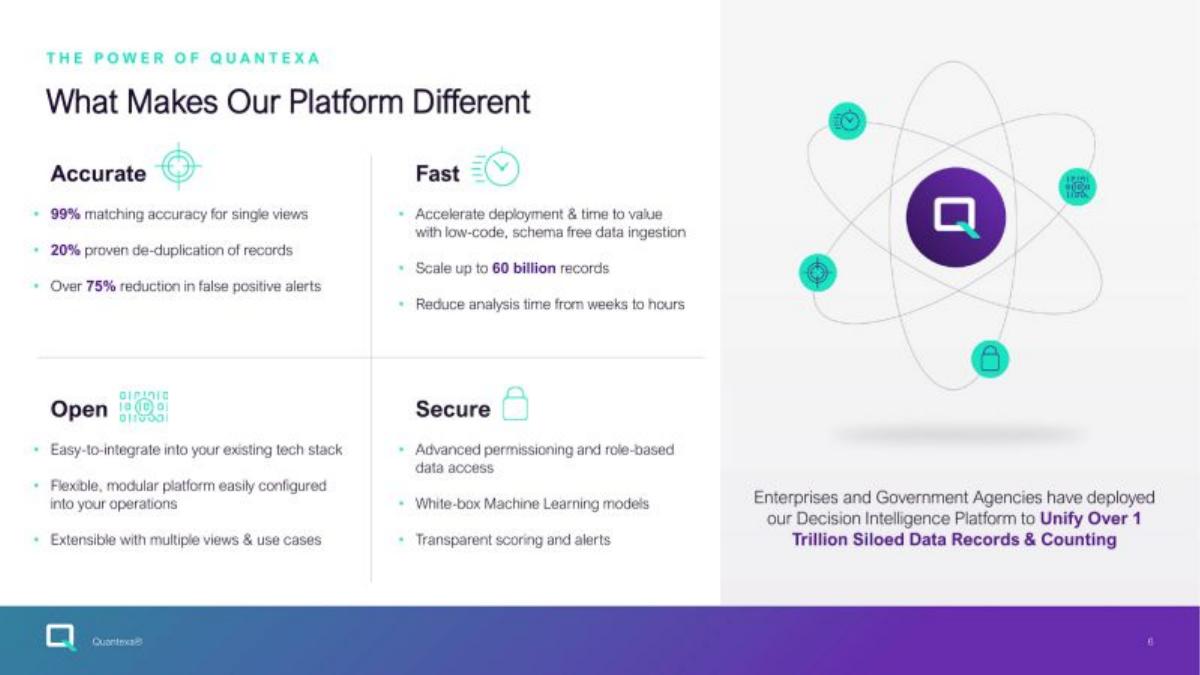
- The platform's scale is quantified by its ability to unify over 1 trillion siloed data records and scale up to 60 billion records for individual deployments (Slide 6).
- Operational efficiency is a core value proposition, claiming a 75% reduction in false-positive alerts and a 20% proven de-duplication of records (Slide 6).
- The company emphasizes its global footprint with offices in 14 major cities, including London, New York, Singapore, and Dubai (Slide 2).
- The Series E investment strategy is explicitly tied to five technical pillars: Low-code data Fusion, Graph Analytics, ML, NLP, and AI (Slide 8).
- The deck omits a dedicated team slide, choosing instead to list a headcount of 630+ innovators and thinkers (Slide 2).
The Anatomy of a $129M Series E Deck
Quantexa’s 2023 pitch deck is a masterclass in late-stage fundraising efficiency. At ten slides, it is shorter than many Seed-stage decks, yet it successfully facilitated a $129M Series E round led by GIC. The deck reflects a company that no longer needs to prove its technology works; instead, it needs to prove that its technology is becoming the global standard for Decision Intelligence. The narrative is built on three pillars: massive scale, elite social proof, and rapid geographic expansion.
Slide 1: The Power of the Anchor Quote
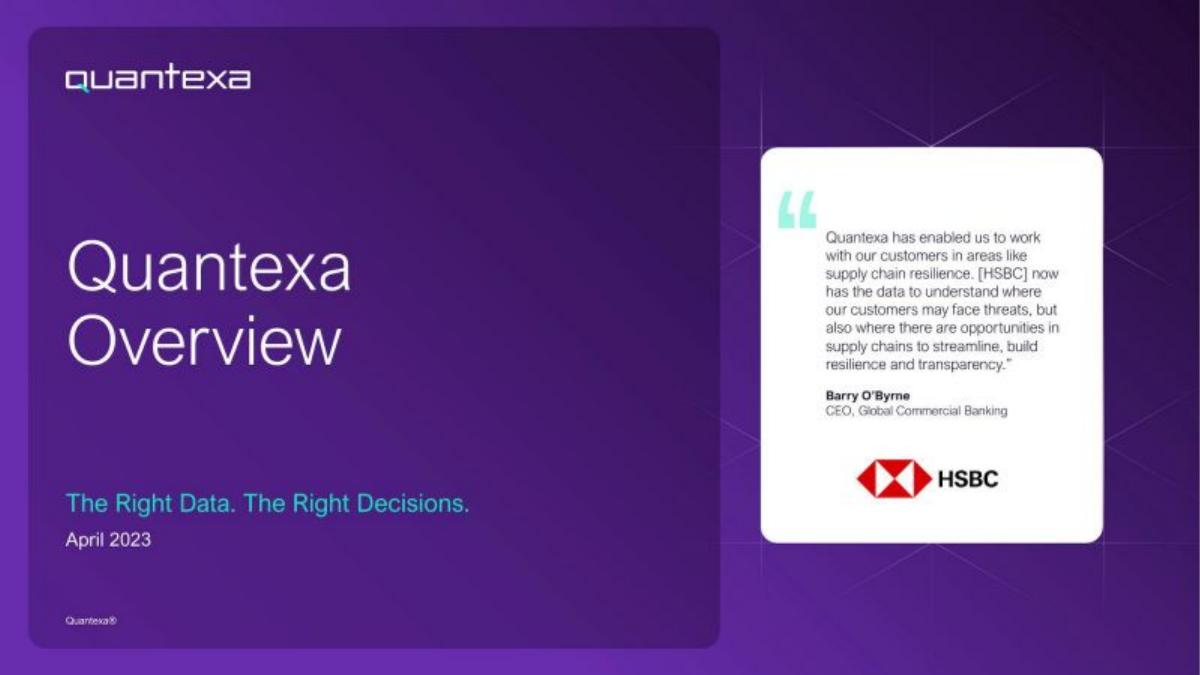
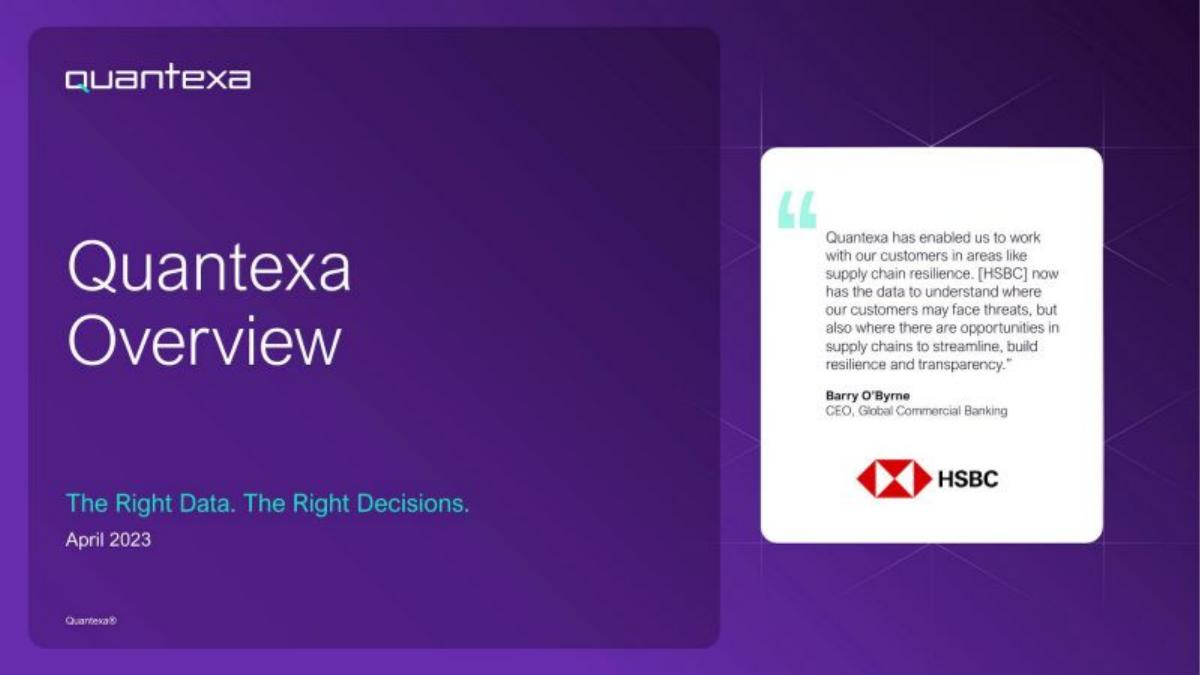
Quantexa opens not with a problem statement, but with a testimonial. The cover slide features a quote from Barry O’Byrne, CEO of Global Commercial Banking at HSBC. By placing a Tier-1 banking executive on the front page, Quantexa immediately establishes its credibility in the most demanding sector of data analytics. The quote specifically mentions 'supply chain resilience' and 'transparency,' signaling that the platform solves complex, real-world problems for the world's largest institutions.
Slide 2: The Global Leader Snapshot
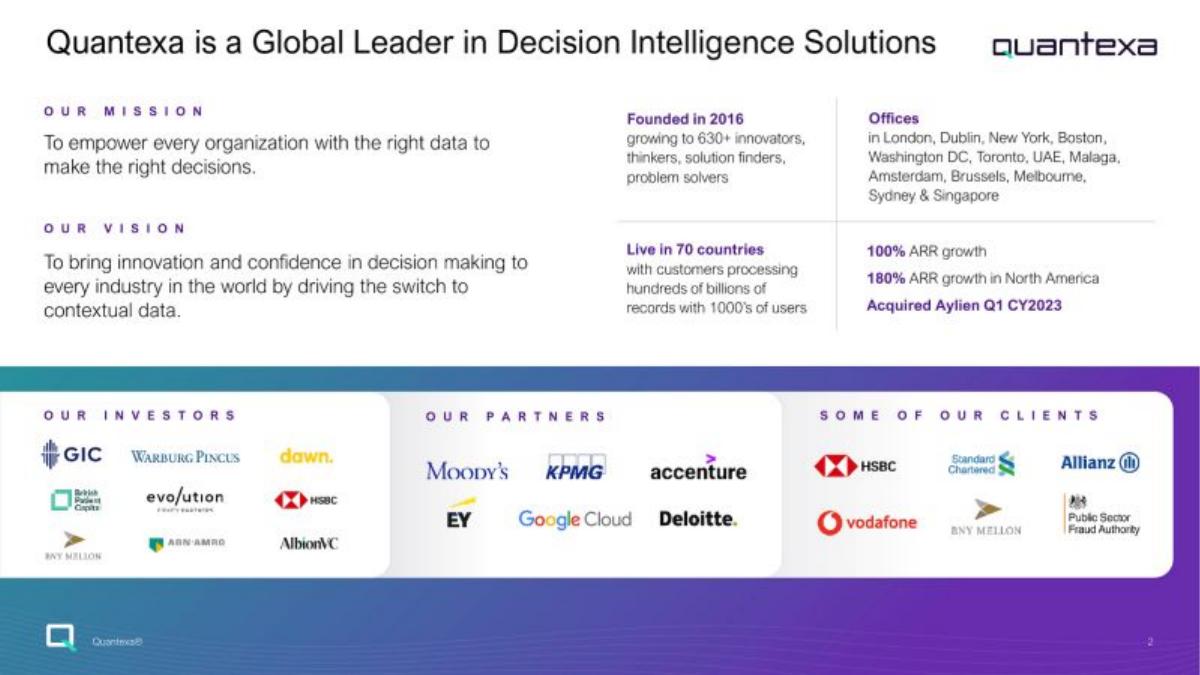
Slide 2 serves as a comprehensive 'Company at a Glance.' It manages to pack an extraordinary amount of data into a single layout without feeling cluttered. Key highlights include: Founded in 2016 , 630+ innovators , and Live in 70 countries . The financial metrics are equally aggressive, citing 100% ARR growth and 180% ARR growth in North America . The bottom of the slide is a 'who's who' of the financial and consulting world, listing investors like Warburg Pincus and Dawn Capital, partners like Google Cloud and Deloitte, and clients like Allianz and Vodafone. This slide effectively tells the investor: 'We have already won the early market; now we are scaling the victory.'
Slide 3: Defining a $230B Category
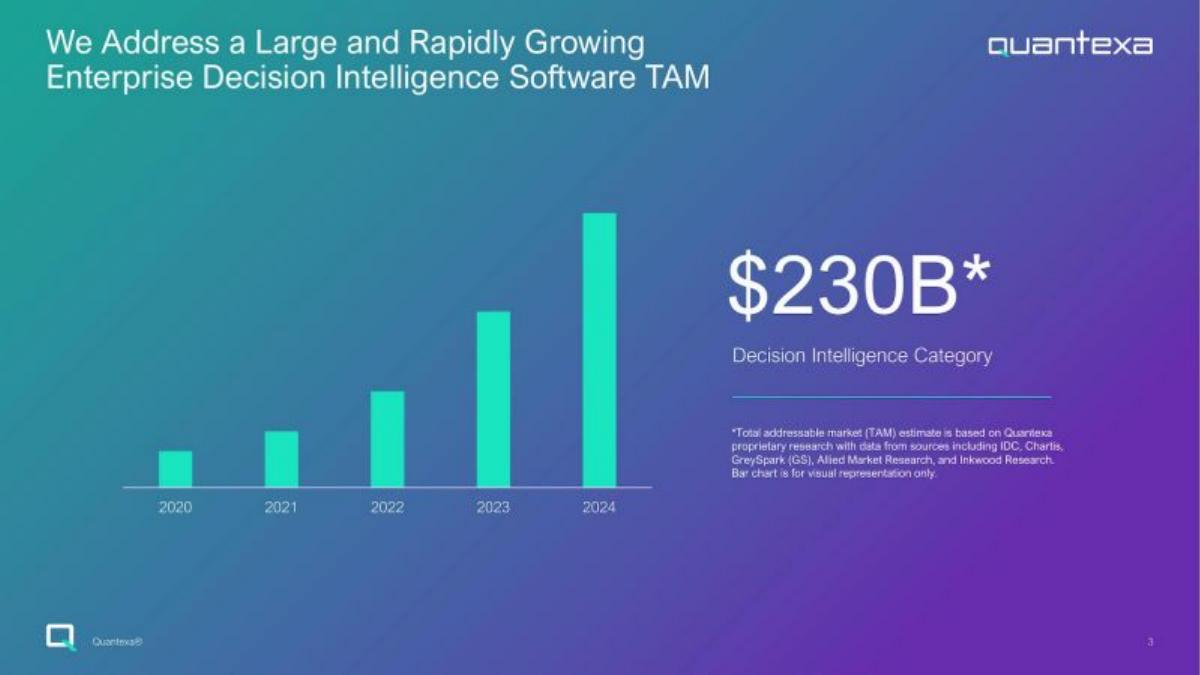
Quantexa positions itself within the 'Decision Intelligence' category. Slide 3 uses a bar chart to show the rapid growth of this TAM, projecting it to reach $230B by 2024 . It is important to note the fine print: the estimate is based on Quantexa's proprietary research using data from IDC, Chartis, and others. For a Series E investor, this slide justifies the valuation by showing that even with high ARR, the company has only scratched the surface of the total opportunity.
Slide 4: The Platform Architecture
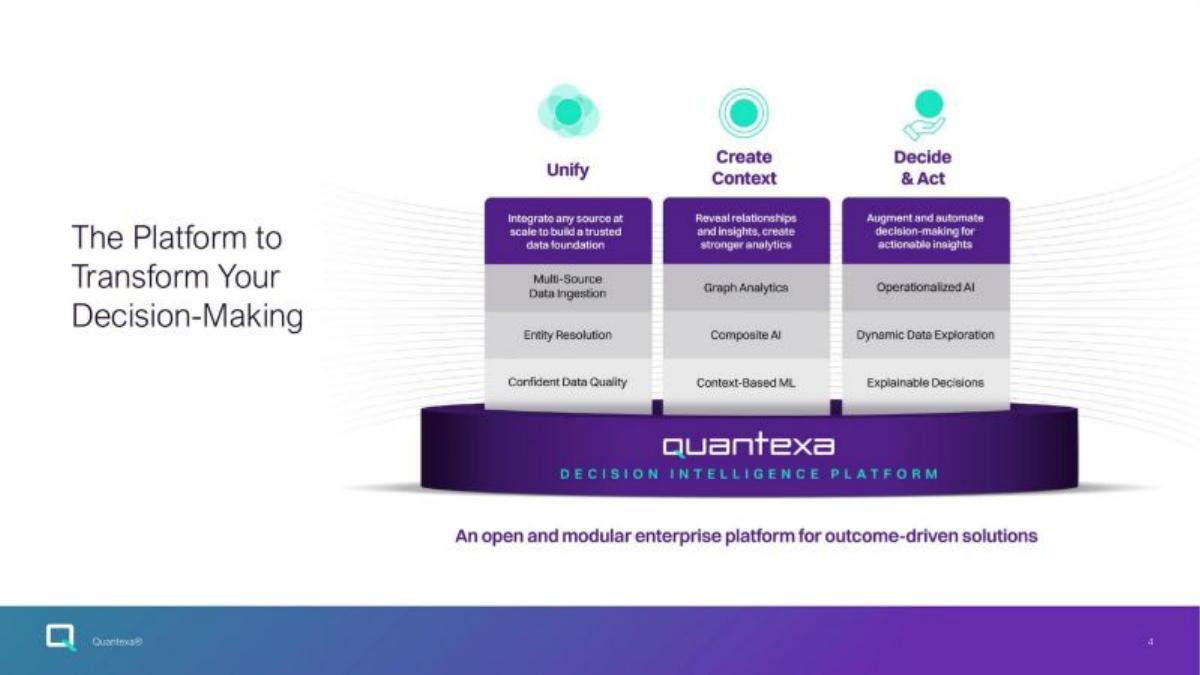
Slide 4 moves into the product, but stays at a high level. It breaks the platform into three stages: Unify (Multi-Source Data Ingestion, Entity Resolution), Create Context (Graph Analytics, Composite AI), and Decide & Act (Operationalized AI, Explainable Decisions). The use of terms like 'Entity Resolution' and 'Graph Analytics' signals to technical due diligence teams that the platform handles the 'hard' parts of data science that traditional BI tools often miss.
Slide 5: The Unified Data Foundation
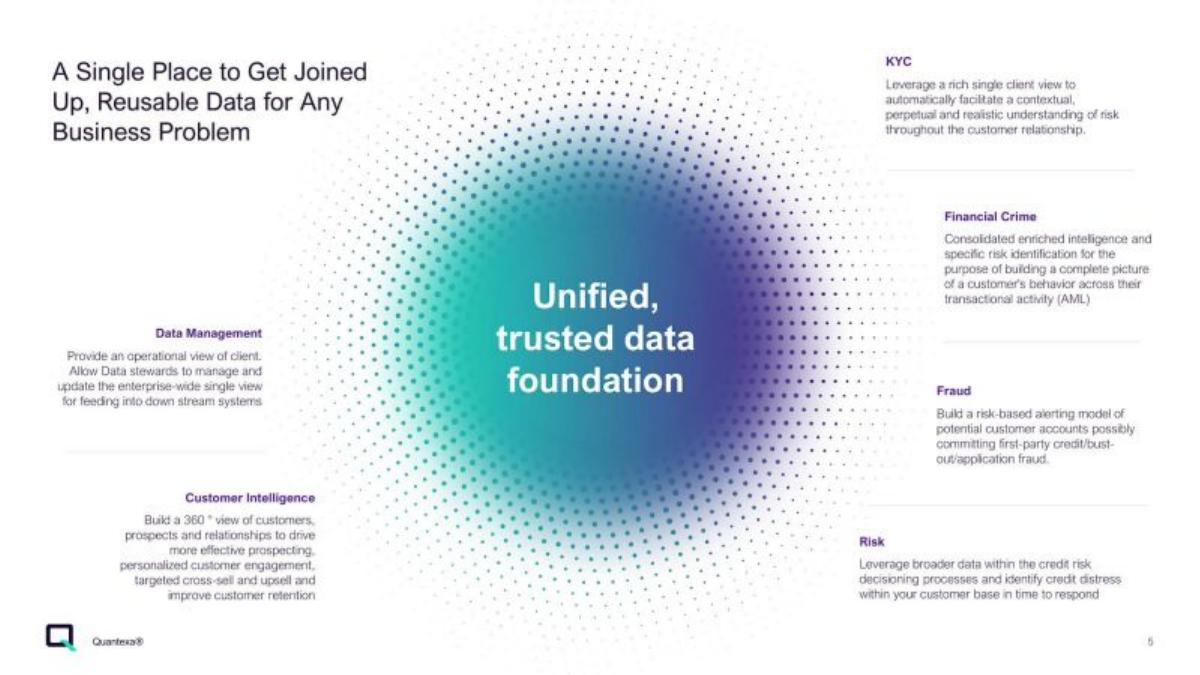
This slide focuses on the versatility of the data foundation. It lists five key use cases: KYC (Know Your Customer), Financial Crime , Fraud , Risk , and Customer Intelligence . By showing that the same 'Unified, trusted data foundation' can power everything from AML (Anti-Money Laundering) to customer cross-selling, Quantexa demonstrates a high 'stickiness' factor. Once a bank integrates this foundation, the cost of switching is enormous because so many different departments rely on it.
Slide 6: Differentiators and Scale
Slide 6 provides the 'hard' metrics that back up the marketing claims. Under the heading 'What Makes Our Platform Different,' Quantexa lists four quadrants: Accurate (99% matching accuracy), Fast (scale up to 60 billion records), Open (easy-to-integrate), and Secure (white-box ML models). The most striking figure on this slide is the claim that enterprises have used the platform to 'Unify Over 1 Trillion Siloed Data Records & Counting.' This is a 'wow' metric designed to end any debate about the platform's ability to handle enterprise-scale workloads.
Slide 7: The Wall of Recognition
Slide 7 is a dense grid of 21 awards and analyst recognitions. It includes logos from Forrester , IDC , Celent , and Chartis . For a late-stage investor, this slide acts as a risk-mitigation tool. It shows that third-party experts have vetted the technology and the company's market position repeatedly over several years (2020 through 2023).
Slide 8: The Series E Strategy
Slide 8 outlines the 'Fundraise Investment Strategy.' It is refreshingly specific, focusing on five technical areas: Low-code data Fusion , Graph Analytics , Machine Learning , NLP , and AI . The slide also mentions accelerating 'joint go-to-market efforts with strategic partners.' This tells investors exactly where their capital will go: R&D to maintain the technical lead and GTM to capture the $230B TAM mentioned earlier.
Slide 9: Closing with Social Proof
The deck ends as it began: with a high-level testimonial. This time, it is from Eric Hirschhorn, Chief Data Officer at BNY Mellon . He emphasizes 'data trust, transparency and explain-ability,' which are the three biggest hurdles for AI adoption in regulated industries. Ending with a client quote rather than a 'Contact Us' slide reinforces the company's customer-centric success narrative.
What Quantexa Omitted
The omissions in this deck are as telling as the inclusions. There is no team slide listing the founders' backgrounds. At this stage, the company is an institution, not a startup, and the 630+ employee count is the relevant 'team' metric. There is also no detailed financial slide showing burn rates, LTV/CAC, or churn. While these were undoubtedly in the data room, the pitch deck itself is designed to sell the vision and the validation, leaving the spreadsheet work for the due diligence phase. Finally, there is no competitor slide . Quantexa chooses to define its own category (Decision Intelligence) rather than compare itself to legacy players, a common tactic for companies seeking to establish market dominance.
Founder Takeaways
Founders should note how Quantexa uses specific technical metrics (99% accuracy, 1 trillion records) to ground their high-level claims. They don't just say they are 'fast'; they say they 'reduce analysis time from weeks to hours.' Another key takeaway is the strategic use of logos . The deck doesn't just list clients; it categorizes them alongside investors and partners to create a sense of an unstoppable ecosystem. For late-stage decks, the goal is to show that the 'machine' is built and working perfectly; the investment is simply the fuel to make it run faster.
Frequently asked questions
- Why does the deck omit a team slide?
- By Series E, a company like Quantexa, with over 630 employees, is no longer selling the individual founders' pedigrees. The 'team' is now the institutionalized talent and the global infrastructure. Investors at this stage are more interested in the 100% ARR growth and the blue-chip client list (Slide 2) than the CVs of the executive team, which are likely already known to the lead investors like GIC and Warburg Pincus.
- How does Quantexa define its market opportunity?
- Quantexa positions itself within the 'Decision Intelligence' category, which it estimates will reach a $230B TAM by 2024 (Slide 3). This is a strategic choice to move beyond 'Big Data' or 'Analytics' into a broader, more mission-critical category. They support this figure by citing proprietary research and data from third-party analysts like IDC and Chartis.
- What are the key performance metrics shared in the deck?
- The deck focuses on high-level growth and scale metrics rather than unit economics. It highlights 100% overall ARR growth, 180% ARR growth in North America, and the acquisition of Aylien in Q1 2023 (Slide 2). Technical performance metrics include 99% matching accuracy for single views and the ability to reduce analysis time from weeks to hours (Slide 6).
- Who are Quantexa's primary customers and partners?
- Quantexa targets high-stakes enterprise and government sectors. Slide 2 lists Tier-1 financial institutions like HSBC, Standard Chartered, BNY Mellon, and Allianz, alongside Vodafone and the Public Sector Fraud Authority. Their partner ecosystem includes global consultancies and cloud providers like KPMG, Accenture, Deloitte, Moody's, and Google Cloud.
- What is the stated purpose of the Series E funding?
- According to Slide 8, the 'Series E Fundraise Investment Strategy' is twofold. First, it aims to boost technology innovation in five specific areas: low-code data fusion, graph analytics, machine learning, natural language processing, and AI. Second, it intends to accelerate joint go-to-market efforts with strategic partners to expand their global reach.