Signal AI's 22-slide deck is a textbook example of a growth-stage pitch, balancing a compelling narrative with hard data. The company, founded in 2013, focuses on uncovering 'unknown unknowns' through an AI-driven platform that analyzes vast amounts of text data. The deck effectively transitions from the 'why' (the explosion of information) to the 'how' (their four-pillar product strategy: Monitor, Insights, Discovery, Influence). What makes this deck stand out is its transparency; it includes a detailed breakdown of their $50B+ market opportunity and a 'Core Business Metrics' slide that benc…
Key takeaways
- The deck opens with a humble 'Where Signal started' slide, showing a small team in a modest office, establishing a narrative of growth (Slide 2).
- Signal AI identifies a clear market problem: the explosion of information and the need for data-driven decisions over instinct (Slide 3).
- The product is structured into four distinct categories: Monitor, Insights, Discovery, and Influence, each addressing a different business need (Slide 7).
- The 'Discovery' and 'Influence' features are explicitly labeled as 'Future,' showing a clear product roadmap (Slides 10-12).
- Case studies demonstrate significant ROI, such as agencies saving 40,000 hours and consultants growing their deal pipeline by 3X (Slides 13-14).
- The market opportunity is quantified at $50B+, broken down into PR & Comms ($5B), Risk & Compliance ($9B), and Business Intelligence ($35B) (Slide 16).
- A unique 3D growth strategy visualization outlines avenues for product upsell, use case cross-sell, and geographic expansion (Slide 18).
- The deck includes a 'Core Business Metrics' slide, benchmarking their 2018 performance against KBCM top-quartile SaaS companies in areas like Net Revenue Retention (110%) and Gross Margin (70%) (Slide 20).
Signal AI: Navigating the Information Explosion
Signal AI's pitch deck is a sophisticated presentation that effectively communicates the company's evolution from a small startup to a significant player in the AI-driven market intelligence space. Founded in 2013 and headquartered in London, Signal AI has raised over $101 million to date. This teardown will walk through their 22-slide deck, analyzing how they present their technology, market opportunity, and impressive growth metrics.
Introduction and Vision
Slide 1: Title Slide The deck opens with a clean, minimalist title slide featuring the Signal AI logo and the tagline "Be in the know." The use of a dark background with red accents sets a professional and modern tone.
Slide 2: Where Signal Started This slide is a classic 'humble beginnings' narrative. It features two black-and-white photos: one of a modest storefront labeled "Little & Pace Motors" and another of a small team working on laptops in a cramped office. This establishes a sense of authenticity and shows how far the company has come.
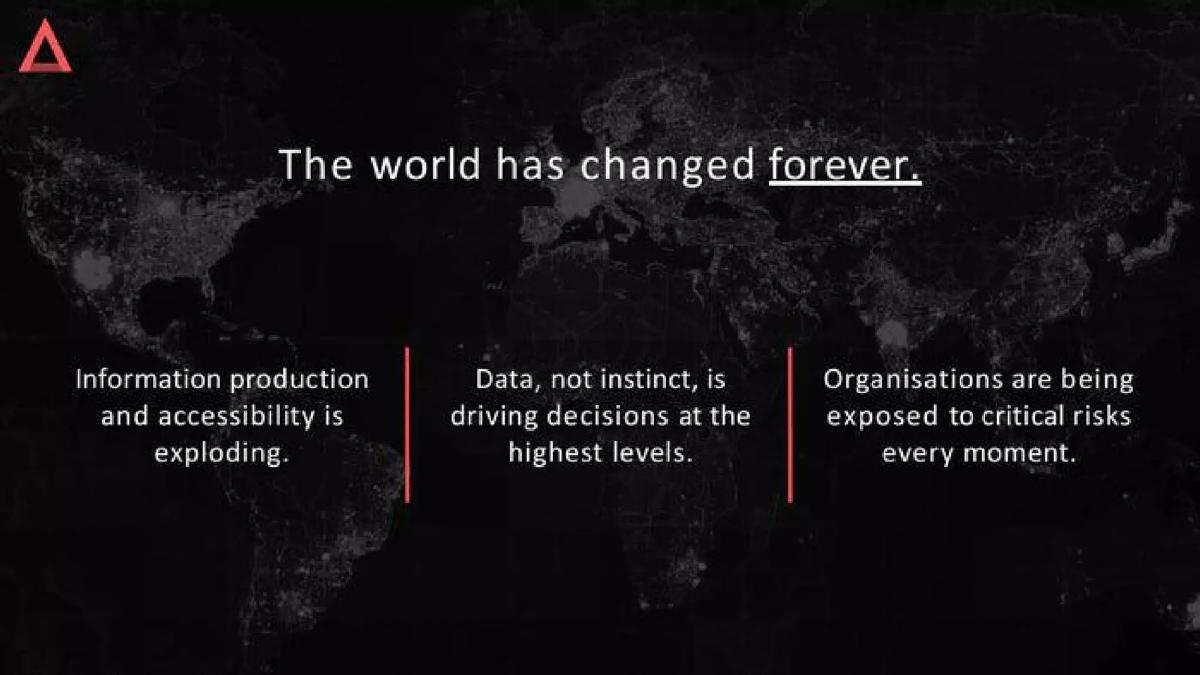
Slide 3: The World Has Changed Forever Signal AI quickly moves to the 'Why Now?' part of their pitch. They highlight three key trends: the explosion of information production, the shift toward data-driven decision-making at the highest levels, and the constant exposure of organizations to critical risks. This slide sets the stage for their solution by framing it as a necessity in a rapidly changing world.
Slide 4: The Vision This slide paints a picture of the future for business leaders. It uses evocative language like "Imagine a world where a business leader knows what their market will do next" and "disrupts new competition before they become a threat." It positions Signal AI as the tool that allows leaders to stay "one step ahead."
Slide 5: The Mission Statement Signal AI clearly states its core purpose: "Signal takes the world’s data and turns it into actionable insights so business leaders make the best possible decisions." The word "decisions" is highlighted in red, emphasizing the practical utility of their platform.
The Platform and Product
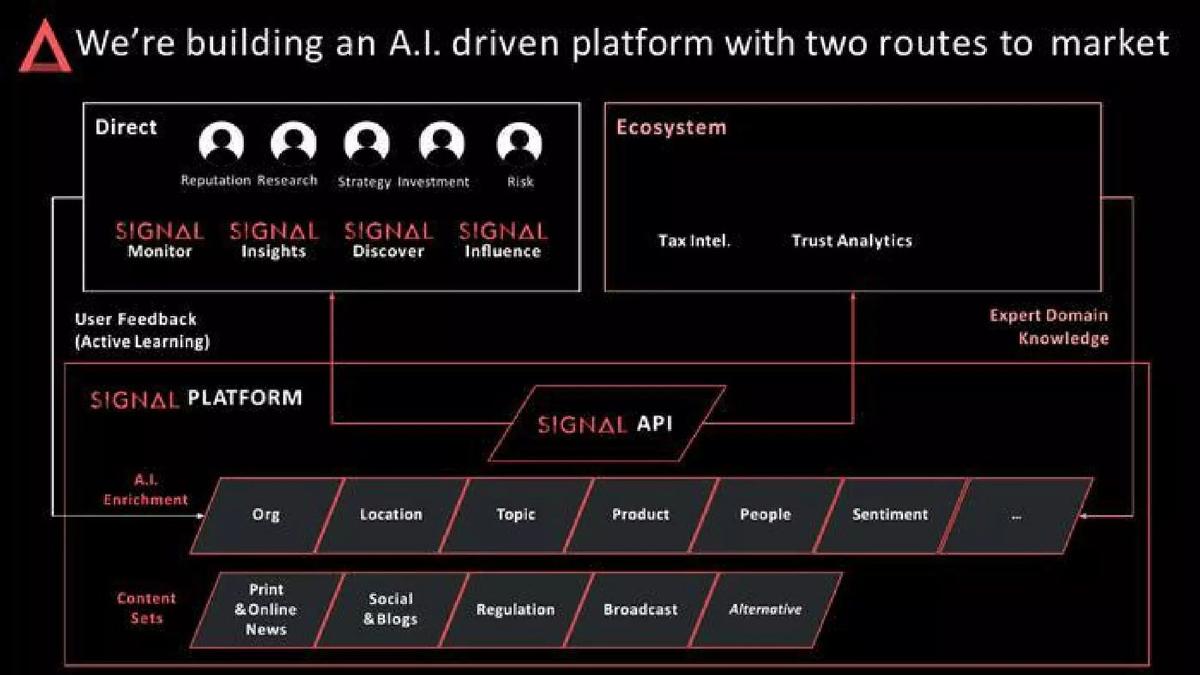
Slide 6: The AI-Driven Platform This slide provides a high-level architectural overview of the Signal platform. It shows two routes to market: "Direct" (targeting roles like Reputation, Research, Strategy, Investment, and Risk) and "Ecosystem" (targeting areas like Tax Intel and Trust Analytics). The bottom half of the slide details the "Content Sets" (News, Social, Regulation, Broadcast, Alternative) and the "A.I. Enrichment" process (Org, Location, Topic, Product, People, Sentiment).
Slide 7: Product Pillars Signal AI breaks its product down into four key areas: Monitor, Insights, Discovery, and Influence. Each pillar is accompanied by a brief description, such as "See everything that matters in real-time" for Monitor and "Surface the unknown unknowns" for Discovery.
Slide 8: Monitor This slide focuses on the 'Monitor' aspect of the platform, highlighting features like real-time alerts, accurate information about brand and market landscape, and a "Feed and Folder" approach for easy segmentation. A screenshot of the platform provides a visual reference for the user interface.
Slide 9: Insights The 'Insights' slide emphasizes visualized analysis, trends, and snapshots. It claims to help clients understand the "past impact of information or decisions" and answer "why" questions. The accompanying screenshot shows a dashboard with a global map and various charts.
Slide 10 & 11: Discovery (Future) These slides introduce the 'Discovery' feature, which is explicitly labeled as "Future." It focuses on association, detection, and suggestion, helping clients plan for the future and detect new market entrants or opportunities. The repetition of this slide (Slide 11 is identical to Slide 10) might be a formatting error in the deck, but it reinforces the importance of this future-looking feature.
Slide 12: Influence (Future) Another future-looking feature, 'Influence,' is designed to help clients engage with the right people to set the agenda. It includes impact scoring for influencers and suggestions on how to best engage with them. This slide, like the others, includes a platform screenshot.
Traction and Case Studies
Slide 13: Agency Case Study Signal AI uses a powerful metric to demonstrate value: "Agencies like [Redacted] saved 40,000 hours last year." They attribute this to automating media intelligence reporting and generating instant analysis dashboards. The redaction of the agency name is a common practice in public-facing decks to protect client confidentiality.
Slide 14: Consultant Case Study This slide highlights another impressive result: "Consultants like [Redacted] grew deal pipeline 3X in Q4." The value here comes from tracking distressed firms in real-time and exploring trends in M&A markets.
Slide 15: Advisor Case Study The final case study claims that "Advisors like [Redacted] will reduce £100M costs globally by 2021." This is achieved by surfacing every tax update worldwide and delivering automated briefings to clients. These three slides provide strong social proof and quantifiable ROI across different sectors.
Market Opportunity and Growth Strategy
Slide 16: $50B+ Market Opportunity Signal AI quantifies its total addressable market (TAM) at over $50 billion. They break this down into PR & Comms ($5B), Risk & Compliance ($9B), and Business Intelligence ($35B), citing sources like Burton-Taylor and RegTech Associates. This slide clearly shows the massive scale of the opportunity they are pursuing.
Slide 17: Unique Market Placement Using a standard four-quadrant chart, Signal AI positions itself in the top-right corner: "A.I. Led" and "Comprehensive Content." This differentiates them from "Human Led" or "Limited Content" competitors, though specific competitors are not named.
Slide 18: Avenues for Growth This slide uses a creative 3D cube visualization to show three clear avenues for growth: product upsell, use case cross-sell, and geographic expansion (UK, U.S., and APAC markets). This demonstrates a strategic approach to scaling the business.
Financials and Metrics
Slide 19: Revenue Growth A bar chart shows a clear and consistent upward trend in Annual Recurring Revenue (ARR) from Q1 2015 to Q1 2019. A red line overlay shows the corresponding growth in the number of clients, which appears to be accelerating in the later quarters. The actual revenue figures are redacted, but the trend is unmistakable.
Slide 20: Core Business Metrics This is one of the most important slides in the deck. Signal AI compares its 2018 metrics to the "KBCM Top Quartile" for SaaS companies. They highlight a 110% Net Revenue Retention and a 70% fully-loaded Gross Margin. The slide concludes with the statement: "SaaS metrics are strong: now is the time to really scale what we are doing."
Team and Conclusion
Slide 21: The Team The deck concludes with a group photo of the Signal AI team. While it shows a diverse and professional-looking group, it lacks individual names, titles, or background information, which is a notable omission for a later-stage pitch deck.
Slide 22: Closing Slide The final slide is a simple, clean graphic with the Signal AI logo on a white background, mirroring the opening slide and providing a sense of closure.
What Works in This Deck
Strong Narrative Arc: The deck tells a compelling story, starting with the company's humble beginnings, identifying a major global problem, and presenting a clear, multi-faceted solution. · Quantifiable ROI: The case studies (Slides 13-15) provide concrete examples of how the platform delivers value, using impressive figures like "40,000 hours saved" and "3X deal pipeline growth." · Data-Driven Credibility: The inclusion of a 'Core Business Metrics' slide (Slide 20) that benchmarks the company against top-tier SaaS standards is a powerful way to build investor confidence. · Clear Product Roadmap: By labeling certain features as "Future" (Slides 10-12), Signal AI shows that they have a long-term vision and a plan for continued innovation. · Professional Design: The deck is visually consistent, using a clean layout and a sophisticated color palette that reinforces the company's brand identity.
What Is Missing
The Ask: The most significant omission is a clear 'Ask' slide. There is no mention of how much capital the company is looking to raise or how they plan to deploy those funds. · Team Biographies: While there is a team photo, the deck lacks any information about the founders' or key executives' backgrounds, experience, or previous successes. · Competitor Analysis: Slide 17 shows Signal AI's market placement but doesn't name any specific competitors. A more detailed competitive landscape would help investors understand the company's relative strengths and weaknesses. · Unit Economics: While high-level SaaS metrics are provided, a deeper dive into unit economics (e.g., customer acquisition cost by channel) would provide more granular insight into the business's efficiency.
What a Founder Should Copy
Benchmarking Against the Best: Founders should follow Signal AI's lead in Slide 20 by benchmarking their key metrics against industry standards. This shows that you understand what 'good' looks like and are striving to achieve it. · Using ROI-Focused Case Studies: Instead of just listing features, show how those features translate into real-world benefits for your customers. Use specific, quantifiable metrics whenever possible. · Visualizing Growth Strategy: The 3D growth cube in Slide 18 is a creative way to show multiple dimensions of expansion. Founders should look for innovative ways to visualize their strategic plans. · Framing the 'Why Now?': Signal AI does an excellent job of framing its solution as a response to a fundamental shift in the world. Founders should clearly articulate the external trends that make their product or service essential at this particular moment.
Frequently asked questions
- What is Signal AI's core value proposition?
- Signal AI's core value proposition is to take the world's data and turn it into actionable insights, enabling business leaders to make better decisions. They aim to uncover 'unknown unknowns' by analyzing digital, print, and broadcast media, news, and regulatory data using machine learning. This helps businesses track their competitive landscape, monitor reputation, and stay ahead of market changes.
- How does Signal AI categorize its product offerings?
- The company categorizes its platform into four main areas: Monitor (real-time alerts and search), Insights (visualized analysis of trends and past impact), Discovery (detecting new market entrants and opportunities), and Influence (identifying and engaging with key agenda-setters). Notably, the 'Discovery' and 'Influence' components are presented as future-looking parts of their roadmap in this deck.
- What specific market segments is Signal AI targeting?
- Signal AI identifies a total market opportunity of over $50 billion. They break this down into three primary segments: PR & Communications ($5 billion), Risk & Compliance ($9 billion), and Business Intelligence ($35 billion). They also mention 'Further Markets' as a potential area for expansion, supported by their underlying AI platform.
- What are the key SaaS metrics highlighted in the deck?
- The deck features a 'Core Business Metrics' slide comparing Signal AI's 2018 performance to top-quartile SaaS benchmarks. Key metrics include a 110% Net Revenue Retention, a 70% fully-loaded Gross Margin, and an LTV:CAC ratio of 3. They also show a significant upward trend in both Annual Recurring Revenue and the number of clients from 2015 to early 2019.
- What is missing from the Signal AI pitch deck?
- The deck is notably missing a specific 'Ask' slide, which would typically detail the amount of funding sought and how it will be used. Additionally, while there is a team photo, there are no individual biographies or details on the leadership team's past experience. The deck also lacks a detailed slide on unit economics beyond the high-level SaaS metrics provided.