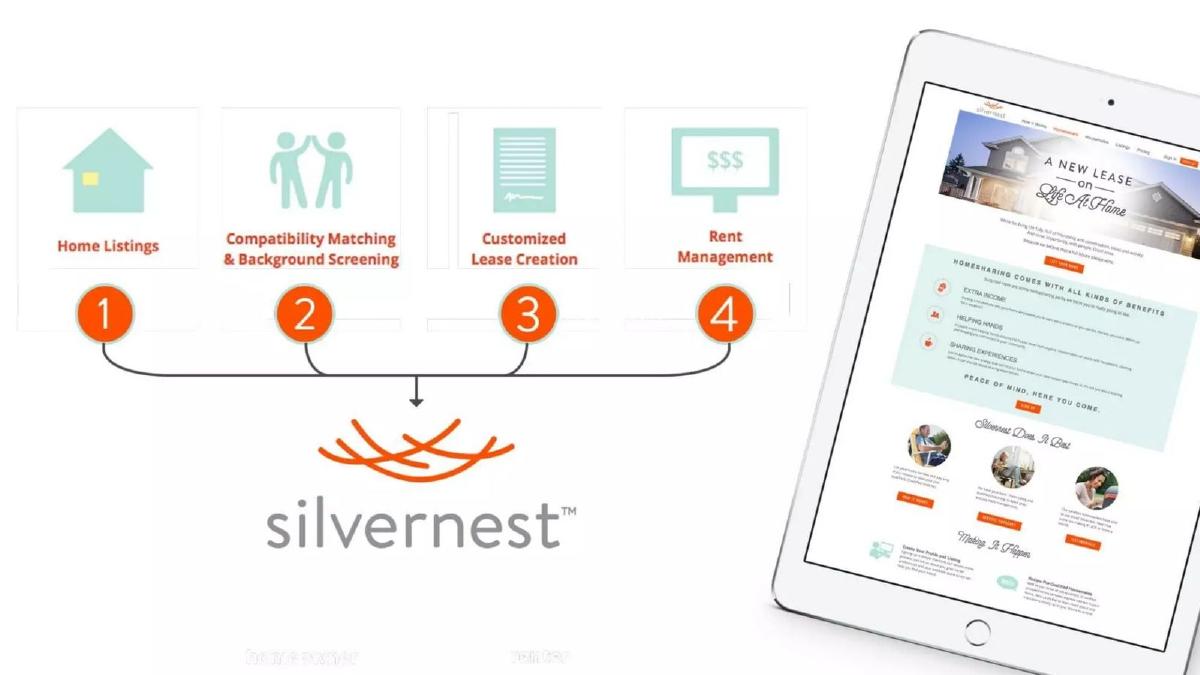
Silvernest’s deck is a study in brevity, consisting of only eight slides that rely heavily on emotional imagery and high-level growth metrics. The company targets the 'aging in place' demographic, specifically the 31 million seniors living alone (Slide 2). By focusing on four core pillars—listings, matching, lease creation, and rent management (Slide 4)—they position themselves as a full-stack solution rather than just a classifieds site. Despite the lack of detailed financial projections, unit economics, or a specific 'Ask' slide, the deck successfully communicates momentum, citing 6,000 use…
Key takeaways
- The deck identifies a massive addressable market of 31 million seniors living alone (Slide 2).
- Product functionality is distilled into a four-step process: Listings, Matching/Screening, Lease Creation, and Rent Management (Slide 4).
- The team slide leverages significant corporate logos, including Motorola, RE/MAX, and Oracle, to establish credibility (Slide 5).
- Traction is shown through a 64% month-over-month growth rate over a two-month period (Slide 6).
- The platform achieved geographic reach across all 50 U.S. states by September 2016 (Slide 6).
- The deck projects a 5-10x growth multiplier for the year 2017 (Slide 7).
- The presentation completely omits a business model, competition analysis, and a specific funding request.
- Visual storytelling is prioritized, using high-resolution photography to contrast the 'problem' of isolation with the 'solution' of companionship (Slides 2 and 3).
The Minimalist Approach to a Massive Demographic
Silvernest entered the market in 2015 with a clear focus on the 'silver economy.' Their pitch deck is a notable example of the 'less is more' philosophy. With only eight slides, the deck functions more as a visual narrative than a data-heavy technical document. It relies on the strength of the macro trend—an aging population—and the pedigree of its leadership team to carry the weight of the investment thesis. According to catalogue facts, this approach helped the company secure $5.6 million in funding.
Slides 1-3: The Emotional Hook
Slide 1: Title Slide The deck opens with a clean, minimalist title slide featuring the Silvernest logo—an orange stylized nest. Contact information for CEO Wendi Burkhardt and a link to their AngelList profile are positioned in the top right corner. This sets a professional, tech-forward tone immediately.
Slide 2: The Situation This is the 'Problem' slide. Instead of bullet points, Silvernest uses high-impact imagery: a close-up of a concerned elderly woman and a small inset of an empty leather wallet. The text is sparse but powerful, stating '31M ALONE' over an image of a suburban house. This slide successfully identifies two problems at once: the loneliness epidemic among seniors and the financial strain of maintaining a home on a fixed income.
Slide 3: The Solution The 'Solution' slide serves as a direct emotional counterpoint to Slide 2. It features two women laughing over tea, with the text 'The SOLUTION IS SIMPLE.' By placing the Silvernest logo directly under this text, the deck positions the brand as the facilitator of this positive outcome. It moves the conversation from 'isolation' to 'companionship' without needing to explain the mechanics of the software yet.
Slides 4-5: Product and People
Slide 4: How it Works This slide introduces the functional aspects of the platform. It breaks the service down into four distinct pillars: 1. Home Listings, 2. Compatibility Matching & Background Screening, 3. Customized Lease Creation, and 4. Rent Management. A mock-up of the website on a tablet is shown to the right. This slide is crucial because it demonstrates that Silvernest is a 'full-stack' roommate platform. By including background screening and lease creation, they address the specific safety and legal anxieties of their target demographic.
Slide 5: The Silvernest Team The team slide is a 'logo play.' While it features headshots and titles for five key executives, the bottom half of the slide is dedicated to the logos of companies where they previously worked. Notable names include Motorola, RE/MAX, Oracle, Johnson & Johnson, and Home Instead Senior Care. For an early-stage startup, this level of corporate pedigree suggests that the founders have the operational experience to scale a complex business in a regulated industry like real estate or senior care.
Slides 6-7: Traction and Future Outlook
Slide 6: The Success Traction is presented through a simple line graph covering January 2016 to September 2016. The deck highlights '35% M.O.M. IN 7 MONTHS' and an acceleration to '64% M.O.M. IN 2 MONTHS.' The slide also notes a milestone of 6,000 users and geographic coverage across 'ALL 50 STATES.' This slide is designed to prove product-market fit and show that the model is scalable across different U.S. markets, not just a local pilot.
Slide 7: The Future (NCOA) This slide is somewhat cryptic but focuses on growth. It features the logo of the NCOA (National Council on Aging) and a graphic indicating '5-10X in 2017.' The 'New & Improved!' badge over a laptop screen suggests a platform relaunch or a significant update to the user experience. This slide serves to show momentum and a roadmap for the coming year, even if it lacks specific tactical details.
Slide 8: Closing
Slide 8: Contact The deck concludes with a repeat of the contact information and a simple line-art illustration of a neighborhood. There is no 'Ask' here—no mention of the dollar amount being raised or the valuation. This suggests the deck was used as a teaser or as a backdrop for a verbal presentation where those details were discussed in person.
What Works in the Silvernest Deck
Emotional Resonance: The transition from the 'lonely' imagery on Slide 2 to the 'social' imagery on Slide 3 is a classic storytelling technique that works well for consumer-facing platforms. · Clarity of Value Proposition: Slide 4 clearly explains that they aren't just a listing site. By including 'Rent Management' and 'Lease Creation,' they define their moat as a service provider that handles the 'messy' parts of property management. · Pedigree: The team slide is exceptionally strong. The inclusion of 'Home Instead Senior Care' is a perfect industry-specific signal that the team understands the aging market. · Traction Velocity: Highlighting month-over-month growth percentages rather than just raw numbers can make a small user base (6,000) look much more impressive to investors looking for momentum.
What is Missing from the Silvernest Deck
Business Model: There is zero information on how Silvernest makes money. Do they charge a subscription fee, a percentage of rent, or a fee for background checks? This is a major omission for a 'Later' stage deck. · The Ask: A fundraising deck usually ends with a clear request for capital and a breakdown of how that capital will be used (e.g., 40% marketing, 30% engineering). This deck omits the 'Ask' entirely. · Competitive Landscape: The deck does not address how it competes with general platforms like Craigslist or Airbnb, or other senior-specific services. · Unit Economics: There is no mention of Customer Acquisition Cost (CAC) or Lifetime Value (LTV), which are standard requirements for assessing the viability of a marketplace model.
What a Founder Should Copy
The Four-Pillar Product Summary: Slide 4 is a masterclass in distilling a complex service into four easy-to-understand steps. Founders should aim for this level of simplicity when explaining their product. · Visual Consistency: The deck uses a consistent color palette (orange and mint green) and high-quality photography that aligns with the brand identity. It looks like a finished product, not a rough draft. · Focus on Macro Stats: By citing '31M ALONE,' Silvernest anchors their pitch in a massive, undeniable demographic trend. Starting with a large, verifiable number helps validate the market size immediately. · Leveraging Logos: If your team has worked at recognizable companies, use the logos. It is the fastest way to build 'borrowed' credibility in a short presentation.
Frequently asked questions
- What is the primary problem Silvernest is trying to solve?
- Silvernest addresses the dual issues of financial insecurity and social isolation among the elderly. Slide 2, titled 'The Situation,' uses imagery of an empty wallet and a pensive senior to highlight these pain points, specifically noting that 31 million seniors live alone. The solution is presented as a way to generate extra income and provide companionship through house sharing.
- How does Silvernest differentiate itself from standard roommate matching sites?
- According to Slide 4, Silvernest is a comprehensive management platform, not just a matching service. It includes 'Compatibility Matching & Background Screening,' 'Customized Lease Creation,' and 'Rent Management.' By handling the legal and financial aspects of the roommate relationship, they provide a layer of security tailored to the concerns of older homeowners.
- What level of traction did the company have at the time of this deck?
- Slide 6 shows that as of September 2016, the platform had 6,000 users and a presence in all 50 states. The slide highlights significant growth velocity, claiming 35% month-over-month growth over a seven-month period, which accelerated to 64% month-over-month growth in the final two months shown on the chart.
- Who are the key members of the Silvernest leadership team?
- The team is led by CEO and Co-Founder Wendi Burkhardt. Other key executives listed on Slide 5 include Kelly Hickey (CFO), Margaret Ann Burness (VP of Marketing), Chase Terwilliger (VP of Product & Biz Development), and Kari Henley (Director of Comm. Relations). The slide emphasizes their collective background at major firms like Johnson & Johnson and Home Instead Senior Care.
- What critical information is missing from this pitch deck?
- This deck is exceptionally lean and omits several standard components. There is no mention of the business model or how the company generates revenue. It lacks a competitive landscape analysis, detailed financial projections, and a specific 'Ask' slide detailing how much capital is being raised and how it will be deployed.