SimplifiMed’s 2015 seed deck is a lean, 9-slide presentation that focuses heavily on a single value proposition: efficiency. The company addresses the massive burden of chronic disease management by proposing a shift from manual 1:1 discovery to chatbot-driven automation. The deck successfully identifies a clear market need—133 million chronic patients—and a regulatory tailwind that incentivizes doctors to manage these conditions. While the deck is visually clean and highlights a strong founding team with deep healthcare and enterprise software experience, it lacks critical financial data, a…
Key takeaways
- The deck identifies a massive total addressable market of 133 million chronic patients on slide 3.
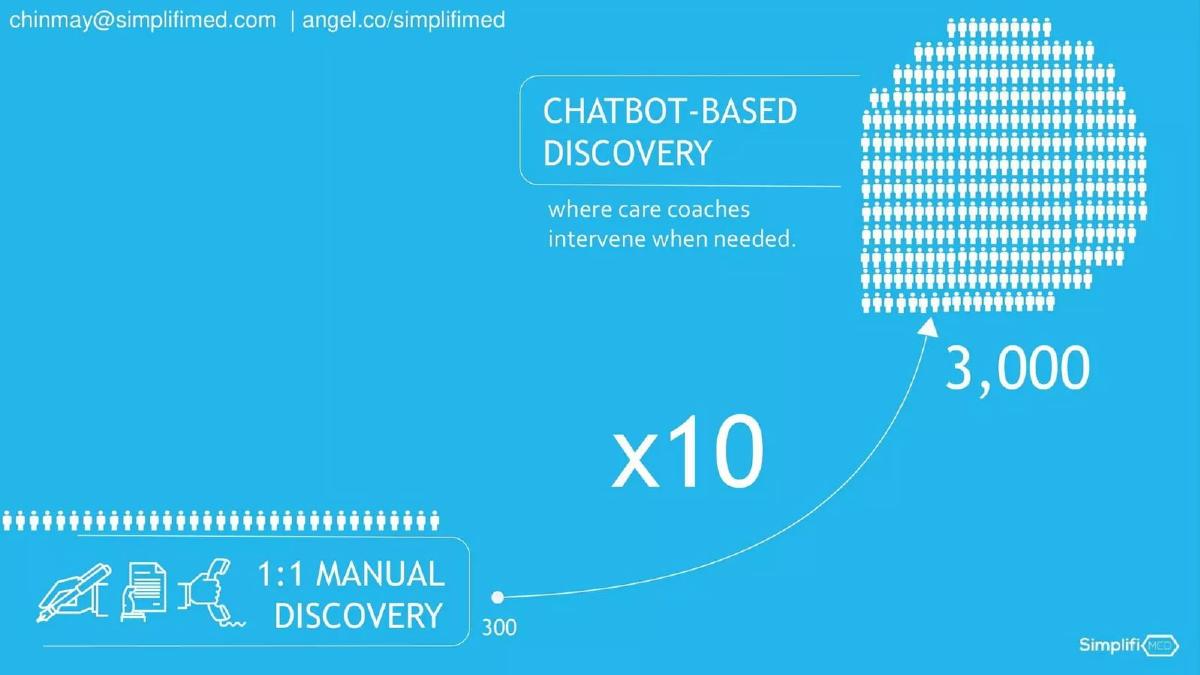
- The core value proposition is a 10x increase in care coach efficiency, moving from 300 to 3,000 patients per year as shown on slide 5.
- SimplifiMed leverages regulatory incentives for doctors to manage chronic conditions, providing a macro-economic 'why now' on slide 6.
- The technology replaces manual 1:1 discovery (calls/mail) with chatbot-based discovery where humans only intervene when needed (slide 5).
- The team slide (slide 8) highlights significant domain expertise, including a CEO with 15 years of healthcare experience and a CMO who was a former CMIO.
- Traction is demonstrated through a development partnership and a pipeline including UCLA Health and the VA (slide 7).
- The deck completely omits a business model, revenue projections, and a specific funding ask.
- The presentation is extremely brief at only 9 slides, prioritizing high-level impact over granular operational detail.
The 9-Slide Efficiency Play
SimplifiMed’s 2015 pitch deck is an exercise in minimalism. In an era where decks often bloat to 25 slides filled with complex diagrams, this 9-slide presentation focuses on a single, powerful metric: 10x. The company isn't just promising a better way to talk to patients; it is promising a fundamental shift in the economics of chronic care management. By using chatbots to automate the 'discovery' phase of patient care, SimplifiMed claims it can enable healthcare providers to scale their impact by an order of magnitude.
The Hook: Problem and Scale
Slide 1: Title The deck opens with a high-quality, emotive image of a caregiver and an elderly patient in a wheelchair. It establishes the healthcare context immediately. The branding is clean, and contact information is provided upfront, including an AngelList profile link.
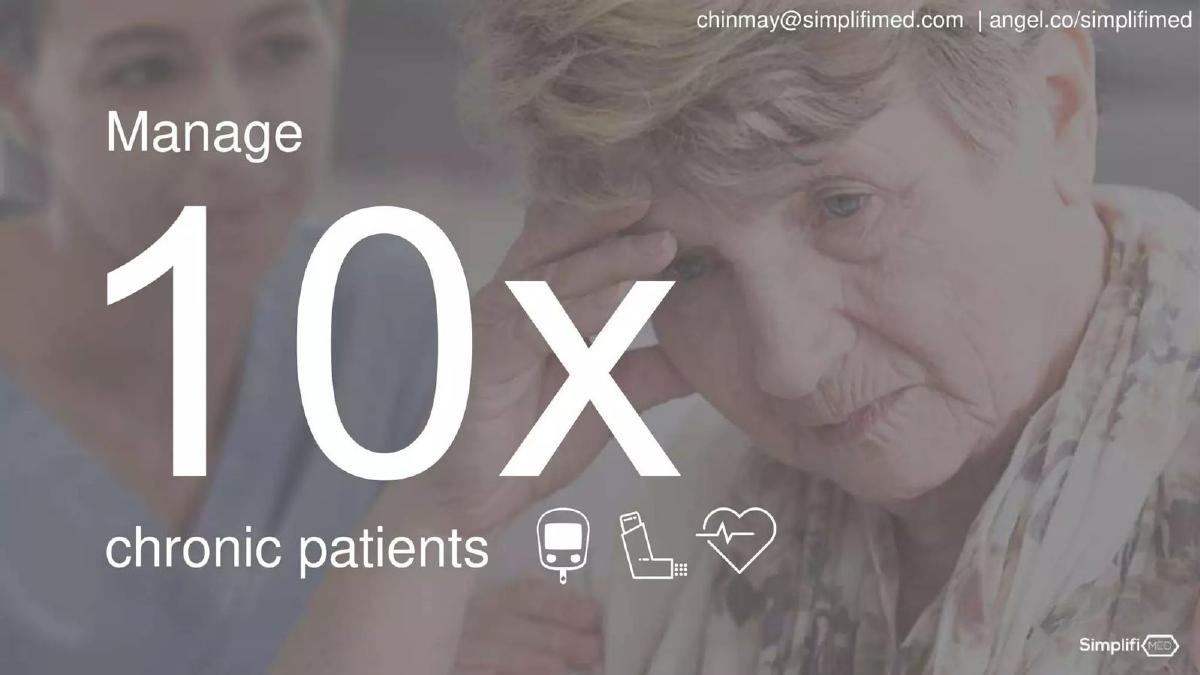
Slide 2: The Value Prop This slide is a 'teaser' for the solution. It features the text 'Manage 10x chronic patients' over an image of a distressed elderly woman. Icons for glucose monitoring, inhalers, and heart health reinforce the 'chronic' focus. It sets a clear expectation for the rest of the deck: this is about productivity gains.
Slide 3: Market Size SimplifiMed uses a single, massive number to define its market: '133 M Chronic patients.' The background is a composite of cityscapes, suggesting the ubiquity of the problem across the United States. It’s a classic 'Big Market' slide that requires no further explanation.
The Solution: Automation vs. Manual Labor
Slide 4: The Current Bottleneck The deck identifies the human bottleneck: 'A care coach can manage 300 patients/yr.' This slide establishes the baseline against which SimplifiMed’s 10x claim will be measured. By quantifying the current limitation, they make the eventual solution feel necessary rather than just 'nice to have.'
Slide 5: The 10x Leap This is the 'money slide' of the deck. It contrasts '1:1 Manual Discovery' (represented by icons of pens, clipboards, and phones) with 'Chatbot-Based Discovery.' The graphic shows a jump from 300 patients to 3,000 patients. Crucially, it notes that care coaches 'intervene when needed,' clarifying that this is a human-in-the-loop AI play, not a total replacement of medical staff.
Market Timing and Validation
Slide 6: Why Now? Healthcare is a highly regulated industry, and SimplifiMed correctly identifies that technology alone isn't enough; you need policy tailwinds. The slide states, 'Regulatory changes provide incentives to doctors to manage chronic conditions.' This refers to the shift toward value-based care and specific CPT codes for chronic care management that were emerging around 2015.
Slide 7: Traction and Pipeline The company demonstrates it isn't just a concept. Under 'Traction,' it lists a 'Development Partnership' with Alameda County Health Coach. Under 'Pipeline,' it displays logos for UCLA Health, NCQA, Huntington Hospital, and the VA. While 'pipeline' is a vague term in startup-land, the caliber of the logos suggests significant early interest from major institutions.
The Team and Conclusion
Slide 8: The Team The team slide is strong for a seed-stage company. CEO Chinmay Singh brings 15 years of healthcare experience and a Duke MBA. CTO Sharad Mankapure adds 20 years of enterprise software experience. Most importantly, CMO Steve Davidson, MD, provides clinical credibility as a Board Certified Emergency Physician and former CMIO at Maimonides Medical Center. This trio covers the three pillars of health tech: domain expertise, technical execution, and clinical validation.
Slide 9: Contact The deck ends as simply as it began, with the logo and contact details. There is no 'Ask' slide, no 'Use of Funds,' and no 'Milestones' slide.
What Works in This Deck
The 10x Narrative: Investors love order-of-magnitude improvements. By framing the entire deck around moving from 300 to 3,000 patients, SimplifiMed makes a compelling economic case for their software. · Visual Clarity: The deck is not cluttered. Each slide has one job and does it well. The use of large typography and simple icons makes it very readable. · Regulatory Alignment: Mentioning the regulatory incentives (Slide 6) shows that the founders understand the macro-environment and the 'Why Now'—a critical component for healthcare investors. · Clinical Credibility: Having a former CMIO (Chief Medical Information Officer) on the founding team is a massive de-risking factor for health tech startups, as it suggests the product will actually fit into clinical workflows.
What is Missing
The Business Model: There is zero mention of how SimplifiMed makes money. Do they charge per patient per month? Is it a licensing fee for the health system? Without this, the '10x' efficiency doesn't clearly translate into a '10x' revenue opportunity. · The Financial Ask: This is a major omission. A pitch deck is a fundraising tool, yet this deck doesn't state how much money is being raised or what that money will be used to achieve. · Competition: The deck assumes a vacuum. In 2015, the patient engagement and chronic care management space was already becoming crowded. A slide addressing why a chatbot is superior to existing 'patient portals' or other automated outreach tools was needed. · Product Screenshots: While 'Chatbot-based discovery' is mentioned, we never see the interface. In 2015, chatbots were still a relatively new concept in healthcare; showing the user experience would have helped prove the '1 in 3 response rate' mentioned in their catalogue description.
What a Founder Should Copy
Quantify the Efficiency: If your startup makes a process faster or cheaper, find the 'unit of labor' (like the 300 patients per coach) and show exactly how your tech multiplies that number. · The 'Pipeline' Slide: If you don't have revenue yet, showing a list of high-authority organizations you are in talks with is the next best thing. It proves that the 'big players' recognize the problem you are solving. · Clean Team Pedigree: Use logos of prestigious universities and former employers to build instant trust. SimplifiMed’s use of Duke, ASU, and Wharton logos is a classic and effective move. · Focus on the Bottleneck: Don't just talk about your features. Talk about the specific human bottleneck (Slide 4) that prevents the industry from scaling. Once the investor agrees that the bottleneck exists, your solution becomes the logical answer.
Frequently asked questions
- What problem is SimplifiMed trying to solve?
- SimplifiMed targets the inefficiency of chronic care management. Currently, care coaches are limited by manual processes—like phone calls and mail—allowing them to manage only about 300 patients per year. With 133 million chronic patients in the US, the current system cannot scale to meet demand without a technological intervention that automates the discovery and triaging process.
- How does the technology actually work according to the deck?
- The deck specifies a 'Chatbot-based discovery' model on slide 5. Instead of a care coach reaching out to every patient manually, the chatbot handles the initial interaction. Care coaches only 'intervene when needed,' which allows a single coach to oversee 3,000 patients instead of the industry standard of 300.
- Who is the target customer for SimplifiMed?
- While not explicitly named as 'customers,' slide 6 and slide 7 imply that the targets are doctors, health systems, and large providers like the VA and UCLA Health. The deck mentions that regulatory changes provide incentives specifically to doctors to manage these chronic conditions, making them the primary economic buyers.
- Is there any evidence of product-market fit in the deck?
- The deck shows early-stage traction on slide 7. It lists a 'Development Partnership' with Alameda County Health Coach and a 'Pipeline' featuring high-profile institutions such as UCLA Health, Huntington Hospital, and the VA. However, it does not disclose if these are paid pilots or letter-of-intent (LOI) stage leads.
- What are the biggest risks for an investor based on this deck?
- The primary risk is the lack of financial and operational detail. There is no mention of the pricing model, the cost of customer acquisition, or how the chatbot integrates with existing Electronic Health Records (EHRs). Furthermore, without a 'The Ask' slide, it is unclear how much capital is needed or how it will be deployed to reach the next milestone.