Simon Data’s Series D pitch deck is a concise, 11-slide narrative that successfully bridges the gap between massive data infrastructure investment and actual business utility. By identifying a specific market failure—that only 13% of enterprises can deliver on their data strategy—Simon Data positions its 'Composable CDP' as the missing link. The deck relies heavily on social proof, citing a 5x G2 Leader status and a strategic partnership with Snowflake. While it redacts specific ARR figures, it highlights a >110% Net Expansion rate and >50% YoY growth, signaling a healthy enterprise SaaS engi…
Key takeaways
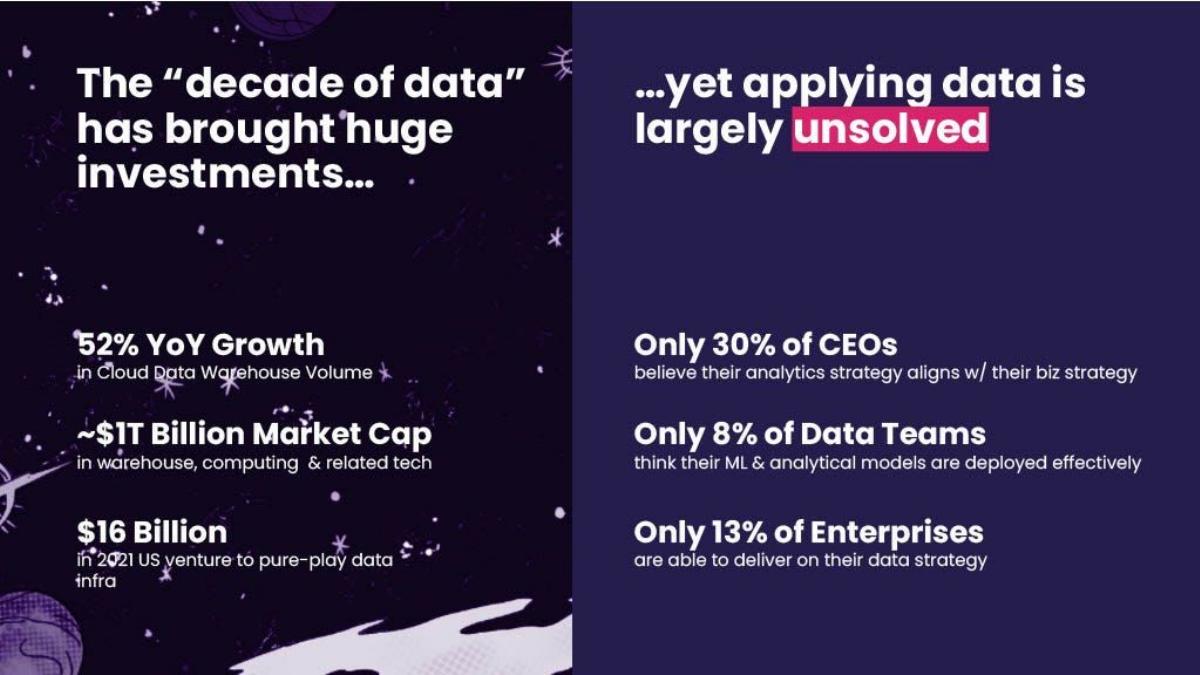
- The deck identifies a massive market opportunity, citing a ~$1T market cap in warehouse and computing tech on Slide 2.
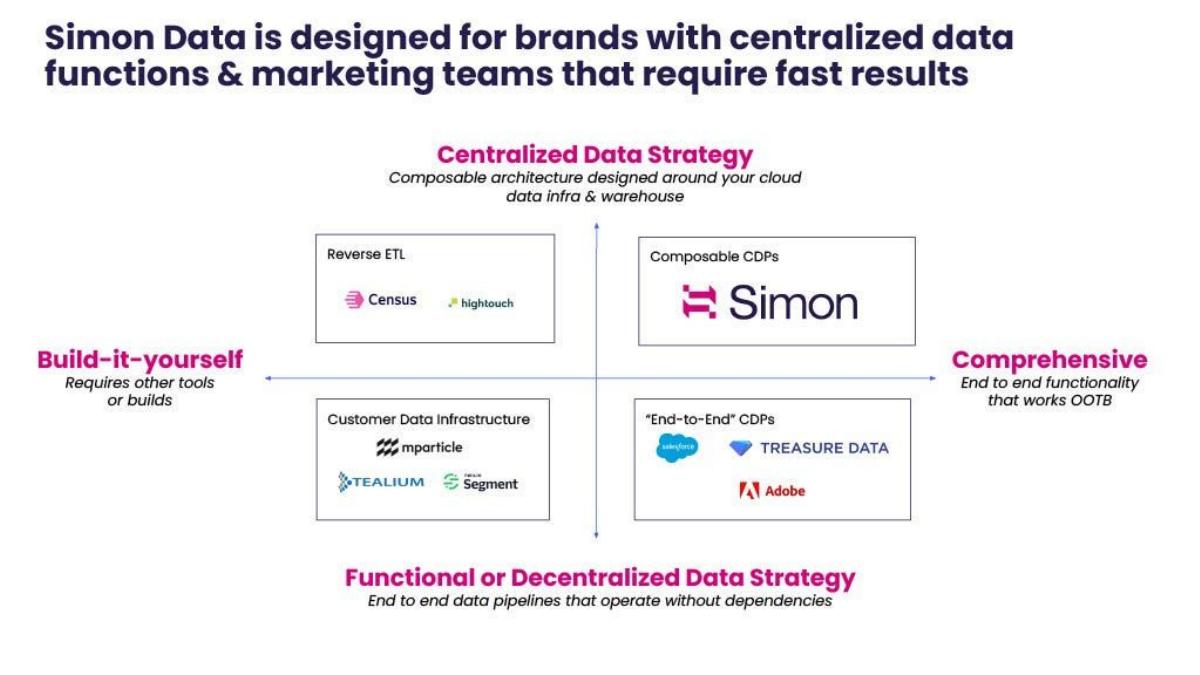
- Simon Data positions itself in the 'Composable CDP' quadrant, differentiating from 'Build-it-yourself' reverse ETL tools and 'End-to-End' legacy CDPs on Slide 3.
- The company claims strong enterprise traction with a Fortune 500 consumer bank and a 5x G2 Leader rating on Slide 4.
- Sales efficiency is highlighted through a >20% close rate and a ~33% close rate on partner-sourced opportunities on Slide 4.
- Retention and growth metrics are robust, with Net Expansion reported at >110% on Slide 4.
- The deck leverages external market shifts, including 3p cookie deprecation and Gen-AI innovation, as core growth drivers on Slide 5.
- The leadership team features deep domain expertise, including a CEO with a PhD in Machine Learning and a CTO with an exit to Etsy on Slide 6.
- The deck omits a specific 'Ask' slide or detailed use-of-funds breakdown, which is common for late-stage Series D rounds reported by Business Insider.
The Strategic Narrative of a Series D Powerhouse
Simon Data’s Series D deck, which supported a $54M raise in 2024, is a masterclass in enterprise positioning. At this stage, investors are less interested in the 'dream' and more focused on the 'machine.' The deck reflects this by spending minimal time on basic problem definitions and maximum time on competitive moats, ecosystem validation, and scalable growth metrics. As reported by Business Insider, the company operates in the data management sector, specifically targeting the marketing technology (MarTech) stack.
Slide 1: Title and Visual Identity
The deck opens with a clean, space-themed visual featuring the Simon Data logo and the title 'Simon Data Overview.' The branding is consistent and professional, signaling a mature company. While simple, the 'Overview' tag suggests this deck is intended to be a comprehensive summary of the business's current state and future trajectory.
Slide 2: The Macro Opportunity and the 'Execution Gap'
Slide 2 sets the stage by contrasting massive infrastructure investment with poor business outcomes. It notes a 52% YoY Growth in Cloud Data Warehouse Volume and a ~$1T Billion Market Cap in warehouse and computing tech. However, the right side of the slide highlights the failure of this investment: Only 13% of Enterprises are able to deliver on their data strategy, and Only 8% of Data Teams think their models are deployed effectively. This creates a clear 'why now'—companies have spent billions on the 'pipes' but still can't use the 'water.'
Slide 3: The Composable CDP Positioning
This is arguably the most important slide in the deck. Simon Data uses a 2x2 matrix to categorize the market. The Y-axis ranges from 'Functional or Decentralized Data Strategy' to 'Centralized Data Strategy.' The X-axis ranges from 'Build-it-yourself' to 'Comprehensive.' Simon Data places itself in the top-right quadrant: Composable CDPs . By doing so, they distance themselves from 'End-to-End' legacy players like Salesforce, Adobe, and Treasure Data (bottom-right) and 'Reverse ETL' tools like Census and Hightouch (top-left). This positioning tells investors that Simon is the only solution that is both comprehensive and aligned with modern, centralized cloud data architectures.
Slide 4: Traction and Social Proof
Slide 4 is a 'wall of wins.' It is divided into three pillars: Customer Champions, A Validated Ecosystem, and Strong Revenue Performance. Key highlights include being a 5x G2 Leader and serving a F500 Consumer Bank . The ecosystem pillar focuses heavily on Snowflake , noting Simon is the 'Only CDP invited to speak at Marketing Analytics Forum.' The revenue column, while redacting the exact ARR EOY figure, boasts a >110% Net Expansion and >50% YoY Growth . These are 'gold standard' metrics for a Series D SaaS company, proving that once they land a customer, they grow within that account.
Slide 5: Market Tailwinds and Future Growth
Slide 5 looks forward, mapping market trends to 'Simon Opportunities.' It identifies four key drivers: migration to cloud warehouses, post-COVID digitization, Gen-AI, and 3p cookie deprecation. The inclusion of Gen-AI is timely, with Simon claiming their architecture provides the perfect 'end caps' for AI development. The mention of 3p cookie deprecation is a direct appeal to marketing budgets, as brands are forced to rely more heavily on first-party data—the exact data Simon Data manages.
Slide 6: The Leadership Team
The team slide is designed to build absolute confidence. CEO Jason Davis and CTO Matt Walker both have PhDs or exits to Etsy (Adtuitive) . CCO Doina Harris brings massive scale experience from AppNexus (sold to AT&T for $1.6B) and Google. The rest of the leadership team features pedigrees from McKinsey, Goldman Sachs, and Deloitte . For a $54M round, investors need to know the 'pilots' have flown large planes before; this slide proves they have.
Slides 7-11: Omitted Content
The provided text indicates that slides 7 through 11 exist but contain the same 'Simon Data' placeholder text in the summary. In a typical Series D deck, these slides would likely cover detailed financial projections, a deep dive into the product roadmap, case studies of specific enterprise deployments, and the specific terms of the 'Ask.' The omission of these in the public-facing version is standard practice to protect sensitive competitive data.
What Works in This Deck
1. The 2x2 Matrix: Slide 3 is a masterclass in competitive positioning. It doesn't just list competitors; it explains why they are structurally different. By defining the category as 'Composable CDP,' Simon Data makes legacy competitors look outdated and point-solution competitors look incomplete.
2. Ecosystem Alignment: By tethering their success to Snowflake (Slide 4), Simon Data rides the coattails of one of the most successful enterprise software stories of the decade. It suggests that as Snowflake grows, Simon Data grows automatically.
3. Efficiency Metrics: Highlighting a >20% Close Rate and ~33% Partner Sourced Ops (Slide 4) tells investors that the sales motion is efficient. In a 'growth at all costs' era, these metrics might have been secondary, but in 2024, capital efficiency is paramount.
What is Missing
1. The 'Ask': There is no slide detailing how much they are raising or how the capital will be deployed. While we know from publisher reports that they raised $54M, a founder using this as a template should remember to include a clear 'Use of Funds' slide.
2. Unit Economics: While Net Expansion is mentioned, there is no mention of CAC (Customer Acquisition Cost) or LTV (Lifetime Value). For a Series D, investors usually want to see the 'payback period' to ensure the growth is sustainable.
3. Product Deep-Dive: The deck is very high-level. There are no screenshots of the platform or specific workflow diagrams. While this works for a high-level overview, a technical due diligence deck would need significantly more 'under the hood' detail.
What Founders Should Copy
1. The 'Execution Gap' Opening: Start your deck by showing how much money has been spent in your category and how little value has been realized. It makes your solution feel like a logical necessity rather than a luxury.
2. The 'Validated Ecosystem' Slide: If you have a partnership with a market leader (like Snowflake, AWS, or Salesforce), dedicate significant space to it. It acts as a proxy for technical validation.
3. Pedigree-Focused Team Slide: Notice how Slide 6 focuses on 'Exits' and 'Deal Teams' rather than just 'Years of Experience.' If your team has won before, make that the headline.
Final Thoughts
Simon Data’s deck is a lean, efficient narrative. It avoids the fluff of early-stage decks and focuses on the structural advantages of their technology in a shifting market. By the time an investor reaches Slide 6, the case for Simon Data as the 'connective tissue' of the modern data stack is firmly established.
Frequently asked questions
- What is a Composable CDP as defined in this deck?
- According to Slide 3, a Composable CDP is a platform designed for brands with a centralized data strategy. It utilizes a composable architecture built around existing cloud data infrastructure and warehouses, offering comprehensive, out-of-the-box functionality without requiring the 'build-it-yourself' approach of standard reverse ETL tools.
- What are the primary market tailwinds Simon Data is riding?
- Slide 5 identifies four key trends: the migration to cloud data warehouses, ongoing post-COVID digitization, explosive innovation in Gen-AI, and the deprecation of third-party cookies. These trends force enterprises to move toward first-party audience management and more agile, data-driven marketing solutions.
- How does Simon Data demonstrate its relationship with the broader data ecosystem?
- Slide 4 highlights a 'Validated Ecosystem,' specifically mentioning Snowflake. Simon Data claims to be the only CDP invited to speak at the Marketing Analytics Forum and notes 14 public touchpoints and joint case studies with Snowflake, positioning themselves as a preferred partner for the leading data warehouse provider.
- What metrics does the deck use to prove product-market fit?
- The deck focuses on enterprise-grade performance metrics on Slide 4: a >110% Net Expansion rate (indicating high customer retention and upsell), >50% YoY growth, and the fact that ~20% of revenue is generated via customer references. These suggest a strong reputation within the F500 segment.
- Who are the key competitors mentioned in the Simon Data deck?
- Slide 3 explicitly names competitors across three categories: Reverse ETL (Census, Hightouch), Customer Data Infrastructure (mParticle, Tealium, Segment), and 'End-to-End' CDPs (Salesforce, Treasure Data, Adobe). Simon Data positions itself as the superior alternative that combines centralized strategy with comprehensive functionality.