The Option Alpha pitch deck is a masterclass in demonstrating product-market fit through extreme capital efficiency. By 2018, the company had achieved a 1,116% three-year CAGR and $3.6 million in revenue with an LTV/CAC ratio where acquisition costs are less than $1. The deck successfully identifies a massive gap in the retail trading market: while 90% of all trades are automated, retail investors are still stuck with 'outdated point-and-click' interfaces like Robinhood and thinkorswim. The transition from a pure education play to an 'Industry 1st' auto-trading bot platform is the core value…
Key takeaways
- The company reports a massive three-year CAGR of 1,116% on slide 9.
- Revenue reached $3.6 million with 125,000 members by the time of the deck's creation (slide 9).
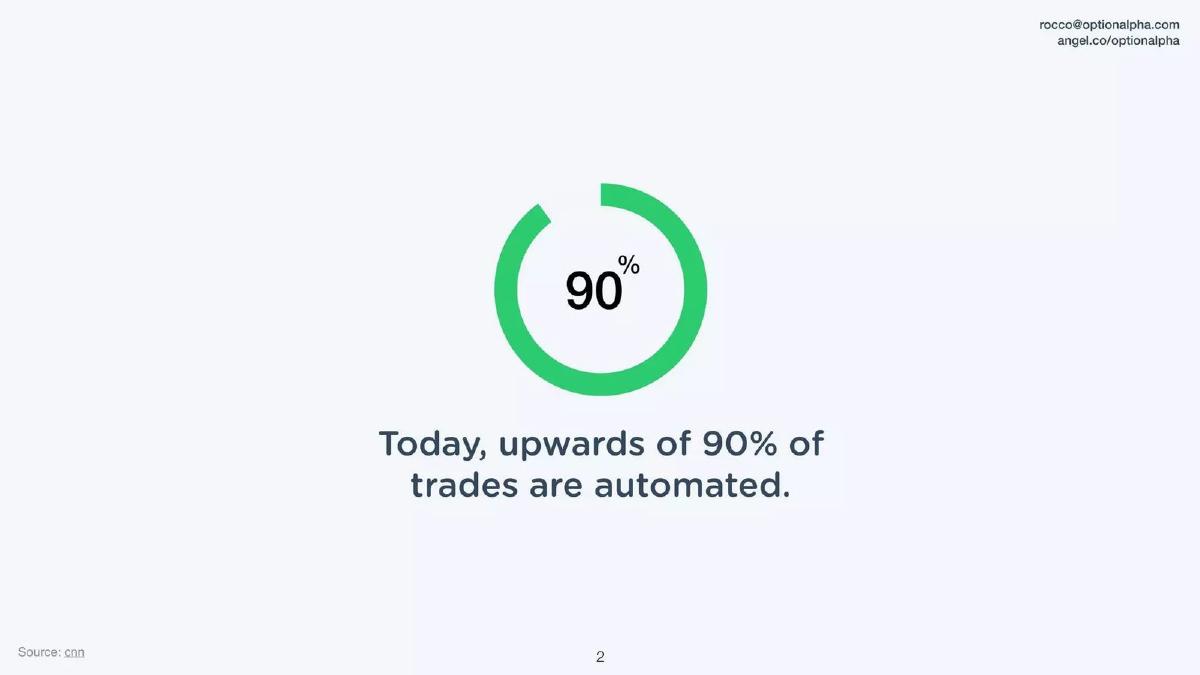
- The deck identifies that upwards of 90% of trades are currently automated, yet retail tools remain manual (slide 2).
- Option Alpha claims an LTV/CAC ratio of $64 to <$1, driven by organic traffic (slide 9).
- The platform is positioned as a replacement for '20 Year Old Point-and-Click' interfaces like thinkorswim (slide 5).
- The team includes founders with exits from companies like Sencha and experience at Deutsche Bank (slide 10).
- The company was ranked #215 on the Inc. 5000 list in 2018 (slide 9).
- The deck notes that 4 million new brokerage accounts are opened per year in the US (slide 4).
Executive Summary: The Automation of the Retail Investor
Option Alpha’s pitch deck is a lean, 11-slide presentation that focuses heavily on market timing and explosive organic growth. The company positions itself at the intersection of two major trends: the rise of the self-directed investor and the ubiquity of automated trading in institutional markets. By contrasting their 'Auto Trading' bot technology against the manual 'point-and-click' interfaces of industry giants, they create a clear 'old way vs. new way' narrative. The deck is particularly strong on traction, showcasing a 1,116% CAGR and a nearly non-existent customer acquisition cost, which suggests a highly efficient business model built on an educational content moat.
Slides 1-3: The Macro Opportunity
The deck opens with a minimalist title slide (Slide 1) featuring the tagline 'Make Smarter Trades.' It immediately moves into the 'Why Now' argument on Slide 2, stating that 'upwards of 90% of trades are automated' today, citing CNN as a source. This sets the stage for the disparity between how the market actually functions and how retail investors are currently forced to participate.
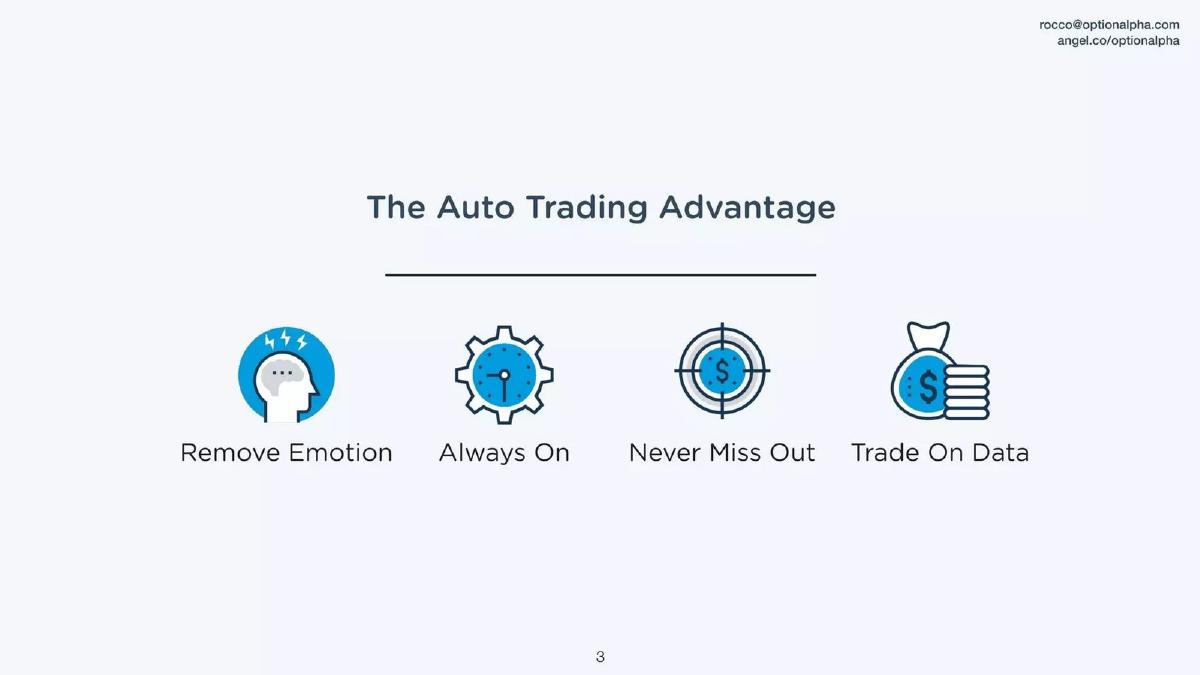
Slide 3 defines 'The Auto Trading Advantage' through four icons: Remove Emotion, Always On, Never Miss Out, and Trade On Data. This slide serves as the psychological hook, addressing the primary pain points of retail traders—fear, greed, and the inability to monitor markets 24/7. It frames automation not just as a convenience, but as a necessary tool for performance parity with institutional players.
Slides 4-5: Market Size and the Competitive Gap
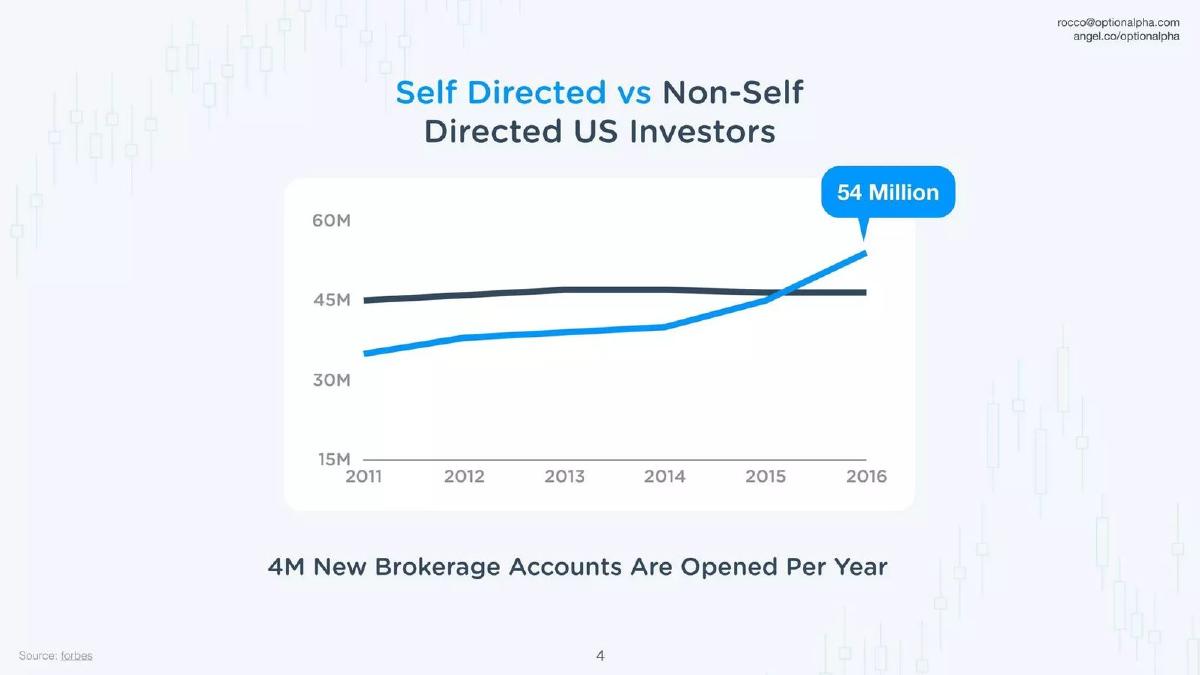
Slide 4 uses a line graph to show the growth of 'Self Directed vs Non-Self Directed US Investors.' The blue line representing self-directed investors crosses the 45 million mark around 2015 and reaches 54 million by 2016. The slide adds a punchy stat: '4M New Brokerage Accounts Are Opened Per Year.' This establishes a massive, growing Total Addressable Market (TAM) that is increasingly taking control of its own financial destiny.
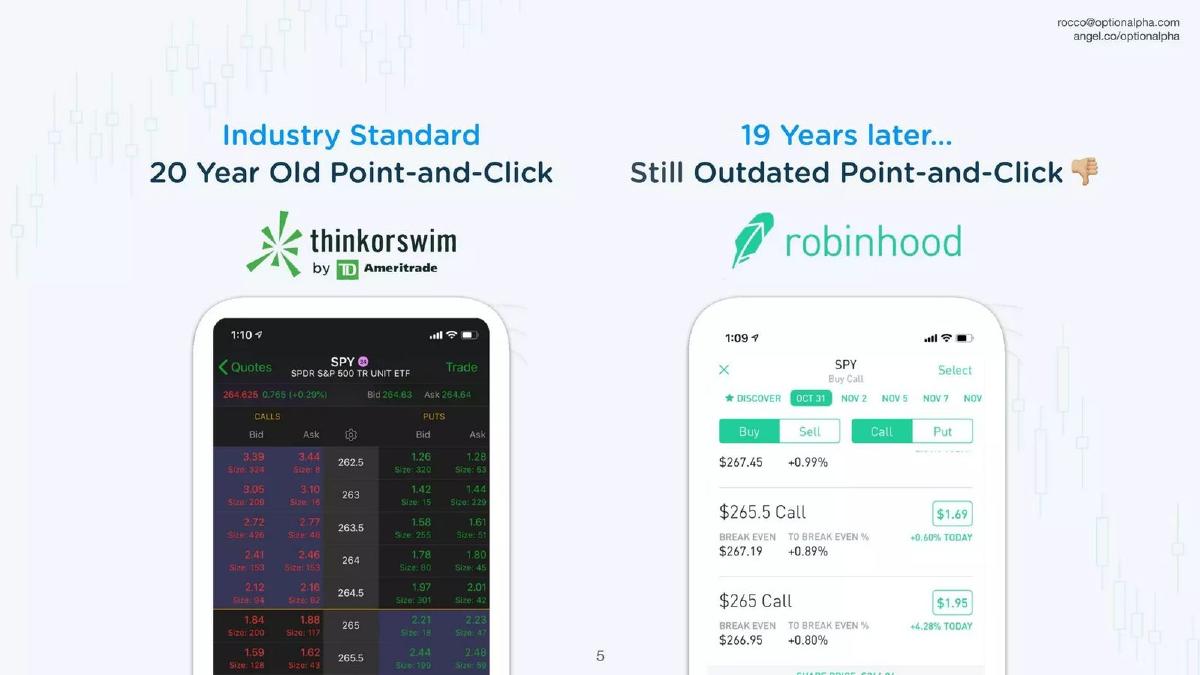
Slide 5 is the 'Villain' slide. It compares 'Industry Standard' tools like thinkorswim (described as '20 Year Old Point-and-Click') with Robinhood (described as 'Still Outdated Point-and-Click'). By including Robinhood—a company often lauded for its modern UX—in the 'outdated' category, Option Alpha makes a bold claim: the problem isn't the user interface, it's the underlying manual workflow. The use of a 'thumbs down' emoji next to Robinhood emphasizes their stance that even 'modern' apps are technologically stagnant in terms of execution logic.
Slides 6-8: The Solution and Product Deep-Dive
Slide 6 re-introduces the brand with a mission statement: 'We enable investors to make smarter, more profitable options trades.' This leads directly into the product reveal on Slide 7, which showcases the 'Industry 1st Auto Trading' interface. The screenshot features an 'AAPL - Bot' with a dashboard showing returns, P/L, and drawdowns. The visual emphasis is on 'No more point-and-click,' replacing manual entry with 'Routines' and 'scan routines.'
Slide 8 addresses the two biggest barriers to entry for new traders: 'Don’t know how to trade?' and 'Don’t know what to trade?' The solution for the former is 'In-Depth Training' (Free forever), and for the latter, 'AI & ML for Trade Ideas.' This slide is crucial because it explains the top-of-funnel strategy. By offering free education, they build the trust and knowledge base necessary for users to eventually utilize their paid automation tools.
Slide 9: The Traction Powerhouse
This is the most important slide in the deck. It presents three high-impact boxes:
CAGR: 1,116% (3 years) with $3.6M Revenue. · Members: 125,000, growing at 200 per day. · LTV / CAC: $64 LTV against a CAC of The inclusion of the Inc. 5000 #215 badge for 2018 provides third-party validation for these figures. For an investor, an LTV/CAC ratio of 64:1 is extraordinary and suggests that the company has mastered a low-cost acquisition channel, likely through their educational content, which they can now leverage to upsell the new auto-trading technology.
Slides 10-11: Team and Conclusion
Slide 10 introduces the four founders. The pedigree is strong, with two founders (Jack Slocum and Adam Mishcon) having previously founded Sencha, a well-known web development framework. Kirk Du Plessis is positioned as the domain expert ('Head Trader') with M&A experience at Deutsche Bank. The slide also mentions that they have already raised '$1.4M including 500 Startups - Batch 20,' which establishes previous venture backing and successful due diligence.
The final slide (Slide 11) summarizes the investment thesis: 1,000%+ CAGR, Organic Repeatable Growth, and the fact that they are 'Cash Flow Positive.' It provides a direct contact email for Rocco Savage to handle inquiries.
What Works in the Option Alpha Deck
1. Extreme Capital Efficiency: The most compelling part of this deck is the unit economics. A CAC of less than $1 is almost unheard of in the fintech space, where customer acquisition costs often exceed $100. By highlighting this, Option Alpha proves they don't need investor money to survive, but rather to accelerate an already profitable engine.
2. Clear Market Dichotomy: The deck does an excellent job of bucketed 'Manual' vs. 'Automated.' By framing even Robinhood as 'outdated,' they carve out a unique space for themselves that isn't just 'another trading app,' but a 'trading bot platform.'
3. Proven Education-to-SaaS Funnel: Slide 8 and 9 together show a clear path of how they acquire users (free education) and how that translates into a massive member base (125,000). This de-risks the 'if you build it, will they come?' question that plagues most new platforms.
What is Missing from the Option Alpha Deck
1. The 'Ask': The deck never explicitly states how much money they are looking to raise or what the valuation expectations are. While this is sometimes left for the first meeting, including a 'Use of Funds' slide would have clarified if the capital is for engineering, marketing, or regulatory compliance.
2. Regulatory and Compliance Details: Automated trading for retail investors is a heavily regulated space. The deck mentions a 'General Counsel' on the team, but it doesn't address how they handle the legal complexities of bots executing trades on behalf of users, which is a major hurdle in fintech.
3. Future Financial Projections: While the historical CAGR is impressive, there is no forward-looking data. Investors want to see if the $3.6M revenue can scale to $36M or $360M, and what the margin profile looks like as the product shifts from education to a technology platform.
What a Founder Should Copy
1. The Traction Box Layout: Slide 9 is a perfect example of how to present metrics. It doesn't hide behind vanity metrics; it shows revenue, growth rate, and unit economics in a clear, easy-to-digest format. If you have a high LTV/CAC, make it the centerpiece of your deck.
2. Comparative Screenshots: Slide 5’s comparison of thinkorswim and Robinhood is very effective. Instead of just saying 'competitors are bad,' they show the actual interfaces and label exactly what is wrong with them ('Point-and-Click'). This visual evidence is much more persuasive than a standard feature-comparison checklist.
3. The 'Why Now' Hook: Starting with the 90% automation stat (Slide 2) is a great way to create a sense of urgency. It makes the investor feel like the retail market is 'behind' and that Option Alpha is the inevitable bridge to the modern era.
Conclusion Option Alpha’s deck is a 'traction-first' presentation. It relies on the strength of its existing business to justify its future technology pivot. For founders who have built a profitable business or a large community before seeking venture capital, this deck provides a blueprint for how to use that leverage to tell a much larger story about market disruption.
Frequently asked questions
- What is the primary problem Option Alpha is solving?
- Option Alpha addresses the technological gap between institutional and retail traders. Slide 2 notes that 90% of trades are automated, but slide 5 points out that retail investors are still using 'outdated' point-and-click interfaces. They aim to bring institutional-grade automation, which removes emotion and trades on data, to the 54 million self-directed US investors.
- How does Option Alpha acquire customers so cheaply?
- According to slide 9, the company has an LTV/CAC ratio of $64 to less than $1. This is attributed to 'Organic Traffic.' The company's origins in education and coaching (as per the catalogue listing) likely created a massive content funnel that allows them to acquire 200 new members per day without significant paid advertising spend.
- What are the key features of the Option Alpha platform?
- The platform offers three main pillars: 'Industry 1st' Auto Trading bots that eliminate manual clicking (slide 7), in-depth training for those who don't know how to trade, and AI/ML-driven trade ideas for those who don't know what to trade (slide 8).
- Who is the team behind Option Alpha?
- The team consists of four founders with a mix of technical and financial backgrounds. Jack Slocum (CEO) and Adam Mishcon (General Counsel) were founders at Sencha. Kirk Du Plessis (CMO) brings trading expertise from Deutsche Bank, and Rocco Savage (CRO) was the first business development hire at Sencha (slide 10).
- Is Option Alpha currently profitable?
- Slide 11 explicitly states that the company is 'Cash Flow Positive.' This is supported by the traction slide showing $3.6 million in revenue and a very low customer acquisition cost. This status suggests the fundraising effort is for scaling an already working engine rather than reaching initial viability.