Orchard’s 12-slide deck presents a compelling case for a software-driven approach to smartphone insurance, specifically targeting the enterprise 'Bring-Your-Own-Device' (BYOD) market. The company identifies a $48 billion opportunity where 75% of smartphones remain uninsured. By leveraging their existing background in a used phone marketplace—which already generated $2 million in annual sales—Orchard introduced a diagnostic app capable of testing over 35 functions in three minutes. This technical moat allows them to insure used devices that traditional providers avoid. While the deck is light…
Key takeaways
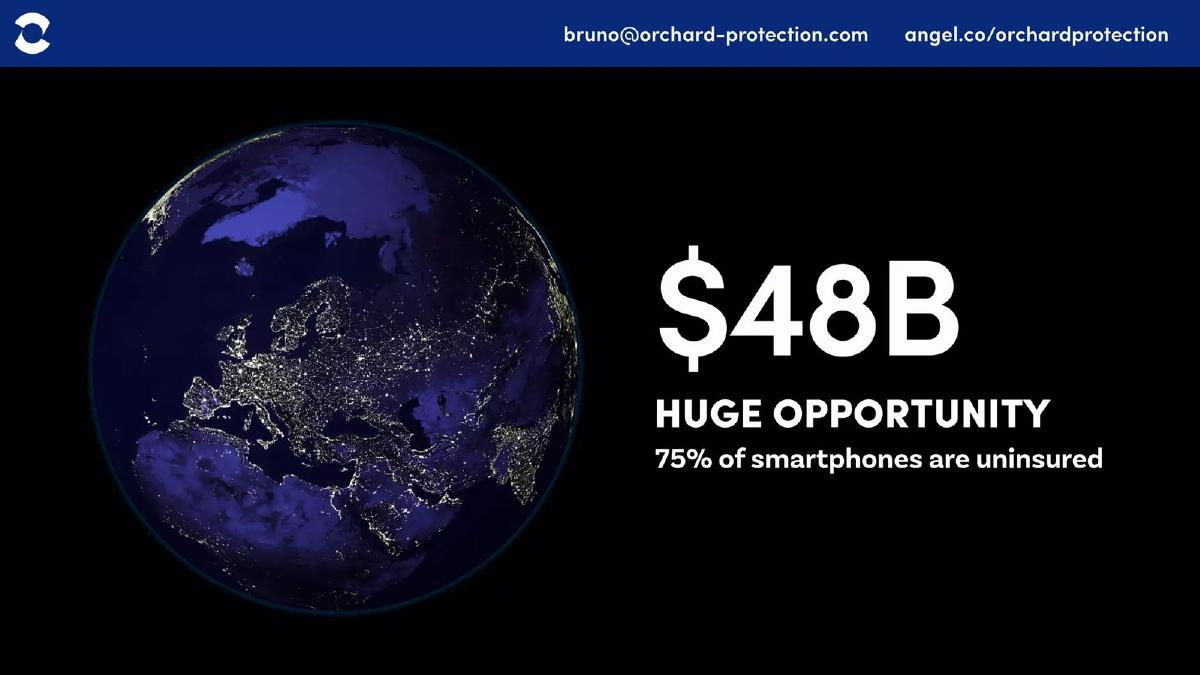
- The total addressable market is valued at $48B, with 75% of smartphones currently uninsured (Slide 2).
- Orchard identifies a specific enterprise pain point: 60% of companies use BYOD, creating significant security risks (Slide 4).
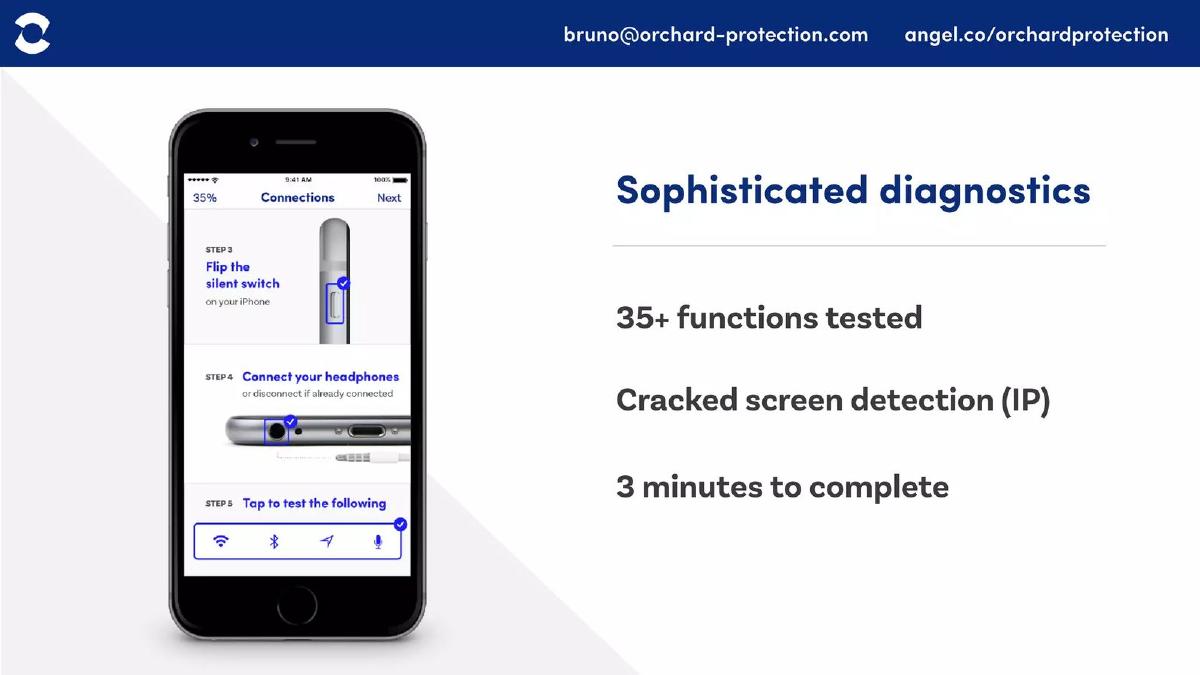
- The product features a proprietary diagnostic tool that tests 35+ functions and detects cracked screens via IP (Slide 6).
- Early traction is demonstrated through a sales funnel of 5,800 active policies across companies like IDEO, DocSend, and Masterclass (Slide 8).
- Orchard claims superior unit economics, charging $15/month compared to the $5/month industry average (Slide 9).
- The company secured a strategic partnership with Arch Insurance, an A+ global provider, to handle scaling (Slide 10).
- The founding team brings deep domain expertise from a used phone marketplace with $2M in annual sales and 60,000+ phones diagnosed (Slide 11).
- The deck omits a specific funding amount, valuation, or detailed use-of-funds breakdown (Slide 12).
The Orchard Teardown: From Marketplace to Insurtech
Orchard’s 2018 seed deck is a masterclass in the 'pivot-to-platform' narrative. Originally a marketplace for used iPhones, the company realized that the real value lay not in the transaction of hardware, but in the data generated by their diagnostic tools. This deck represents their move into the high-margin world of B2B insurtech. By targeting the 'Bring-Your-Own-Device' (BYOD) trend in enterprises, Orchard found a niche that traditional insurers—who rely on point-of-sale partnerships with carriers like Verizon or AT&T—simply cannot reach.
The Macro Opportunity (Slides 1-4)
Slide 1 is a minimalist title slide featuring the Orchard logo. It establishes a clean, professional brand identity from the outset. Slide 2 immediately jumps into the 'Why Now?' and 'How Big?' questions. It cites a $48B huge opportunity, noting that 75% of smartphones are uninsured . The use of a night-view globe suggests a global ambitions, though the subsequent slides focus heavily on North American enterprise trends.
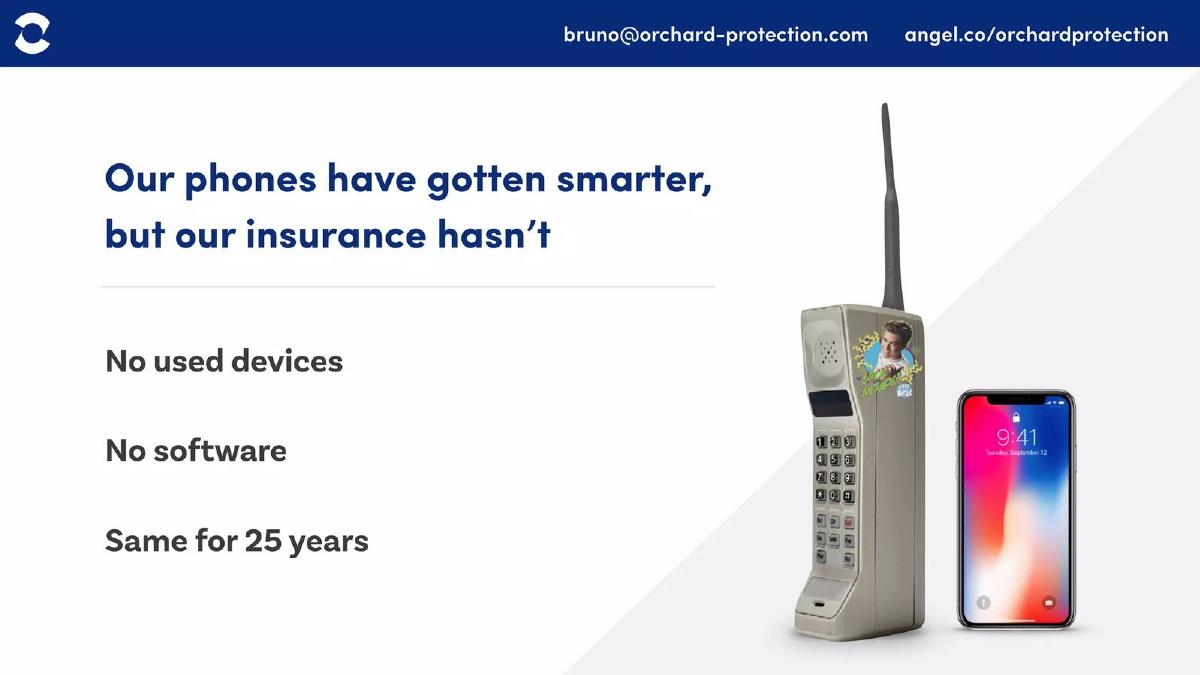
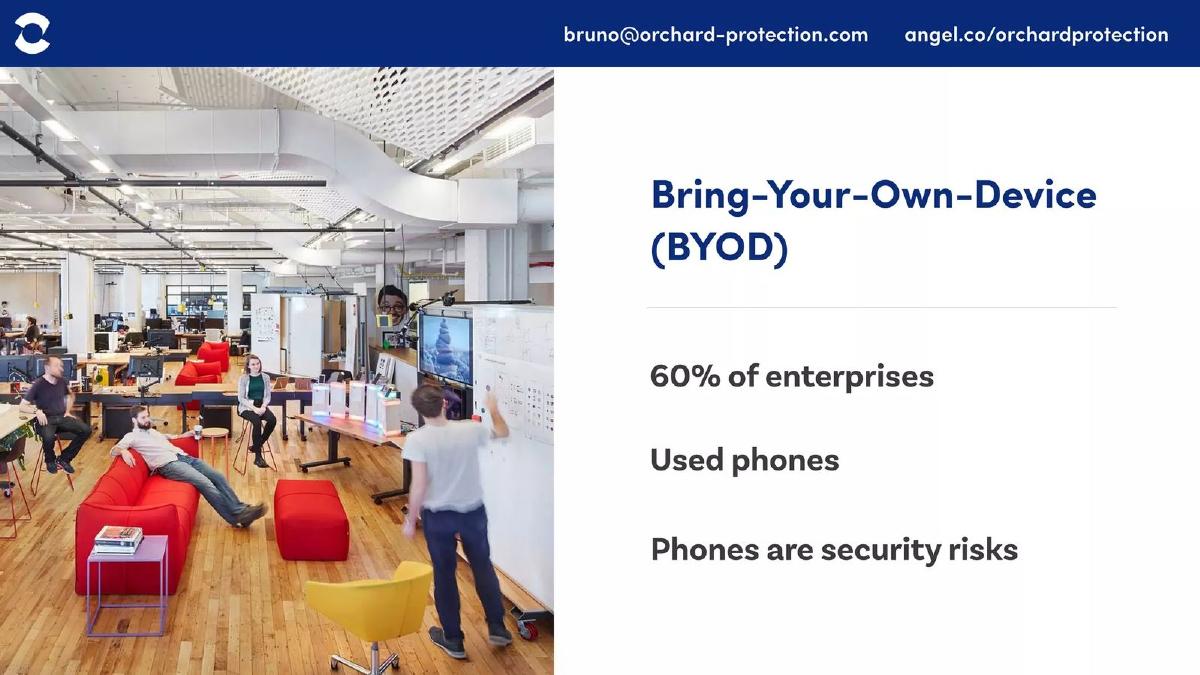
Slide 3 defines the problem: 'Our phones have gotten smarter, but our insurance hasn’t.' The slide lists three critical failures of the legacy insurance industry: no coverage for used devices, a lack of integrated software, and a stagnant business model that hasn't changed in 25 years. This sets the stage for a software-first solution. Slide 4 narrows the focus to the B2B sector. It highlights that 60% of enterprises now operate under a BYOD model. This creates two problems for the employer: the use of unvetted 'used phones' and the fact that these 'phones are security risks.' This is a clever framing; Orchard isn't just selling insurance; they are selling peace of mind for IT departments.
The Software Solution and Product (Slides 5-7)
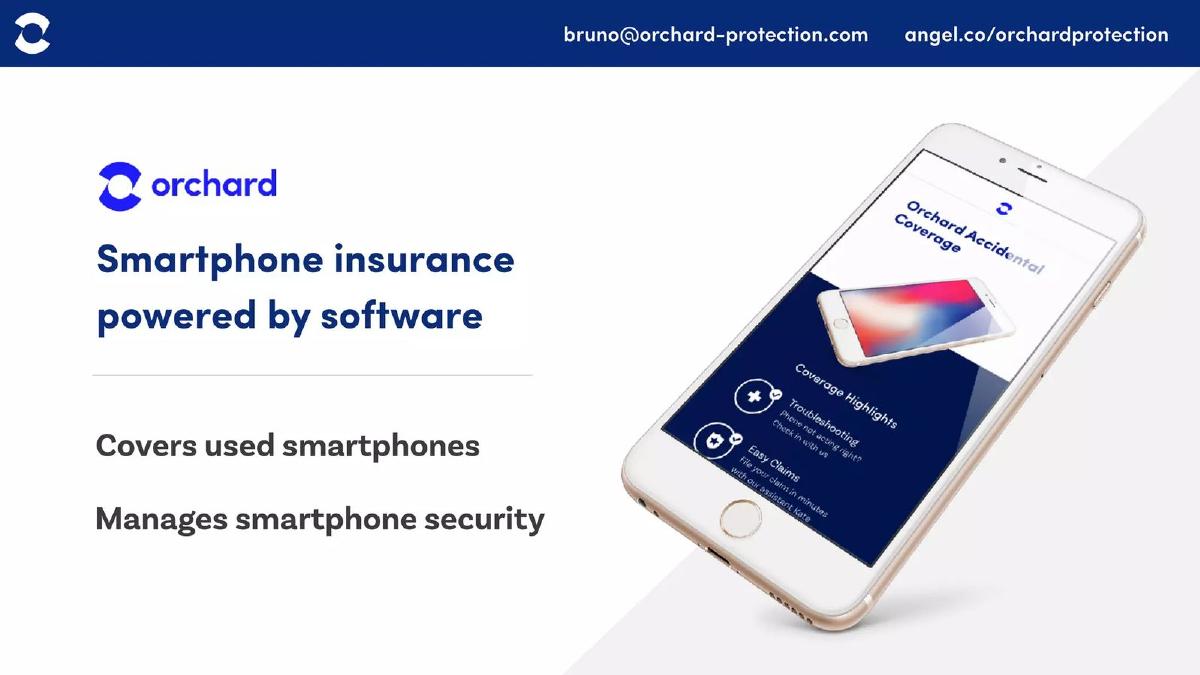
Slide 5 introduces the Orchard solution: 'Smartphone insurance powered by software.' The value proposition is twofold: it covers used smartphones and manages smartphone security. The visual shows a clean mobile interface, emphasizing the 'easy claims' process. Slide 6 is the technical heart of the deck. It describes their 'Sophisticated diagnostics' which include 35+ functions tested and a Cracked screen detection (IP) . The claim that this takes only 3 minutes to complete is vital—it lowers the friction for a user to get insured, which is the primary barrier in the used device market.
Slide 7 expands on the 'security' aspect of the product. It shows an interface that gives the user a '100%' security score based on a checklist: Remote Wipe, Touch ID, Face ID, OS Updates, and Cloud Backup. Crucially, it notes 'No personal data: Full privacy,' addressing the primary concern employees have when installing company-mandated software on personal devices.
Traction and Unit Economics (Slides 8-9)
Slide 8 is perhaps the strongest slide for a seed-stage investor. It visualizes a sales funnel from the 'First 2 months.' It shows 65 policies closed , 1,300 policies at the commercial terms stage (with logos like Evernote and Herschel), and an active funnel of 5,800 policies featuring heavy hitters like Pivotal, IDEO, and Masterclass. This demonstrates that the BYOD insurance message is resonating with high-growth tech companies.
Slide 9 addresses the business model. Orchard positions itself as a premium offering at $15/month , which is 3X the price of 'SquareTrade & the other guys' at $5/month. The justification for this premium is the combination of 'Insurance & security.' While a 3x price point might seem risky, in a B2B context where the company is often subsidizing the cost, the added security features make it a more defensible expense than a simple consumer protection plan.
Partnerships and Team (Slides 10-11)
Slide 10 reveals how Orchard plans to handle the actual insurance risk. They are partnering with Arch Insurance , described as an 'A+ Global insurance provider.' This is a standard but necessary move for an insurtech startup; it proves they have the institutional backing to actually pay out claims, which is the 'trust' component of the business.
Slide 11 introduces the team: Bruno Wong (CEO), Alex Sebastian (COO/CFO), and Hamza Javed (CTO). The 'domain expertise' is backed by their previous success: a Used phone marketplace that has already diagnosed 60,000+ phones and generated $2M in annual sales . This is a critical piece of the narrative—they aren't just guessing that their diagnostics work; they've already battle-tested the tech on 60,000 devices in a retail environment.
The Conclusion and Omissions (Slide 12)
Slide 12 serves as the closing, but it is surprisingly weak. Instead of a clear 'Ask' (e.g., 'We are raising $2M to hire 5 engineers and scale sales'), it simply says 'Introduce us to more companies.' While this is a common 'soft' closing for a deck shared via email, it leaves the investor guessing about the actual funding requirements.
What Works in the Orchard Deck
The Pivot Narrative: The deck successfully explains how a marketplace company turned into a software company. The fact that they already had $2M in sales from their previous iteration gives the 'diagnostics' claim immense credibility. · Clear B2B Focus: By focusing on BYOD and security, they move away from the 'commodity' insurance market and into the 'enterprise software' market, which commands higher multiples. · Visual Traction: Slide 8's funnel is excellent. It shows a clear path from lead to close and uses recognizable logos to build social proof. · Technical Moat: Emphasizing the 35+ diagnostic tests and the IP for cracked screen detection suggests that their software is not easily replicated by a traditional insurance company.
What is Missing from the Orchard Deck
The Ask: As noted, there is no mention of how much money is being raised or what the terms are. This is a significant omission for a pitch deck. · Loss Ratios: In insurance, revenue is only half the story. Investors need to know what percentage of premiums are paid out in claims. Without this, 'the best unit economics' is an unsubstantiated claim. · Churn and Retention: For a subscription model ($15/month), seeing early retention data from those first 65 closed policies would be highly beneficial. · Competition: While they mention 'SquareTrade & the other guys,' they don't address other emerging insurtechs or the risk of Apple/Google expanding their own protection plans (AppleCare+) into the enterprise space.
What a Founder Should Copy
The 'Why Now' Slide: Slide 4 (BYOD) is a perfect example of identifying a specific market shift that creates a new opportunity. · Product-Market Fit via Traction: If you have a sales funnel, show it exactly like Slide 8. It’s much more effective than a generic 'Go-to-Market' strategy slide. · Leveraging Past Success: If your current startup is an evolution of a previous project, use the stats from the old project to de-risk the new one, just as Orchard did with their $2M marketplace sales.
Frequently asked questions
- What is Orchard's primary product?
- Orchard provides smartphone insurance powered by diagnostic software. Unlike traditional insurers that focus on new devices at the point of sale, Orchard's app allows users to insure used devices by running a 'sophisticated diagnostic' check. This tool tests over 35 hardware and software functions in three minutes to verify the device's condition before coverage begins.
- How does Orchard differentiate itself from competitors like SquareTrade?
- Orchard differentiates through its pricing model and target audience. While competitors like SquareTrade typically charge around $5 per month for basic protection, Orchard positions itself at $15 per month by bundling insurance with active device security management. They specifically target the B2B 'Bring-Your-Own-Device' (BYOD) market, which traditional consumer-facing insurers often overlook.
- What is the significance of the Arch Insurance partnership?
- The partnership with Arch Insurance (an A+ rated global provider) is critical for Orchard's scalability. As a startup, Orchard likely lacks the balance sheet to underwrite massive insurance risk themselves. Partnering with a major carrier allows them to act as a Managing General Agent (MGA), focusing on the software, customer acquisition, and diagnostics while Arch provides the financial backing for claims.
- What evidence of market traction does the deck provide?
- The deck shows a multi-stage sales funnel from its first two months of operation. It lists 65 closed policies with firms like Checkfront and Otter Consulting, 1,300 policies at the 'commercial terms' stage (including Evernote and Herschel), and an 'active funnel' of 5,800 policies featuring high-profile tech companies like IDEO, DocSend, and Masterclass.
- What are the main weaknesses of this pitch deck?
- The deck is notably missing a 'The Ask' slide. It does not state how much money the company is raising, the valuation, or how the funds will be allocated. Additionally, while it mentions 'the best unit economics,' it provides no data on Customer Acquisition Cost (CAC), Lifetime Value (LTV), or loss ratios, which are the most important metrics for an insurtech company.