Opus successfully raised $6.8M in a 2024 Seed round by positioning itself as the essential operating system for the 'deskless' workforce. The deck identifies a massive, underserved market—70% of the American workforce—and presents a solution that lowers training labor by 60%. By emphasizing a mobile-first interface and 'ready-made' templates, Opus demonstrates how it solves the friction of traditional LMS platforms for industries like hospitality and retail. The narrative moves effectively from a $50 billion top-down TAM to a granular vertical expansion strategy, backed by social proof from b…
Key takeaways
- The deck identifies a massive target audience of 110 million US workers who do not sit at a desk, representing 70% of the workforce (Slide 2).
- Opus claims a significant efficiency metric, stating the platform lowers training labor by 60% (Slide 4).
- The market opportunity is framed through three lenses: $2.5 trillion in annual frontline wages, $250 billion in economic value created, and a $50 billion top-down TAM (Slide 5).
- Product functionality is highlighted through mobile-first features including auto-translated video messaging and verification for hands-on skills (Slide 6).
- The platform leverages 'ready-made templates' to allow managers to build content quickly, even from a car, according to a customer quote (Slide 7).
- GTM strategy is proven through a diversified lead source mix including Outbound, Inbound (Social Led), and two types of Referrals (Slide 8).
- Long-term vision includes expanding into six specific high-value verticals, with Healthcare representing a $1.1B ARR opportunity (Slide 9).
- The funding ask was clearly defined as a range of $6-8M to expand product development and accelerate GTM (Slide 10).
Opus Pitch Deck Teardown: The Mobile-First Frontline Revolution
Opus, a New York-based HR tech startup, raised $6.8M in 2024 to solve a problem that has plagued the hospitality and retail sectors for decades: how to effectively train a workforce that never touches a laptop. Their pitch deck is a masterclass in identifying a massive, underserved segment and presenting a product that feels native to the user's environment.
Slide 1: The Hook and Social Proof
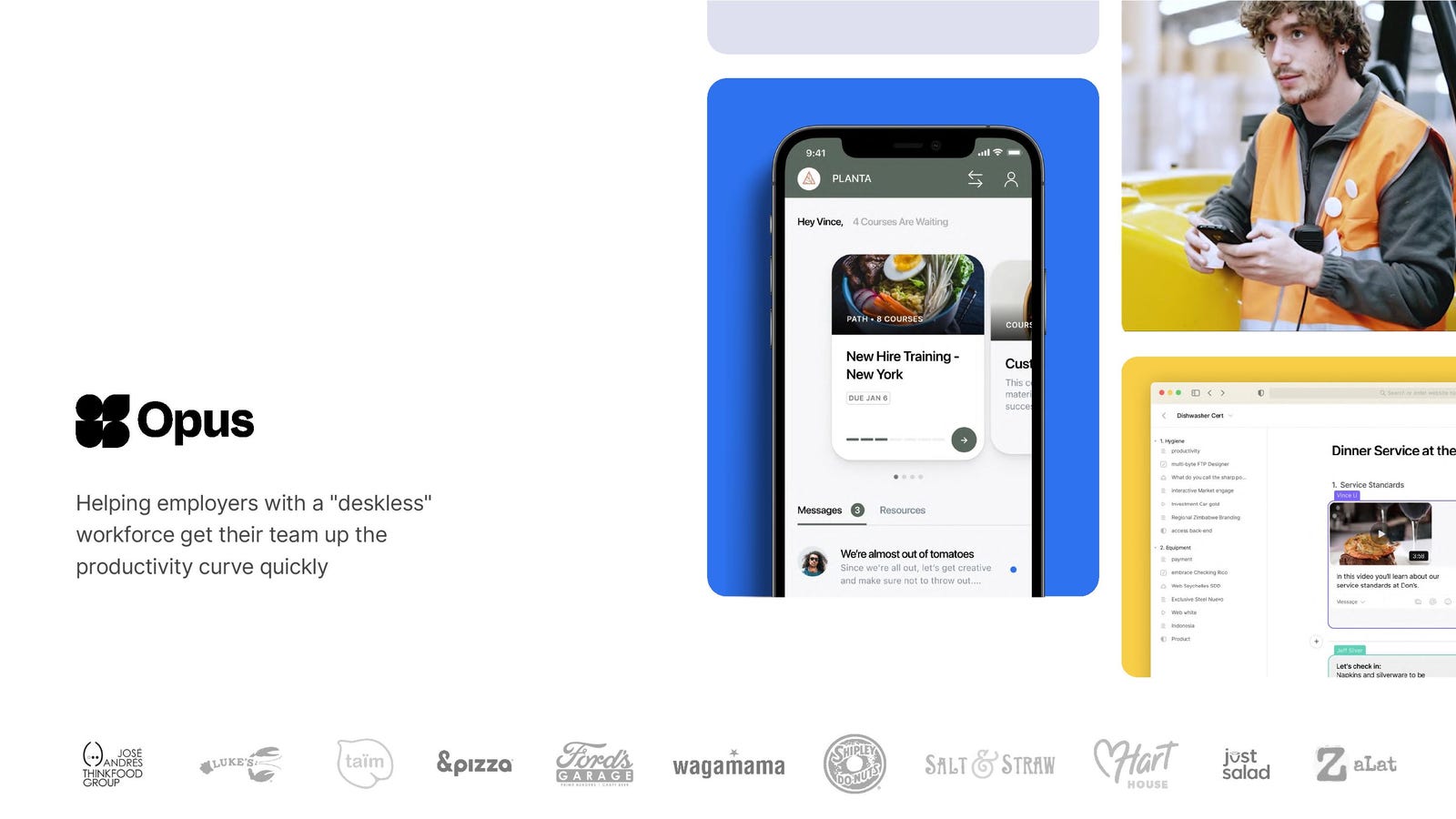
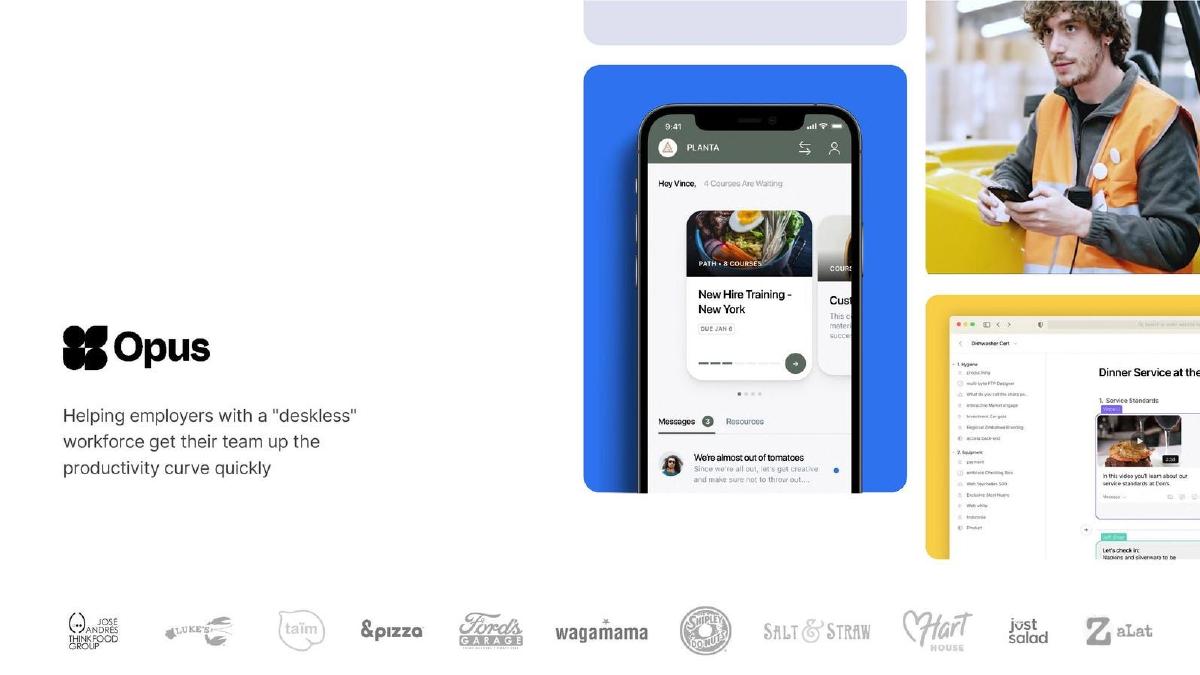
The cover slide does more than just state the company name. It provides a clear value proposition: "Helping employers with a 'deskless' workforce get their team up the productivity curve quickly." By putting 'deskless' in quotes, they immediately signal their niche. The bottom of the slide is anchored by a high-density row of logos including Wagamama, Salt & Straw, and Just Salad. This establishes immediate credibility in the foodservice sector before the investor even turns the page.
Slide 2: Defining the Massive 'Deskless' Problem
Slide 2 uses a stark, high-contrast layout to present a single, powerful statistic: "110 Million US workers don't sit at a desk all day." They clarify that this represents 70% of the American workforce. The use of diverse imagery—a construction worker, a chef, a retail team—reinforces that while they may be starting in food, the problem is universal across the frontline economy.
Slide 3: Meet Opus - The Product Reveal
Slide 3 introduces the solution with a split-screen view of the interface. It shows a desktop view for content creation ("Dinner Service at the Bar") alongside the mobile experience for the worker. This slide effectively communicates that the platform is a bridge between management (who might use a computer) and the frontline (who use phones). The text is simple: "Opus helps companies with a large deskless workforce effectively train and engage their people."
Slide 4: The Macro Economic Case
Slide 4 takes a sophisticated turn by citing the National Bureau of Economic Research. It compares output and tenure during the 2008 recession to argue that "Demand is only expected to increase." The right side of the slide delivers the 'Why Opus?' punchline: "Opus lowers training labor by 60%." This is a critical ROI metric for Seed investors. It also notes their target personas: COOs, CFOs, and CTOs, showing they understand the enterprise buying committee.
Slide 5: Market Size and Value Creation
Market slides are often inflated, but Opus attempts to ground theirs in labor costs. They cite $2.5 Trillion in annual frontline wages. From there, they estimate $250 Billion in economic value created, leading to a $50 Billion top-down TAM. By framing the TAM as a fraction of the total wages they are optimizing, the $50B figure feels more earned than a generic industry report number.
Slide 6: Feature Deep-Dive for Managers
Slide 6 focuses on the 'Breathless Manager.' It highlights four specific mobile features: a mobile app for managers, auto-translated video messaging (critical for multilingual workforces), verification for hands-on skills, and employee tracking. The inclusion of a 5-point scale for "How well did Walter do?" shows the platform moves beyond simple multiple-choice quizzes into actual performance management.
Slide 7: Speed of Implementation
One of the biggest hurdles in HR tech is the time it takes to build content. Slide 7 addresses this head-on with "Ready-made templates." The slide is visually busy, filled with tiles for courses like "Pest Control Basics," "De-escalation Training," and "Food Safety Fundamentals." A quote from the COO of Naya Mediterranean adds weight: "I do it from my car." This emphasizes the 'low-friction' nature of the tool.
Slide 8: Go-To-Market Strategy
Slide 8 presents a donut chart showing a diversified GTM strategy. It isn't just cold calling; the leads come from Outbound, Inbound (Social Led), Referral - Manager, and Referral - Channel. They include a screenshot of a LinkedIn message from a prospect, which serves as anecdotal evidence that their 'Social Led' inbound strategy is actually generating high-intent conversations.
Slide 9: The Multi-Vertical Vision
This is the 'billion-dollar' slide. While the previous slides focused on food, Slide 9 maps out the expansion into Logistics, Manufacturing, Retail, Construction, and Healthcare. For each vertical, they list the number of workers and the potential ARR. Healthcare is the largest prize at $1.1B ARR for 20.8M workers. This tells investors that Opus isn't just a 'restaurant app,' but a horizontal platform for the frontline.
Slide 10: The Ask
The final slide in this selection is the capital request. They state a range of "$6-8M" for product development and GTM acceleration. The simplicity of this slide—dark green background with centered white text—ensures the focus remains entirely on the number and the intended use of funds. As reported by Business Insider, they closed at $6.8M, landing squarely in their target zone.
What Works in the Opus Deck
Mobile-First Visuals: Every product shot is framed within a mobile device or shows a worker in their natural environment. This reinforces the 'deskless' theme better than words ever could. Granular Vertical Expansion: Instead of saying "we will expand to other industries," Slide 9 provides specific worker counts and ARR targets for five distinct sectors. This shows a level of planning that gives investors confidence in the scale. Social Proof Integration: The deck doesn't wait for a 'Customers' slide at the end. It uses logos on the cover and quotes from COOs and CEOs throughout the narrative to validate the product's utility in real-time.
What is Missing from the Opus Deck
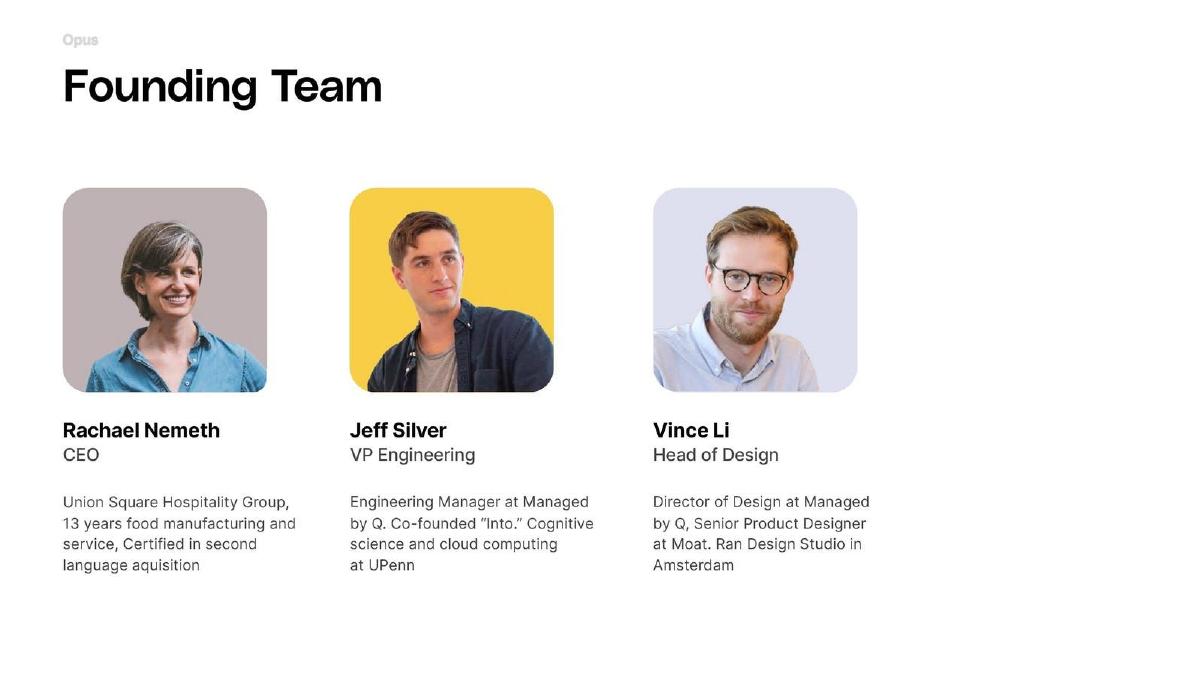
The Team Slide: In the provided 10-slide selection, there is no mention of the founders' backgrounds. For a Seed round, the 'Why us?' is usually as important as the 'Why now?'. Unit Economics: While they mention lowering labor costs by 60%, the deck lacks data on Customer Acquisition Cost (CAC), Lifetime Value (LTV), or specific pricing tiers. Competitive Landscape: There is no mention of existing players like Axonify, Beekeeper, or traditional LMS giants like Workday. Investors need to know how Opus wins against incumbents who are also trying to move into mobile.
Founder Takeaways: What to Copy
The 'Problem' Framing: Don't just say your market is big; define it by the people it serves. Opus defining 70% of the workforce as 'deskless' creates an immediate 'us vs. them' narrative against traditional software. Use Anecdotal Evidence: The screenshot of the LinkedIn message on Slide 8 is a low-cost, high-impact way to prove GTM traction. It feels more authentic than a generic growth chart. Verticalized TAM: If you are starting in one niche but plan to expand, copy the format of Slide 9. Breaking down the TAM by vertical with specific worker counts makes a massive number feel achievable through a series of logical steps.
Frequently asked questions
- What is the primary problem Opus is solving?
- Opus targets the 'deskless' workforce—the 70% of American workers who don't work at a desk. Traditional training software is often built for desktop users, creating friction for frontline industries. Opus provides a mobile-first platform that allows managers to create, translate, and verify training content quickly, reducing the labor required for onboarding by a reported 60%.
- How does Opus calculate its Total Addressable Market (TAM)?
- Opus uses a top-down approach on Slide 5, starting with $2.5 trillion in annual frontline wages. They estimate the economic value created by their solution at $250 billion, ultimately landing on a top-down TAM of $50 billion. This indicates they view their market not just as 'software spend' but as a percentage of the labor value they optimize.
- What industries does Opus currently serve and plan to enter?
- The deck shows current traction in the foodservice and hospitality sectors (Slide 1). Slide 9 outlines a vertical expansion strategy into Logistics ($259M ARR potential), Manufacturing ($581M ARR), Retail ($753M ARR), Construction ($338M ARR), and Healthcare ($1.1B ARR), totaling millions of workers across these segments.
- What are the key product features highlighted in the deck?
- The deck emphasizes mobile accessibility for both managers and employees. Key features include auto-translated video messaging to bridge language gaps, 'Ready-made templates' for fast course creation, verification tools for hands-on skills, and employee tracking to monitor open rates and completion (Slides 6 and 7).
- How did Opus justify their $6.8M Seed round ask?
- On Slide 10, Opus set a target range of $6-8M. They justified this by stating the funds would be used for two primary pillars: expanding product development and accelerating their 'go-to-market engine.' The publisher-reported figure of $6.8M falls directly within this stated range, showing strong alignment between their pitch and the final investment.