Optera's Series A deck, used to raise $12M in 2024 as reported by Business Insider, is exceptionally concise at only seven slides. It eschews traditional deck elements like a dedicated team slide or detailed financial projections in favor of a high-level narrative about the institutionalization of carbon accounting. The deck positions carbon management as a core finance function, driven by looming SEC and EU regulations. Its strongest asset is Slide 6, which reveals that despite being a relatively small team, they have already captured 17 Fortune 500 clients and track $187B+ in supply chain s…
Key takeaways
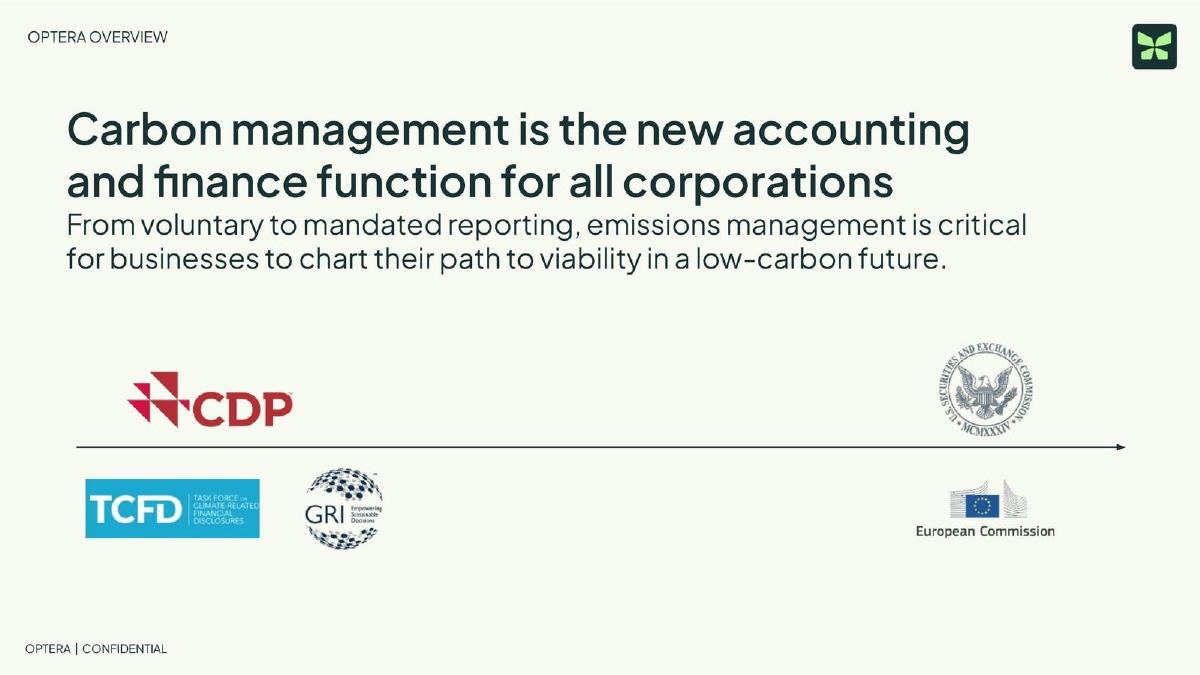
- The deck positions carbon management as the 'new accounting and finance function,' moving from voluntary to mandated reporting (Slide 2).
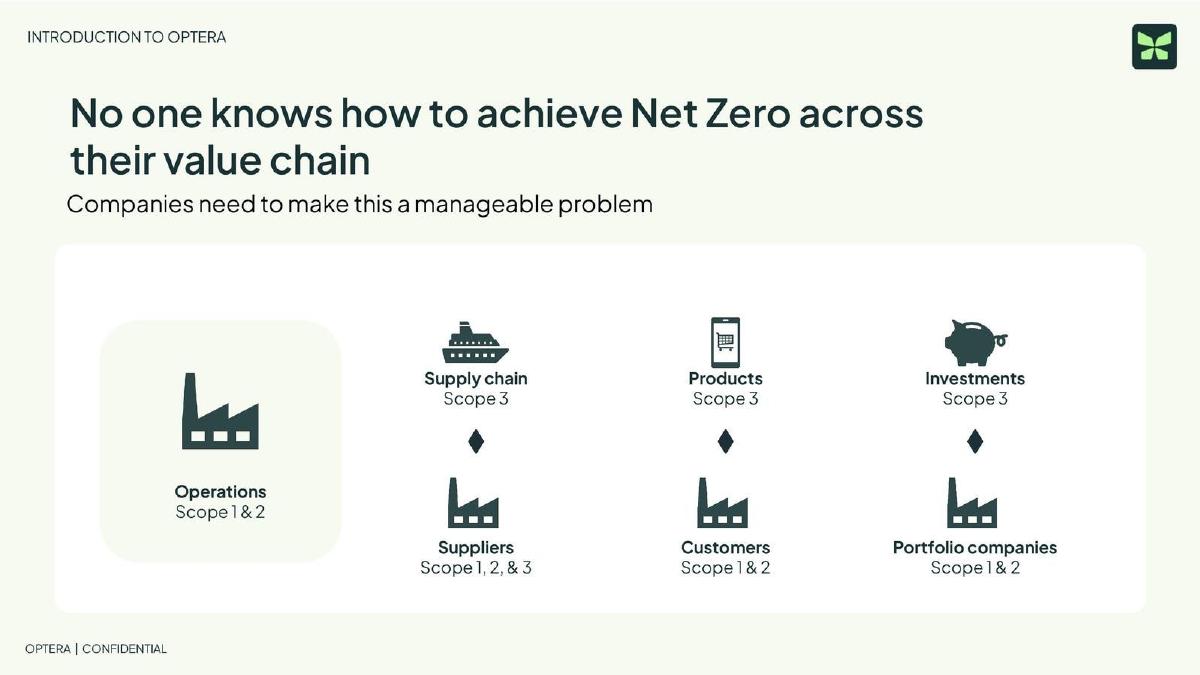
- Optera highlights a specific focus on Scope 3 emissions, identifying this as the 'unmanageable' problem for global value chains (Slide 4).
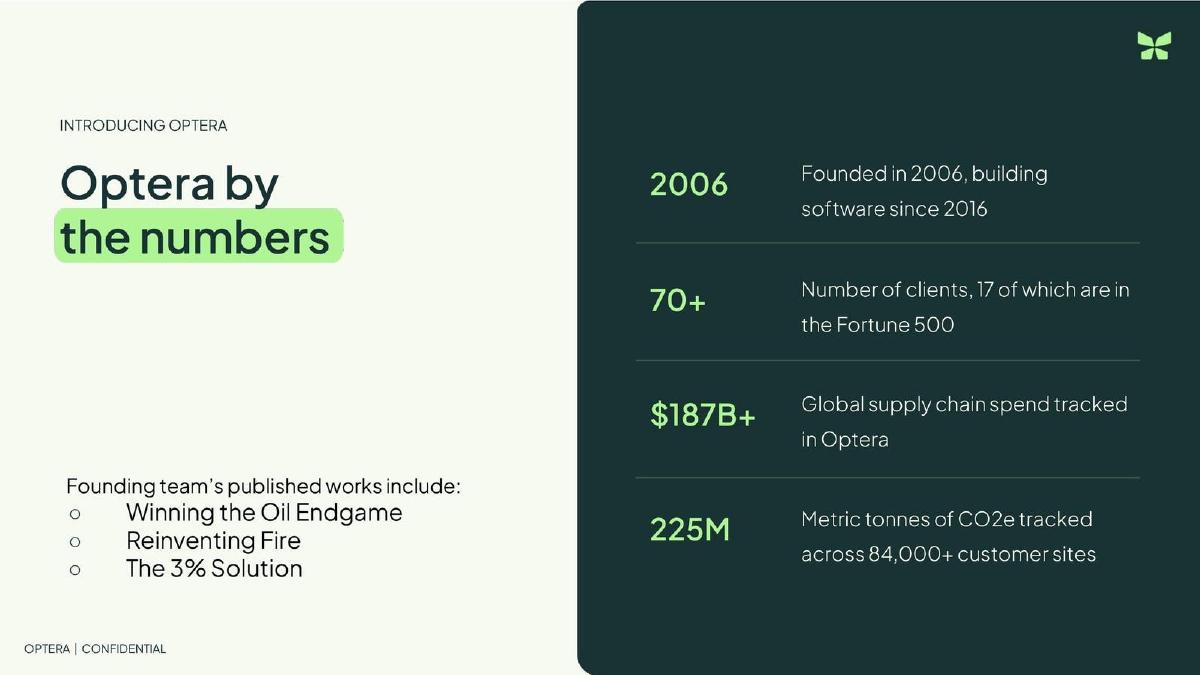
- The company demonstrates significant enterprise validation with 70+ clients, including 17 of the Fortune 500 (Slide 6).
- Traction is quantified by scale: $187B+ in global supply chain spend and 225M metric tonnes of CO2e tracked (Slide 6).
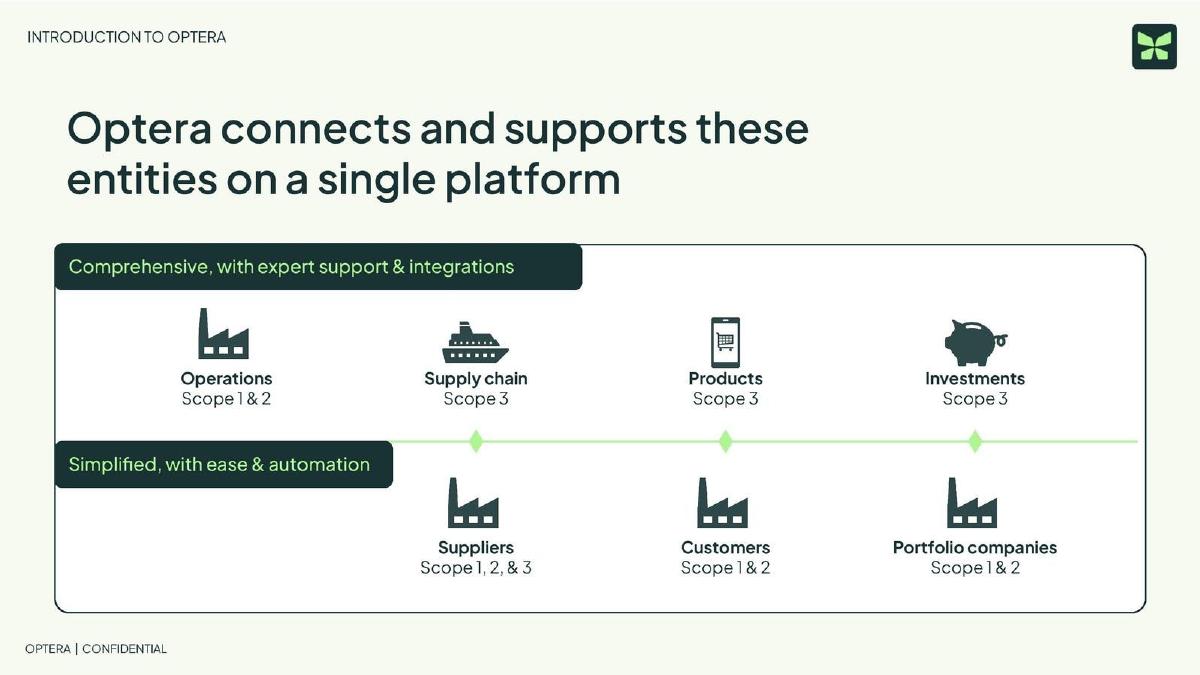
- The platform is presented as a 'single platform' that connects operations, supply chains, products, and investments (Slide 5).
- The deck identifies regulatory pressure from the SEC and European Commission as primary market drivers for both public and private companies (Slide 3).
- The vision is explicitly tied to a 2050 timeline, aiming to help the world's largest companies achieve net-zero (Slide 7).
- The founding team's credibility is established through published works rather than traditional resumes, citing titles like 'Winning the Oil Endgame' (Slide 6).
The 7-Slide Series A: Brevity as a Power Move
Optera’s Series A deck is a masterclass in narrative efficiency. In an industry—ESG and carbon accounting—often bogged down by technical jargon and vague promises of 'doing good,' Optera presents a crisp, business-first case. As reported by Business Insider, this deck helped secure $12M in 2024. The core thesis is simple: carbon management is no longer a PR exercise; it is a mandatory finance function. By focusing on the 'why now' (regulation) and the 'who' (Fortune 500 clients), Optera bypasses the need for a 20-slide deck.
Slide 1: The Introduction
The title slide is minimalist, featuring the Optera logo and the tagline: 'ESG & carbon management software for global companies.' It sets the stage for an enterprise-focused pitch. The use of the word 'global' is intentional, signaling that the company is built for the complexity of multinational corporations rather than SMEs.
Slide 2: The Macro Shift
Slide 2 establishes the 'Why Now.' It uses a timeline to show the evolution of carbon management. On the left, we see voluntary frameworks like CDP, TCFD, and GRI. On the right, the timeline points toward the SEC and the European Commission. The headline, 'Carbon management is the new accounting and finance function for all corporations,' is the most important sentence in the deck. It moves the product from the 'sustainability budget' to the 'finance budget,' which is significantly larger and less discretionary.
Slide 3: Universal Pressure
This slide breaks down the market into Public and Private companies. For public companies, the drivers are regulation, market valuations, and cost of capital. For private companies, the driver is 'supply chain pressure.' This is a sophisticated insight: even if a private company isn't regulated, their public company customers are, and those customers will demand carbon data. This creates a 'cascading' effect that expands Optera's Total Addressable Market (TAM) beyond just the Fortune 500.
Slide 4: The Scope 3 Problem
Slide 4 identifies the specific pain point: Scope 3 emissions. The slide notes that 'No one knows how to achieve Net Zero across their value chain.' It visually separates 'Operations (Scope 1 & 2)'—which is relatively easy to track—from the complex web of supply chains, products, and investments that make up Scope 3. By labeling this a 'manageable problem,' Optera positions itself as the solution to the hardest part of the carbon equation.
Slide 5: The Single Platform Solution
Slide 5 is the product slide, though it shows a conceptual architecture rather than software screenshots. It illustrates how Optera connects various entities (suppliers, customers, portfolio companies) on a single platform. The two value propositions are 'Comprehensive' (expert support and integrations) and 'Simplified' (ease and automation). This slide promises to turn the chaos of Slide 4 into a streamlined workflow.
Slide 6: Optera by the Numbers
This is the 'money slide.' It provides four key metrics that prove the company has moved past the seed stage:
2006: Founded in 2006, building software since 2016. This shows longevity and deep domain expertise. · 70+: Number of clients, 17 of which are in the Fortune 500 . This is an incredible ratio for a Series A company and serves as the ultimate social proof. · $187B+: Global supply chain spend tracked. This metric speaks to the scale of the data Optera is processing. · 225M: Metric tonnes of CO2e tracked across 84,000+ customer sites.
The slide also lists the founding team's published works, including 'Winning the Oil Endgame' and 'Reinventing Fire.' This establishes the founders as world-class experts in the energy transition, which is often more valuable to investors than a standard SaaS background.
Slide 7: The Vision
The final slide is a vision statement: 'Optera is used by tens of thousands of the world’s largest companies (>50% of global corporate emissions) to help them achieve net-zero emissions by 2050.' It is a bold, long-term goal that aligns the company's success with the global climate agenda. The phrase 'Progress starts here' serves as a call to action.
What Works in the Optera Deck
Regulatory Urgency: The deck does a fantastic job of framing carbon accounting as an inevitability. By citing the SEC and the European Commission, they make the purchase of their software seem like a compliance necessity rather than a choice. This reduces the perceived sales cycle risk for investors.
Enterprise Validation: Having 17 Fortune 500 clients is the strongest possible signal for a Series A company. It tells investors that the product can handle the security, integration, and scale requirements of the world's largest organizations. The deck wisely highlights this front and center on Slide 6.
Focus on Scope 3: By identifying Scope 3 as the 'unmanageable' problem, Optera carves out a niche. Many carbon accounting tools are 'Scope 1 & 2 lite.' Optera’s focus on the supply chain and investments suggests a deeper, more 'sticky' technical moat.
What is Missing from the Optera Deck
The 'Ask': There is no slide detailing how much money they are raising or what they plan to do with it. While we know from publisher reports that they raised $12M, a standard pitch deck usually includes a 'Use of Funds' slide to show how the capital will accelerate growth (e.g., hiring, sales expansion).
Competitive Landscape: The carbon accounting space is incredibly crowded, with players like Watershed, Persefoni, and Sweep. Optera does not address how they win against these well-funded competitors. They rely on their Fortune 500 list to imply superiority, but a direct comparison is missing.
Unit Economics and Financials: There is no mention of Annual Recurring Revenue (ARR), Churn, or Customer Acquisition Cost (CAC). For a Series A, investors typically want to see the 'machine' of the business—how much it costs to acquire these Fortune 500 clients and how much they pay over time.
Product Screenshots: The deck is entirely conceptual. There are no images of the dashboard, the data visualizations, or the reporting interface. While the narrative is strong, seeing the actual 'single platform' would help ground the pitch in reality.
Founder's Guide: What to Copy
The 'New Accounting' Narrative: If you are building in a new category, copy Optera’s approach of anchoring your product to an existing, essential business function. By calling carbon management 'the new accounting,' they instantly communicate the product's importance to a CFO.
Proxy Metrics for Scale: If your revenue is still growing but your platform handles massive amounts of data, use proxy metrics like Optera’s '$187B+ spend tracked.' It makes the company feel larger and more institutional than just a revenue figure might suggest.
Expertise over Resumes: If your team has deep academic or industry expertise, list your 'published works' or significant projects rather than just a list of previous employers. It positions you as a thought leader who understands the 'why' behind the market, not just the 'how' of the software.
Clean, Minimalist Design: Optera uses a dark, professional color palette and avoids cluttered slides. This design choice mirrors the 'enterprise-grade' nature of their product. Founders should avoid over-designing slides and focus on one clear message per page.
Frequently asked questions
- Why is the Optera deck so short at only 7 slides?
- For a Series A, a 7-slide deck usually suggests a high level of pre-existing investor interest or a 'teaser' format used to secure the first meeting. Optera relies on massive traction metrics—like having 17 Fortune 500 clients—to do the heavy lifting, assuming that the strength of the customer list proves the product-market fit without needing 20 slides of explanation.
- How does Optera differentiate itself in the crowded ESG software market?
- According to Slide 4 and 5, Optera differentiates by tackling the complexity of Scope 3 emissions across the entire value chain. While many competitors focus on Scope 1 and 2 (direct operations), Optera emphasizes connecting suppliers, customers, and portfolio companies on a single platform to solve the 'unmanageable' problem of indirect emissions.
- What regulatory drivers does the deck cite as catalysts?
- Slide 2 and 3 explicitly mention the SEC (U.S. Securities and Exchange Commission) and the European Commission. The deck argues that carbon reporting is transitioning from a voluntary ESG 'nice-to-have' to a mandated financial requirement, which increases the urgency for enterprise-grade accounting software.
- Is there a team slide in the Optera deck?
- Technically, no. There is no slide with headshots or bios. Instead, Slide 6 mentions the 'Founding team’s published works,' citing three specific books. This approach sells the team as thought leaders and subject matter experts in the energy transition rather than just software executives.
- What is missing from this deck that a typical Series A investor would want to see?
- The deck lacks a competitive matrix, a detailed go-to-market strategy, and a 'Use of Funds' slide. It also omits specific revenue figures or growth rates, though it provides proxy metrics like 'spend tracked.' Most Series A investors would require these details during the due diligence phase following this initial presentation.