Concept Ventures raised £50M in 2022 to establish what they claim is the largest dedicated UK pre-seed fund. Their 12-slide deck is a masterclass in positioning, moving away from traditional financial jargon to focus on empathy and accessibility. By identifying specific pain points in the VC industry—such as 'opaque promises' and 'sheep-like' behavior—they position themselves as the antithesis of the status quo. The deck highlights a team with experience at high-growth companies like Uber and Revolut, and backs their 'approachability' with a 100% founder approval rating. While the deck is lig…
Key takeaways
- Concept Ventures identifies as the largest dedicated UK Pre-Seed Fund (Slide 2).
- The fund targets founders reshaping the 'Work, Play and Learn' sectors (Slide 2).
- The team leverages experience from major tech entities including Uber, Y Combinator, and Revolut (Slide 4).
- They claim founders on their cap table are 2x more likely to raise a subsequent seed round (Slide 6).
- The firm emphasizes transparency through an open-sourced term sheet and a 4-step investment process (Slide 7).
- Over 50% of their 2021 investments originated from cold inbound or outbound channels (Slide 8).
- The fund offers cheques up to £600k for 8-12% equity stakes (Slide 10).
- Success stories include portfolio companies that have progressed to rounds led by Local Globe and Highland Europe (Slide 9).
The Narrative of the 'Anti-VC' VC
The Concept Ventures deck is a significant departure from the data-heavy, IRR-focused presentations typical of venture capital firms. Instead, it reads like a manifesto for founders. In an era where pre-seed capital is becoming increasingly commoditized, Concept Ventures uses this 12-slide deck to sell a specific culture and a promise of partnership. By raising £50M with this narrative, they proved that LPs (Limited Partners) and founders alike are buying into the 'founder-friendly' brand as a competitive moat.
Slide 1: Title and Mission
The deck opens with a minimalist cover slide featuring the company logo and the tagline: "A pre-seed fund built for you." The use of the word "you" immediately establishes the founder as the protagonist of the story. The visual style is modern and abstract, signaling a tech-forward approach.
Slide 2: Identity and Scope
Slide 2 answers the "Who Are We" question. It defines Concept Ventures as "the largest dedicated UK Pre-Seed Fund." This is a bold claim of market leadership. They also define their investment thesis here, focusing on founders "reshaping how we Work, Play and Learn." This broad but distinct thematic focus allows them to cover EdTech, Future of Work, and Consumer sectors without appearing unfocused.
Slide 3: The Problem Statement
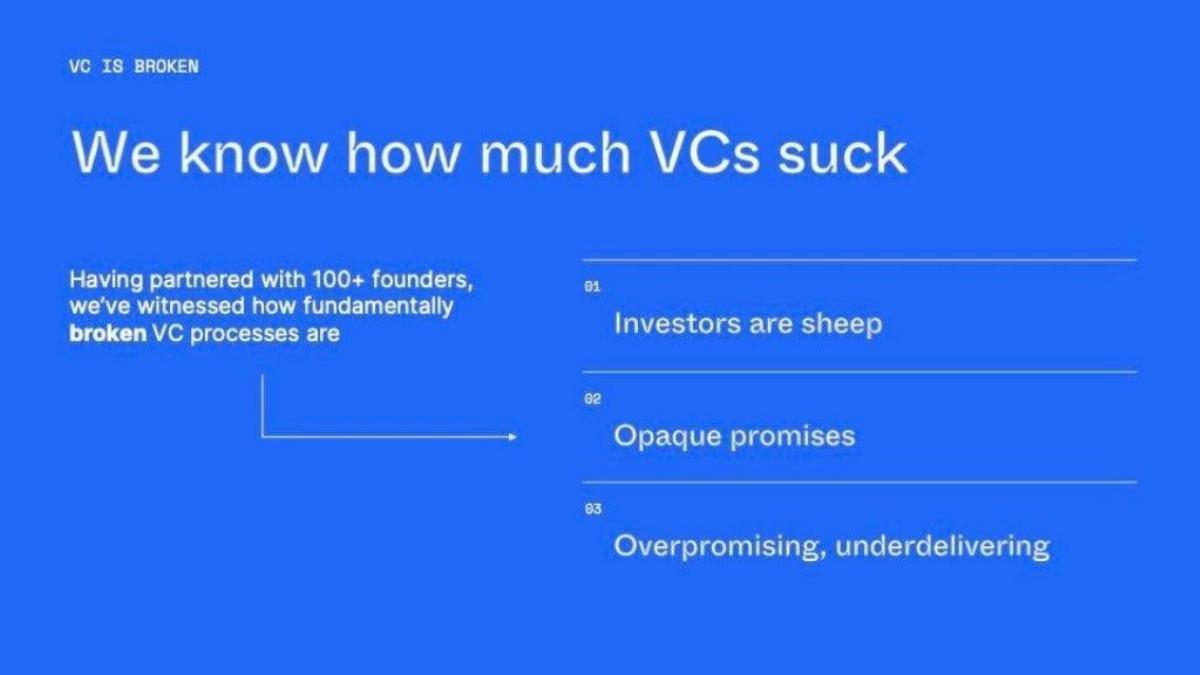
In a rare move for a VC deck, Slide 3 uses the headline "We know how much VCs suck." This is a high-conviction attempt to build rapport through shared frustration. They list three specific industry failures: 1) Investors are sheep, 2) Opaque promises, and 3) Overpromising, underdelivering. By acknowledging these "broken" processes, they set the stage for their own solution. They cite experience partnering with 100+ founders as the source of this insight.
Slide 4: The Team
The "Why Are We Here" slide focuses on the human capital. Rather than listing academic credentials, they use high-profile logos to establish credibility. The slide features logos for Uber, Y Combinator, Adobe, Revolut, Improbable, and Gumtree. This suggests a team that has seen the inner workings of both world-class startups and the world's most famous accelerator.
Slide 5: Philosophy
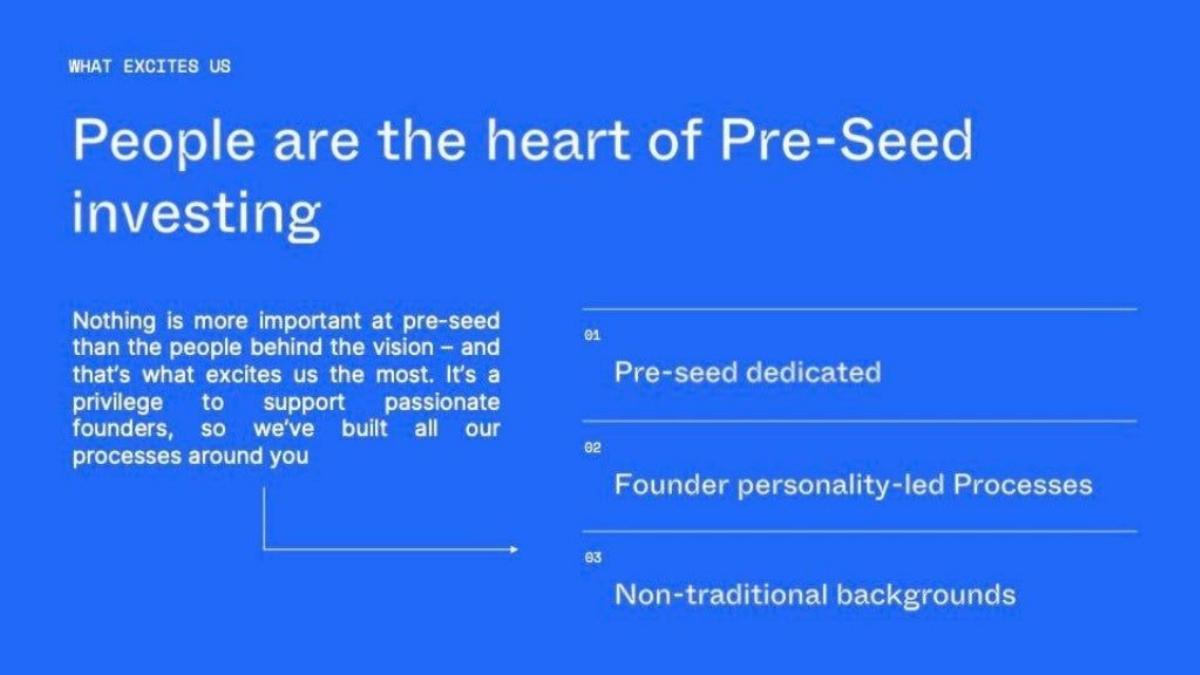
Slide 5 reinforces the "People-first" mantra. It highlights three pillars: Pre-seed dedicated, Founder personality-led Processes, and Non-traditional backgrounds. This is a direct response to the "sheep" criticism on Slide 3, suggesting they look for unique individuals rather than following the herd.
Slide 6: Value Proposition
This slide moves from philosophy to tangible benefits. It claims that founders with Concept on their cap table are "2X more likely to raise a next round." It also mentions that their functional experts have "been there before" (citing a £34bn figure, though the context of this figure—whether it is combined exit value or AUM—is not explicitly detailed on the slide). Finally, they promise connections to "Tier-1" investors for the next phase of growth.
Slide 7: Operational Transparency
To combat the "opaque promises" mentioned earlier, Slide 7 outlines their commitment to transparency. They mention a "4-step" investment process and "24/7" support. Most notably, they state they have "open-sourced everything - inc. our term sheet," which is a significant trust-building move for pre-seed founders who may be navigating their first legal documents.
Slide 8: Accessibility and Track Record
Slide 8 addresses the "exclusive" nature of VC. They claim that ">50%" of their 2021 investments came from "cold-inbound/outbound channels," challenging the notion that you need a warm intro to get funded. They also claim a "100% Founder Approval Rating" and reiterate that the team has "founded, incubated & invested in over 60 early-stage companies."
Slide 9: Portfolio Success
The "Success Stories" slide provides social proof. It displays logos for companies like Eleven Labs, Screenloop, and Juno. It also highlights specific graduation milestones: Condense x Local Globe (Seed), Reachdesk x Highland Europe (Series B), and Cliff AI x Gtmhub (Acquired). This proves the fund's ability to pick winners that attract larger, follow-on institutional capital.
Slide 10: The Investment Terms
Slide 10 is the "Ask" in reverse. It clearly states their parameters: "up to £600K cheques for 8-12%" equity. They emphasize flexibility, stating they are happy to "lead, co-lead or follow." This clarity is highly efficient, as it self-selects founders who fit these specific criteria.
Slide 11: Regulatory Compliance
Slide 11 is a standard legal disclaimer. It notes that Concept VC Limited is registered in England & Wales and is "authorised and regulated by the FCA in the United Kingdom, Firm Reference Number 939163." This adds a layer of institutional professionalism to the otherwise disruptive tone of the deck.
Slide 12: Resource Promotion
The final slide is an external promotional slide for a pitch deck library, which was likely added by the hosting platform rather than being part of the original fund-raising presentation to LPs.
What Concept Ventures Does Well
The deck is exceptionally strong in its positioning . By identifying as the "largest dedicated UK pre-seed fund," they claim a specific niche that distinguishes them from multi-stage firms where pre-seed might be an afterthought. Their use of empathy as a sales tool —specifically calling out why VCs "suck"—is a powerful way to build a brand that founders want to work with. Furthermore, the clarity of terms on Slide 10 (cheque size and equity range) is a model for efficiency in the venture industry.
What Is Missing from the Deck
Because this deck is founder-facing, it lacks the deep financial metrics that an LP-facing deck would require. There is no mention of Fund I performance (DPI, TVPI), no detailed breakdown of the management fee structure, and no specific geographic or sector-based market sizing data. Additionally, while they mention a "£34bn" figure on Slide 6, the lack of attribution or specific definition for this number makes it a "vanity metric" that would require significant due diligence to verify.
What Other Founders (and VCs) Should Copy
1. The "Anti-Competitor" Slide: Instead of a standard 2x2 matrix, Concept Ventures uses Slide 3 to list the failures of their industry. This is a much more engaging way to explain why your company needs to exist. 2. Radical Transparency: Mentioning an open-sourced term sheet (Slide 7) and cold-outbound statistics (Slide 8) are excellent ways to prove you are actually different, rather than just saying it. 3. The Graduation Slide: Slide 9 doesn't just show logos; it shows who the next investors were. For a pre-seed fund, your success is measured by who follows you. Founders should similarly show the caliber of their partners and customers as a proxy for their own quality.
Frequently asked questions
- What is the primary investment focus of Concept Ventures?
- According to slide 2 and slide 10, Concept Ventures focuses on UK-centric founders who are reshaping how society works, plays, and learns. They are strictly a pre-seed fund, offering cheques up to £600k in exchange for 8-12% equity, and they are willing to lead, co-lead, or follow in these rounds.
- How does the fund differentiate itself from other VCs?
- The deck positions the fund as the 'fix' for a broken VC industry. On slide 3, they criticize the industry for having opaque promises and 'sheep' mentalities. They differentiate through transparency (open-sourced term sheets), accessibility (50%+ cold outreach investments), and a 100% founder approval rating as stated on slide 8.
- What kind of support can founders expect post-investment?
- Slide 6 highlights 'Focused Value-Add,' making the founder's first 12-18 months the fund's top priority. They provide access to functional experts who have collectively been involved with £34bn in value and offer connections to Tier-1 investors for subsequent rounds.
- What is the team's background?
- Slide 4 showcases a team with diverse experience from Tier-1 tech companies and accelerators. Logos displayed include Uber, Y Combinator, Adobe, Revolut, Improbable, and Gumtree. Slide 8 further notes that as a team, they have founded, incubated, or invested in over 60 early-stage companies.
- What are some notable companies in their portfolio?
- Slide 9 lists several success stories, including Eleven Labs, Screenloop, and Juno. It specifically highlights 'beyond pre-seed' success such as Condense (partnered with Local Globe), Reachdesk (partnered with Highland Europe), and Cliff AI, which was acquired by Gtmhub.