ConcertWithMe’s 2014 seed deck is a study in contrast. On one hand, it presents undeniable traction: 180,000 monthly fans and 1,400% organic growth over 60 weeks. On the other, it abandons almost all corporate norms, featuring a slide of a founder covered in cash and flour, and a closing slide with a cartoon character gouging its eyes out. The core value proposition—automating concert promotion for artists to drive ticket sales—is clearly articulated through a simple flow chart and real-world examples of social media assets. However, the total absence of team backgrounds, a specific funding a…
Key takeaways
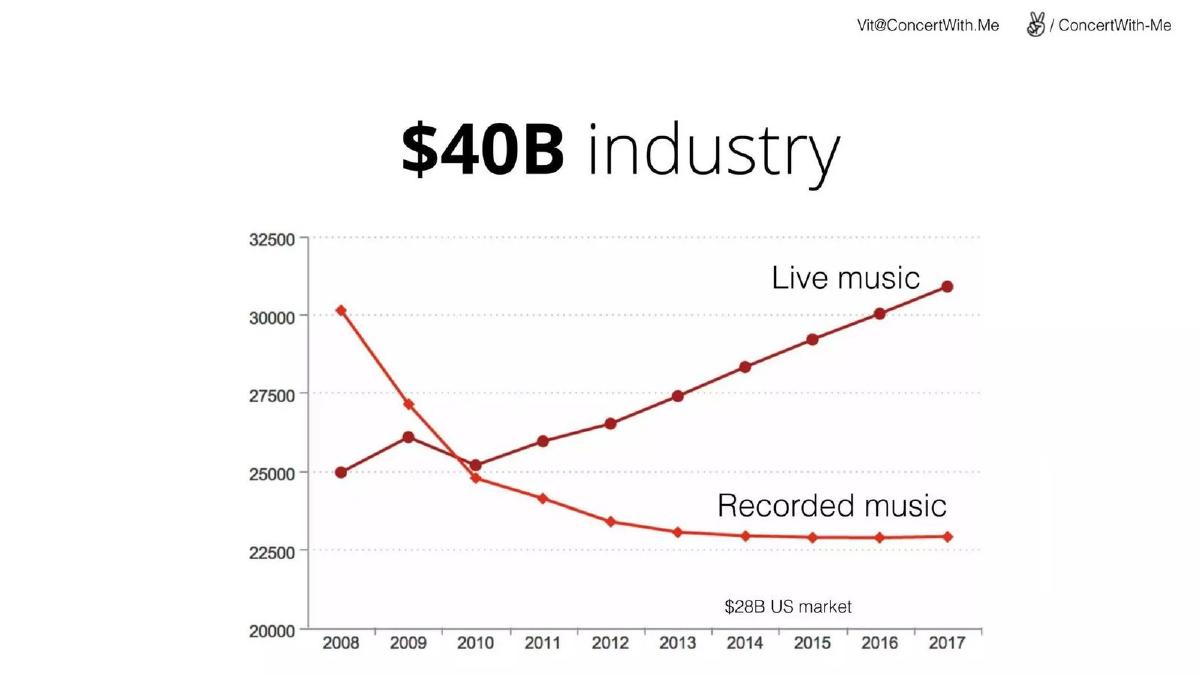
- The deck identifies a $40B industry where live music revenue is trending upward while recorded music declines (Slide 2).
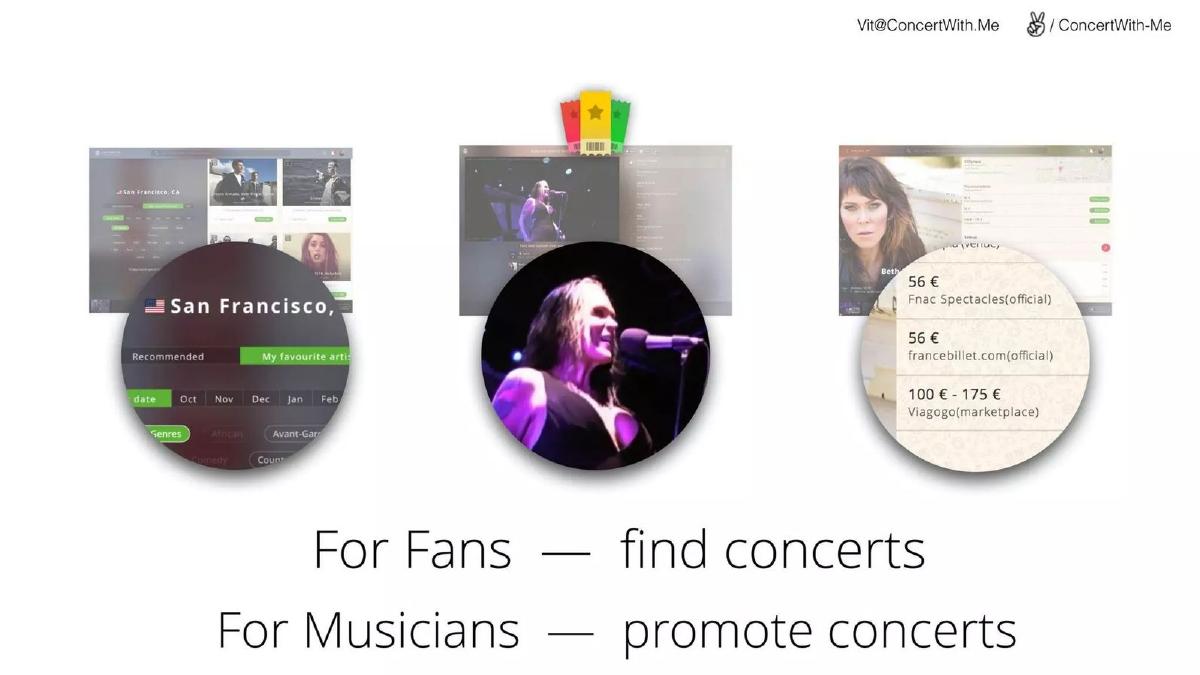
- It positions the product as a bridge between fans finding concerts and musicians promoting them (Slide 4).
- The platform claims to be 100% automated and free for artists, generating assets like images, GIFs, and tweet-setlists (Slide 7).
- A 'Zenefits for concerts' analogy is used to explain the business model of driving sales through automated campaigns (Slide 8).
- Traction is the deck's strongest point, citing 180,000 monthly fans and 1,400% organic growth (Slide 10).
- Conversion metrics show 17,000 buyers were sent to ticketing websites in a single month (Slide 11).
- The company generated $10,000 in direct ticket sales in its first two weeks, despite only covering 5% of available events (Slide 12).
- The team slide (Slide 14) contains no names, titles, or professional history, showing only four men in '500 Strong' t-shirts.
The Traction-Heavy, Professionalism-Light Seed Deck
ConcertWithMe’s 2014 seed deck is a fascinating artifact from the 'growth at all costs' era of tech startups. Launched in Europe and later participating in the 500 Startups accelerator, the company used this 15-slide presentation to showcase a product that automated the most tedious parts of music promotion. The deck is characterized by extremely high growth percentages and a visual style that borders on the irreverent. While it succeeds in proving product-market fit through raw numbers, it leaves significant gaps in its business plan and team pedigree.
Slides 1-3: Market Context and Opportunity
The deck opens with a busy title slide (Slide 1) featuring various small icons representing social media, data, and music. The subtitle, "Automated concert promotion," immediately defines the product category. Slide 2 establishes the 'Why Now' by showing a $40B industry in flux. A graph illustrates that while recorded music revenue has been in a steady decline since 2008, live music revenue is on a consistent upward trajectory, reaching a $28B US market. This slide effectively argues that the money in music is now in the event, not the album.
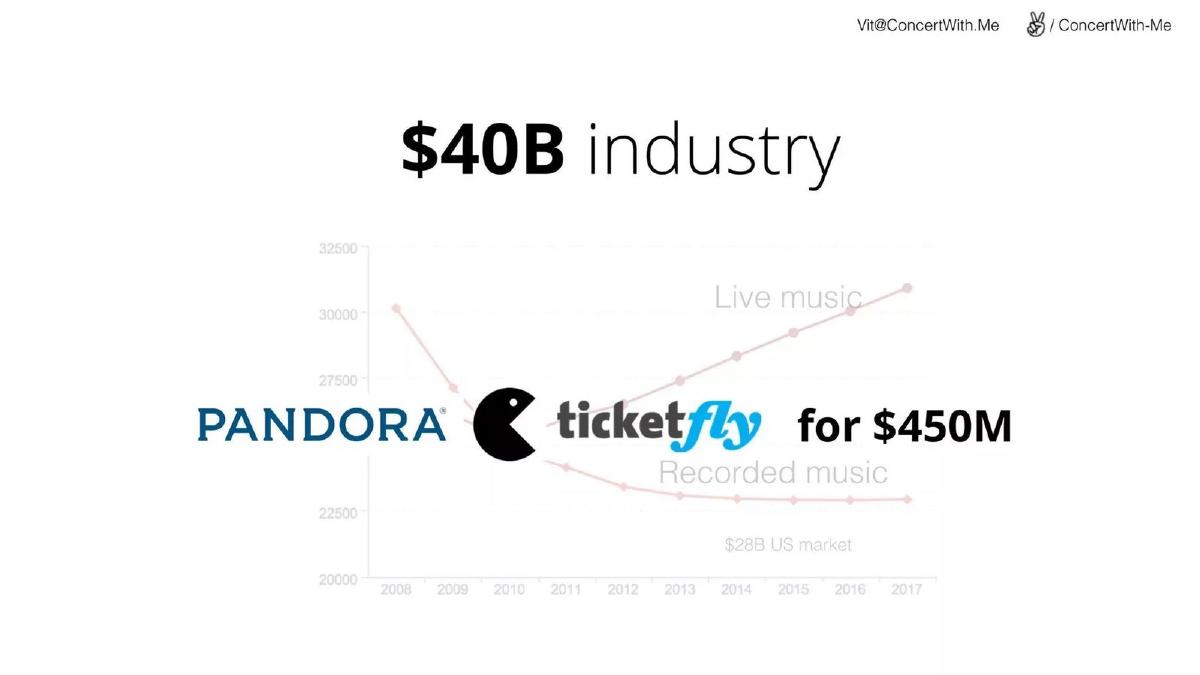
Slide 3 provides a 'validation by proxy' moment. It overlays the news of Pandora acquiring Ticketfly for $450M over the previous market graph. This serves two purposes: it shows that major players are betting on the intersection of music streaming and ticketing, and it establishes a potential exit path for a company like ConcertWithMe.
Slides 4-7: The Product and Competitive Positioning
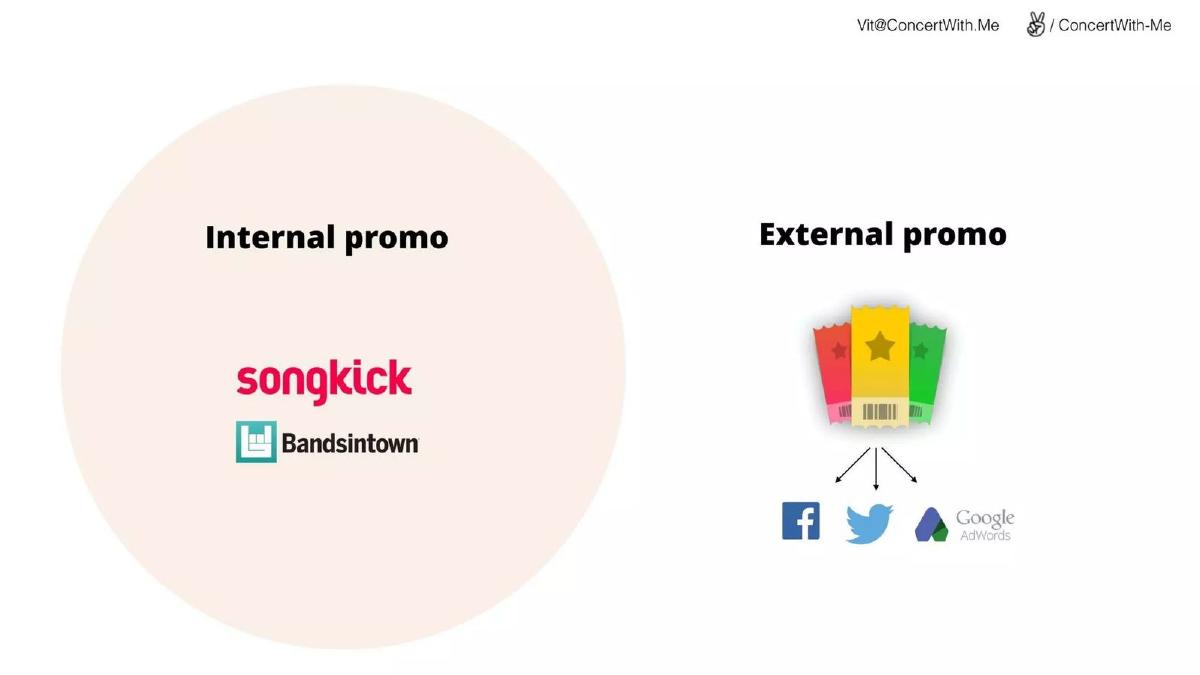
Slide 4 breaks down the dual-sided nature of the platform: "For Fans — find concerts" and "For Musicians — promote concerts." It uses three circular screenshots to show the interface, including a price comparison tool that lists official sellers like Fnac Spectacles alongside marketplaces like Viagogo. Slide 5 attempts to differentiate the product from incumbents. It places Songkick and Bandsintown in a circle labeled "Internal promo," implying they are passive discovery tools. ConcertWithMe is positioned as "External promo," using arrows to show how it pushes data to Facebook, Twitter, and Google AdWords.
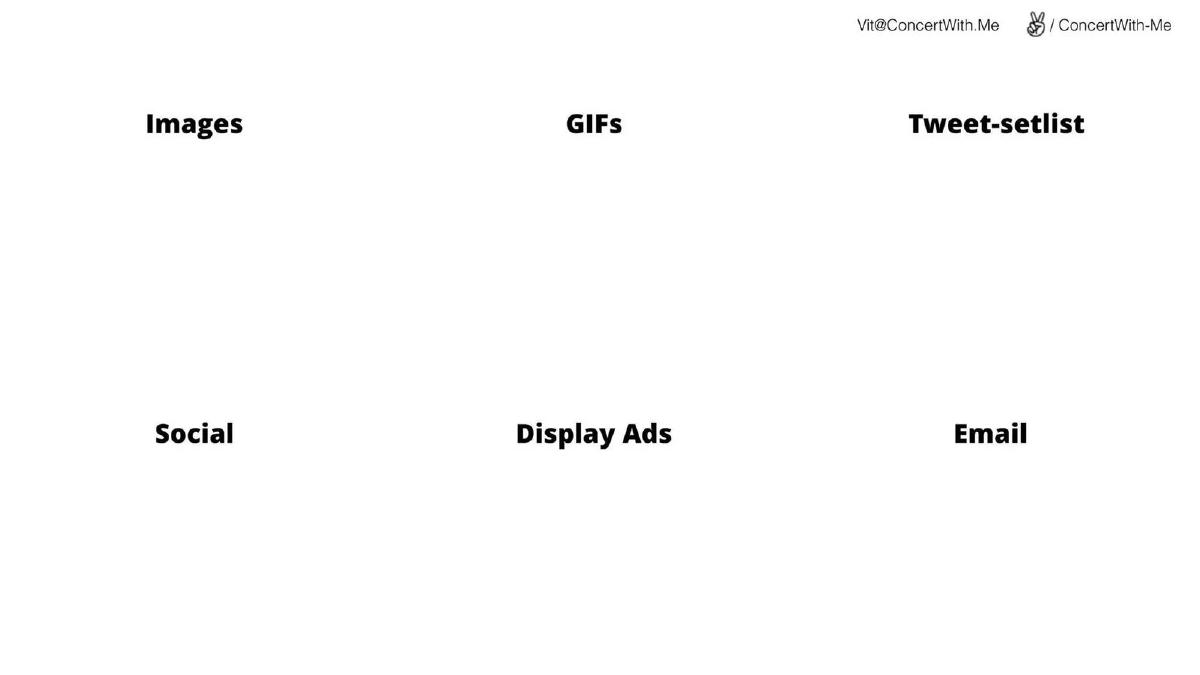
Slides 6 and 7 focus on the output of the automation engine. Slide 6 lists the formats: Images, GIFs, Tweet-setlists, Social, Display Ads, and Email. Slide 7 then shows these in action, claiming the process is "100% automated and free for artist." The visual examples—such as a 'probable setlist' for a Beth Hart concert—demonstrate how the tool creates high-engagement content without manual intervention from a band's marketing team.
Slides 8-12: The Business Model and Traction
Slide 8 uses a popular 2014 trope: the 'X for Y' analogy. By stating "It’s like Zenefits, but for concerts," the founders were likely referencing Zenefits' model of giving away software for free to capture a lucrative downstream transaction (insurance in Zenefits' case, ticket sales here). The flow chart shows bands' social data feeding into the platform, which then targets users with campaigns to drive sales. Slide 9 reinforces the supply side of the marketplace by showing headshots of artists like Ricky Martin, MC Hammer, and Zedd, claiming over 2,000 other bands are on the platform.
The 'meat' of the deck arrives in Slides 10 through 12. Slide 10 reports 180,000 music fans monthly and a staggering 1,400% organic growth over the last 60 weeks. Slide 11 shows the conversion funnel, stating 17,000 buyers were sent to ticketing websites in the last month, representing 4,600% growth. Slide 12 provides a snapshot of direct monetization: $10,000 in direct ticket sales in the first two weeks, noting this was achieved with only 5% of available events. These slides are the strongest part of the deck, providing the 'hard proof' that investors look for at the seed stage.
Slides 13-15: The Team and the 'Crazy' Close
The final section of the deck is where the tone shifts dramatically. Slide 13 features a photo of a man (presumably a founder) lying on a couch covered in stacks of cash and white powder. A caption at the bottom clarifies: "Our first revenue helped us to pay rent in San Francisco. To celebrate it we decided to cook pancakes. My colleague was tired, so he took a nap." The 'flour' on the table and the cash are intended as a joke about startup hustle, but it is a high-risk visual for a professional pitch. Slide 14 shows the team of four in '500 Strong' t-shirts but provides no names, no LinkedIn links, and no prior experience. Slide 15 closes with a bulleted summary (40B market, High demand, Proven model) and a contact email: crazy-russian@concertwith.me , accompanied by a cartoon of Mickey Mouse gouging his eyes out.
What Works in This Deck
Traction is King: The growth metrics on Slides 10 and 11 are undeniable. A 1,400% organic growth rate over 60 weeks suggests a product that users actually want and share. · Clear Value Prop: The deck explains exactly what the product does in the first 30 seconds: it automates the creation of promotional assets to sell tickets. · Market Timing: Slide 2 does a great job of showing why the live music space is the right place to build, using macro-economic trends to support the micro-business case. · Visual Proof: Showing the actual automated assets (Slide 7) helps investors visualize the 'magic' of the software.
What is Missing
The Ask: There is no mention of how much money the company is raising, the valuation, or the milestones they intend to hit with the new capital. · Team Pedigree: Investors back people as much as ideas. By omitting names and backgrounds, the founders are asking investors to trust them based solely on a 60-week growth chart. · Unit Economics: While they show $10,000 in sales, they don't explain the take rate, the customer acquisition cost (CAC), or the lifetime value (LTV) of a fan. · Product Roadmap: The deck shows what has been built but offers no vision for what comes next. How do they get from 5% of events to 100%?
What a Founder Should Copy
The 'X for Y' Analogy: If your business model is complex, using a well-known successful company as a reference point (Slide 8) can save minutes of explanation. · The Divergence Graph: Using two lines moving in opposite directions (Slide 2) is a classic way to illustrate a market opportunity created by a shift in consumer behavior. · Referral Metrics: If you don't own the final transaction, showing how many 'intent-filled' users you send to the checkout page (Slide 11) is the next best way to prove value.
Final Analysis
The ConcertWithMe deck is a product of its time and its environment (500 Startups). It relies on the 'shock and awe' of massive growth percentages to carry a presentation that is otherwise lacking in professional rigor. The decision to include a photo of a founder covered in cash and flour is a polarizing choice that likely worked in the high-energy atmosphere of a Demo Day but might struggle in a one-on-one partner meeting at a traditional VC firm. Ultimately, the deck succeeds because the underlying business—automated lead generation for a growing $40B market—is fundamentally sound and clearly demonstrated through the traction slides.
Frequently asked questions
- What is the core business model of ConcertWithMe?
- ConcertWithMe operates as an automated concert promotion platform. According to Slide 8, it scrapes band data from social and web sources, engages users through automated campaigns (images, GIFs, emails), and drives them toward ticket sales. The service is free for artists, suggesting a revenue model based on affiliate fees from ticket sales, as evidenced by the 17,000 buyers sent to ticketing sites on Slide 11.
- How does the deck demonstrate market timing?
- Slide 2 uses a line graph to show a divergence in the music industry: recorded music revenue is falling while live music revenue is rising. By citing a $40B industry and a $28B US market, the deck argues that the value in music has shifted to live performances, creating a massive opportunity for tools that facilitate ticket discovery and sales.
- What traction metrics are highlighted in the deck?
- The deck emphasizes three main metrics: user reach, conversion, and revenue. Slide 10 claims 180,000 monthly fans with 1,400% organic growth over 60 weeks. Slide 11 notes 17,000 buyers were referred to ticketing sites in the last month (a 4,600% increase). Slide 12 highlights $10,000 in direct sales within the first two weeks of launching that feature.
- Is there a competitive analysis in the deck?
- The deck touches on competition briefly on Slide 5. It categorizes Songkick and Bandsintown as 'Internal promo' tools, while positioning ConcertWithMe as an 'External promo' engine that pushes content out to Facebook, Twitter, and Google AdWords. This framing suggests that while others wait for fans to visit their apps, ConcertWithMe actively finds fans where they live online.
- What are the biggest risks in this pitch deck's structure?
- The primary risk is the lack of professional substance regarding the team and the deal. Slide 14 shows the team but provides no credentials, and Slide 13 features a founder covered in money, which may alienate conservative investors. Furthermore, the omission of a clear 'Ask' (how much they want and what for) means the deck functions more as a teaser than a complete investment proposal.