Connected Analytics (ThankUCash) raised $1.2 million in 2018 with a 12-slide deck that emphasizes market-specific friction and rapid early adoption. The deck identifies a dual problem: the dominance of cash transactions (80% of business) and the prohibitive cost of traditional loyalty infrastructure. By positioning itself as a payment-agnostic platform that works via SMS, the company demonstrated a clear understanding of the African retail landscape. The deck is particularly strong on traction, citing $24.2 million in spend across 684,000 users in just over a year. While it lacks a formal 'As…
Key takeaways
- The problem slide identifies that cash accounts for 80% of business transactions in the target market (Slide 3).
- The company claims a payment-agnostic solution that allows customers to earn rewards regardless of paying with cash or card (Slide 4 and 5).
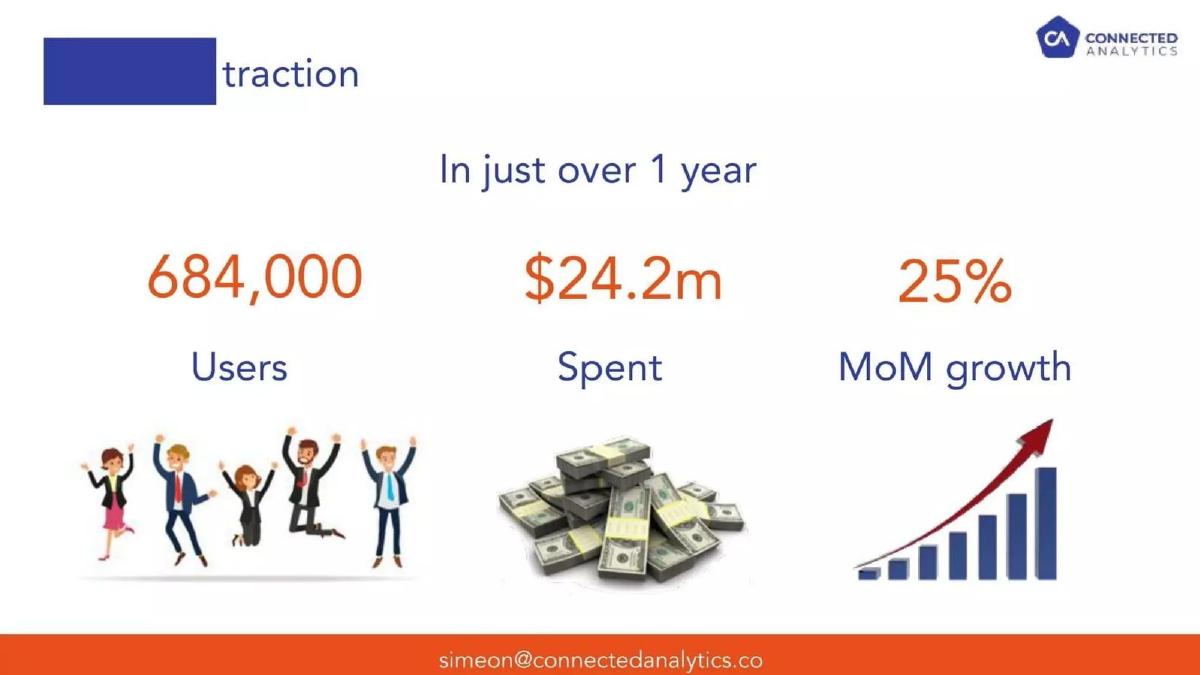
- Traction is a core highlight, showing 684,000 users and $24.2 million in spend within just over one year (Slide 6).
- The deck lists major strategic channel partners including Visa, Interswitch, and Zenith Bank (Slide 7).
- Market size projections scale from a $35 billion opportunity in Lagos to $500 billion across Africa (Slide 8).
- Competitive advantage is defined by being '1st to African Market' and having 170,000 terminal integrations (Slide 9).
- The founding team includes a CEO with a prior exit and a CTO with 20 years of experience at Microsoft and Huawei (Slide 10).
- The deck omits a specific 'Ask' slide, failing to detail how much capital is being raised or the intended use of funds.
Connected Analytics: Solving the African Loyalty Gap
Connected Analytics, operating primarily through its brand ThankUCash, presents a 12-slide deck that is a masterclass in highlighting market-specific problems. In 2018, the African fintech landscape was rapidly evolving, but retail loyalty remained a fragmented and expensive endeavor. This teardown examines how the company leveraged its early traction and deep technical integrations to secure $1.2 million in seed funding.
The Hook and the Problem (Slides 1-3)
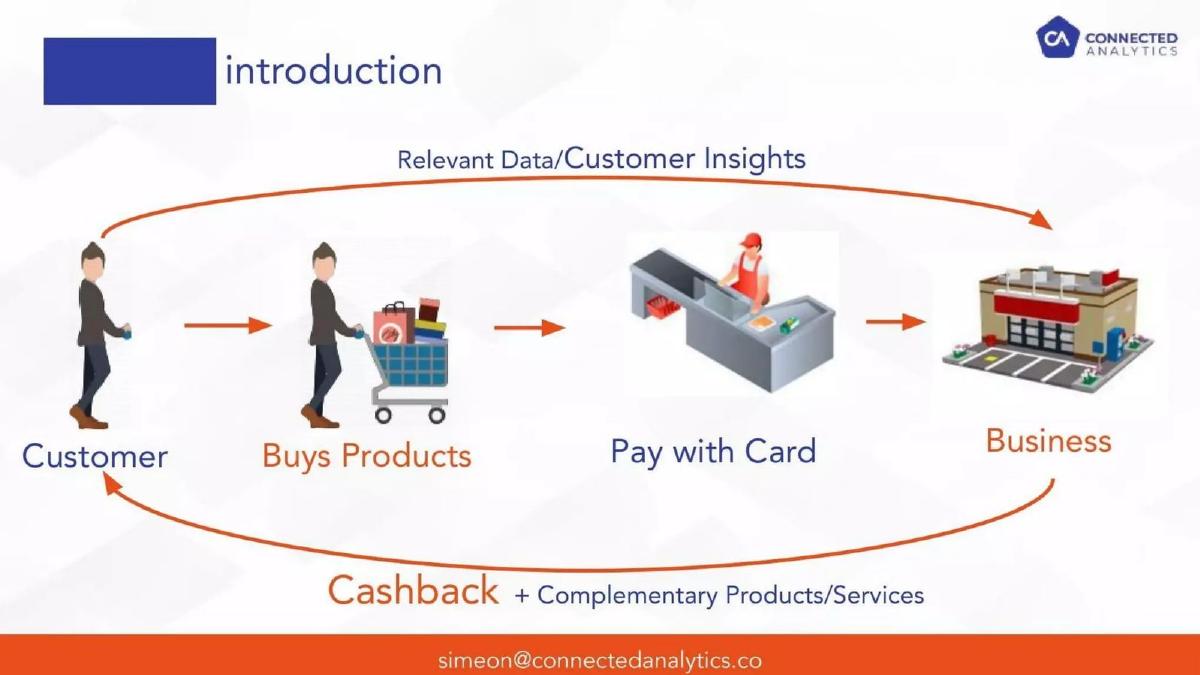
Slide 1 serves as a standard title page, introducing Simeon Ononobi as the Co-Founder and CEO. The tagline, "Providing customer engagement and insights to drive business growth," is broad but sets the stage for a B2B2C play. Slide 2, titled "Introduction," uses a simple circular flow diagram to show the relationship between the customer, the purchase, the business, and the resulting cashback. It is a clean visualization of a standard loyalty loop.
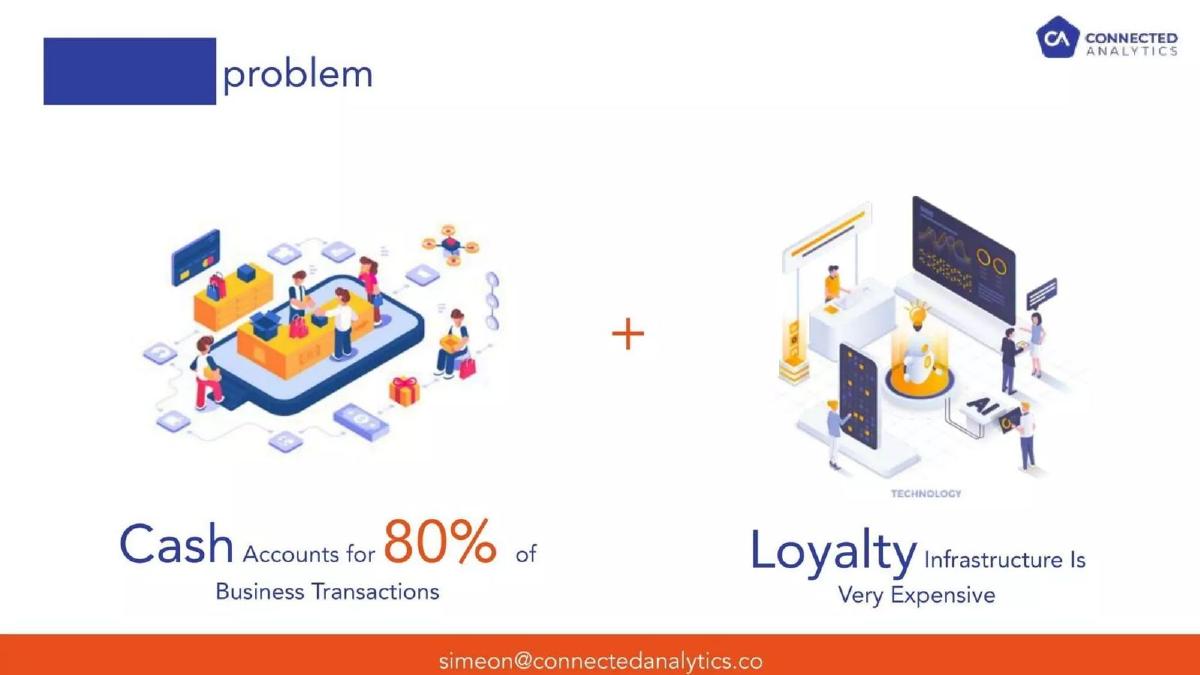
Slide 3 is where the deck finds its footing. It identifies two critical pain points: "Cash Accounts for 80% of Business Transactions" and "Loyalty Infrastructure Is Very Expensive." By quantifying the cash dominance, the founders immediately signal to investors that they understand the unique friction of the African market. Most Western loyalty platforms rely on credit card rails; ThankUCash identifies that to win in Africa, you must solve for cash.
The Solution and Product Mechanics (Slides 4-5)
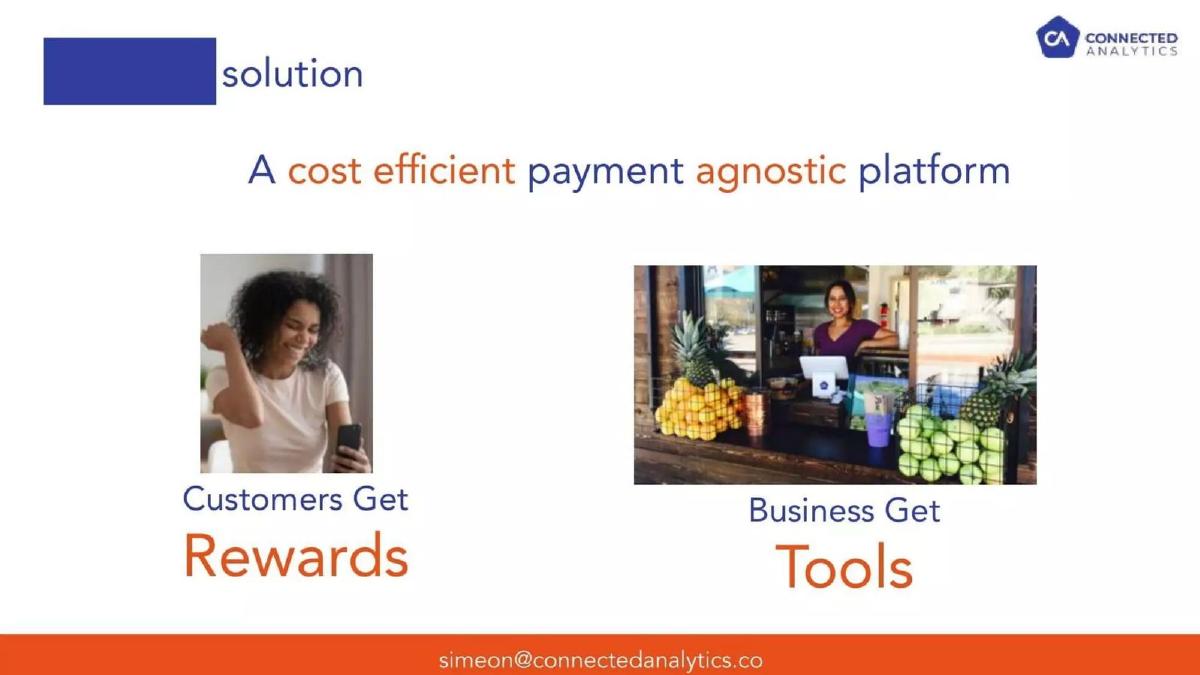
Slide 4 introduces the solution as a "cost efficient payment agnostic platform." The phrase "payment agnostic" is the most important term in the deck, as it directly addresses the 80% cash problem mentioned on the previous slide. The slide is visually sparse, simply stating that customers get rewards and businesses get tools.
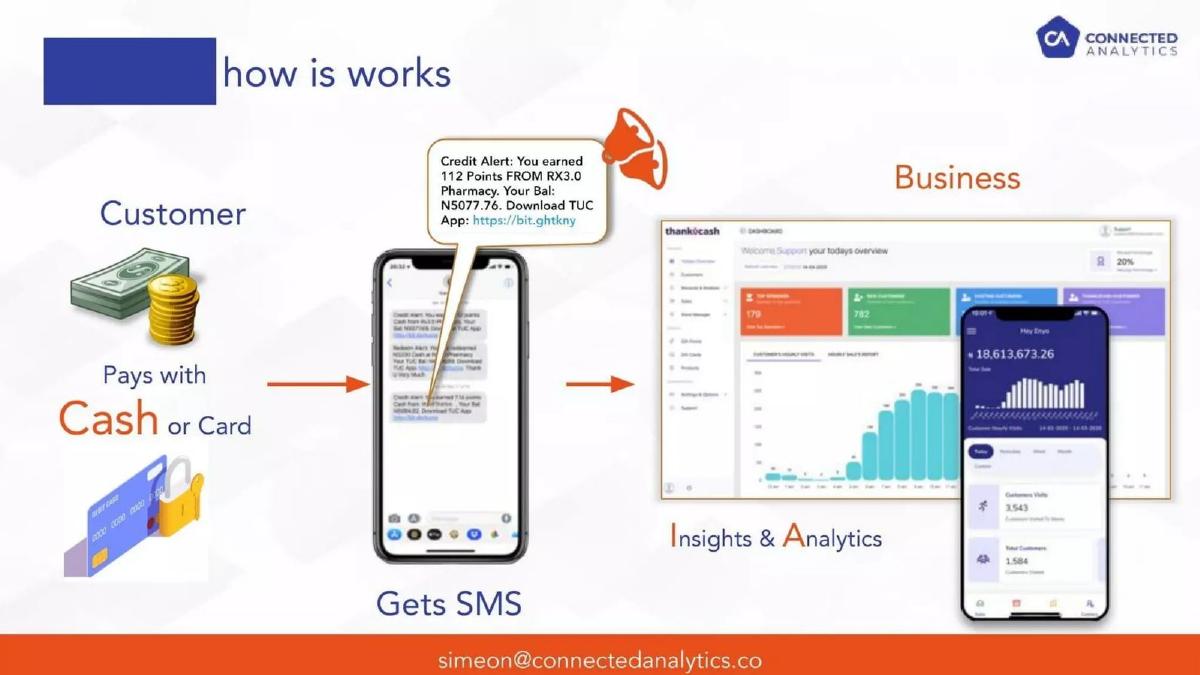
Slide 5, "how is works" (sic), provides a functional overview. It shows a customer paying with cash or card, receiving an SMS alert with their point balance, and the business receiving "Insights & Analytics" via a dashboard. The inclusion of an actual SMS screenshot showing a "Credit Alert" for 112 points from a pharmacy adds a layer of tangible reality to the product. It demonstrates that the product is live and functioning in a way that fits local consumer behavior.
Traction and Partnerships (Slides 6-7)
Slide 6 is the strongest slide in the deck. Titled "traction," it lists three massive figures: 684,000 Users, $24.2m Spent, and 25% MoM growth. Achieving nearly 700,000 users in "just over 1 year" is an exceptional metric for a seed-stage startup. The $24.2 million spend figure is particularly impressive as it indicates the platform is handling significant transaction volume, even if that volume isn't direct revenue for the startup.
Slide 7 reinforces this traction by showing "channel partners and brands." The logos are categorized into Coffee Shops (Koffee Hut, Neo), Gas Stations (Enyo, CET Energy), Supermarkets (DewMart, Adiba), and most importantly, Debit/Credit Card Companies (Interswitch, Visa) and Banks (Zenith, Wema, Sterling). The presence of Visa and Interswitch logos provides massive institutional validation. For a seed-stage company, having these integrations suggests they have already cleared significant regulatory and technical hurdles.
Market Opportunity and Competition (Slides 8-9)
Slide 8 addresses "market size" using a geographic expansion narrative. It starts with Lagos at $35 billion, moves to Nigeria at $100 billion, and ends with Africa at $500 billion. The slide cites a study by the Africa Growth Initiative at Brookings, which adds academic weight to these large numbers. This helps investors visualize the "venture scale" of the opportunity beyond just a local loyalty app.
Slide 9, "competition," lists Ibotta, Rakuten, and Dosh. Rather than a complex feature matrix, the founders list three simple advantages: being first to the African market, local knowledge, and "Exclusive Integrations" with over 170,000 terminals. This last point is a crucial defensive moat. If ThankUCash is already baked into 170,000 point-of-sale terminals, a foreign competitor would face a multi-year uphill battle to displace them.
Team and Advisors (Slides 10-11)
Slide 10 introduces the team. Simeon Ononobi (CEO) is highlighted as a 3X entrepreneur with one exit. Suraj Supekar (CTO) is credited with 20 years of experience, including roles at Microsoft and Huawei. Madonna Anagor (COO) and Harshal Gandole (VP Engr) round out the leadership. The bottom of the slide features logos for Microsoft, Huawei, GTBank, and Nokia, associating the team with world-class organizations. This is a high-pedigree team for a seed round.
Slide 11 lists "Advisers and some backers," including Craig Fenton (COO, Google UK), Stephen Ozoigbo (Lion Africa), and Brandon Drew (GP, SaaS Growth). Having a high-ranking Google executive as an advisor adds significant international credibility and suggests the company has access to high-level strategic guidance.
Conclusion and Contact (Slide 12)
The final slide is a simple contact page with the CEO's email and phone number. The closing tagline, "Help African Businesses Grow While Making Money," attempts to blend social impact with profitability, a common theme in African tech investment.
What Works in This Deck
The Traction Slide: Slide 6 is undeniable. In the seed stage, investors are looking for any sign of momentum. 684,000 users in year one is a "lean forward" moment for any VC. It proves that the SMS-based loyalty hook actually works with the target demographic.
Addressing the Cash Economy: By explicitly stating that 80% of transactions are cash (Slide 3) and then offering a "payment agnostic" solution (Slide 4), the founders show they aren't just copying a Western model (like Rakuten) and pasting it into Nigeria. They have adapted the tech to the reality of the ground.
Institutional Validation: The logos on Slide 7 (Visa, Interswitch, Zenith Bank) do the heavy lifting for the company's technical credibility. Investors know that getting a partnership with a major bank or a global payment processor is a long, difficult process. Showing these logos early suggests a high level of execution capability.
What Is Missing
The Business Model: There is no mention of how Connected Analytics generates revenue. Do they take a percentage of the cashback? Do they charge merchants a SaaS fee for the analytics dashboard? Do they sell anonymized consumer data? This is a significant omission that leaves the "$24.2m Spent" figure without context regarding the company's top line.
The Ask: The deck completely omits a funding slide. There is no mention of how much they are raising, the valuation they are seeking, or what the milestones for the next 18 months look like. While this information is often handled in the verbal pitch, its absence in the deck makes it harder for the document to stand alone as a fundraising tool.
Unit Economics: While the user growth is impressive, there is no data on Customer Acquisition Cost (CAC) or Lifetime Value (LTV). In a loyalty business, the margin on each transaction and the retention rate of users are the primary drivers of long-term success. Without these, it is hard to tell if the 25% MoM growth is sustainable or burning excessive capital.
What a Founder Should Copy
The "How it Works" Visualization: Slide 5 is excellent because it uses a real-world artifact (the SMS screenshot). Founders should always try to show their product in the context of the user's life rather than just showing a clean UI mockup.
The Geographic Market Expansion: Slide 8 does a great job of showing a "beachhead" market (Lagos) and then logically expanding to the country and continent. This makes a $500 billion TAM feel more attainable because it shows the starting point.
Founder Pedigree Layout: Slide 10 is a great example of how to use corporate logos to build trust. Even if the founders didn't start those companies, their experience at Microsoft or Huawei serves as a proxy for their professional standards and technical ability.
Final Thoughts
The Connected Analytics deck succeeded because it combined massive early traction with a deep understanding of a specific regional problem. It didn't need to be flashy; it needed to prove that the founders had found a way to digitize the insights of a cash-heavy retail market. Despite the missing financial details, the sheer volume of users and the quality of the partnerships made the $1.2 million seed round a logical outcome.
Frequently asked questions
- What is the core value proposition of ThankUCash?
- ThankUCash, under the parent company Connected Analytics, provides a data-powered rewards system for African businesses. As shown on Slide 4, the platform is 'payment agnostic,' meaning it allows merchants to offer loyalty rewards and gain customer insights even when customers pay with cash, which accounts for 80% of transactions in the region. This bridges the gap between traditional retail and digital analytics.
- How does the technology work for the end user?
- According to Slide 5, the process is triggered when a customer pays with cash or card. The customer receives an SMS notification regarding their earned points and balance. This SMS-based approach is critical for accessibility in markets where smartphone penetration or consistent data usage may vary, ensuring the loyalty loop is closed immediately after the transaction.
- What kind of traction did the company have at the time of this deck?
- Slide 6 reports significant early-stage growth. In just over one year of operation, the company reached 684,000 users and processed $24.2 million in total spend. Additionally, they reported a 25% month-over-month growth rate, which is a key metric for seed-stage investors looking for signs of product-market fit and scalability.
- Who are the key competitors and how does ThankUCash differentiate?
- Slide 9 identifies global loyalty and cashback giants Ibotta, Rakuten, and Dosh as competitors. ThankUCash differentiates itself through 'Local Knowledge' and 'Exclusive Integrations.' Specifically, they cite over 170,000 terminal integrations, suggesting a deep technical moat within the local banking and POS infrastructure that international players would struggle to replicate quickly.
- What is missing from this pitch deck?
- The deck is notably missing a 'Business Model' slide explaining how they make money (e.g., transaction fees, SaaS fees, or data sales). It also lacks a 'Financial Projections' slide and, most importantly, an 'Ask' slide. While we know from catalogue facts that they raised $1.2 million, the deck itself does not state the funding goal or the planned allocation of capital.