Connectu Media operates as a white-label mobile application developer, creating branded communication tools for cities, associations, and non-profits. The deck highlights early traction with €1.25M in European sales and a contract with the State of California Knights of Columbus for 600 apps. The company utilizes a 'Connect' franchise model to scale, projecting a jump from $7K in 2016 revenue to $18.8M by 2020. While the deck demonstrates a clear target market and existing partnerships, it relies heavily on future projections and lacks a detailed breakdown of unit economics or a competitive l…
Key takeaways
- The company claims €1.25M in sales across four European countries prior to its U.S. debut, as noted on slide 2.
- A significant portion of their projected $29M revenue by 2020 is attributed to 'City Connect Franchise Apps,' accounting for $28M of that total (slide 2).
- The market size slide identifies a $2.48B opportunity in the USA, driven by 1.2M charitable and philanthropic organizations (slide 4).
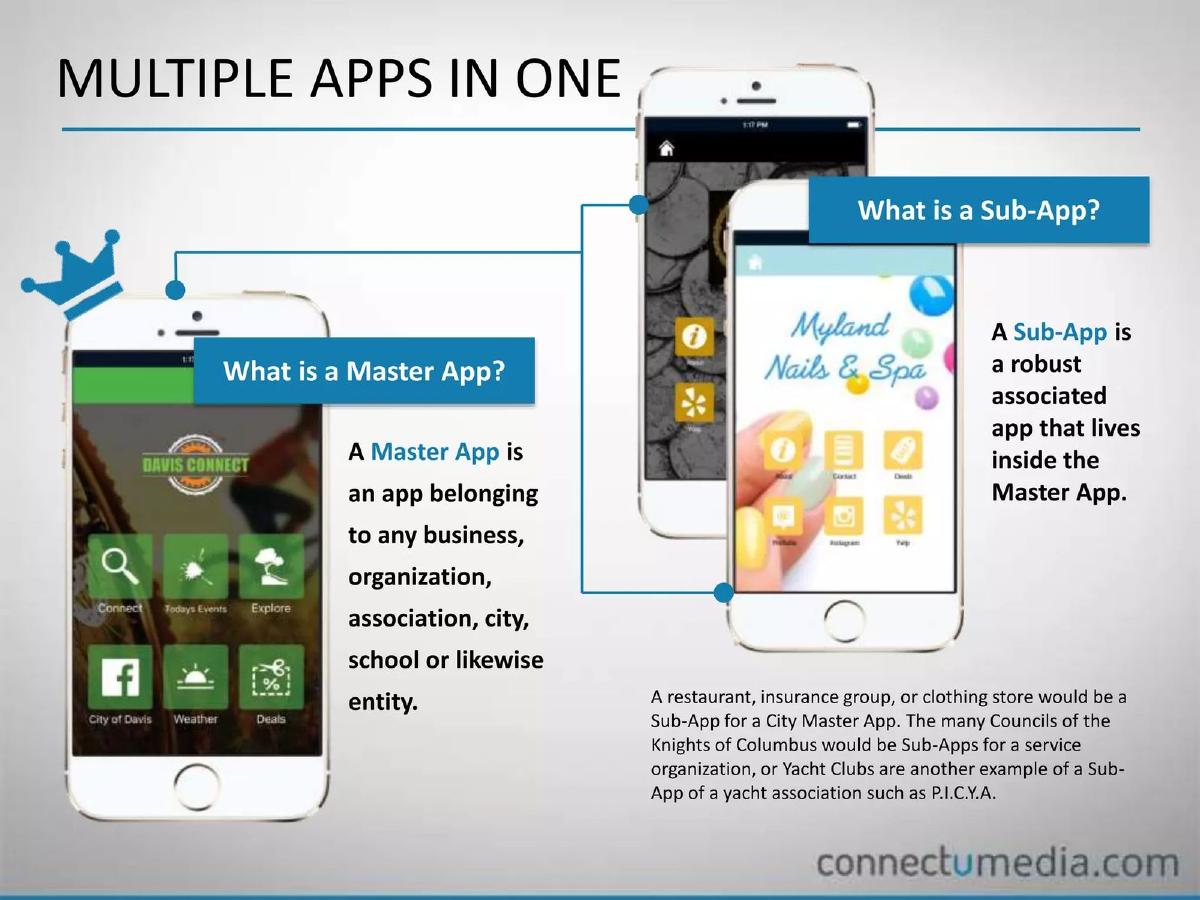
- Connectu employs a hub-and-spoke model where they build a 'master app' for an organization and sub-apps for member clubs, such as the Pacific Inter-Club Yacht Association (slide 5).
- Financial projections show a steep growth curve, moving from a $431K loss in 2016 to a projected $7.7M profit in 2020 (slide 6).
- The timeline indicates a March 2015 launch, with a goal to reach 60 city-specific apps by 2018 (slide 7).
- The $2.5M capital ask is specifically earmarked for purchasing IP, hiring a VP of Technology and VP of Sales, and funding marketing (slide 8).
- The deck omits a dedicated team slide, leaving the backgrounds of the President and CEO mentioned on the cover slide (slide 1) unexplained.
Connectu Media: The White-Label App Factory
Connectu Media positions itself as a comprehensive solution for niche community communication. By focusing on 'Communication Apps For Everything,' the company attempts to solve the fragmentation of digital engagement for small municipalities, trade associations, and non-profits. The deck emphasizes a transition from a proven European model to a high-growth U.S. franchise model.
Slide 1: Title and Leadership
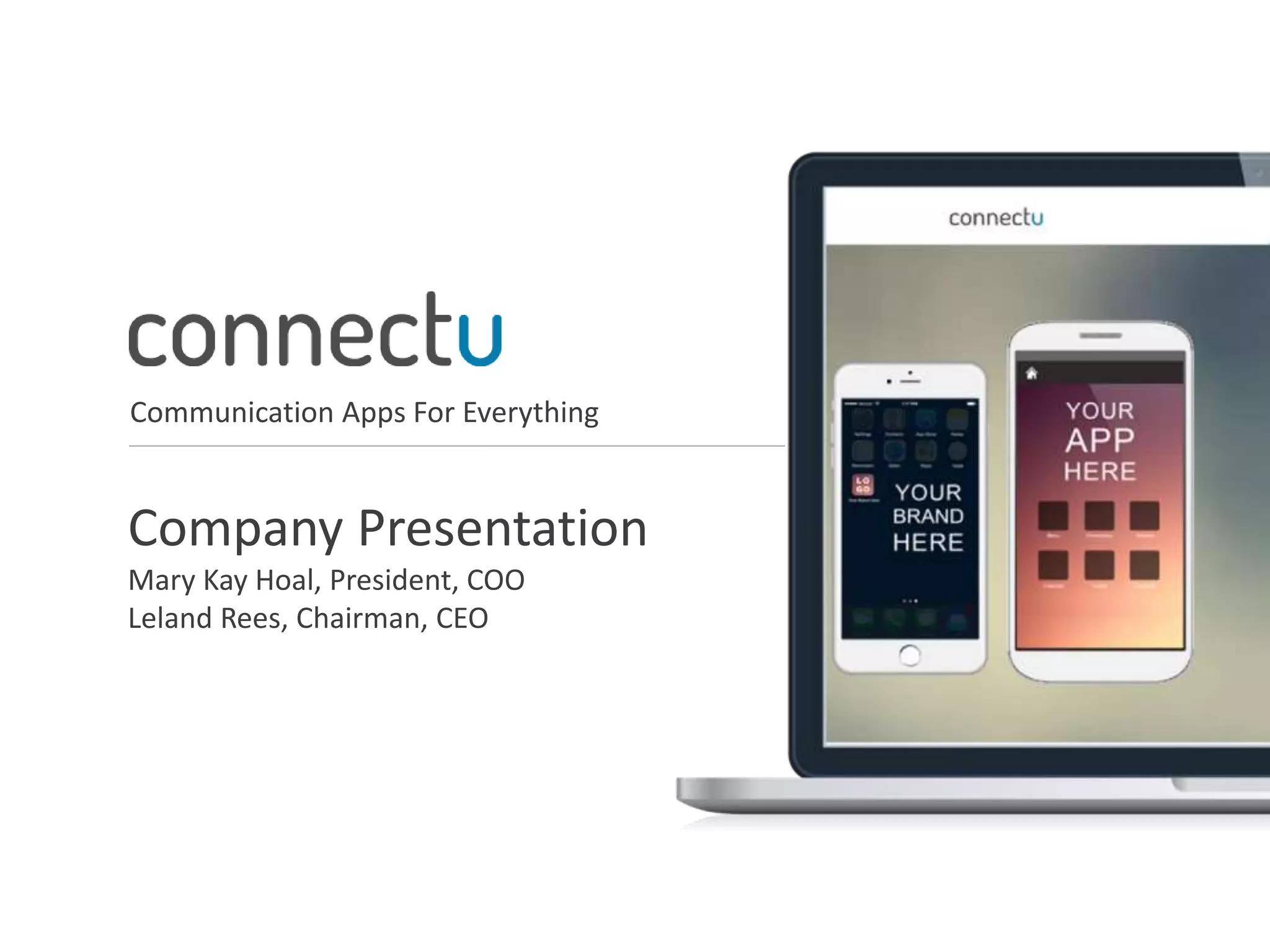
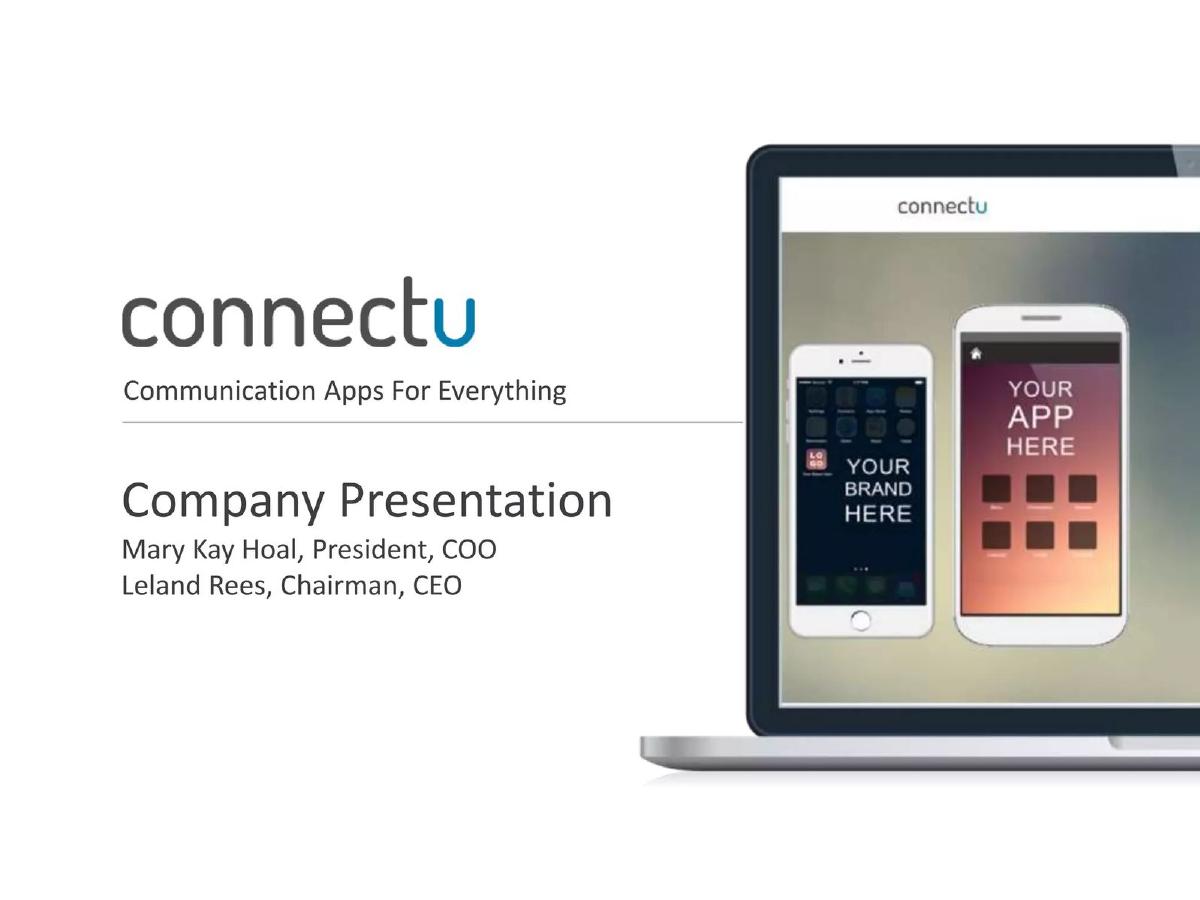
The cover slide introduces the company name, Connectu, with the tagline 'Communication Apps For Everything.' It lists two key executives: Mary Kay Hoal as President and COO, and Leland Rees as Chairman and CEO. Visually, it features a laptop and mobile devices displaying a generic 'Your App Here' interface, establishing the company's focus on mobile software development.
Slide 2: Deal Highlights
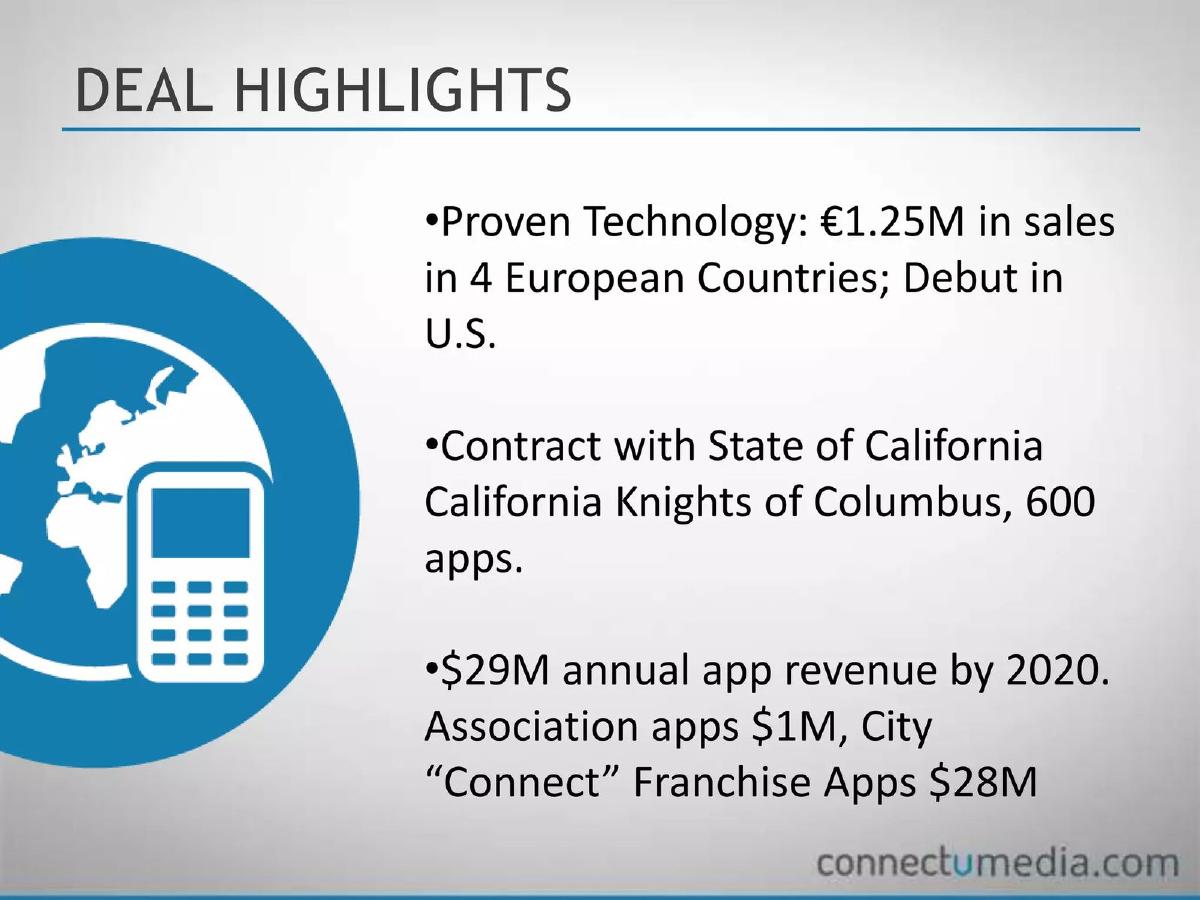
This slide serves as the executive summary. It claims 'Proven Technology' with €1.25M in sales across four European countries. It highlights a major contract with the State of California Knights of Columbus to produce 600 apps . Most notably, it sets a target of $29M in annual revenue by 2020 , with $28M of that derived from 'City Connect' Franchise Apps. This indicates that the company's primary growth engine is not individual sales, but a scalable franchise system.
Slide 3: The Market Creation Model
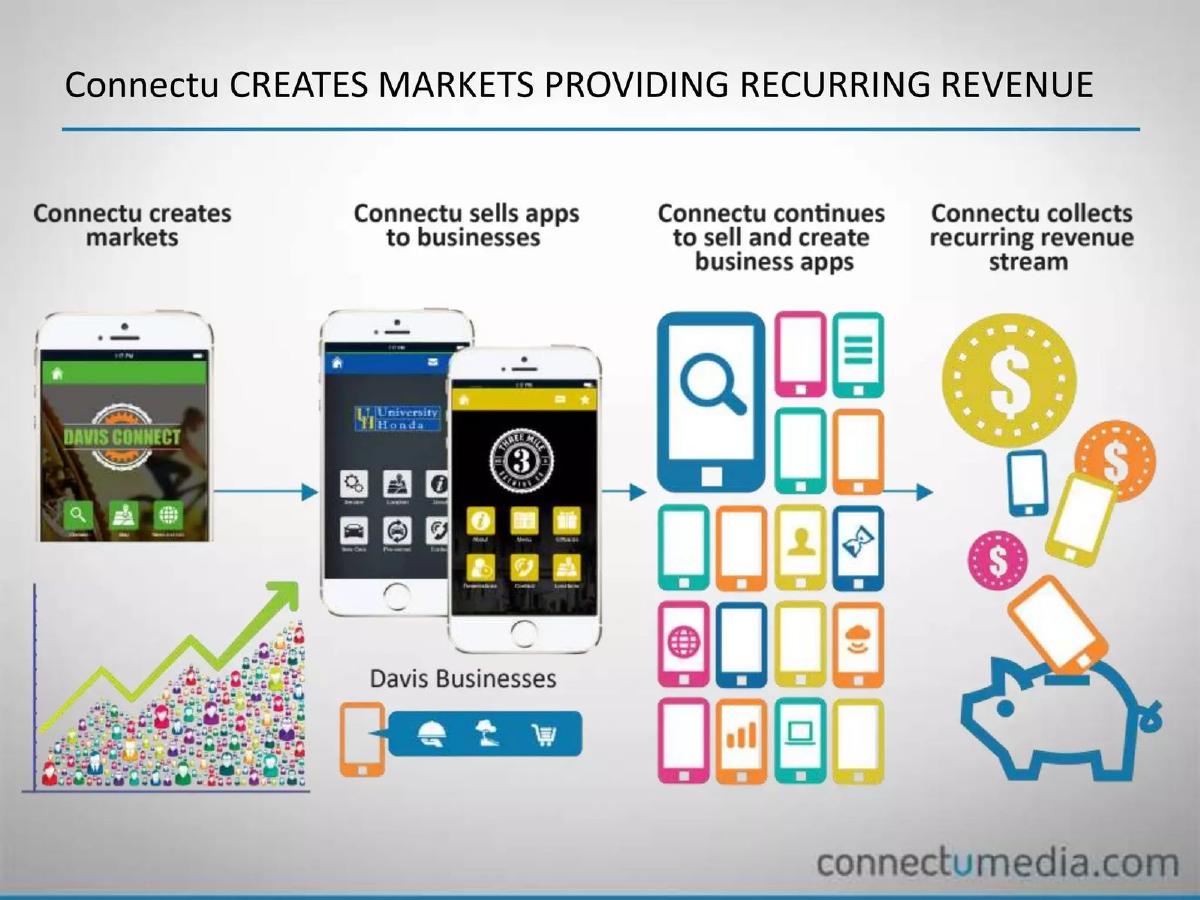
Slide 3 uses a flowchart to explain the business model. It starts with 'Connectu creates markets' (using 'Davis Connect' as an example), followed by selling apps to local businesses. The graphic shows a progression from a single city app to a grid of business apps, eventually leading to a 'recurring revenue stream' represented by a piggy bank and dollar signs. This suggests a B2B2C approach where the city app acts as a portal for local commerce.
Slide 4: Market Size
The company divides its market into two geographic segments. For the USA, it claims 1.47M potential customers and a $2.48B market size . This is broken down into 17,000 college cities/small towns, 92,000 trade associations, and 1.2M charitable organizations. For Australia and Canada, it estimates 231K potential customers and a $91M market . The discrepancy in market value per customer between the two regions is not explained.
Slide 5: Market Leadership and Verticals
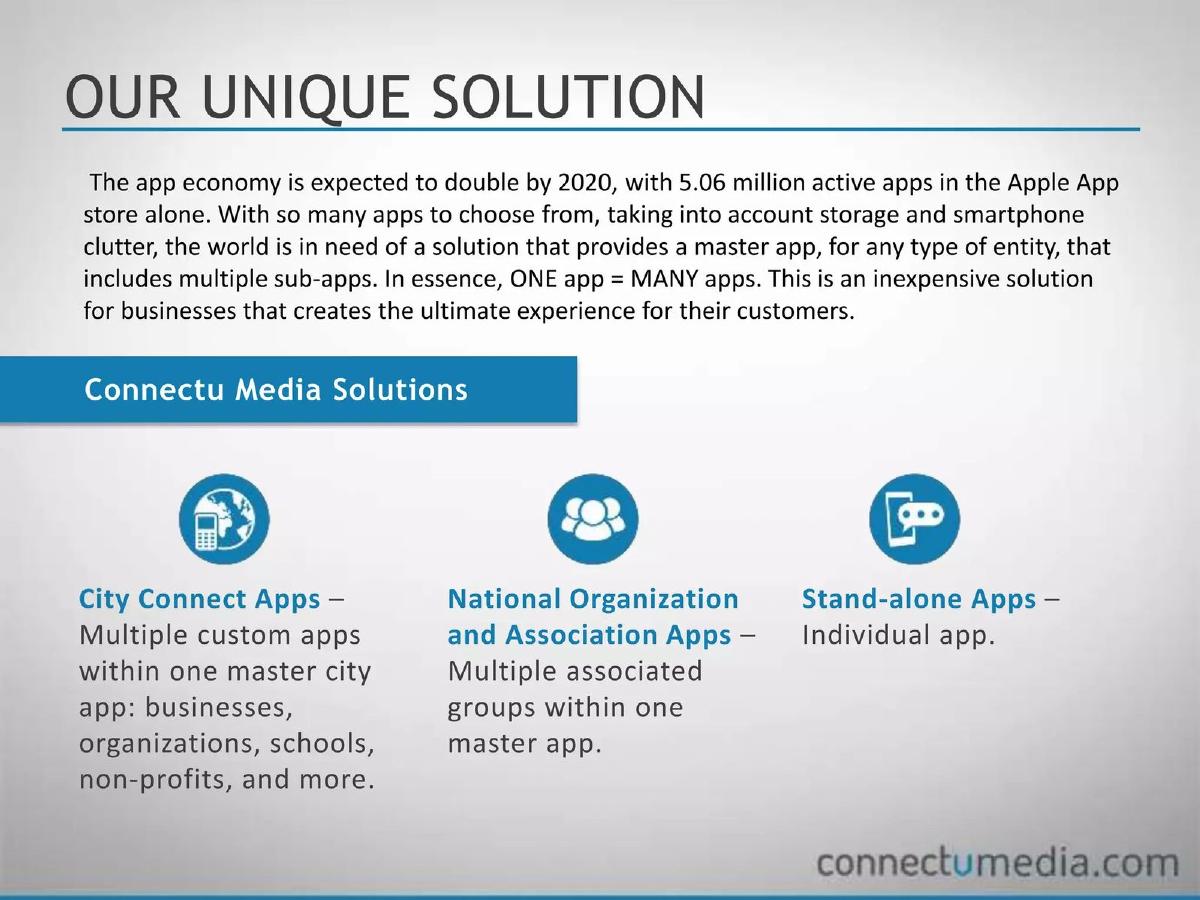
This slide lists the various sectors Connectu targets: Cities, Military, Schools, Lifestyle, Non-Profits, Professional Associations, Athletics, and Religious organizations. It reiterates the Knights of Columbus contract and mentions a new contract with the Pacific Inter-Club Yacht Association (PICYA) to build a master app and sub-apps for member clubs. This 'Master/Sub-app' architecture appears to be their primary technical differentiator.
Slide 6: Financial Projections
The financial data is presented in a bar chart covering 2016 through 2020. The revenue growth is back-loaded: $7K (2016), $385K (2017), $2.4M (2018), $8.1M (2019), and $18.8M (2020) . Expenses are projected to grow from $438K to $11.2M in the same period. The company projects its first year of profitability in 2019 ($1.4M), reaching $7.7M in profit by 2020 . The 2016 revenue of $7K stands in stark contrast to the €1.25M in European sales mentioned on slide 2, suggesting the $7K refers specifically to new U.S. operations.
Slide 7: Key Milestones to Date
A timeline shows the company's trajectory from its launch in March 2015. It displays various logos of partners acquired in 2016, including CBRE and the State of California. The timeline marks 2017 as the year to Raise $2.5M and launch 18 new City Connect apps. By 2018, the goal is to have 60 City Connect Apps in operation.
Slide 8: Use of Capital
The final slide in the provided set details how the $2.5M will be spent. The four pillars are: Purchase IP , Hire Key Staff (specifically VPs of Technology and Sales), Fund Software Development to expand app capabilities, and Advertising and Marketing . The mention of 'Purchase IP' is significant, as it suggests the company may not currently own all the core technology it is using to generate its European sales.
What Connectu Media Does Well
The deck excels at identifying a specific, repeatable sales motion. By targeting 'Master' organizations like the Knights of Columbus or the Pacific Inter-Club Yacht Association, they solve the problem of high customer acquisition costs. Instead of selling 600 individual apps, they sell one master contract that trickles down to 600 entities. This 'hub-and-spoke' distribution model is a strong selling point for investors looking for scalability in the crowded mobile app market.
Furthermore, the deck provides clear, quantifiable goals. The milestone of reaching 60 city apps by 2018 gives investors a tangible metric to track progress against the $2.5M investment. The use of real-world examples, like 'Davis Connect,' helps ground the abstract concept of a 'communication app' into a recognizable local utility.
What is Missing from the Deck
The most glaring omission is a Team Slide . While names are mentioned on the cover, there is no information regarding the founders' previous successes, technical expertise, or industry background. For an early-stage company, the 'why us' is often as important as the 'what.'
There is also a complete lack of Competitive Analysis . The white-label app space was highly congested during this period, with competitors ranging from DIY app builders like AppyPie to specialized municipal platforms. Connectu does not explain why their 'Connect' platform is superior to existing social media groups or specialized SaaS tools.
Finally, the Unit Economics are absent. While total revenue projections are provided, the deck does not state the cost to build a single app, the monthly subscription fee charged to businesses, or the churn rate. Without these figures, the jump from $385K to $18.8M in revenue feels like an arbitrary 'hockey stick' projection rather than a calculated forecast.
Founder Takeaways: The Franchise Strategy
Founders can learn from Connectu’s verticalization strategy . Rather than trying to be a general communication tool for everyone, they identified specific 'tribes' (yacht clubs, religious groups, small towns) that are often underserved by major tech platforms. If you are building a platform, showing how you can capture an entire ecosystem through a single 'Master' contract is a powerful way to demonstrate a path to scale.
However, founders should be wary of the 'IP Purchase' trap in a pitch deck. Listing 'Purchase IP' as a primary use of funds can be a red flag for investors, as it implies the company is currently operating on borrowed or licensed technology. If you need to buy your core tech, be prepared to explain why you don't already own it and how that purchase secures the company's future defensibility.
Company: Connectu Media · Sector: Mobile Software / White-Label Apps · Stage: Early Stage / Seed · Year: Circa 2016-2017 (based on projections) · Slides: 15 total (8 analyzed) · Deck Type: Investor Pitch Deck · Outcome: Not stated · HQ: Not stated (U.S. focus mentioned)
Frequently asked questions
- What is the core product offered by Connectu Media?
- Connectu Media builds white-label mobile communication applications. According to slide 5, they target diverse verticals including cities, military organizations, schools, non-profits, and religious groups. Their strategy involves creating 'master apps' for large organizations, which then branch into sub-apps for individual chapters or member entities, such as the 600 apps mentioned for the Knights of Columbus on slide 2.
- How does the company plan to generate revenue?
- The company focuses on recurring revenue streams. Slide 3 illustrates a flow where Connectu creates a market (e.g., 'Davis Connect'), sells apps to local businesses within that market, and then collects ongoing fees. Slide 2 further breaks this down, projecting that by 2020, $28M of their $29M annual revenue will come from these 'City Connect' franchise applications.
- What is the current stage of the company based on the deck?
- Based on the milestones on slide 7, the company launched in 2015. At the time of the deck's creation (likely late 2016 or early 2017), they were seeking a $2.5M raise to scale from their initial pilot apps to 60 city-based apps by 2018. They cite existing European sales of €1.25M as proof of concept (slide 2).
- What are the primary risks identified in the financial projections?
- The projections on slide 6 show an extremely aggressive revenue jump from $385K in 2017 to $18.8M in 2020. This represents a nearly 50x increase in three years. The risk lies in the execution of the 'Franchise' model, which must scale rapidly to meet these targets, especially since the company was still reporting losses ($580K) as late as 2018 in their projections.
- What is the intended use of the $2.5M investment?
- As detailed on slide 8, the funds are allocated to four key areas: purchasing intellectual property (IP), hiring executive staff (VP of Technology, VP of Sales, and general sales staff), expanding software development to increase app capabilities, and funding marketing campaigns for both existing and planned applications.