Conquerors of The Realm is a fantasy-themed gaming project that initially developed a physical board game before pivoting to a geolocation-based Augmented Reality (AR) mobile app. The 24-slide deck focuses heavily on the product's visual assets, including miniatures and card designs, while justifying the move to AR through market growth data and social media validation. The company highlights a technical team with a track record of 5,000,000 downloads on Google Play across various simulator titles. However, the deck lacks a formal financial 'ask,' specific unit economics, or a detailed roadma…
Key takeaways
- The project is a hybrid of fantasy style, augmented reality, and geolocation-based mechanics (Slide 3).
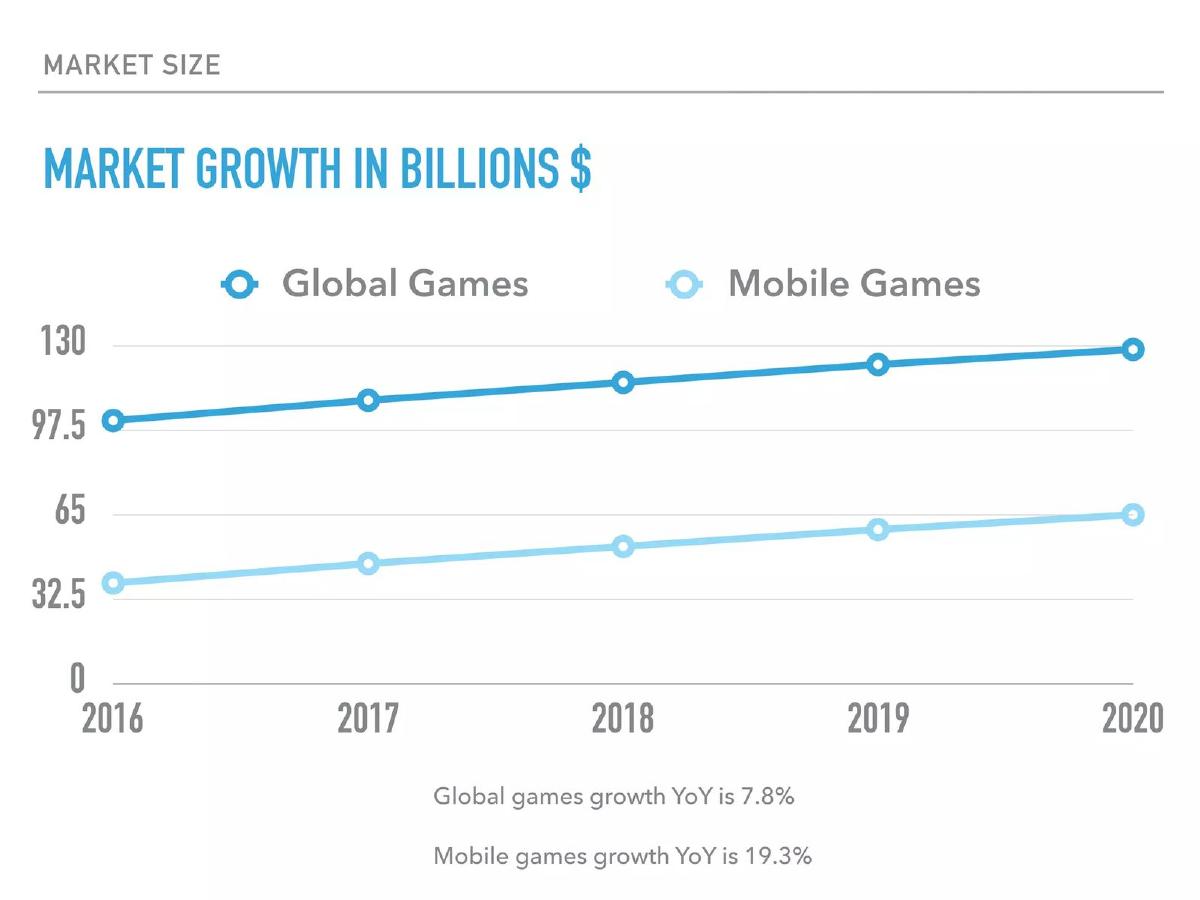
- Mobile gaming market growth is cited at 19.3% YoY, significantly outpacing the global games growth of 7.8% (Slide 4).
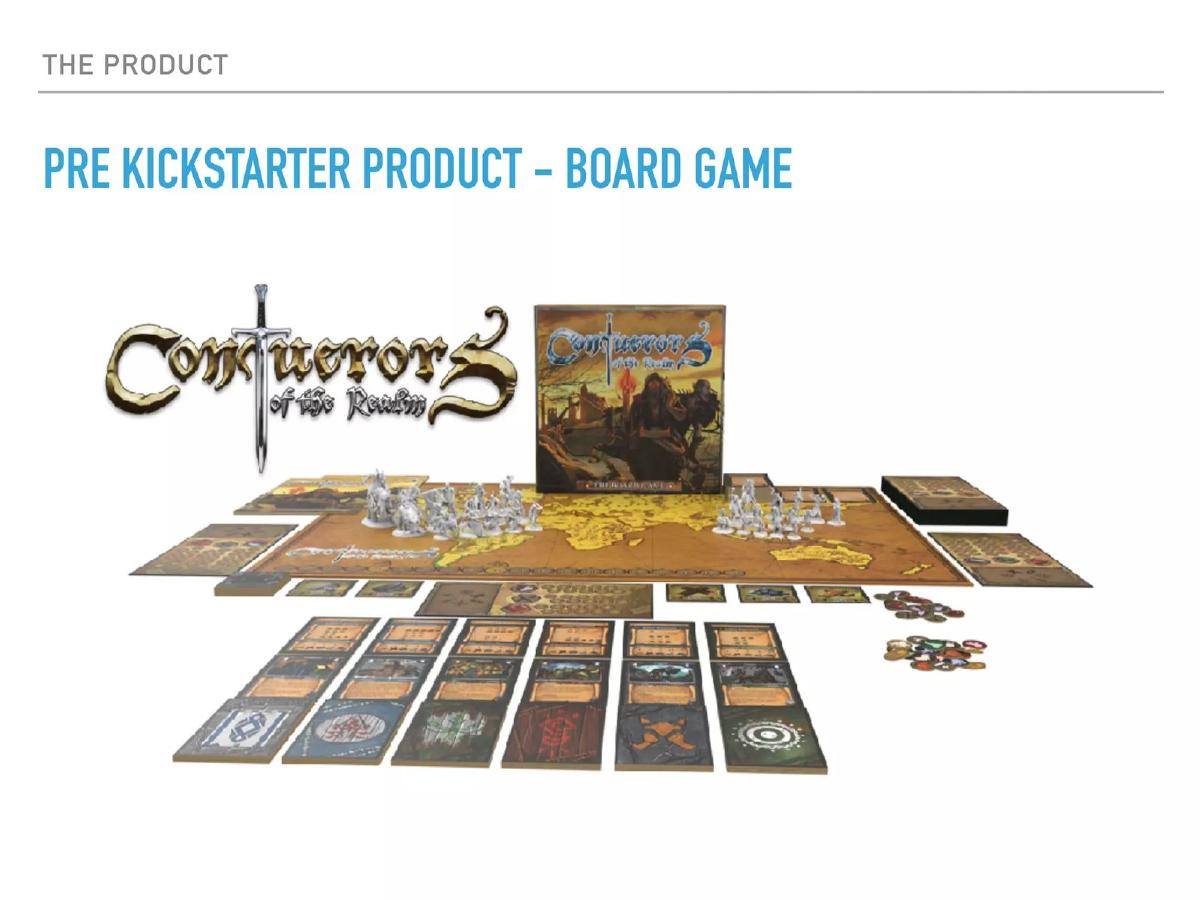
- The product originated as a physical board game with 34 event cards and custom miniatures for factions like Dwarves and Goblins (Slides 7-10).
- Validation for the pivot to AR came from social media engagement and direct feedback from a software developer (Slides 15-18).
- The company identifies Pokemon GO and Geocaching as primary market competitors (Slide 14).
- The monetization strategy assumes a 3.5% conversion rate for in-app purchases with an average spend of $9.39 per month (Slide 21).
- The technical team claims over 5,000,000 downloads on Google Play for previous titles like 'Russian Submarine' and 'Bus Parking Driver Simulator' (Slide 24).
- The deck omits a specific funding request, valuation, or use-of-funds breakdown.
Executive Summary and Vision
Conquerors of The Realm enters the pitch with a high-concept premise: 'When fantasy worlds land on Planet Earth.' The introductory slides (1-2) establish a tone of world-building, suggesting a new 'population' for the planet. Slide 3 clarifies the technical pillars of the startup: Fantasy Style, Augmented Reality (AR), and Geo-Location based mechanics. This suggests a gameplay loop similar to popular location-based games but wrapped in a high-fantasy skin.
Market Opportunity and Growth
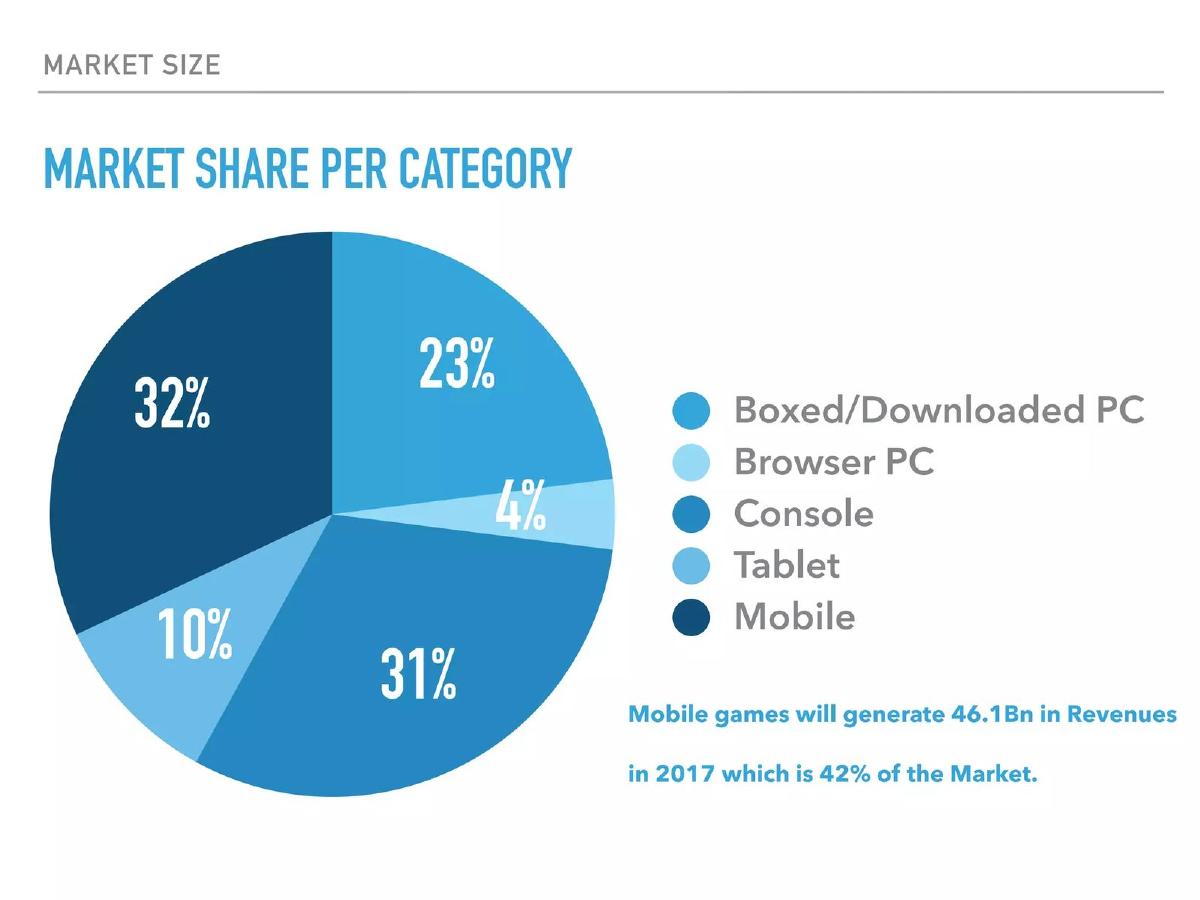
Slides 4 and 5 focus on the macro-economic environment of gaming. The deck cites a Global Games growth rate of 7.8% YoY, while highlighting that Mobile Games are growing at 19.3% YoY. By 2020, the deck projects the market to reach approximately $130 billion. Slide 5 breaks down market share, noting that Mobile represents 32% of the market (as of the data's time), with a specific claim that mobile games would generate $46.1 billion in revenue in 2017, accounting for 42% of the total market.
The Product Evolution: From Board Game to AR
A significant portion of the deck (Slides 6-10) is dedicated to the 'Pre Kickstarter Product,' which was a physical board game. These slides showcase detailed assets, including a world map, 34 event cards, and 3D-rendered miniatures for factions like Dwarves and Goblins. This section serves as proof of concept for the intellectual property and aesthetic, even if the delivery mechanism has changed.
Slides 11-13 transition into the 'Mobile/AR Part.' These slides use mockups to show a world map on a smartphone and tablet, character creation screens, and AR 'found' states where 3D fantasy models are overlaid on real-world street views. The UI shown includes latitude/longitude coordinates and 'Seed' locations, reinforcing the geolocation aspect.
Validation and Competition
Slide 14 provides market validation by comparing the concept to Pokemon GO (65 million MAU) and Geocaching (3 million MAU). This is a standard 'X for Y' comparison intended to show the scale of the addressable audience. Slides 15 and 16 display social media feedback, showing Instagram comments and Facebook messages from users expressing interest in the concept. Slide 17 highlights the global nature of their early interest, listing backers from Lebanon, Canada, France, Germany, and the US, though the numbers are small (e.g., 5 backers from the US, 3 from Canada).
The Strategic Pivot
Slides 18-20 explain the 'Why' behind the pivot to AR. Slide 18 features a chat log with a software developer named Mathew, who suggests that the board game 'can all be done digitally' and questions why a user would pay $40 for a physical version when it could be a virtual experience. Slide 19 leverages a screenshot of Mark Zuckerberg at an F8 conference to align the company with broader industry trends in AR. Slide 20 lists the core values of the AR version: Community, Warriors, and 'Patriotism' (defined here as creating a sense of belonging by restricting play to local time zones/areas).
Monetization and Financial Goals
Slide 21 outlines the monetization strategy, citing that 3.5% of gamers engage in in-app purchases with an average spend of $9.39 per month. Slide 22 sets an 18-month goal: reach 1,000,000 gamers and start earning $320,000 per month. This revenue target is relatively conservative if they actually hit the 1,000,000 user mark, as it implies an ARPU (Average Revenue Per User) of only $0.32, far below the $9.39 industry average they cited on the previous slide.
Team and Technical Track Record
The deck concludes with the team (Slides 23-24). The founders come from diverse backgrounds, including electrical engineering and business development. The 'Technical Team' slide is perhaps the strongest evidence of execution capability, showcasing six previously released mobile titles (mostly vehicle and animal simulators). They claim 'Around 5,000,000 Downloads on Google Play and 35,000 five star Ratings,' which suggests they have the internal capacity to build and launch mobile software, even if their previous titles were in a different genre.
What Works in This Deck
Visual Assets: The deck does an excellent job of showing, not just telling. The inclusion of the board game assets (cards, miniatures) gives the fantasy world a sense of depth and 'readiness' that many early-stage gaming pitches lack. · Technical Credibility: By listing previous games with millions of downloads, the team mitigates the risk that they cannot actually build the app. This is a crucial 'proof of work' for a technical team. · Clear Pivot Logic: The transition from a physical product to a digital one is well-justified through both user feedback and market growth data.
What Is Missing from This Deck
The Ask: There is no slide stating how much money the company is raising, what the terms are, or how the capital will be allocated. · Unit Economics: While they mention average spend per user, they do not provide projected Customer Acquisition Costs (CAC) or Lifetime Value (LTV) specific to their game. · Roadmap: The deck jumps from 'Pre-Kickstarter Board Game' to '18-month revenue goals' without showing the development milestones in between. · Gameplay Mechanics: While the AR 'found' state is shown, the actual mechanics of the 'conquering' or 'realm' management are not explained.
Founder Takeaways
Leverage Existing IP: If you are pivoting from one medium to another, show the assets you've already built. It proves the creative work is done. · Use Third-Party Validation: Including screenshots of real user comments and expert feedback (like the developer chat) adds a layer of authenticity to the pivot. · Highlight Distribution Success: If your team has shipped products before, lead with the download numbers. In the crowded mobile market, the ability to get eyes on a product is as important as the ability to build it.
Frequently asked questions
- What is the core product of Conquerors of The Realm?
- Based on the deck, the product is a geolocation-based AR mobile game set in a fantasy world. It appears to have evolved from a physical board game, utilizing the same lore and character designs (Dwarves, Goblins, Humans) but moving the mechanics to a mobile interface where players find 'seeds' and characters in the real world using their phone's camera.
- How does the company plan to make money?
- The monetization strategy relies on in-app purchases. Slide 21 notes that typically 3.5% of gamers spend money on in-app purchases, averaging $9.39 per month. Their 18-month goal is to reach 1,000,000 gamers and generate $320,000 in monthly revenue, which implies a slightly lower average revenue per user than their cited industry average.
- Who are the competitors mentioned in the deck?
- The deck specifically names Pokemon GO (65,000,000 monthly active users as of April 2017) and Geocaching (3,000,000 monthly active users) as competitors on Slide 14. This positioning suggests the game relies heavily on physical movement and location-based discovery.
- What is the background of the founding team?
- The team includes Ziad Talge (Co-Founder/Lead Hiker), Marc Raphael (Earliest Co-Founder), Vladimir Petrov (Lead AR Developer), and Egor Taravasov (Lead Mobile Developer). The technical team has experience in mobile simulators, claiming millions of downloads for titles like 'Modern Jet Fighter' and 'Crazy Shark Attack 3D' (Slides 23-24).
- Is there a specific investment ask in this deck?
- No. The deck concludes with team bios and technical achievements but does not include a slide detailing how much capital they are seeking, the equity offered, or the specific milestones that the funding would enable. It functions more as a product vision and validation document than a complete financial pitch.