Constructor's Series B deck is a concise, data-heavy presentation that prioritizes business outcomes over technical jargon. By focusing on Revenue Per Visitor (RPV) and Conversion Rate (CRV) improvements for major brands like Sephora and Petco, the company establishes immediate credibility. The deck is particularly strong in its demonstration of Net Revenue Retention (NRR), which climbed to 118.2% by FY24, signaling a highly sticky enterprise product. While the deck lacks a formal team slide or a detailed competitive landscape, it compensates with a clear 'before and after' product demonstrat…
Key takeaways
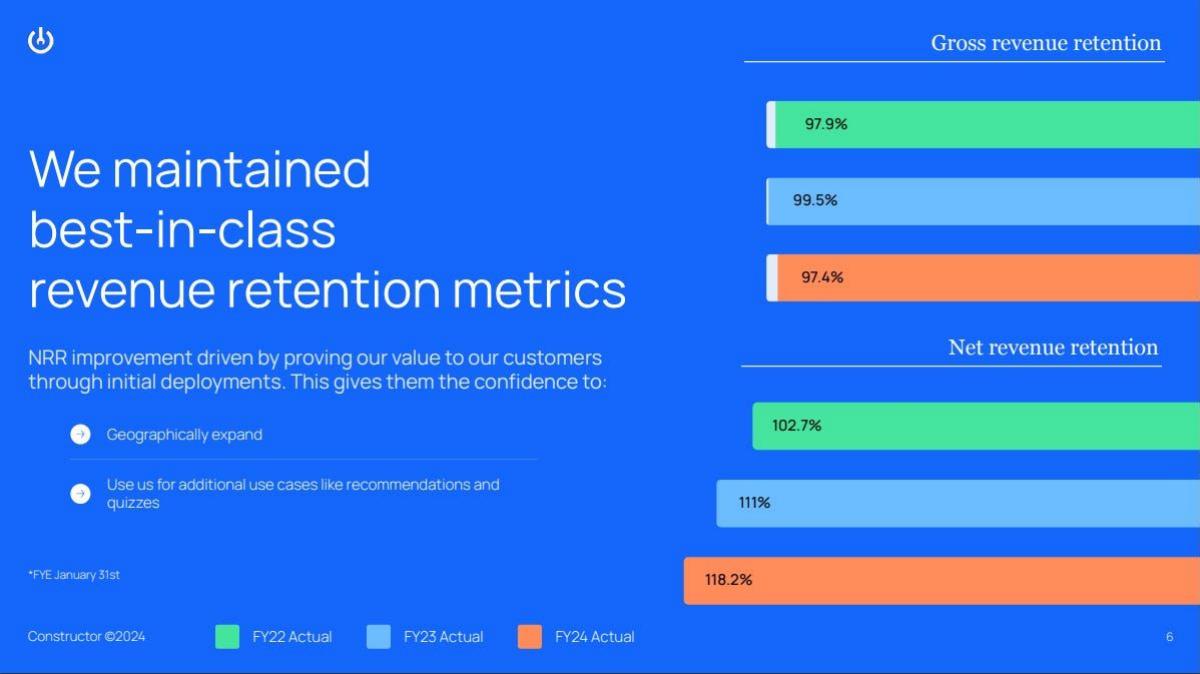
- The deck highlights a significant increase in Net Revenue Retention (NRR) from 102.7% in FY22 to 118.2% in FY24 (Slide 6).
- Constructor claims to be the only platform not built on Lucene, using a proprietary architecture specifically for e-commerce search (Slide 2).
- The company uses specific customer outcomes to prove value, citing a +$40M impact for Sephora and +13% CRV for Petco (Slide 2).
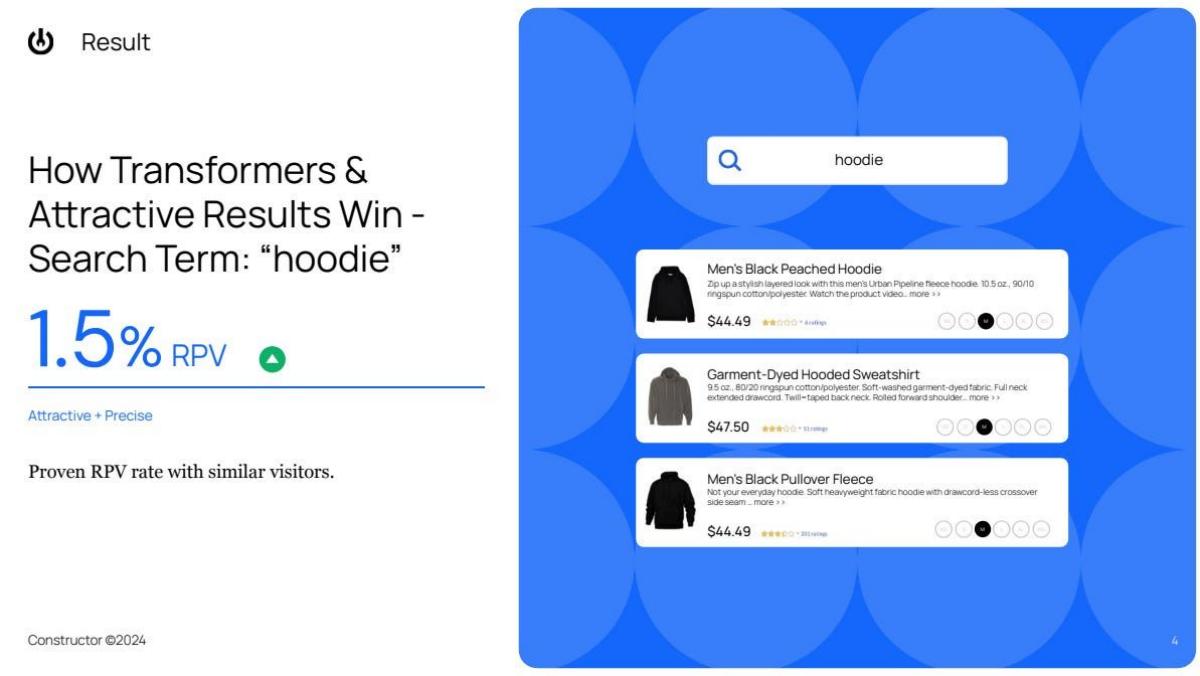
- A direct product comparison shows a 30x improvement in RPV (0.05% vs 1.5%) when using their 'Transformers' approach over general vector relevance (Slides 3-4).
- Headcount data reveals a lean operation, with G&A remaining flat at 7 employees while R&D and S&M scaled significantly (Slide 7).
- The deck omits a traditional 'Team' slide, 'Market Size' slide, and 'The Ask' slide, focusing entirely on product efficacy and growth metrics.
- Gross Revenue Retention (GRR) remained consistently high, reported at 97.4% for FY24 (Slide 6).
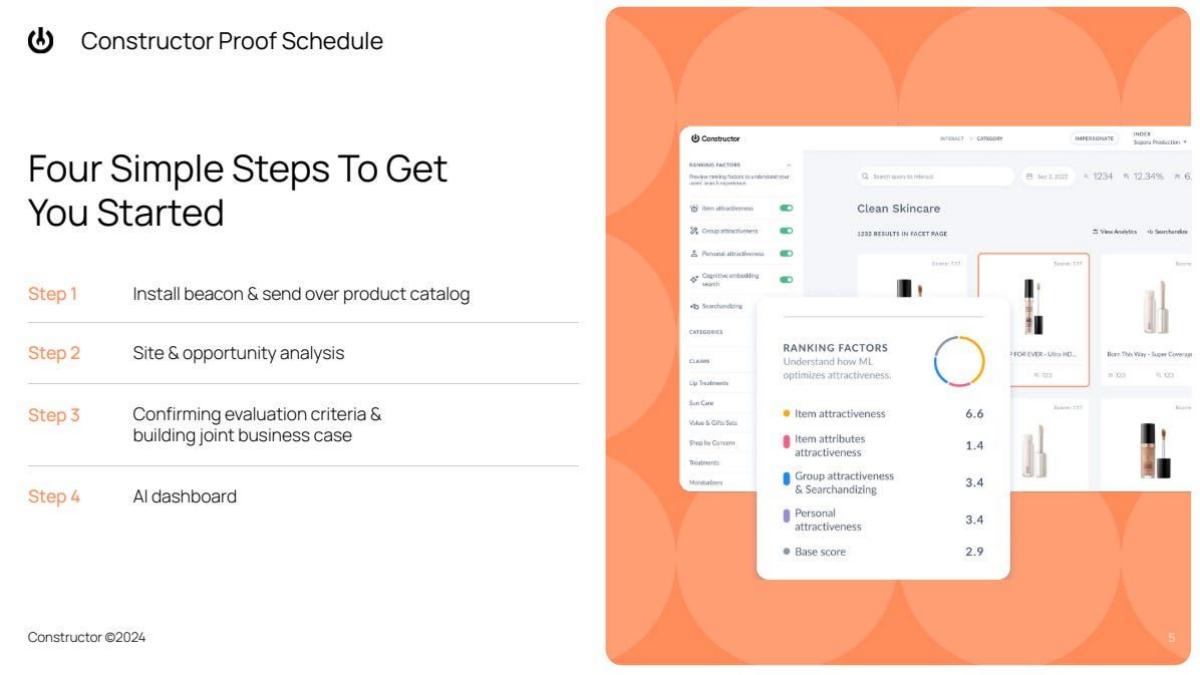
- The implementation process is simplified into a four-step 'Proof Schedule,' moving from beacon installation to an AI dashboard (Slide 5).
Constructor Series B Teardown: Efficiency and Efficacy
Constructor's 2024 Series B deck, which supported a $25 million raise as reported by Business Insider, is a masterclass in brevity. In just seven slides, the company manages to articulate a complex technical value proposition and back it up with top-tier enterprise SaaS metrics. The deck eschews the typical 'visionary' fluff of early-stage pitches, opting instead for a cold, clinical look at how their AI-powered search impacts the bottom line for massive retailers.
Slide 1: The Value Proposition
The title slide is functional and minimalist. It defines the product category immediately: "Search and Product Discovery, Optimized for Ecommerce KPIs." By leading with "Ecommerce KPIs," Constructor signals that they aren't just selling software; they are selling a lift in business performance. The imagery is generic but clean, establishing a professional enterprise tone from the outset.
Slide 2: Differentiation and Social Proof
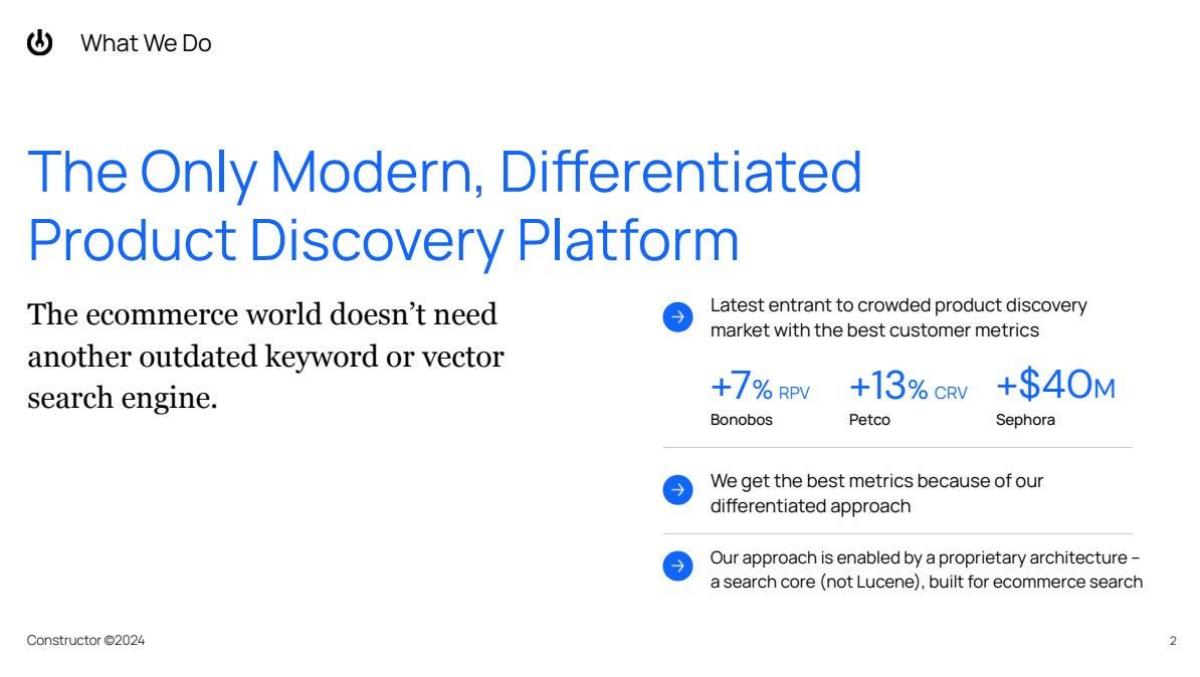
Slide 2 tackles the "Why us?" question. It explicitly calls out the crowded nature of the market, stating that the world doesn't need another "outdated keyword or vector search engine." This is a direct shot at both legacy players and newer vector-based AI startups. The slide provides three critical data points: a +7% RPV for Bonobos, a +13% CRV for Petco, and a staggering +$40M for Sephora. These aren't just logos; they are quantified outcomes. The slide also introduces their technical moat: a proprietary architecture that is "not Lucene." For an enterprise buyer or a technical investor, this is a significant claim of architectural defensibility.
Slide 3: The Failure of General Relevance
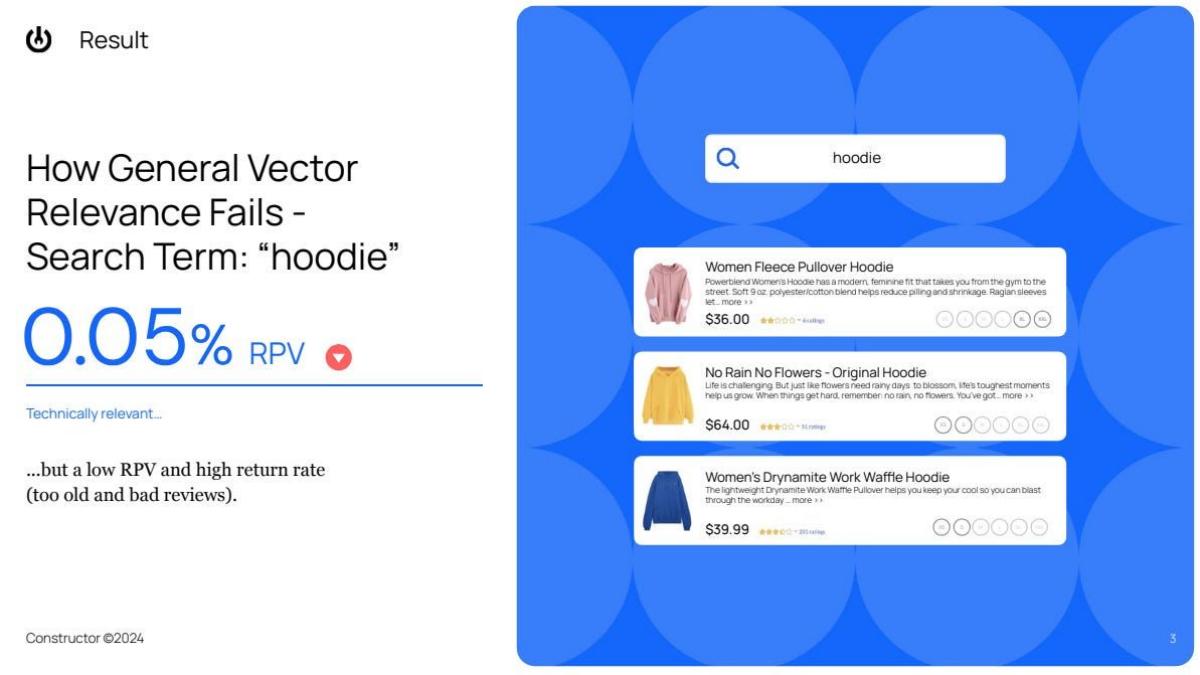
Slides 3 and 4 function as a pair to demonstrate the product in action. Slide 3 shows a search for "hoodie" using "General Vector Relevance." It labels the results as "Technically relevant... but a low RPV and high return rate." The metric provided is a dismal 0.05% RPV. This slide identifies the 'hidden' problem in e-commerce: search results can be accurate to the word but terrible for the business because they surface old products or items with bad reviews.
Slide 4: The Transformer Advantage
Slide 4 provides the 'After' picture. Using their "Transformers & Attractive Results" approach, the same search term yields a 1.5% RPV. This is a 30x improvement over the previous slide. By using a concrete example of a common search term, Constructor makes the value of their AI tangible. They define their winning results as "Attractive + Precise," emphasizing that search must be both relevant to the user and profitable for the merchant.
Slide 5: The Implementation Roadmap
One of the biggest hurdles in enterprise software is the fear of a long, painful implementation. Slide 5 addresses this with "Four Simple Steps To Get You Started." It outlines a path from beacon installation to an AI dashboard. The inclusion of a "joint business case" in Step 3 is a sophisticated sales touch, showing that Constructor aligns its success with the customer's financial goals. The visual of the dashboard shows "Ranking Factors" like "Item attractiveness" and "Personal attractiveness," giving a glimpse into the UI without over-complicating the slide.
Slide 6: The Gold Standard of SaaS Metrics
Slide 6 is arguably the most important slide for a Series B investor. It displays Gross Revenue Retention (GRR) and Net Revenue Retention (NRR) over a three-year period (FY22 to FY24). The GRR is exceptionally stable, dipping only slightly from 97.9% to 97.4%. However, the NRR story is the highlight: it grew from 102.7% to 118.2%. This indicates that once a customer starts using Constructor, they expand their usage significantly. The slide attributes this to geographical expansion and new use cases like "recommendations and quizzes." This is the definition of a 'sticky' product.
Slide 7: Operational Efficiency
The final slide shows headcount by functional area. Total headcount grew from 131 to 177. The most telling detail is the G&A (General & Administrative) bar, which stayed flat at 7 people while the company added 46 people to R&D and S&M. This demonstrates extreme operational leverage. Investors love to see that new capital is being funneled into product development and sales rather than corporate overhead. It paints a picture of a lean, mean, growth machine.
What Works in This Deck
Quantified Outcomes: Constructor doesn't just say they are better; they cite specific percentage lifts for named enterprise clients. This removes the need for investors to guess if the product works.
Technical Defensibility: By mentioning they are "not Lucene," they immediately differentiate themselves from the hundreds of search wrappers built on open-source libraries. It suggests a deeper, more difficult-to-replicate technology stack.
Retention Cohorts: The NRR growth from 102% to 118% is the strongest signal in the deck. It proves that the product has a land-and-expand motion that works at scale.
Visual Clarity: The deck uses a consistent blue and white palette with clear, high-contrast charts. It looks like a modern enterprise tool, matching the brand's positioning.
What Is Missing
The Team: There is no slide introducing the founders or key executives. While less critical at Series B, it is still unusual to omit the leadership's pedigree entirely.
Market Size (TAM): The deck assumes the investor already knows that enterprise e-commerce search is a multi-billion dollar opportunity. There is no mention of the Total Addressable Market.
Competitive Landscape: While they mention "outdated keyword engines," they don't name competitors like Algolia or Bloomreach. A competitive matrix is a standard feature that is absent here.
The Ask: The deck does not state how much they are raising or how they intend to use the funds. This reinforces the idea that this was a supplemental deck for an audience already familiar with the deal terms.
Lessons for Founders
Focus on RPV, not just CTR: In e-commerce, Click-Through Rate (CTR) is a vanity metric if those clicks don't lead to sales. Constructor's focus on Revenue Per Visitor (RPV) is a lesson in aligning your product metrics with your customer's primary business goal.
Show, Don't Just Tell: The 'Hoodie' search comparison is a powerful way to demonstrate AI. Instead of explaining how transformers work, they showed the difference in the results page. Founders should always look for a 'side-by-side' moment to prove superiority.
Highlight Efficiency: If your G&A is low, brag about it. Showing that you can scale your engineering and sales teams without bloating your back office is a huge green flag for late-stage investors.
Use NRR to Tell the Growth Story: New logos are great, but expansion revenue is the lifeblood of a healthy SaaS business. If your NRR is trending upward, make it a full-page highlight.
Frequently asked questions
- Why does the deck omit a team slide?
- At the Series B stage, especially for a company with 177 employees as shown on Slide 7, the 'team risk' is often considered mitigated. Investors at this level are frequently more interested in the scalability of the unit economics and the defensibility of the technology than the individual resumes of the founders, which are likely already known to the lead investors.
- What is the significance of the 'Not Lucene' claim?
- Most search engines are built on top of Lucene (an open-source search library). By stating on Slide 2 that they do not use Lucene, Constructor is signaling to technical investors that they have built a ground-up, proprietary stack that avoids the legacy limitations of general-purpose search tools when applied to complex e-commerce catalogs.
- How does Constructor define its primary success metric?
- Constructor focuses heavily on Revenue Per Visitor (RPV). On Slides 3 and 4, they use RPV as the ultimate arbiter of search quality, contrasting a 'technically relevant' result (0.05% RPV) with an 'attractive and precise' result (1.5% RPV) to show the direct financial impact of their AI.
- What does the headcount slide tell us about their strategy?
- Slide 7 shows that Constructor is heavily weighted toward R&D (110 employees) and Sales & Marketing (60 employees). The fact that General & Administrative (G&A) stayed at exactly 7 people from FY23 to FY24 suggests a highly disciplined approach to overhead and a focus on product-led growth.
- Is this a typical fundraising deck?
- No. This is likely a 'supplemental' or 'data room' deck rather than a first-touch pitch deck. It skips the standard problem/solution narrative and goes straight into technical differentiation and retention cohorts, which is common when a company is in late-stage due diligence or raising from existing insiders.