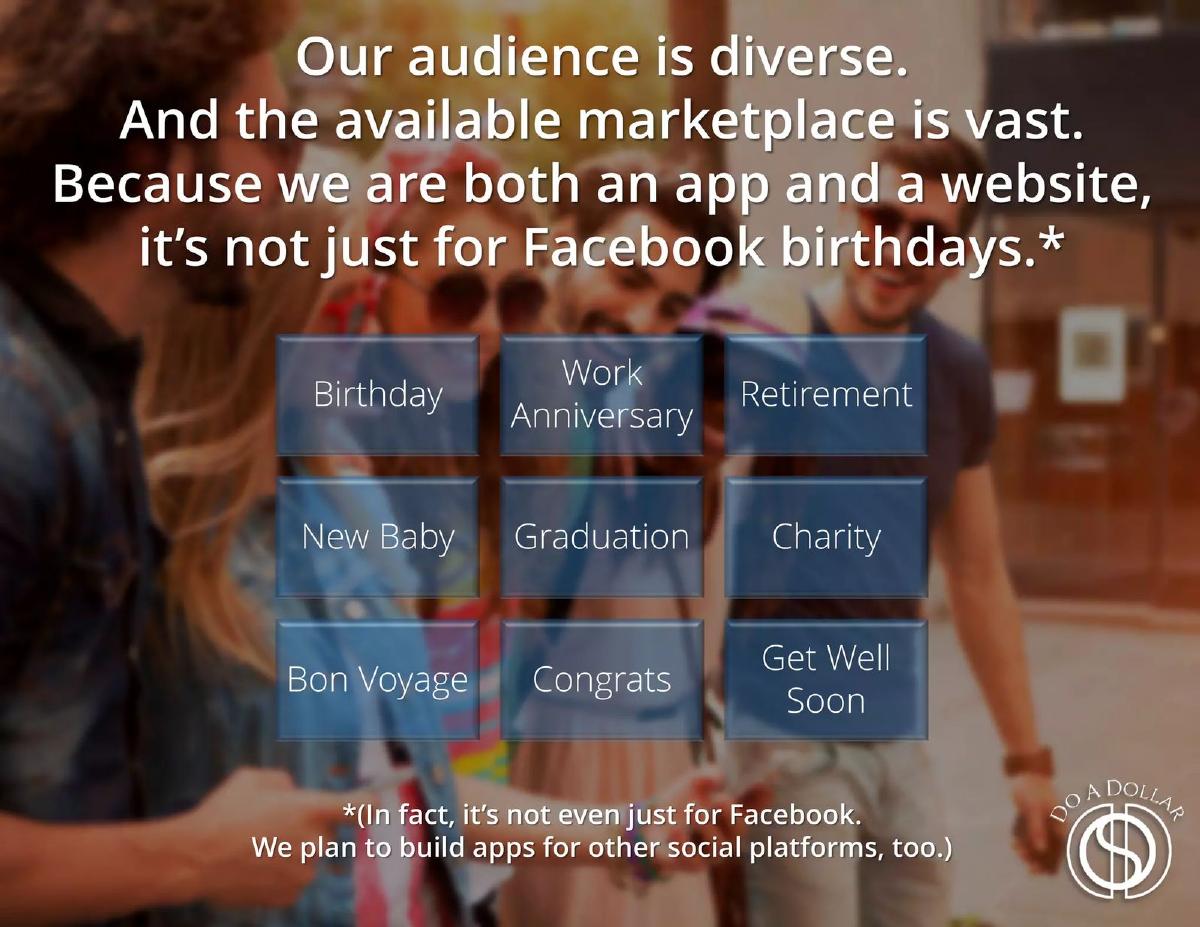
Do A Dollar (DAD) is a social gifting platform aiming to capture the micro-donation and small-gift market by integrating directly with Facebook birthday notifications. The deck, dated late 2016, positions the company as a high-social-functionality, low-friction alternative to traditional crowdfunding and P2P payment apps. By focusing on a 'just do a dollar' mantra, the company seeks to leverage viral effects on social media walls. While the team possesses significant experience in real estate sales, cloud storage, and IT outsourcing, the deck lacks specific financial projections, unit economi…
Key takeaways
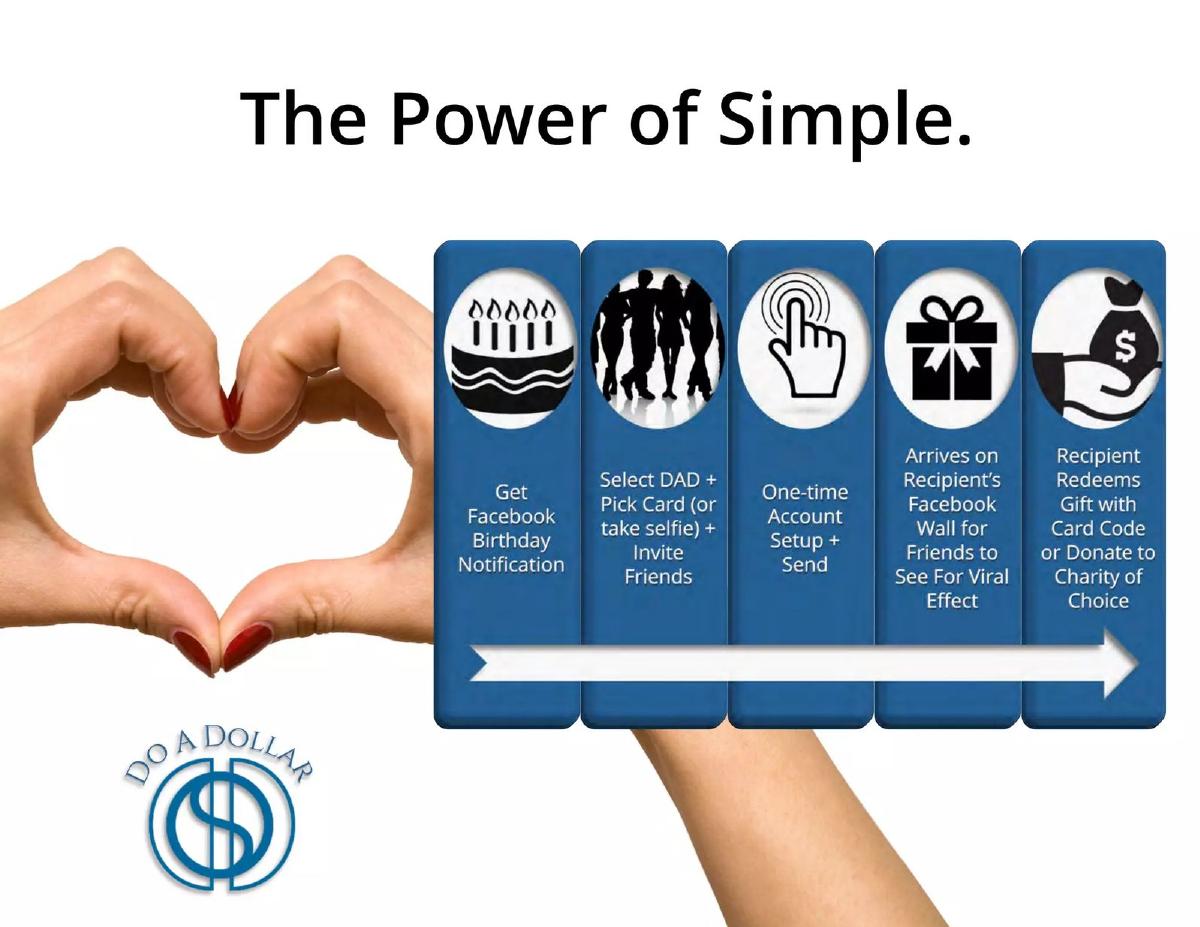
- The platform centers on a five-step user flow triggered by Facebook birthday notifications (Slide 2).
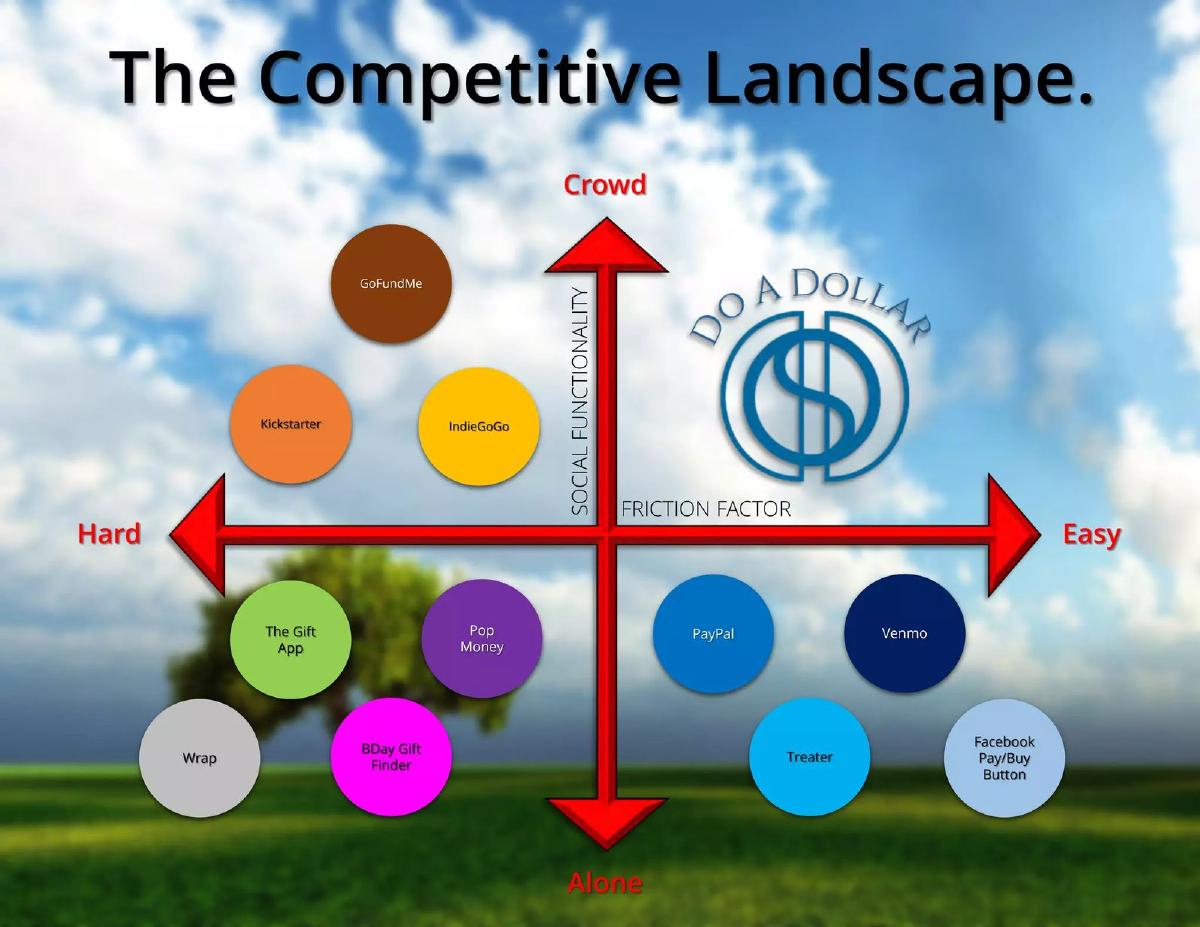
- The competitive landscape positions DAD as having higher social functionality and lower friction than Venmo or PayPal (Slide 3).
- Market penetration strategy relies heavily on cross-social platforms, influencers, and SEO (Slide 4).
- The development roadmap aimed for full platform launch across Web, Android, and iOS by Q4 2016 (Slide 5).
- The company set a growth target of 3,000 daily users within six months of scaling (Slide 5).
- The leadership team includes a Chairman with a background in $500 million of real estate transactions and a CTO with 30 years of IT experience (Slide 6).
- The deck completely omits a business model slide, revenue projections, and the specific investment amount requested.
- The value proposition is built on the 'Power of Simple,' aiming to make 'kindness more convenient' (Slide 1).
Introduction and Value Proposition
Slide 1: Title and Vision
The deck opens with the 'Do A Dollar' logo and a high-altitude landscape image. The central thesis is stated as: 'Despite technology connecting us like never before, simple giving isn’t very efficient. Until now.' The company positions itself as a tool to make 'kindness more convenient' with the tagline 'Just do a dollar.' This slide establishes a mission-driven tone but remains vague about the specific mechanism of the business.
Product and User Experience
Slide 2: The Power of Simple
This slide uses a five-step infographic to explain the user journey. The process begins with a 'Facebook Birthday Notification,' suggesting that the platform is heavily reliant on the Facebook ecosystem for user acquisition and triggers. The steps include selecting a card or selfie, a one-time account setup, and sending the gift. Crucially, the slide notes that the gift 'Arrives on Recipient’s Facebook Wall for Friends to See For Viral Effect.' This indicates that the company views social proof and public gifting as its primary growth engine. The final step allows the recipient to either redeem the gift with a card code or 'Donate to Charity of Choice,' providing a dual-use case for both personal gifting and philanthropy.
Market Positioning
Slide 3: The Competitive Landscape
Do A Dollar uses a standard four-quadrant matrix to map the competition. The Y-axis measures 'Social Functionality' (Crowd vs. Alone) and the X-axis measures 'Friction Factor' (Hard vs. Easy). The company places itself in the top-right quadrant: high social functionality and high ease of use. Competitors like GoFundMe, Kickstarter, and IndieGoGo are placed in the 'Hard/Crowd' quadrant. Traditional payment processors like PayPal and Venmo are placed in the 'Easy/Alone' quadrant. Other niche apps like 'The Gift App,' 'Wrap,' and 'Treater' are scattered across the lower quadrants. By positioning itself here, DAD claims to be the only player that is both socially integrated and frictionless.
Growth and Marketing Strategy
Slide 4: Market Penetration and Channel Strategy
This slide outlines a four-pillar strategy for growth: Social, Referral, Mobile, and Web. The 'Social' pillar focuses on being 'Embedded in Social Platforms' and 'Cross-social platforms.' The 'Referral' pillar mentions 'Promotions,' 'Incentives,' and 'Influencers.' The 'Mobile' and 'Web' pillars list standard digital marketing tactics such as Search, Key Words, Ads, Video, SEO, Banners, and Affiliates. While comprehensive in terms of listing channels, the slide lacks specific details on which channel will be the primary driver or what the projected Customer Acquisition Cost (CAC) might be.
Execution Roadmap
Slide 5: A Swift Path to Launch
The roadmap provides a timeline from late 2016 through mid-2017. Step 01 (Q4-16) focuses on completing platform development across Web, Android, and iOS. Step 02 (Q1-17) involves rolling out the Beta to friends and family. Step 03 (Q1-17) sets a goal of 3,000 new users in the first 30 days through 'grass roots marketing.' Step 04 (Q2-17) aims for 'Scale' via Facebook advertising with a 6-month goal of reaching 3,000 daily users. The targets are relatively modest, suggesting an early-stage seed or pre-seed effort.
Leadership Team
Slide 6: Our Team
The team slide features four individuals with extensive professional backgrounds, though not necessarily in consumer social apps. Ronald Vergara (Chairman & CMO) is described as a leader in Sales and Real Estate Investment with over $500 million in closed transactions. Andy Bui (CTO & Interim CEO) is noted as a business strategist with 30 years of experience and a founder of over 8 companies, including IT outsourcing in Vietnam. Jeffrey Sesol (COO) is credited with growing a cloud-based storage company to 28 million users and another firm from $2 million to $24 million in sales. Henry Joseph (Vice President) is a technology consultant with 25 years of experience. The team appears to have significant operational and technical depth, though the 'Interim CEO' title for the CTO suggests a leadership gap at the time of the deck's creation.
What Do A Dollar Does Well
The deck excels at defining a very specific niche: the 'one dollar' social gift. By tying the product trigger to Facebook birthday notifications, the founders identified a high-frequency, recurring event that naturally prompts social interaction. The competitive matrix is also well-constructed; it doesn't just list competitors but explains the specific dimensions (social vs. friction) where the company intends to win. The emphasis on the 'viral effect' of posting to a recipient's wall shows an understanding of how social platforms can be leveraged for low-cost distribution.
What Is Missing from the Deck
The most glaring omission is the business model. There is no explanation of how Do A Dollar generates revenue. Do they take a percentage of the dollar? Do they charge the sender a fee? Do they make money from the gift card redemptions? Without this, the deck describes a project rather than a business. Additionally, there is no 'Ask' slide. An investor looking at this deck would not know how much money the company is seeking or what the valuation expectations are. Furthermore, the deck lacks any data on the size of the gifting market (TAM/SAM/SOM) or any evidence of early traction beyond the stated goals for the future.
Founder Takeaways
Founders should take note of the clear, step-by-step product explanation on Slide 2. Using simple icons and a linear flow makes a new concept immediately understandable. However, this deck serves as a cautionary tale regarding the 'missing slides.' A pitch deck must answer three fundamental questions: What are you building? How does it scale? And how does it make money? This deck answers the first two but completely ignores the third. Finally, the inclusion of an 'Interim CEO' on the team slide can be a red flag for investors, as it signals instability or a lack of full-time commitment from a dedicated leader.
Frequently asked questions
- What is the primary problem Do A Dollar is trying to solve?
- According to Slide 1, the company believes that despite technological connectivity, 'simple giving isn’t very efficient.' They aim to solve the friction associated with small-scale charitable giving or gifting by making the process more convenient and social, specifically targeting the 'just do a dollar' impulse.
- How does the product actually work for a user?
- Slide 2 outlines a five-step process: 1. Receive a Facebook birthday notification. 2. Select the DAD app and pick a card or take a selfie. 3. Complete a one-time account setup and send. 4. The gift appears on the recipient's Facebook wall for viral visibility. 5. The recipient redeems the gift via a code or donates it to charity.
- Who are the main competitors identified by the company?
- Slide 3 categorizes competitors along axes of 'Social Functionality' and 'Friction.' It lists crowdfunding sites like GoFundMe, Kickstarter, and IndieGoGo as high-friction/high-social. P2P apps like Venmo and PayPal are listed as low-friction but low-social. DAD claims the quadrant of low-friction and high-social functionality.
- What are the key milestones on the company's roadmap?
- Slide 5 details a 'Swift Path to Launch' starting with platform development in Q4 2016. Q1 2017 was slated for beta testing with friends and family, followed by a launch aiming for 3,000 new users in the first 30 days. By Q2 2017, the goal was to scale via Facebook advertising to reach 3,000 daily users.
- What is missing from this investor deck?
- The deck is missing several critical components for a professional fundraise. There is no slide explaining the business model (how they make money), no financial projections, no mention of the total addressable market (TAM), and no 'Ask' slide detailing how much capital is being raised or how it will be used.