Consolidated Water (CWCO) operates in the critical infrastructure sector, providing potable water through seawater desalination in regions with limited freshwater. The deck outlines a business model built on long-term contracts and geographic concentration in the Caribbean, including the Cayman Islands, The Bahamas, Belize, and the British Virgin Islands. A central pillar of their growth strategy is the Rosarito Project in Mexico, a 100 MGD facility designed for both local use and export to the US. Financial data from the first half of 2017 shows steady performance with $31.0 million in reven…
Key takeaways
- The company designs, builds, finances, and operates seawater desalination plants in water-scarce regions (Slide 3).
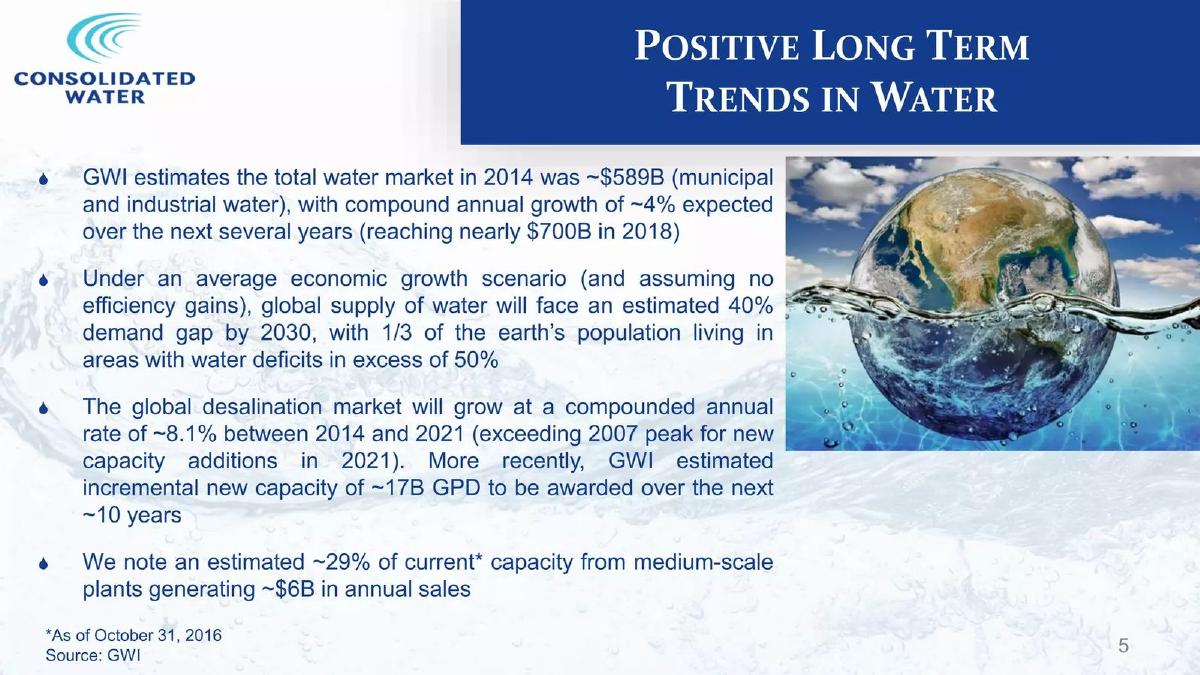
- Global water market demand is projected to face a 40% gap by 2030, with the desalination market growing at ~8.1% CAGR (Slide 5).
- Consolidated Water maintains a significant Caribbean footprint, including 6 plants in the Cayman Islands with 9.0M gallons/day capacity (Slide 7).
- The Rosarito Project in Mexico represents a major organic expansion opportunity with a planned 100 MGD capacity (Slide 9).
- Regulatory and permitting hurdles for the Rosarito Project include seawater allocation permits and federal water discharge permits (Slide 11).
- Diversification is being pursued through the 51% acquisition of Aerex Industries, an OEM for water treatment (Slide 13).
- Revenue grew from $29.4 million in H1 2016 to $31.0 million in H1 2017 (Slide 15).
- Net income from continuing operations remained flat at $4.4 million year-over-year for the first half (Slide 15).
Executive Summary: A Public Infrastructure Play
The Consolidated Water (NASDAQ: CWCO) investor presentation from October 2017 is a classic example of a public company update designed to reassure shareholders of stability while teasing massive upside from a single 'mega-project.' The deck focuses on the essential nature of the product—potable water—and the geographic moats the company has built in the Caribbean. Unlike a startup deck seeking seed capital, this presentation is built to demonstrate operational maturity and the ability to manage complex, multi-decade utility contracts.
Slide 1: Title and Branding
The cover slide establishes the company's identity as a publicly traded entity on NASDAQ under the ticker CWCO. The imagery is split between lifestyle (a beach) and industrial (desalination equipment), immediately signaling the company's primary market: tourist-heavy, water-scarce island nations. The branding is professional and conservative, appropriate for a utility-style investment.
Slide 3: Our Business
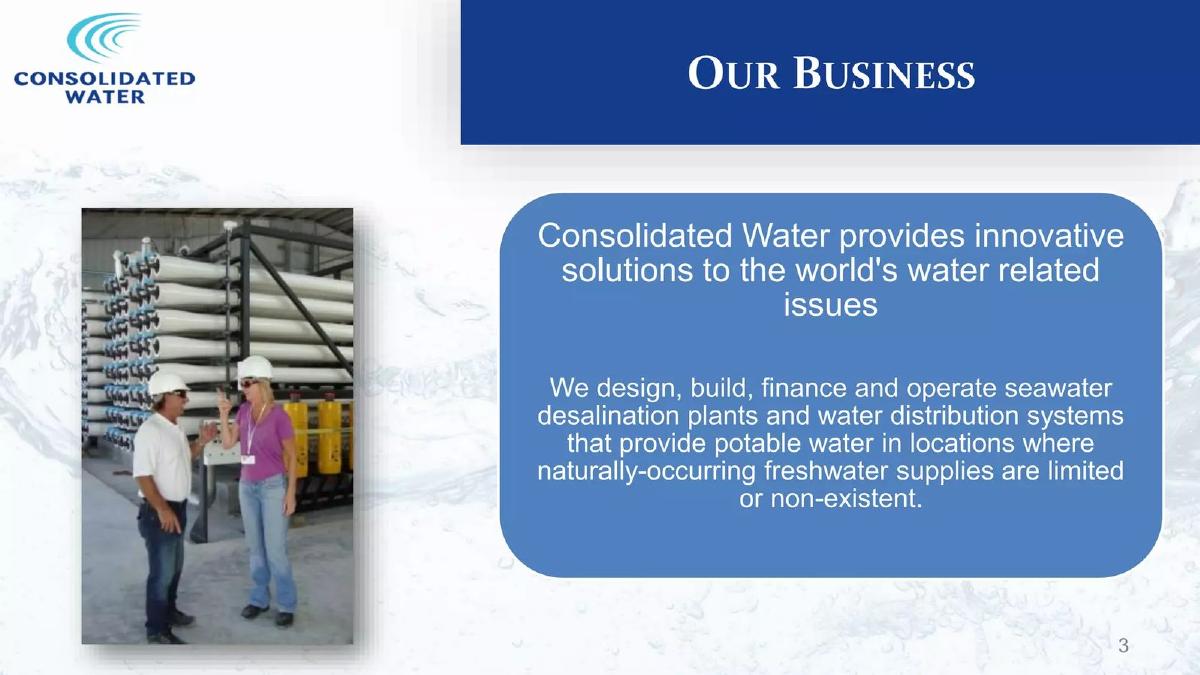
This slide defines the company's value proposition. Consolidated Water positions itself as a full-lifecycle provider: they design, build, finance, and operate seawater desalination plants. The key phrase here is "locations where naturally-occurring freshwater supplies are limited or non-existent." This highlights their niche—operating where there is no competition from traditional groundwater or surface water sources.
Slide 5: Positive Long Term Trends in Water
The company uses Global Water Intelligence (GWI) data to frame the market opportunity. They cite a total water market of ~$589B in 2014 , growing to $700B by 2018 . The most compelling figure is the 40% demand gap projected by 2030. By highlighting that 1/3 of the earth's population lives in water-deficient areas, they justify the long-term necessity of desalination technology. They also note that the desalination market is growing at ~8.1% CAGR , which is double the growth rate of the general water market (~4%).
Slide 7: Consolidated Water’s Footprint
This is the 'traction' slide for an infrastructure company. It lists specific assets and their daily capacities. The Bahamas is their largest current market by volume at 15.2M gallons/day across 3 plants. The Cayman Islands has the highest density of assets with 6 plants. The slide also notes the Mexico project is "under development" with a massive 50.0M + 50.0M gallons/day capacity, which dwarfs their current operational total. This visualizes the company's transition from a regional Caribbean player to a significant North American infrastructure operator.
Slide 9: Organic Expansion Opportunities - Rosarito Project
The Rosarito Project is the centerpiece of the growth narrative. The slide outlines a 100 MGD plant built in two phases. The strategic importance is two-fold: it provides water to Mexico and offers an export opportunity to US markets (likely Southern California). The business model for this project involves a 40-year O&M contract through a joint venture with Suez, ensuring long-term recurring revenue. The mention of "third party non-recourse debt and equity" suggests the company is looking to minimize direct balance sheet risk for this massive undertaking.
Slide 11: Rosarito Project – Next Steps
Transparency regarding regulatory hurdles is vital for public companies. This slide lists the bureaucratic milestones remaining: establishing payment trusts, obtaining seawater allocation permits from federal authorities, and acquiring rights of way for the aqueduct. By listing these, the company acknowledges the complexity and potential delays inherent in large-scale international infrastructure projects.
Slide 13: Consolidation and Diversification via Acquisitions
This slide addresses the risk of being a single-technology company. By acquiring a 51% interest in Aerex Industries in February 2016, Consolidated Water moved into the OEM (Original Equipment Manufacturer) space. Aerex serves as a platform to enter the US water/wastewater O&M market , which is a significant departure from their traditional build-own-operate model in the Caribbean. It represents a shift toward a more diversified service-based revenue stream.
Slide 15: Financial Performance
The financial slide provides a year-over-year comparison for the first half (H1) of 2016 and 2017. Revenue grew from $29.4 million to $31.0 million . Gross profit rose slightly to $13.4 million . However, the net income from continuing operations remained flat at $4.4 million . For investors, this indicates a stable, profitable business, but one that is currently spending its incremental revenue on growth or operational overhead rather than dropping it to the bottom line.
Slide 17: Investment Highlights
The final slide summarizes the bull case. It reiterates the long-term contracts that provide "good visibility" (predictable revenue). A key defensive point is made in the last bullet: "Rosarito investment masks strong core business performance." This is a direct message to analysts that the costs associated with developing the Mexico project are temporarily weighing down the financial statements, and the underlying Caribbean operations remain highly profitable.
What Works in This Deck
The deck excels at geographic clarity . Slide 7 provides a clear, quantified map of exactly where the company makes its money and how much water it produces. For an infrastructure investor, this is the most important data point. The deck also does a good job of framing the macro-opportunity . By using GWI data to show a 40% water demand gap, they move the conversation from "why desalination?" to "how fast can we build it?" Finally, the regulatory roadmap on Slide 11 builds credibility; it shows the management team understands the legal and political complexities of cross-border utility projects.
What Is Missing
The most glaring omission for a modern investor is the lack of ESG (Environmental, Social, and Governance) metrics . Desalination is energy-intensive and has environmental impacts regarding brine discharge. In 2017, these were becoming major investor concerns, yet the deck does not address energy efficiency or environmental mitigation strategies. Additionally, there is no team slide in the provided selection. While this is a public company where the CEO is known, a slide highlighting the engineering and project management expertise required to run these plants would have strengthened the 'Proven operating expertise' claim on Slide 17. Finally, there is no detailed breakdown of the 'US export' opportunity mentioned for the Rosarito project—given the potential size of the US market, more detail on the cross-border infrastructure required would have been beneficial.
Founder Lessons: Copy These Strategies
Quantify Your Moat: If you have geographic dominance or long-term contracts, list them explicitly as CWCO did on Slide 7. Don't just say you are a leader; show the capacity and the number of plants. · Address the 'Masking' Effect: If you are spending heavily on a future project that makes your current financials look weaker than they are, use CWCO's tactic from Slide 17. Explicitly tell investors that your R&D or expansion costs are "masking" the strength of the core business. · Macro-Validation: Use third-party industry experts (like GWI) to validate your market size. It is always more credible than internal projections. · Next Steps as De-risking: Listing the specific permits and agreements needed for a project (Slide 11) might seem like a list of obstacles, but to a sophisticated investor, it is a checklist of de-risking milestones. It shows you have a plan, not just a dream.
Frequently asked questions
- What is the primary technology used by Consolidated Water?
- Based on Slide 3, the company specializes in seawater desalination plants and water distribution systems. They provide potable water to locations where naturally occurring freshwater is limited. The imagery on Slide 2 and Slide 3 suggests industrial-scale reverse osmosis or similar membrane-based filtration systems, though the specific technical specifications of the membranes are not detailed in this deck.
- Where are the company's current operational assets located?
- According to Slide 7, the company's footprint is concentrated in the Caribbean and Central America. Key locations include the Cayman Islands (6 plants, 9.0M gallons/day), The Bahamas (3 plants, 15.2M gallons/day), Belize (1 plant, 0.6M gallons/day), and the British Virgin Islands (2 plants, 0.8M gallons/day). They also have a corporate office and Aerex Industries located in the United States.
- What is the significance of the Rosarito Project?
- Slide 9 identifies the Rosarito Project in Mexico as a massive organic expansion opportunity. It is designed as a 100 MGD (millions of gallons per day) plant to be built in two phases. Notably, the slide mentions the opportunity to export water to US markets and a 40-year operations and maintenance (O&M) contract through a joint venture with Suez.
- How has the company diversified beyond desalination?
- Slide 13 details the acquisition of a 51% interest in Aerex Industries in February 2016. Aerex is an Original Equipment Manufacturer (OEM) and service provider for municipal and industrial water and wastewater treatment. This move allows Consolidated Water to penetrate the US water/wastewater O&M market and diversify its revenue streams beyond plant ownership.
- What are the financial trends shown in the deck?
- Slide 15 compares the first half of 2017 to the first half of 2016. Revenues increased from $29.4 million to $31.0 million. Gross profit also saw a slight increase from $13.0 million to $13.4 million. However, net income from continuing operations remained stagnant at $4.4 million for both periods, suggesting that increased revenues were offset by higher operating costs or investments.