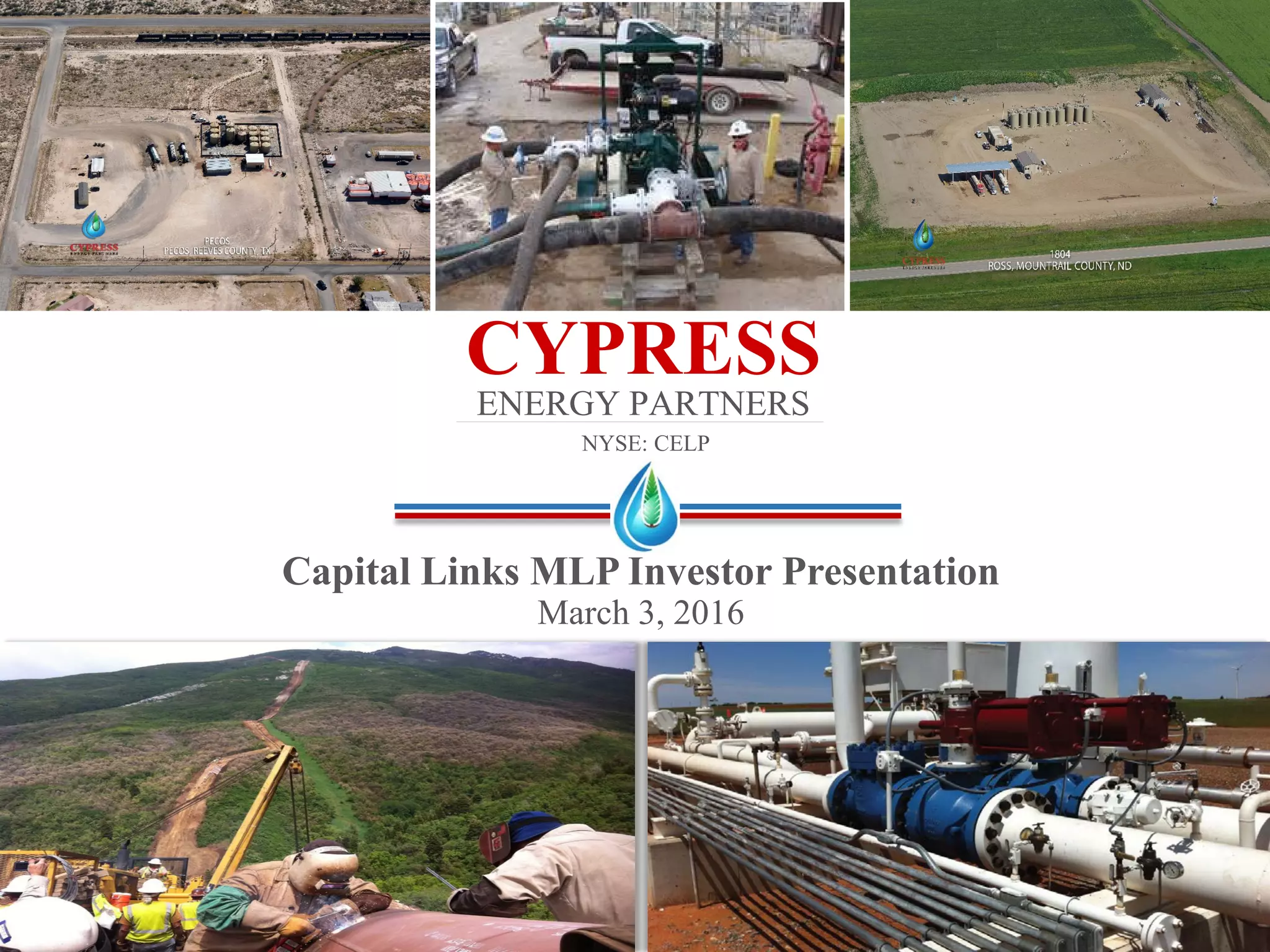
Cypress Energy Partners (CELP) presents a mature, post-IPO investor deck from 2016 that prioritizes stability and regulatory compliance over speculative growth. Operating as a Master Limited Partnership (MLP), the company highlights its two core segments: Water & Environmental Services (W&ES) and Pipeline Inspection & Integrity Services (PIS). The deck is notable for its emphasis on an IRS Private Letter Ruling (PLR), which the company uses as a competitive advantage to expand into non-traditional MLP-eligible areas. With over 80% of revenue coming from investment-grade customers and a fixed-…
Key takeaways
- The company operates under a Master Limited Partnership (MLP) structure, trading on the NYSE under the ticker CELP (Slide 1).
- A significant competitive advantage is a specific IRS Private Letter Ruling (PLR) that allows for tax-advantaged expansion into unique service areas (Slide 7).
- Revenue stability is anchored by a fixed-fee model and the fact that over 80% of revenue is derived from investment-grade customers (Slide 4).
- The Pipeline Inspection segment (PIS) demonstrated a 46% CAGR in TIR revenue from 2010 to 2014 (Slide 16).
- The Water & Environmental Services (W&ES) segment disposed of approximately 52,000 barrels of water per day as of Q3 2015 (Slide 4).
- Management and insiders retain a high level of ownership, holding 65% of the Limited Partner (LP) interests and 100% of the General Partner (GP) interests (Slide 7).
- The company maintains a strong liquidity position with over $180 million available in its credit facility (Slide 7).
- Financial performance in Q3 2015 showed an Adjusted EBITDA of $7.2 million and a distribution coverage ratio of 1.17x (Slide 22).
Executive Summary: The Midstream Service Moat
The Cypress Energy Partners (CELP) investor presentation from March 2016 is a technical document tailored for the Master Limited Partnership (MLP) investor class. Unlike a typical venture capital deck that sells a vision of the future, this deck sells stability, regulatory compliance, and cash flow predictability. The company positions itself as an essential service provider in the North American energy infrastructure space, specifically focusing on the 'unsexy' but mandatory aspects of the industry: water disposal and pipeline safety.
Slide 1: Title and Identity
The cover slide establishes CELP as a publicly traded entity on the NYSE. The imagery is industrial and functional, featuring aerial views of disposal sites and ground-level shots of pipeline welding and infrastructure. It immediately communicates that this is a 'bricks and mortar' industrial play. The sub-header 'Capital Links MLP Investor Presentation' indicates the target audience: institutional investors and analysts familiar with the tax-advantaged MLP structure.
Slide 4: Factors Enhancing Stability
This slide serves as the core value proposition. It breaks the business into three pillars: Stable Product Focus (W&ES), Required Services (PIS), and Stability/Diversity/Growth (CELP). Key metrics cited include that 96% of water in Q3 was produced water (which occurs for the life of a well, ensuring longevity) and that over 80% of revenue comes from investment-grade customers. The slide explicitly mentions a 'Fixed-fee model,' which is a crucial signal to investors that the company is not a wildcatter subject to the whims of oil prices, but a service provider with steady margins.
Slide 7: Investment Highlights
Cypress uses this slide to build credibility through its track record and alignment. They note the company started in 2012 and IPO'd in January 2014. A standout point is the 'Aligned Interests' section, stating that insiders retain 65% of the Limited Partner (LP) interests and 100% of the General Partner (GP) interests. This is a powerful signal in the MLP world, suggesting that management suffers or prospers alongside the common unitholders. They also highlight a $180 million credit facility, emphasizing liquidity.
Slide 10: The Regulatory Moat (IRS PLR)
This is perhaps the most technical yet strategically important slide in the deck. It lists eight specific activities—ranging from the treatment of flowback water to remote monitoring of E&P assets—that qualify as income under their existing IRS Private Letter Ruling (PLR). By securing this ruling, Cypress effectively created a legal barrier to entry, allowing them to operate a wider variety of services within the tax-efficient MLP structure than their competitors might be able to without similar rulings.
Slide 13: PIS Market Dynamics and Customers
Focusing on the Pipeline Inspection & Integrity Services (PIS) segment, this slide uses 2013 data to show a growing market. It cites over $2.1 billion spent on integrity management (up 31% vs. prior year) and 47,000 miles of pipeline inspected (up 34%). The bottom half of the slide is a 'logo wall' featuring industry giants like ExxonMobil, Phillips 66, and Enbridge. This validates the company's market position and the essential nature of its services to the world's largest energy firms.
Slide 16: PIS Revenue and Headcount
This slide provides a historical look at the PIS segment's growth. It claims a 46% CAGR in TIR (Technical Inspection Resources) revenue from 2010 to 2014, growing from $85 million to $382 million. However, the 'Average TIR Inspector Headcount' chart shows a peak of 1,745 inspectors in 3Q13, followed by a decline to 1,406 by 3Q15. This transparency is notable; it suggests a cooling market or a shift in operational efficiency, which a savvy investor would likely question during a Q&A.
Slide 19: W&ES Facilities Overview
To demystify their water disposal operations, Cypress provides a labeled aerial photo of a Salt Water Disposal (SWD) facility in Ross, Mountrail County, ND. It explains the process of subsurface injection, noting that saltwater is injected at depths of at least 4,000 feet. A key business detail is mentioned here: they remove residual 'skim' oil from the water and 'sell the oil,' providing a secondary revenue stream alongside their primary disposal fees.
Slide 22: Consolidated Financial Performance (3Q15)
This slide delivers the 'hard' numbers for the third quarter of 2015. It reports a distribution of $0.406413 per unit ($1.63 annualized) and an Adjusted EBITDA of $7.2 million. The charts show a decline in revenue from $111 million in 3Q14 to $96.4 million in 3Q15, yet Adjusted EBITDA actually rose from $5.3 million to $7.2 million in that same period. This indicates significant margin improvement or a shift toward higher-margin services despite a lower top line.
Slide 25: The Investment Opportunity Summary
The final slide uses a circular graphic to summarize the 'Attractive Investment Opportunity.' It reiterates six themes: Geographic diversity, Independent inspection, Significant industry experience, Fragmented markets, Long life assets, and Growing regulatory focus. It positions the company at the center of 'U.S. energy independence,' a popular political and economic theme of the 2016 era.
What Cypress Energy Partners Does Well
The deck is exceptionally disciplined in its messaging. Every slide reinforces the idea that Cypress is a 'toll booth' business—essential, legally mandated, and insulated from commodity price swings. The inclusion of the IRS PLR (Slide 10) is a brilliant move for a mid-cap MLP, as it highlights a specific legal advantage that larger competitors might not have bothered to secure for these specific niche services. The use of actual facility photos (Slide 19) and specific customer logos (Slide 13) grounds the investment in reality, moving it away from abstract financial engineering.
Omissions and Weaknesses
The most glaring omission is a detailed 'Team' slide. While Slide 7 mentions '200+ years of energy experience,' there are no headshots, names, or specific biographies of the executive leadership in the provided slides. For an MLP, where management's capital allocation skills are paramount, this is a missed opportunity to build personal trust. Additionally, the data in Slide 13 is from 2013, despite the presentation being dated March 2016. Using three-year-old market data can make a company look out of touch with current trends, especially in the fast-moving energy sector.
Founder Takeaways
Founders in industrial or service-based sectors should study how Cypress turns 'boring' regulatory requirements into a 'moat.' By framing their business around 'Required Services' (Slide 4) and 'Growing regulatory focus' (Slide 25), they transform themselves from a vendor into a necessity. Furthermore, the transparency in Slide 22—showing that EBITDA can grow even when revenue falls—is a masterclass in demonstrating operational efficiency to investors. If your business has a specific legal or tax advantage (like the PLR in Slide 10), it should be a centerpiece of your deck, not a footnote.
Frequently asked questions
- What is the primary business model of Cypress Energy Partners?
- Cypress Energy Partners operates as a midstream service provider focusing on two areas: Water & Environmental Services (W&ES) and Pipeline Inspection & Integrity Services (PIS). They utilize a fixed-fee or daily rate model, which insulates them from direct commodity price fluctuations. Their W&ES segment focuses on the disposal of produced water from oil and gas wells, while their PIS segment provides mandatory safety inspections for pipelines.
- How does the company handle commodity price risk?
- According to slide 4, the business is 'resilient' with a 'low correlation to commodity prices.' This is achieved through a fixed-fee model where they charge for services rendered rather than taking ownership of the commodities. Furthermore, their services, particularly pipeline inspections, are required by state and federal laws regardless of the current price of oil or gas.
- What is the significance of the IRS Private Letter Ruling (PLR) mentioned?
- The PLR is a critical regulatory moat. It provides Cypress with official IRS confirmation that their specific diversified service offerings qualify as 'qualifying income' for the MLP structure. This allows them to maintain their tax-advantaged status while expanding into service areas that might otherwise be ineligible for other MLPs, providing a unique growth path (Slide 10).
- Who are the main customers for Cypress Energy Partners?
- The company serves over 200 customers across North America. Slide 13 lists major energy players as 'Key Customers,' including ExxonMobil, Phillips 66, Enbridge, TransCanada, Magellan, and Shell. Over 80% of their revenue is generated from these types of investment-grade entities, reducing credit risk.
- What are the key financial metrics for the MLP's health?
- Investors in this deck are directed toward the distribution coverage ratio and Adjusted EBITDA. In Q3 2015, the company reported an Adjusted EBITDA of $7.2 million and a coverage ratio of 1.17x based on Distributable Cash Flow (DCF) of $5.6 million. This indicates they were generating 17% more cash than needed to cover their quarterly distributions (Slide 22).