Nanonets' Series B deck is a masterclass in demonstrating product-market fit through clear use cases and expansion mechanics. By 2024, the company had already penetrated 34% of the Fortune 500, a metric that anchors their enterprise credibility. The deck moves quickly from the problem of 'trapped data' to specific, high-ROI examples in procurement and customer support. Their business model is particularly compelling, showing a clear transition from simple data extraction ($0.xx per extraction) to complex workflow automation ($0.0x per step). With a 3.7x traffic growth in 12 months and a visio…
Key takeaways
- The company claims 34% of Fortune 500 companies have already used the product as of slide 17.
- Revenue is diversified across departments, with Finance & Accounting representing the largest share at 25% (slide 8).
- The 'Land and Expand' strategy transitions customers from $0.xx per extraction to multi-step workflow pricing (slide 10).
- Traffic grew 3.7x in the 12 months leading up to the 2024 raise (slide 14).
- The founders, Sarthak Jain and Prathamesh Juvatkar, have 13 years of experience building ML together (slide 12).
- Nanonets identifies Accounts Payable as their most dominant finance use case, accounting for 33% of that sector's revenue (slide 9).
- The deck highlights a specific competitive advantage: a SaaS solution takes ~1 month to go live versus 12+ months for in-house builds (slide 20).
- The long-term vision focuses on 'Amorphous Data Layers' to enable interoperability between siloed applications like CRMs and billing software (slide 23).
Executive Summary: The Shift from Extraction to Orchestration
Nanonets' Series B deck, used to raise $29M in 2024, represents a strategic pivot in how AI companies present themselves to investors. In the early days of AI/ML, companies focused on technical accuracy. Nanonets moves past this, focusing instead on workflow orchestration and business ROI . The deck is structured to prove that they are no longer a 'startup' experimenting with tech, but a scaling enterprise engine with significant Fortune 500 penetration.
Slides 1-3: The Problem of Trapped Data
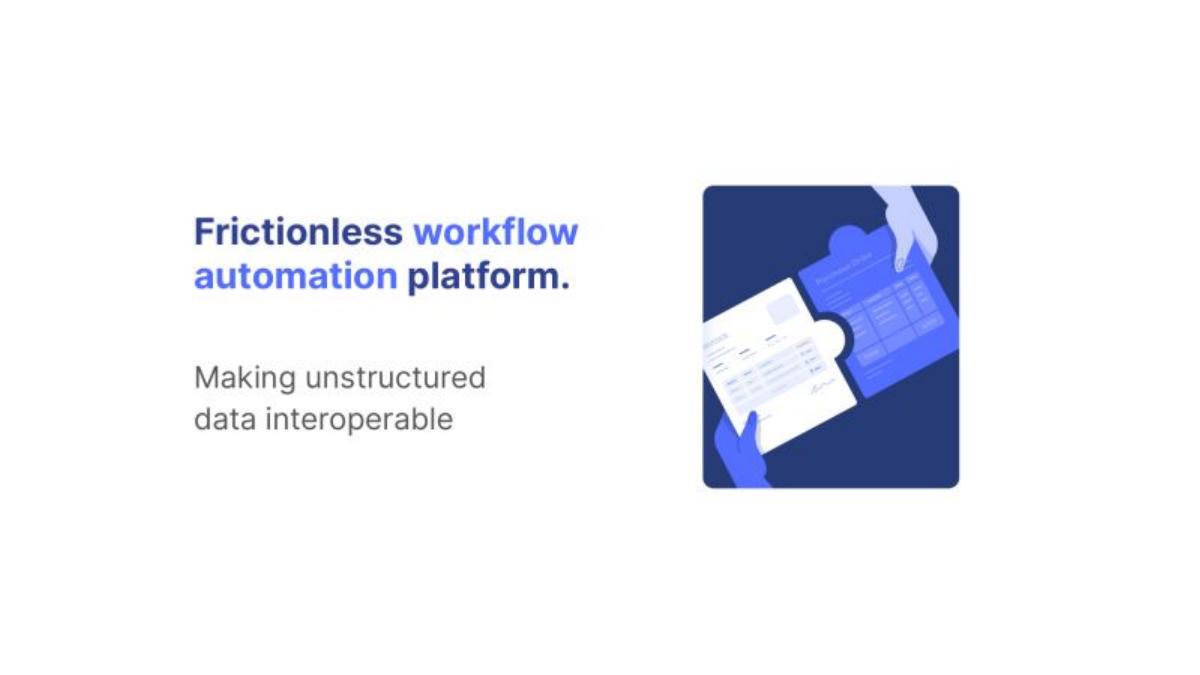
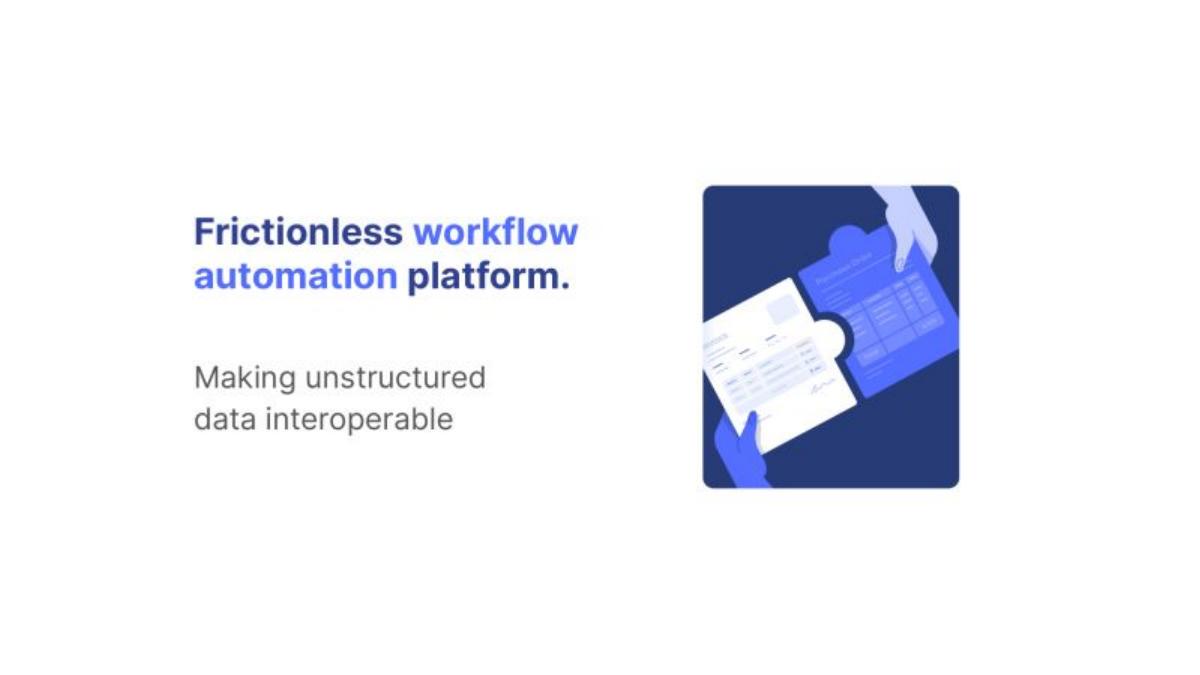
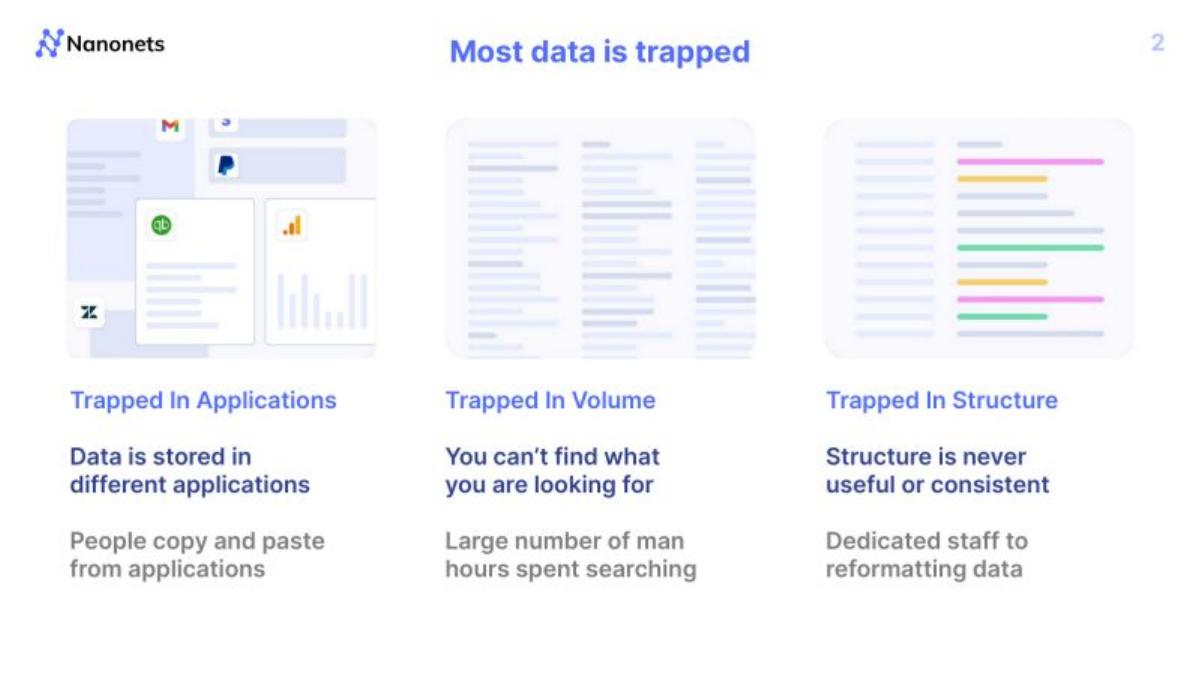
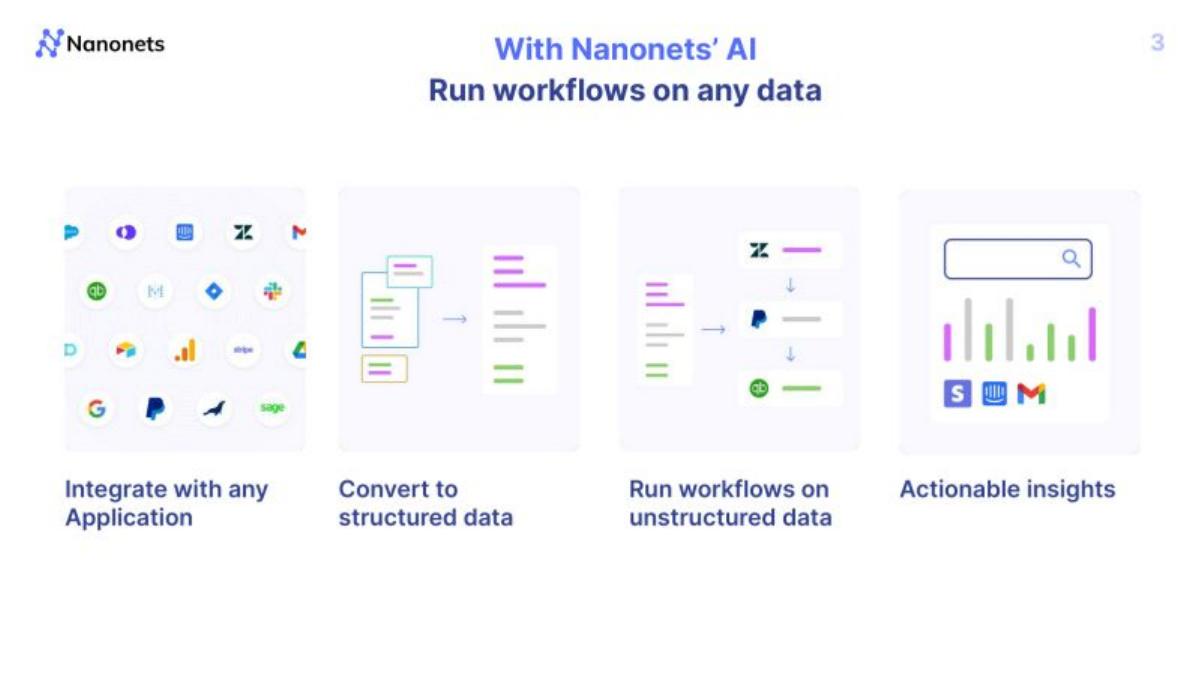
The deck opens with a clear mission: "Making unstructured data interoperable." Slide 2 identifies three specific pain points: data trapped in applications (requiring manual copy-pasting), data trapped in volume (making it unsearchable), and data trapped in structure (requiring dedicated staff for reformatting). Slide 3 introduces the Nanonets solution as a four-step process: Integrate, Convert, Run Workflows, and provide Insights. This sets the stage for a platform play rather than a single-feature tool.
Slides 4-6: Real-World Utility and Customer Pain
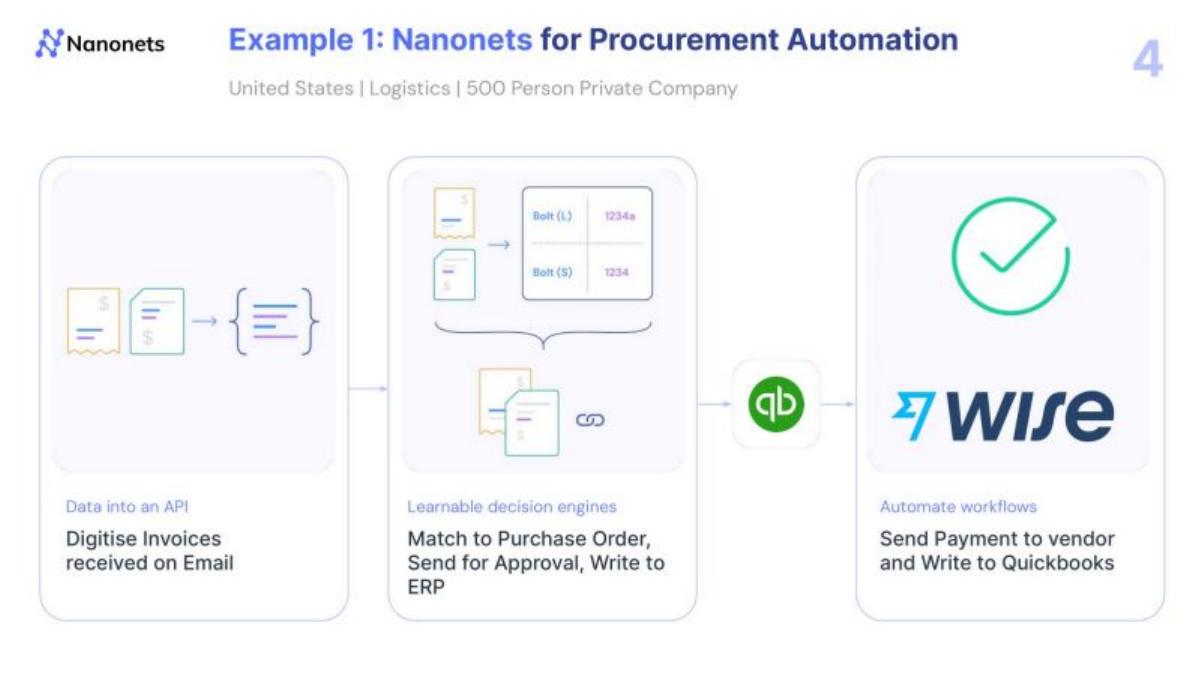
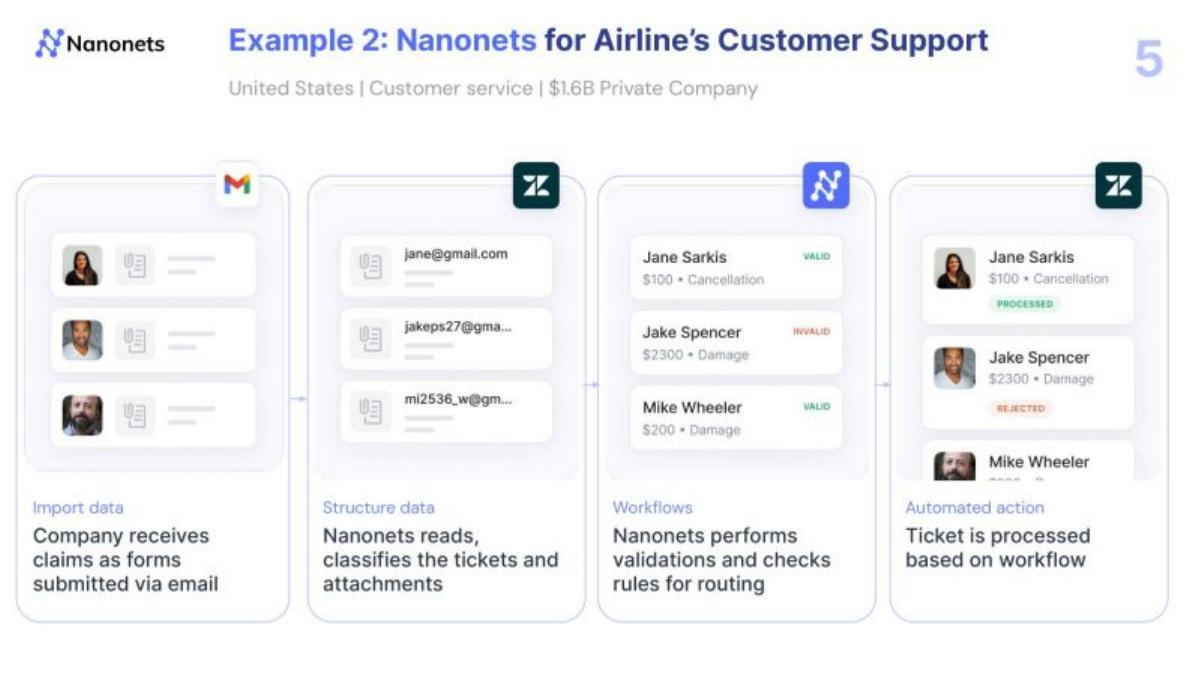
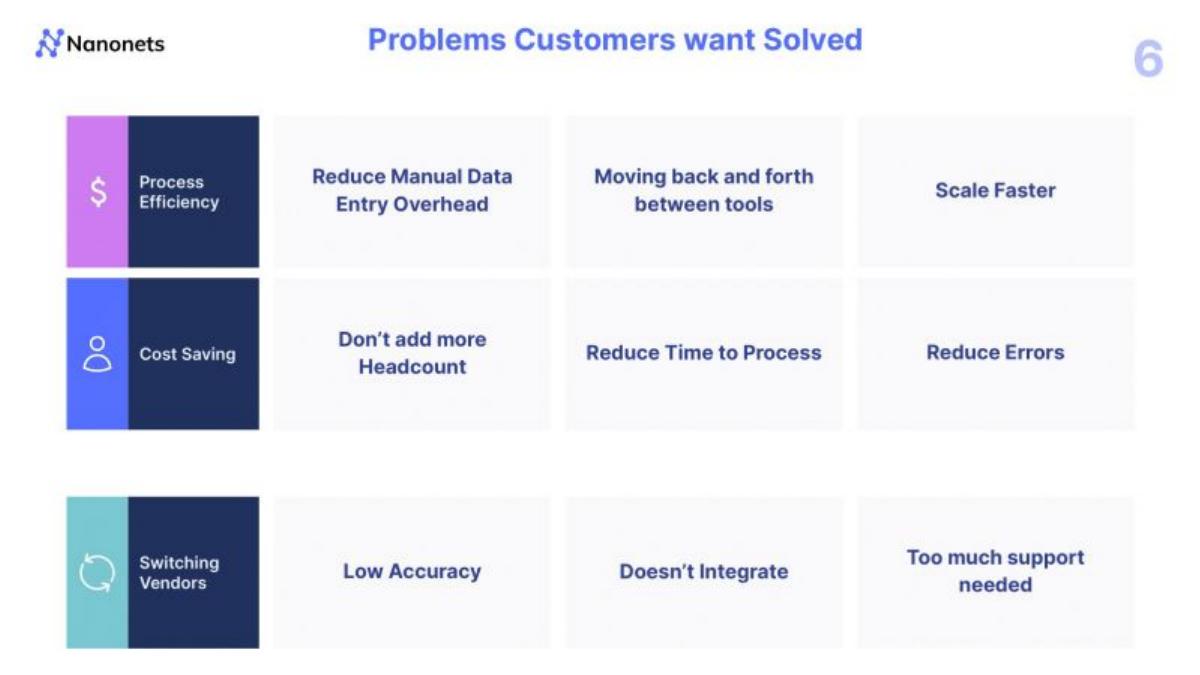
Nanonets uses concrete examples to ground their technology. Slide 4 details a procurement automation use case for a 500-person logistics company, showing a flow from email invoices to Wise payments and QuickBooks entries. Slide 5 shows a customer support use case for a $1.6B airline, where Nanonets classifies tickets and attachments to automate claims processing. Slide 6 categorizes the problems customers want solved into three buckets: Process Efficiency, Cost Saving, and Switching Vendors (due to low accuracy or lack of integration).
Slides 7-9: Market Segmentation and Revenue Distribution
Slide 7 introduces a 'Generate Workflows Instantly' feature, using a natural language prompt to create complex logic across Zendesk, QuickBooks, FedEx, and Shopify. This is a crucial nod to the Generative AI trend. Slides 8 and 9 provide a rare level of transparency regarding revenue. We see that Finance & Accounting is the lead vertical (25%), with Accounts Payable being the single largest use case within that vertical (33%). This data tells investors exactly where the 'wedge' is and where the company has found the strongest product-market fit.
Slides 10-11: The Expansion Engine
The 'Land and Expand' slides (10 and 11) are the most important for a Series B investor. They demonstrate how a small initial contract grows. Nanonets 'lands' with simple data extraction ($0.xx per extraction). As the customer adds volume and data types, they move into 'Workflows,' where Nanonets charges for every automated step. This creates a compounding revenue effect where the platform becomes more valuable (and expensive) as it touches more parts of the customer's stack.
Slides 12-14: Team, Traction, and Growth
Slide 12 highlights the 13-year working relationship between the founders, Sarthak Jain and Prathamesh Juvatkar, and lists their previous exit (Cubeit). Slide 13 shows a bar chart of ARR Projections, indicating a steady upward trajectory from January 2022 through a projected January 2025. Slide 14 shows that web traffic grew 3.7x in 12 months , suggesting a highly effective inbound marketing engine.
Slides 15-17: Go-To-Market and Enterprise Credibility
Slide 15 breaks down their content marketing strategy, showing how they target users based on tasks (Extract Data), industry (State of AP Automation), goals (Write Invoices to QuickBooks), and tools (Convert PDF to CSV). Slide 16 defines their Ideal Customer Profile (ICP), targeting IT Managers, Finance Managers, and CXOs. The 'mic drop' moment is Slide 17, which uses a grid of checkboxes to state that 34% of the Fortune 500 have already used the product. This removes almost all 'buyer risk' for a Series B lead.
Slides 18-20: Technical Moat and SaaS Advantage
Slide 18 explains their 'Deep Learning' loop: a base model is fine-tuned with customer data and human feedback to create a superior customer model. Slide 19 emphasizes the 'Self Serve' nature of the product—Import, Train, Postprocess, and Export—which is vital for scaling without massive professional services teams. Slide 20 compares Nanonets to in-house development, claiming their SaaS solution takes 1 month to go live versus 12+ months for a custom build, with the added benefit of continuous improvement.
Slides 21-23: The Future Vision
The deck concludes by defining the current state of the market (Slide 21: Workflow Automation = Data Extraction + RPA) and their future vision. Slide 22 introduces the concept of "Enabling 5 Person $1B Companies," suggesting that Nanonets will provide the automation backbone that allows tiny teams to operate at massive scale. Finally, Slide 23 visualizes the 'Amorphous Data Layer,' where Nanonets acts as the universal translator between support, CRM, and billing software.
What Nanonets Does Well
Specific Use Cases: Instead of vague promises about 'AI,' the deck uses specific examples (logistics, airlines) and specific integrations (QuickBooks, Wise, Zendesk). · Revenue Transparency: Breaking down revenue by department and use case (Slides 8-9) builds immense trust with investors. · The 34% Stat: Claiming a third of the Fortune 500 as users is a powerful validation of their GTM strategy. · Pricing Logic: Clearly showing the transition from per-extraction pricing to per-step workflow pricing explains the path to a $100M+ ARR company.
What is Missing
Churn and Retention: While the 'Expand' part of the model is shown, there is no data on Net Revenue Retention (NRR) or logo churn, which are critical for Series B. · Specific Financial Totals: The ARR chart (Slide 13) lacks Y-axis denominations. It shows growth, but not the absolute scale of the revenue. · Competitive Landscape: There is no slide addressing competitors like Rossum, Hyperscience, or legacy players like ABBYY. · The 'Ask': The deck does not explicitly state the amount being raised or the intended use of funds (though the catalogue facts confirm a $29M raise).
Founder's Playbook: What to Copy
The 'Land and Expand' Visual: If you have a usage-based model, use Slide 10 as a template. It perfectly explains how a small customer becomes a large one. · Departmental Revenue Breakdown: If your tool is horizontal, show which departments are actually paying the bills. It proves you know your market. · The 'Build vs. Buy' Comparison: Slide 20 is a classic enterprise sales tool. Use it to show the opportunity cost of an investor's capital being spent on a competitor or an in-house project. · The Vision Statement: "Enabling 5 Person $1B Companies" is a sticky, memorable vision that captures the current zeitgeist of AI efficiency.
Frequently asked questions
- What is Nanonets' core value proposition?
- Nanonets positions itself as a frictionless workflow automation platform that makes unstructured data interoperable. According to slide 3, the platform integrates with applications, converts unstructured data into structured formats, runs automated workflows, and provides actionable insights. This solves the problem of data being 'trapped' in different applications, volumes, and structures.
- How does Nanonets generate revenue?
- The company utilizes a usage-based SaaS model. Slide 10 and 11 detail a 'Land and Expand' strategy where they start with simple data extraction (priced per extraction) and expand into complex workflows. Revenue increases as customers add more volume, more data types, and more automated steps (priced per step/workflow).
- Which industries or departments use Nanonets most?
- While applicable across many sectors, Finance & Accounting is their primary driver at 25% of revenue, followed by Supply Chain & Operations (15%), Human Resources (15%), and IT (15%). Within Finance, Accounts Payable (33%) and Payroll Automation (27%) are the top use cases, as shown on slides 8 and 9.
- What is the background of the founding team?
- The team is led by CEO Sarthak Jain and CTO Prathamesh Juvatkar. Slide 12 notes they have been building machine learning solutions together for 13 years across universities and startups. They were previously the founders of Cubeit and are alumni of IIT-GN (2012).
- Who are the primary investors in Nanonets?
- As of the Series B round, the company is backed by Accel India (Lead), Elevation Capital, and Y-Combinator. Slide 12 also lists angel investors who are founders of prominent companies such as BrowserStack, Chargebee, Whatfix, PubMatic, and Ally.