Nanonets successfully raised $10M by framing document processing not just as a technical challenge, but as a massive financial drain on global business. The deck highlights a $1.5 trillion global loss due to manual data entry and counters this with a highly scalable $0.10 per page business model. The company demonstrated exceptional capital efficiency, citing 10x ARR growth in 18 months at zero burn. By contrasting their 'learnable decision engines' against static, rule-based competitors, Nanonets provided a clear technical moat. While the deck omits specific competitor names and hides some c…
Key takeaways
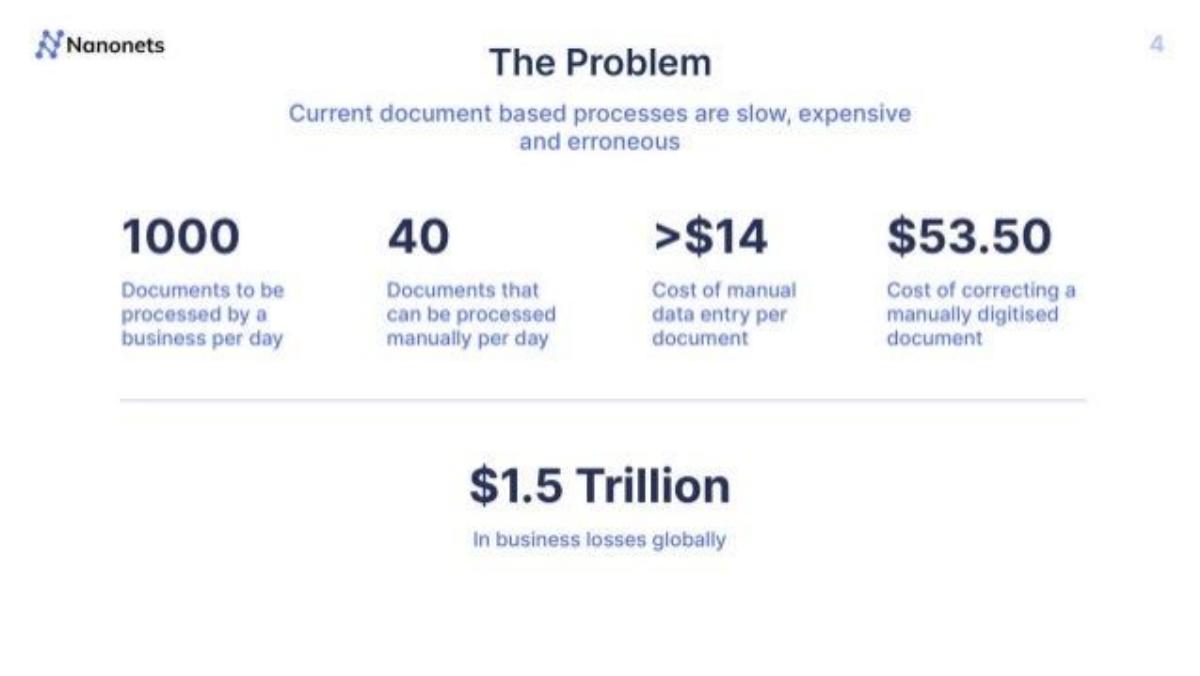
- The problem is quantified as a $1.5 trillion global business loss, with manual data entry costing over $14 per document (Slide 4).
- Nanonets differentiates its AI as a 'learnable system' that improves with more data, unlike static rule-based tools (Slide 8).
- The business model is highly transparent, utilizing a $0.1/page pricing structure and a freemium entry point (Slide 13).
- Financial performance is anchored by a 132% Net Revenue Retention (NRR), indicating strong expansion within existing accounts (Slide 13).
- The company achieved 10x ARR growth over an 18-month period while maintaining zero burn (Slide 14).
- Implementation speed is a key value prop, showing AI training and testing takes roughly 2 days compared to weeks for manual rule-writing (Slide 10).
- The founders emphasize a long-term partnership, noting they have built ML products together for 11 years (Slide 16).
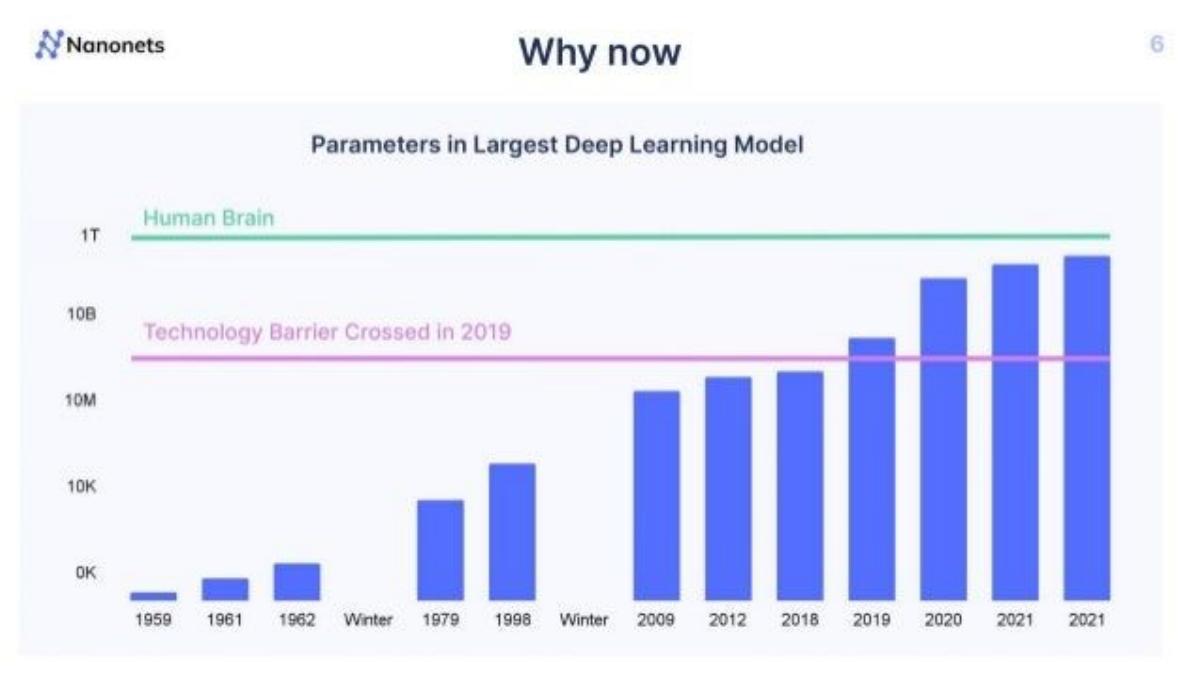
- Market timing is justified by the crossing of a 'Technology Barrier' in 2019 regarding deep learning model parameters (Slide 6).
The Nanonets Series A Teardown
Nanonets provides a look into how a technical SaaS product can bridge the gap between complex AI and practical business ROI. In their 2022 Series A deck, which helped secure $10M, the company avoids the trap of over-explaining the 'how' of their neural networks and instead focuses on the 'how much'—specifically how much money businesses are losing to paper-based workflows.
Slides 1-3: The Hook and the Context
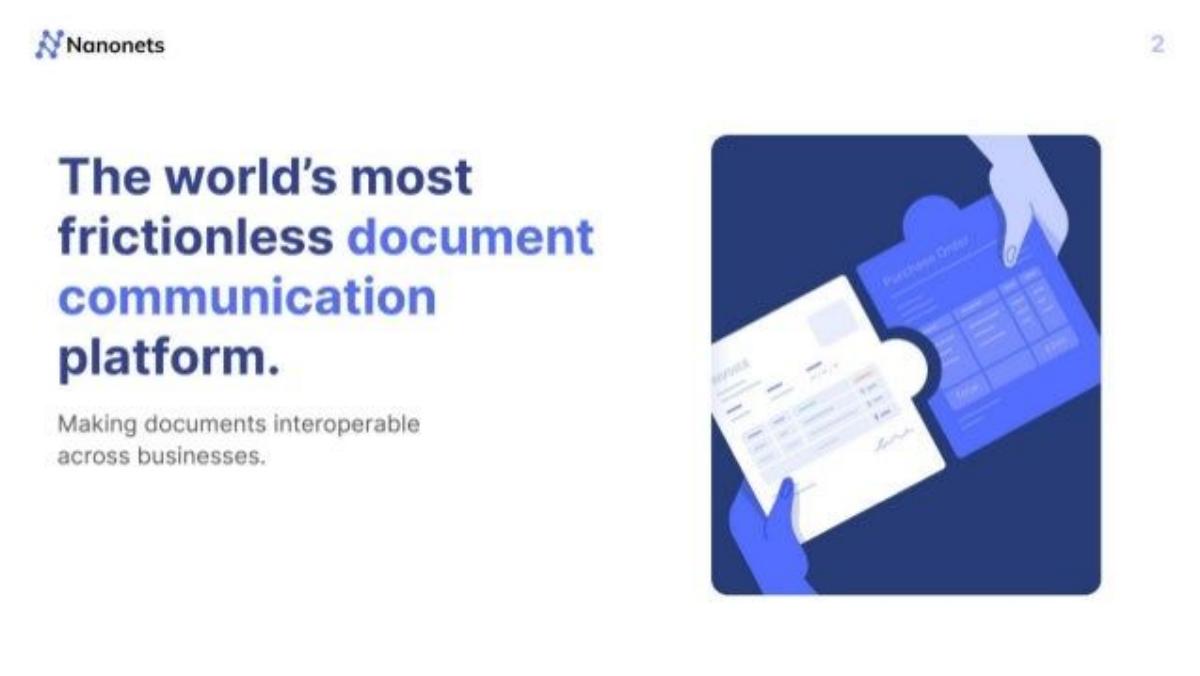
The deck opens with a clean title slide and moves immediately to a vision statement on Slide 2: "The world's most frictionless document communication platform." The use of the word "interoperable" is key here; it signals that Nanonets isn't just a scanner, but a layer that allows different business systems to talk to one another. Slide 3 sets the temporal context, using the "It's 2022 and we're still..." trope to highlight the absurdity of manual record-keeping in a digital age.
Slide 4: The Economic Problem
This is arguably the most important slide in the deck. Nanonets quantifies the pain with four specific metrics: 1,000 documents processed per business per day, a manual capacity of only 40 documents per day, a cost of >$14 per manual entry, and a staggering $53.50 cost to correct errors. By rolling this up into a $1.5 trillion global loss figure, they transform a boring back-office task into a massive market opportunity.
Slides 5-7: The Solution and Market Timing
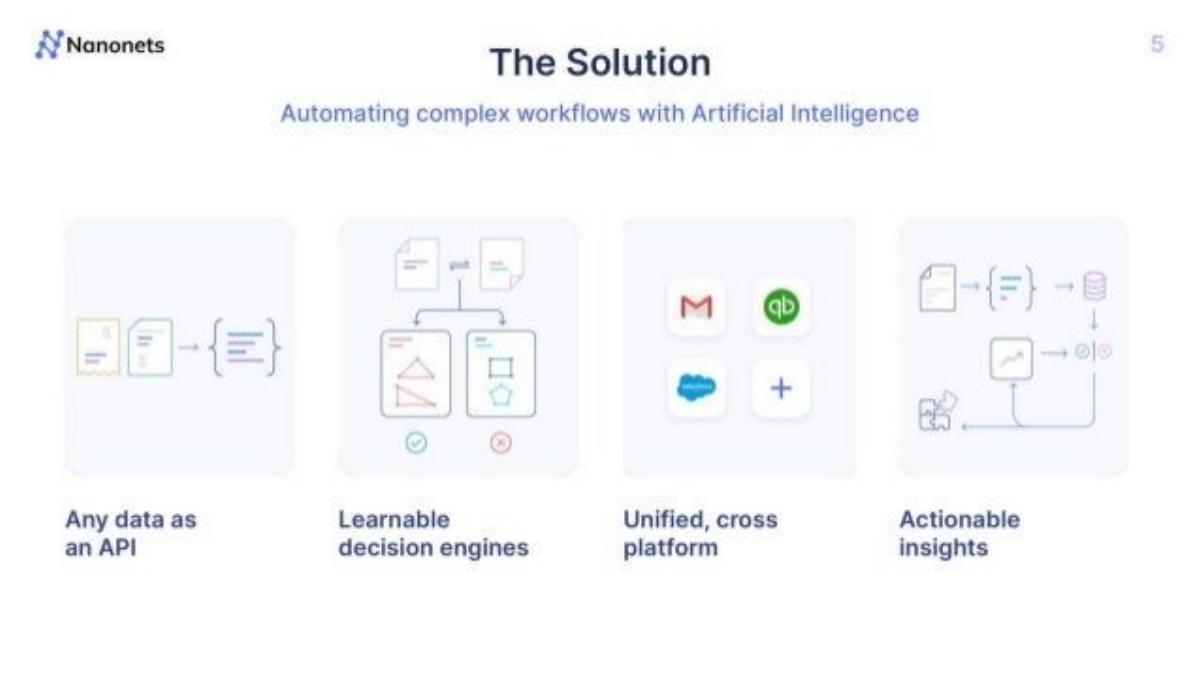
Slide 5 introduces the solution as "Automating complex workflows with Artificial Intelligence," highlighting four pillars: API integration, learnable engines, cross-platform utility, and actionable insights. Slide 6 addresses "Why now" by charting the growth of deep learning parameters, claiming a "Technology Barrier" was crossed in 2019. This gives investors confidence that Nanonets is riding a new wave of capability rather than fighting in the old OCR market. Slide 7 projects the industrial automation software market growing to $60.83 billion by 2028 with a 36.8% CAGR for Intelligent Document Processing.
Slides 8-10: Technical Differentiation
Nanonets uses Slide 8 to create a clear divide between themselves and "Traditional OCR" or "AP Only Tools." The checkmarks emphasize that Nanonets is self-learning and works from day zero. Slide 9 uses a conceptual graph to show that as the number of documents increases, Nanonets' accuracy increases while effort reduces—the inverse of rule-based systems. Slide 10 visualizes the "Time to go live," showing that AI training replaces weeks of engineering rules and testing, allowing a company to be "Ready to process" by day three.
Slides 11-12: Product Walkthrough
Slide 11 provides a four-step process flow: Import, Analyze, Initiate, and Monitor. This simplifies a complex technical process into a digestible workflow. Slide 12 shows actual product screenshots, which is vital for a Series A deck to prove the product is real and functional. It highlights the UI for reviewing data and viewing insights, reinforcing the "IT Friendly" claim made earlier.
Slides 13-15: The Business Engine
Slide 13 details a very simple business model: $0.1/page. This transparency is rare in enterprise SaaS decks but highly effective for modeling. They also list a 132% NRR (Net Revenue Retention), though they use "XX%" placeholders for churn and free trial conversion in this public version. Slide 14 is the "Traction" slide, showing a steep revenue curve and the impressive claim of "10x ARR in 18 Months at 0 Burn." Slide 15 provides a forward-looking ARR growth projection through 2026, though specific dollar amounts are redacted.
Slides 16-17: The Team and Conclusion
The team slide (Slide 16) focuses on the two founders, Sarthak Jain and Prathamesh Juvatkar. The standout metric here isn't their education, but the fact that they have been "building Machine Learning Products together" for 11 years. This mitigates co-founder conflict risk. The deck ends on Slide 17 with contact information and a San Francisco HQ address.
What Nanonets Does Exceptionally Well
Quantifying the Cost of Inaction: By assigning a dollar value ($14) to every single document processed manually, Nanonets makes the cost of not buying their software feel irresponsible. Founders often describe the problem qualitatively; Nanonets describes it mathematically.
Structural Advantage: The deck does a great job of explaining why AI is better than rules. Slide 9, showing the divergence of effort and accuracy between ML and rule-based systems, is a perfect visual representation of a technical moat.
Capital Efficiency: The mention of "0 Burn" on Slide 14 is a massive signal to investors. It suggests that the $10M Series A will be used for aggressive growth rather than plugging a leaky bucket.
What is Missing from the Nanonets Deck
The Ask: There is no slide detailing how much they are raising or how they will spend the money. While we know from external records it was $10M, a standard pitch deck usually includes a "Use of Funds" slide to show planned headcount or market expansion.
Named Competitors: While they categorize competitors (Traditional OCR, AP Tools), they don't name the giants in the space (like ABBYY or Kofax). Naming them and explaining exactly why a customer switched from them to Nanonets would have added more weight to the differentiation claim.
Unit Economics: While they show the $0.1/page price, they don't show the cost to process that page. For an AI company, understanding the gross margin on compute costs is critical for long-term viability.
Founder's Guide: What to Copy
Use the "1/Effort" Graph: If your software gets easier to use as the customer uses it more, visualize that. It is the definition of stickiness. · Price by Value Unit: If you can, price your product by the unit of work it performs (pages, transactions, seats) rather than a vague "Pro" tier. It makes the ROI calculation easier for the buyer and the investor. · Highlight Founder History: If you have worked with your co-founder for a long time, put the number of years on the slide. It is one of the strongest signals of company stability. · The "Time to Live" Comparison: Showing a side-by-side timeline of your implementation vs. the status quo (Slide 10) is the best way to prove operational efficiency.
Frequently asked questions
- How does Nanonets justify the 'Why Now' for their AI technology?
- Nanonets uses Slide 6 to show the exponential growth of parameters in deep learning models. They specifically mark 2019 as the year a 'Technology Barrier' was crossed, moving the industry closer to the complexity of the human brain. This suggests that previous attempts at document automation failed due to hardware or algorithmic limitations that have only recently been solved.
- What is the specific cost-saving promise made in the deck?
- On Slide 4, Nanonets breaks down the economics of manual work: it costs over $14 to manually enter data per document and $53.50 to correct a manually digitized document. By offering a $0.10 per page model (Slide 13), they imply a 99% reduction in the primary cost of data entry, excluding the software subscription fees.
- What are the key financial metrics disclosed in the Series A deck?
- The deck highlights three primary financial pillars: 10x ARR growth in 18 months (Slide 14), a 132% Net Revenue Retention rate (Slide 13), and the fact that this growth was achieved at '0 Burn' (Slide 14). These metrics together signal a highly efficient, product-led growth engine that doesn't require excessive capital to scale.
- How does Nanonets compare itself to traditional OCR competitors?
- Slide 8 features a comparison matrix. Nanonets claims to be the only solution offering 'Self learning' and 'Learnable Decision Engines.' They categorize competitors into 'Traditional OCR' and 'AP Only Tools,' critiquing them for being 'Rule Based' and requiring developers or extensive training to set up, whereas Nanonets works 'from day 0.'
- Is there a specific 'Ask' or use of funds slide in this deck?
- No. The 17-slide deck concludes with a team slide and a contact slide. It does not explicitly state the $10M target or how the funds will be allocated across hiring, R&D, or sales. This information was likely reserved for the verbal pitch or a separate supplemental document.