My US Doctor is a medical facilitation platform designed to connect China's growing population of high-net-worth individuals (HNWIs) with elite US healthcare providers. The 2015 deck identifies a target market of over 1 million individuals with assets exceeding $2 million, citing health as their primary concern. The company differentiates itself from existing competitors like Saint Lucia Consulting by offering a proprietary technology engine, mobile medical record management, and a direct network of over 600 Chinese-speaking US doctors. With a $3 million funding ask, the startup plans to scal…
Key takeaways
- The company targets a market of 1,050,000 Chinese HNWIs with assets over $2M as of 2012 (Slide 2).
- My US Doctor claims a competitive advantage through a network of 600+ Chinese-speaking US doctors via an agreement with SCAPE (Slide 6).
- The startup is seeking $3 million in funding to support two years of operations, with $0.6M allocated to marketing and $0.7M to staff recruiting (Slide 6).
- Initial traction includes the completion of 10 medical facilitation cases and obtaining letters of intent from MGM China and Elite Health (Slide 6).
- The team includes a mix of medical, investment, and marketing expertise, featuring an MIT PhD and a former director of the Cancer Center of Chinese Medical Institute (Slide 5).
- The go-to-market strategy relies heavily on high-end Chinese social and media channels, including WeChat, Weibo, and Youku (Slide 4).
- The advisory committee includes high-ranking medical professionals from Stanford, MD Anderson, and major Chinese hospitals (Slide 8).
- The deck identifies two primary exit strategies for investors: acquisition or an initial public offering (Slide 6).
Executive Summary: Bridging the Gap in Global Healthcare
My US Doctor presented this deck in April 2015 at the Boston Seagull Entrepreneurship Contest. The company positions itself as a specialized medical tourism and facilitation platform. The core value proposition is connecting the burgeoning class of Chinese high-net-worth individuals (HNWIs) with elite medical institutions and specialists in the United States. By leveraging a network of Chinese-speaking physicians in the US, the company aims to remove the linguistic and systemic barriers that typically prevent international patients from accessing American healthcare.
Slide 1: Title and Contact Information
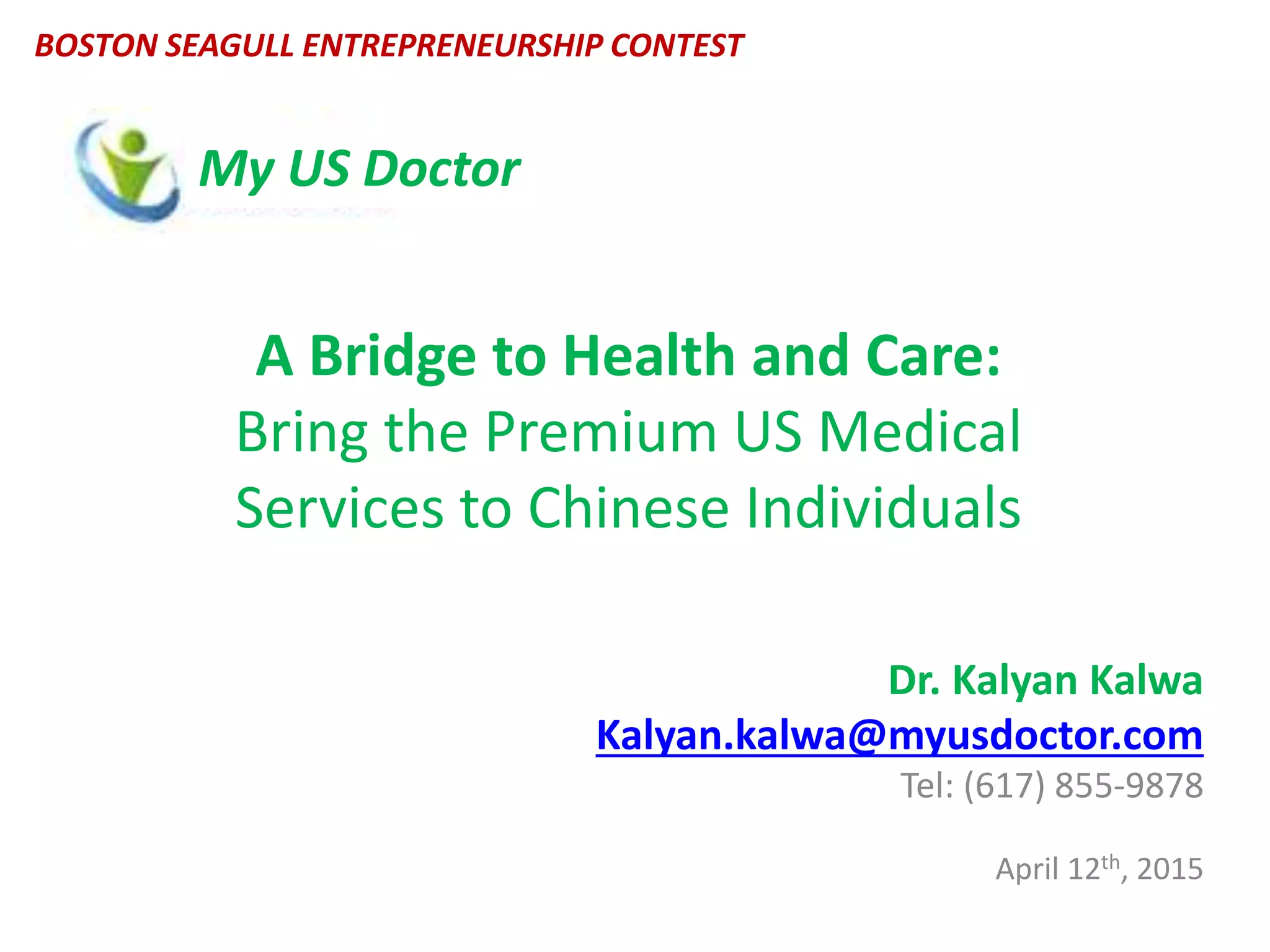
The cover slide introduces the company name, "My US Doctor," and the tagline: "A Bridge to Health and Care: Bring the Premium US Medical Services to Chinese Individuals." It identifies Dr. Kalyan Kalwa as the primary contact and dates the presentation to April 12th, 2015. The branding is simple, utilizing a green and blue color palette that suggests health and professionalism.
Slide 2: Market Opportunity and Problem Statement
Titled "Problems Give Birth to Opportunities," this slide uses data from the 2012 Hurun Report to quantify the target market. It notes there are 1,050,000 individuals in China with assets over $2 million and 64,500 with over $20 million. The slide asserts that health is the primary concern for this group, citing that 25% feel they are not healthy enough and 33% feel they do not exercise enough. A quote attributed to Jack Ma reinforces the sector's potential: "The next person who surpasses me must be from the healthcare industry."
Slide 3: Competitive Landscape
The company compares itself against two established entities: Saint Lucia Consulting (founded 2010) and the Beijing 301 Telemedicine Center (founded 1997). My US Doctor claims superiority by offering features its competitors lack, such as a proprietary US doctor and hospital network, tele-consultation capabilities, online/mobile medical record management, and an online shopping/reservation system. The slide emphasizes that Saint Lucia has "no prop technology" and "no way to choose doctors," while Beijing 301 has "no USA components."
Slide 4: Go-to-Market Plan
The marketing strategy is centralized around the My US Doctor platform, branching out into several high-touch and digital channels. These include:
Team connections with senior corporate executives (e.g., MGM China). · High-end magazines and training agencies. · WeChat public accounts. · Weibo and Youku (video platform). · Hospitals' websites.
This multi-channel approach aims to capture the attention of HNWIs through both professional networks and popular Chinese social media.
Slide 5: The Leadership Team
The deck highlights four key team members, describing them as having "complimentary skills":
Dr. Kalyan Kalwa: Physician, Medical IT, and Founder of Health Innovators (4300 members). · Ning Wu: Peking University graduate, MIT PhD, with 5 years of investment advisory experience involving $3 billion in deal value. · Quinn Place: CPA/CMA with 5 years in wellness product marketing and 3 years in medical facilitation. · Charles Yang: Emeritus Director of the Cancer Center of Chinese Medical Institute.
Slide 6: Status Quo and The $3M Ask
This slide details the company's progress and its financial requirements. Accomplishments include building the technology engine, obtaining letters of intent from MGM China (demand) and Elite Health/Pinnacle Care (supply), and securing a network agreement with SCAPE for 600+ Chinese-speaking US doctors. They also report completing 10 initial cases. The company is seeking $3 million to fund two years of operations, broken down as follows:
Marketing: $0.6M · Doctor recruiting: $0.6M · Staff recruiting: $0.7M · Business development: $0.5M · Office setup: $0.4M · Legal consulting: $0.2M
The slide also lists Acquisition and IPO as potential exit strategies.
Slide 7: Strategic Partnerships (Demand and Supply)
The company elaborates on its "Strong Network and Market Penetrating Capability." On the demand side, it lists MGM China, the United Chamber of Industrial and Commercial Services, and various high-end private clubs and EMBA training centers. On the supply side, it claims partnerships with SCAEP, Elite Health, and Pinnacle Care, and mentions that Boston Children’s Hospital has agreed on market support. It also lists top-tier institutions like Mayo Clinic, Harvard Affiliated Hospitals, MD Anderson, and Johns Hopkins as entities that "want more patients."
Slide 8: Advisory Committee
The final slide in the provided set lists a prestigious advisory committee intended to bolster business development. The list includes:
Dr. Xiang Qian (President of SCAPE) · Dr. Homero Rivas (Medical Director at Stanford Medical School) · Dr. Winston Guo (Former medical director of Brigham Women’s Hospital) · Dr. Dongfeng Tan (Oncologist at MD Anderson) · Dr. Jiren Zhang (Medical director of Southern Medical University in China) · Dr. Yupei Zhao (President of Xiehe Hospital) · Dr. Jie He (President of Tumor Hospital, China Medical Science Institute)
What Works in This Deck
The deck excels at establishing credibility through association. By listing specific, high-ranking individuals on the advisory board and naming world-renowned medical institutions like Mayo Clinic and Johns Hopkins, the founders signal that they have the necessary industry access to execute their plan. The clear quantification of the target market using the Hurun Report provides a solid foundation for the "why now" argument, specifically highlighting the wealth explosion in China during that period. Furthermore, the specific breakdown of the $3M ask shows a level of operational planning that investors appreciate, even if the numbers are rounded.
What Is Missing
The most significant omission is a clear revenue model. While the deck explains what they do and who they serve, it does not explain how they make money. Is it a commission on medical fees, a flat facilitation fee, or a subscription model for HNWIs? Without this, the $3M ask lacks context regarding the path to profitability. Additionally, the deck lacks financial projections. There is no indication of the expected volume of patients or the projected revenue over the two-year period funded by the investment. Finally, the competitive analysis is somewhat one-sided; while it lists weaknesses of competitors, it doesn't address the significant regulatory and legal hurdles involved in international medical facilitation, such as HIPAA compliance or international liability.
Founder Takeaways
Founders in the service-facilitation space should note how My US Doctor uses "Supply and Demand" columns to demonstrate market fit. By showing they have already secured the "supply" (doctors) and have a pipeline for "demand" (MGM China), they reduce the perceived risk of a two-sided marketplace. Another takeaway is the importance of a localized go-to-market strategy. For a company targeting China, mentioning WeChat and Weibo is essential; it shows the founders understand the specific digital ecosystem of their target demographic. However, founders should avoid the mistake of listing prestigious institutions (like Harvard or Mayo Clinic) without clarifying the exact nature of the relationship, as vague claims of "wanting more patients" can sometimes be viewed as a stretch of the truth by discerning investors.
Frequently asked questions
- What is the core problem My US Doctor is solving?
- The deck identifies a lack of access to premium US medical services for high-net-worth Chinese individuals. It notes that health is the largest concern for this demographic, yet existing competitors lack proprietary technology, doctor networks, or online reservation systems. My US Doctor aims to provide a 'bridge' through a tech-enabled platform and a vetted network of US-based, Chinese-speaking physicians.
- How does the company plan to acquire customers?
- The go-to-market plan focuses on high-end channels to reach HNWIs. This includes leveraging the team's connections with senior corporate executives, partnering with MGM China, and advertising in high-end magazines. They also plan to utilize Chinese social media platforms like WeChat (public accounts), Weibo, and Youku, alongside presence on hospital websites to build credibility and reach.
- What is the current stage of the product and business?
- As of the 2015 deck, the company had built its 'technology engine' and completed 10 cases of medical facilitation. They had secured letters of intent from both the demand side (MGM China) and the supply side (Elite Health, Pinnacle Care). Additionally, they established a network agreement with SCAPE, providing access to over 600 Chinese-speaking doctors in the US.
- Who are the key members of the leadership team?
- The team is led by Dr. Kalyan Kalwa, a physician and founder of Health Innovators. He is joined by Ning Wu (MIT PhD with investment advisory experience), Quinn Place (CPA with medical facilitation experience), and Charles Yang (Emeritus Director of the Cancer Center of Chinese Medical Institute). This combination suggests a balance of clinical knowledge, financial acumen, and regional market expertise.
- What are the primary risks or omissions in this deck?
- The deck lacks a detailed business model or pricing structure, making it unclear how the company generates revenue per case. There are no financial projections beyond the use of funds for the $3M raise. Furthermore, while the advisory board is prestigious, the deck does not specify the level of day-to-day involvement these advisors have in the startup's operations.