Movecrop is a logistics and telecom platform tailored for the e-commerce sector, offering a dual-interface system comprising a web application for agents and a mobile app for field workforces. The deck emphasizes its integration capabilities with major regional third-party logistics providers like Grab, AhaMove, and NinjaVan. A standout feature of the presentation is the high-level market validation, specifically citing a partnership with Vietnam Post involving 30,000 shippers. The business model is a straightforward SaaS play with three tiers ranging from $45 to $80 per month, though the dec…
Key takeaways
- The platform consists of a back-end web application for operations management and a front-end mobile app for field workforce synchronization (Slide 2).
- Integration is a core value proposition, connecting management systems like POS and ERP with third-party carriers including Grab, be, and J&T Express (Slide 3).
- The reporting dashboard, 'INSIGHT 360', provides real-time data on order volume, shipping fees, and COD values (Slide 4).
- Market validation is demonstrated through a partnership with Chinh Nhan/Nguyen Kim, an IT hardware distributor with 40 shippers (Slide 5).
- The company claims significant scale through a partnership with Vietnam Post, involving 30,000 shippers (Slide 6).
- The business model is a tiered SaaS subscription: Basic ($45/mo), Popular ($70/mo), and Advance ($80/mo) (Slide 7).
- Pricing tiers are differentiated by the number of shippers, partners, and the inclusion of email/SMS integrations and portals (Slide 7).
- The deck highlights technical capabilities such as creating orders and shipments via API and status updates via Webhooks (Slide 3).
Movecrop Pitch Deck Analysis
Movecrop enters the logistics technology space with a clear focus on the Vietnamese market, positioning itself as a bridge between e-commerce operations and the physical delivery of goods. The deck is structured to emphasize product functionality and existing market traction. It presents a solution that is both a management tool for back-office staff and a tactical tool for drivers on the road. By integrating with a wide array of established logistics giants in the region, Movecrop attempts to solve the 'last-mile' visibility problem that plagues many growing e-commerce brands.
Slide 1: Title Slide
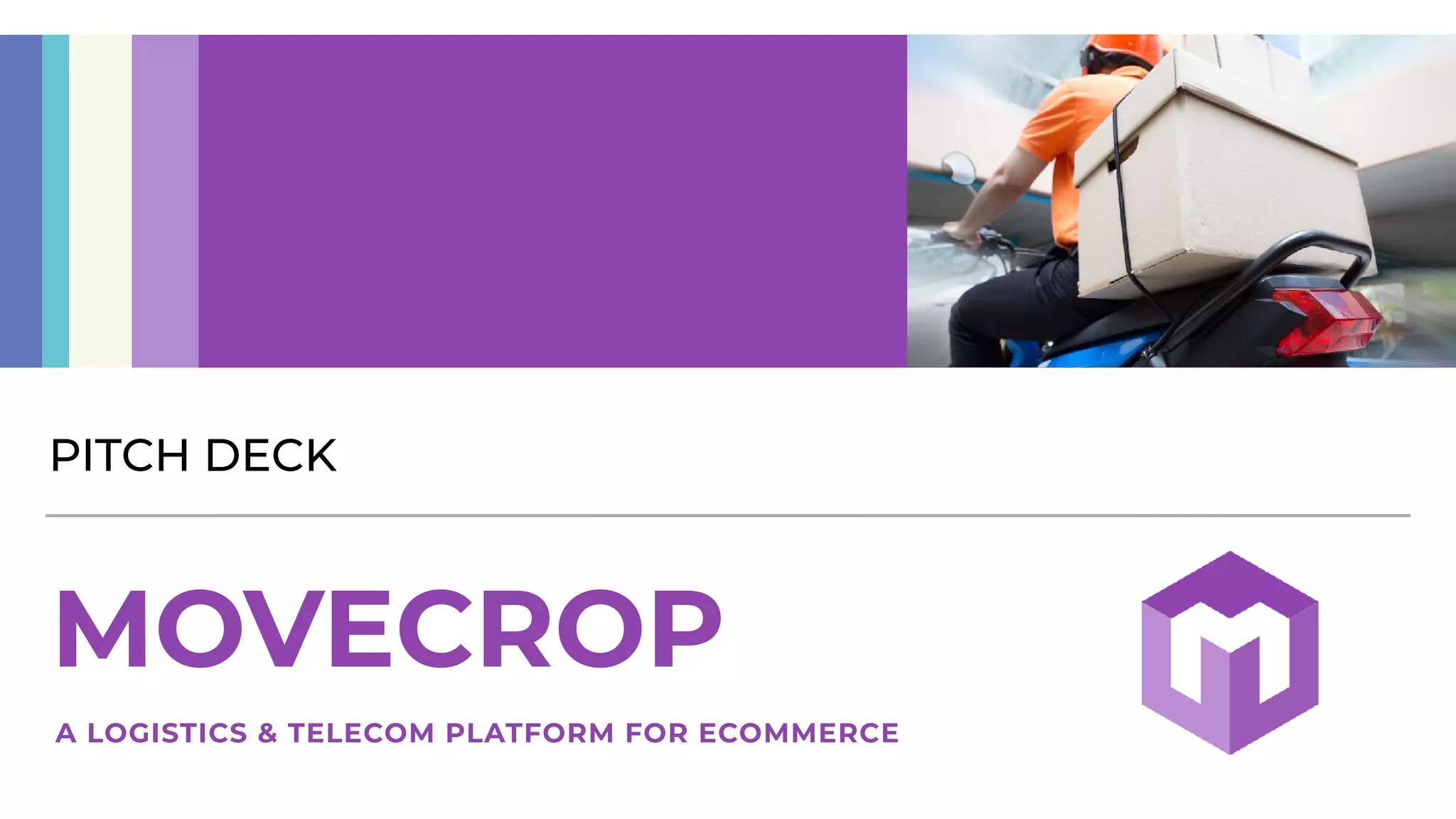
The cover slide establishes Movecrop as a "Logistics & Telecom Platform for Ecommerce." The visual branding uses a purple color palette and a geometric 'M' logo. The imagery of a delivery driver on a motorbike immediately signals the last-mile delivery focus, which is particularly relevant in the high-density urban environments of Southeast Asia. The inclusion of "Telecom" in the subtitle is an interesting choice that suggests the platform may handle SMS or voice communication between drivers and customers, though this is explored later in the feature lists.
Slide 2: The Solution
Slide 2 defines Movecrop as a "logistics fleeting management solution." It breaks the product down into two primary components: Back-end and Front-end . The back-end is described as a web application for agents to manage and monitor operations, while the front-end is a mobile application for the field workforce to synchronize activities. This dual-sided approach is standard for modern logistics SaaS, ensuring that data flows from the road back to the office in real-time. The slide claims to solve "all the problems which were mentioned," referring to a problem slide that was not included in this specific selection of slides.
Slide 3: Integration Ecosystem
This is perhaps the most critical slide for understanding Movecrop's place in the value chain. It shows the platform sitting in the center of four distinct groups: Management Systems (E-commerce software, POS, CRM, ERP), Third Parties (AhaMove, NinjaVan, GHN, Viettel Post, Grab, be, J&T Express), Mobile App (the driver interface), and Receivers (the end customer). The slide details the technical methods of connection, including API for creating orders and shipments, and Webhooks for status updates. This positioning suggests Movecrop is an orchestration layer rather than a carrier itself.
Slide 4: Reporting and Analytics
Slide 4 showcases the "INSIGHT 360" dashboard. The screenshot is in Vietnamese, confirming the primary target market. It displays metrics such as total orders (62), total shipping fees (1,155,670), and total COD value (76,719,999). The dashboard includes a line graph showing order trends over time and bar charts ranking shippers by performance. The presence of "COD" (Cash on Delivery) as a top-level metric is a specific nod to the Southeast Asian market, where COD remains a dominant payment method for e-commerce.
Slide 5: Market Validation - Chinh Nhan / Nguyen Kim
The first case study focuses on an IT hardware supplier and distributor. The slide lists four specific uses for the platform: controlling shipping orders, monitoring delivery status, verifying delivery processing, and optimizing productivity. It notes the business has 40 shippers. This slide serves to prove that the platform works for mid-sized private enterprises with their own small fleets.
Slide 6: Market Validation - Vietnam Post
Slide 6 provides a much larger scale of validation. It states that VNPOST (Vietnam Post) has chosen Movecrop to "utilize social resources" for handling shipping orders. The most significant figure on this slide is the mention of 30,000 shippers . If accurate, this represents a massive enterprise-grade deployment. The slide suggests Movecrop is used as a communication platform for the entire ecosystem, which aligns with the "Telecom" mention on the title slide.
Slide 7: Product and Business Model
The final slide in this set outlines the SaaS pricing strategy under the "Movecrop Basic" banner. There are three tiers:
Basic: $45 / month. Includes 10 Shippers, 10 Partners, and 10 Agents. It lacks Email/SMS integration and Portals. · Popular: $70 / month. Includes 20 Shippers, 20 Partners, and unlimited Agents. It adds Email/SMS integration and Portals. · Advance: $80 / month. Includes 30 Shippers, unlimited Partners, and unlimited Agents.
The pricing is relatively low, suggesting a volume-based strategy or a focus on the SMB (Small and Medium Business) segment. However, the jump from 20 to 30 shippers for only an extra $10 seems like a narrow upsell path. There is no mention of an enterprise tier, which is surprising given the Vietnam Post case study mentioned on the previous slide.
What Works in This Deck
The Movecrop deck succeeds in clearly defining its technical role within a complex ecosystem. By showing exactly how it sits between a company's ERP and third-party delivery services like Grab or NinjaVan, it answers the "how does this fit into my current workflow?" question immediately. The inclusion of API and Webhook details (Slide 3) appeals to the technical buyer or a CTO evaluating the platform's extensibility.
The market validation is also a strong point. Citing Vietnam Post (Slide 6) gives the company instant credibility. In the world of logistics, scale is everything, and claiming to support a network of 30,000 shippers is a powerful signal to investors that the technology is robust enough to handle high-concurrency environments and large-scale data processing.
What is Missing from This Deck
While the product and validation are clear, several standard fundraising components are missing from these slides: Unit Economics and Financials: Beyond the $45-$80 monthly pricing, there is no information on Customer Acquisition Cost (CAC), Lifetime Value (LTV), or current Monthly Recurring Revenue (MRR). Investors need to see the growth trajectory, not just the price list.
The Team: There is no slide introducing the founders or their background in logistics or telecom. In early-stage startups, the 'who' is often as important as the 'what.' The Ask: The deck does not state how much capital is being raised, the valuation, or how the funds will be allocated (e.g., 50% engineering, 30% sales). Competitive Landscape: While they show integrations with carriers, they don't show how they differ from other logistics SaaS platforms or internal tools built by the carriers themselves.
What a Founder Should Copy
Founders should emulate the Integration Map found on Slide 3. Many B2B SaaS companies struggle to explain their place in a crowded tech stack; Movecrop uses a simple flow chart to show exactly where data originates and where it ends up. This reduces the cognitive load for the investor.
Additionally, the tiered pricing table on Slide 7 is a good example of how to clearly differentiate features. By using a simple grid, they make it obvious why a customer would want to upgrade (e.g., moving from Basic to Popular to get SMS integration). This clarity is essential for demonstrating a clear path to increasing Average Revenue Per User (ARPU).
Final Thoughts on the Movecrop Pitch
Movecrop presents a functional, utility-driven deck that focuses heavily on the product's ability to integrate and scale. The validation from Vietnam Post is the 'hook' that would likely get a VC to take a meeting. However, to close a round, the founders would need to supplement these slides with a deep dive into their financial performance and the specific expertise of their leadership team. The low price points suggest a need for high volume, and the deck would benefit from showing a clear pipeline of other enterprise-level customers similar to VNPOST to prove that their success isn't limited to a single large contract.
Frequently asked questions
- What specific problem does Movecrop solve for e-commerce businesses?
- Movecrop functions as a 'logistics fleeting management solution.' It addresses the fragmentation between internal management systems (like CRM and ERP) and external delivery services. By providing a centralized backend for agents and a mobile app for drivers, it allows businesses to monitor delivery status, verify processing, and optimize productivity across multiple third-party logistics providers.
- How does Movecrop's pricing model scale with business growth?
- The pricing model scales based on the volume of shippers and the depth of feature access. The 'Basic' plan at $45/month supports 10 shippers, while the 'Advance' plan at $80/month supports 30 shippers and offers unlimited partners and agents. This suggests the current model is targeted at small to mid-sized fleets rather than massive enterprises, despite their Vietnam Post validation.
- Which third-party logistics providers are integrated into the platform?
- Slide 3 explicitly lists several major Southeast Asian logistics and delivery brands as integrated third parties: AhaMove, NinjaVan, GHN (Giao Hang Nhanh), Viettel Post, Grab, be, and J&T Express. This positioning allows Movecrop to act as a neutral orchestration layer for businesses that don't rely on a single carrier.
- What kind of data does the 'INSIGHT 360' reporting tool provide?
- Based on Slide 4, the reporting dashboard tracks four primary KPIs: total orders (Tong van don), total shipping fees (Tong phi giao hang), total COD value (Tong gia tri COD), and total delivery turns (Tong luot giao hang). It also includes heatmaps and performance tracking by specific shipper and geographic region.
- Is there evidence of large-scale enterprise adoption in the deck?
- Yes, Slide 6 highlights a partnership with Vietnam Post (VNPOST). The slide states that VNPOST uses Movecrop to utilize social resources for handling shipping orders and to create a communication platform for all parties in the ecosystem. Most notably, it cites a scale of 30,000 shippers, which is significantly larger than their other listed case study.