Motatos, operating as Matsmart in its home market, uses its 13-slide Series C deck to position itself as a critical infrastructure layer for the FMCG industry rather than just a discount e-tailer. By focusing on the 'Prevention' tier of the food waste hierarchy (Slide 3) and showcasing a roster of 300+ global suppliers including Coca-Cola and Nestlé (Slide 5), the company demonstrates a dual-value proposition: solving inventory headaches for brands while providing 20-90% discounts to consumers. While the deck is notably light on unit economics and specific revenue figures, it leans heavily on…
Key takeaways
- The deck frames food waste as a €1 trillion annual global problem, grounding the business in a massive total addressable market (Slide 2).
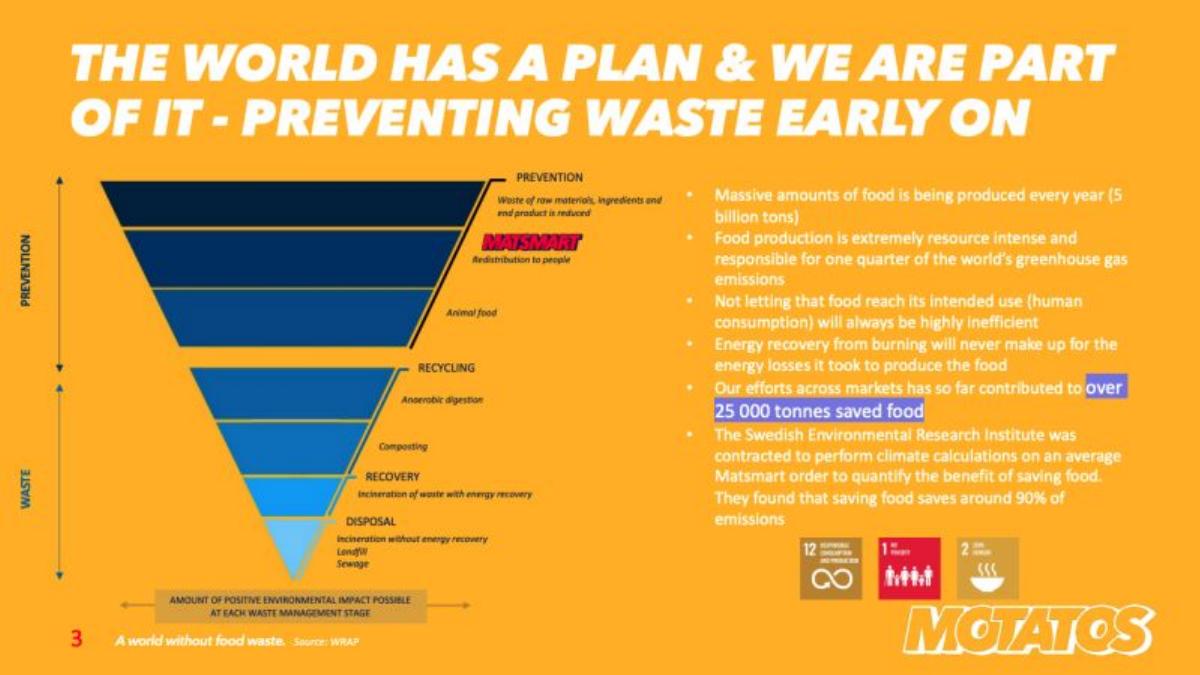
- Motatos positions itself at the top of the waste management hierarchy under 'Redistribution to people,' which offers the highest environmental impact (Slide 3).
- The company reports having saved over 25,000 tonnes of food across its active markets (Slide 3).
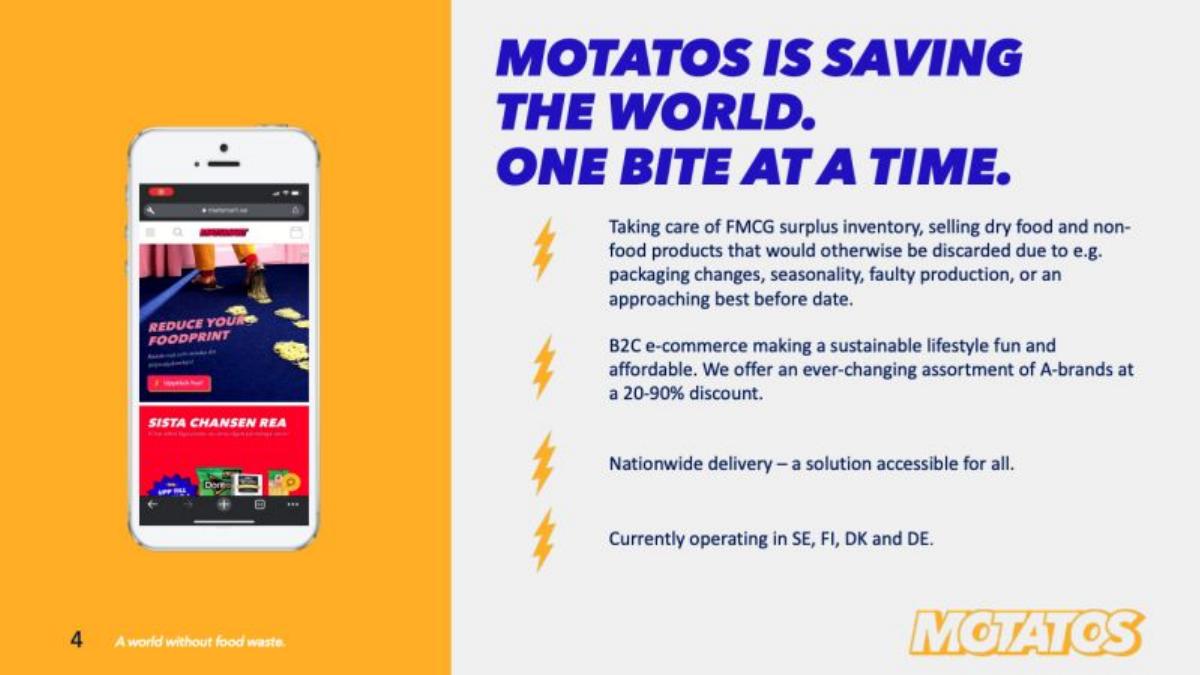
- Assortment consists of A-brands offered at a 20-90% discount to the end consumer (Slide 4).
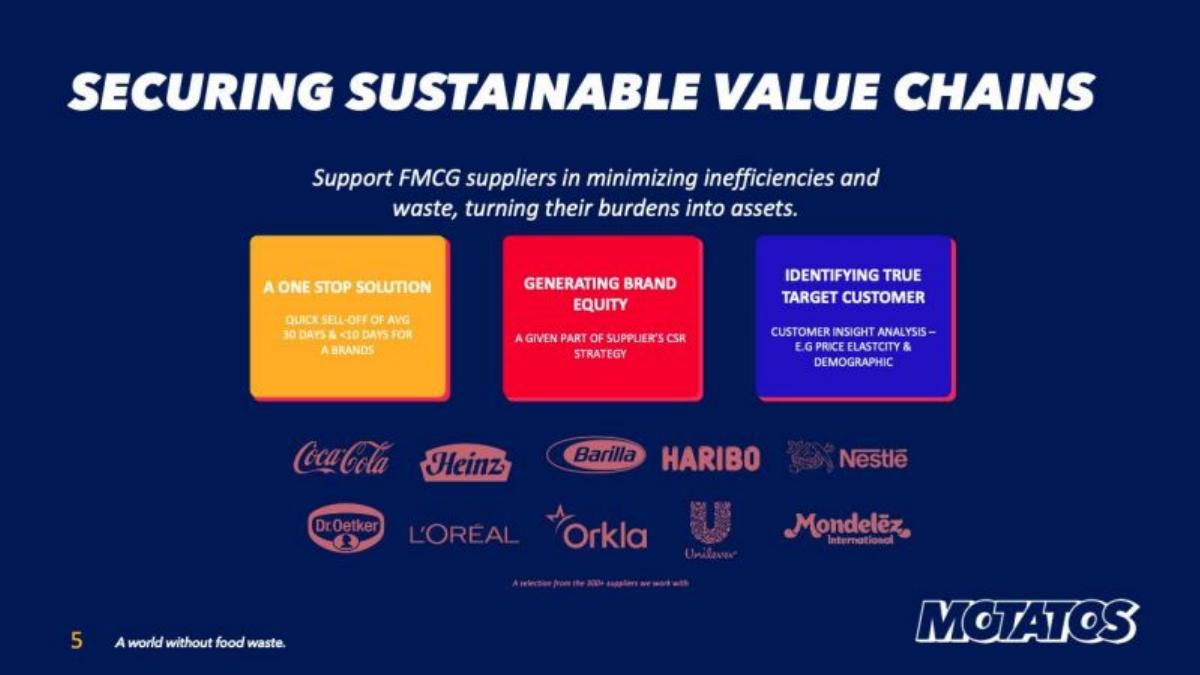
- The B2B value proposition focuses on quick sell-off times, averaging 30 days and under 10 days for top-tier brands (Slide 5).
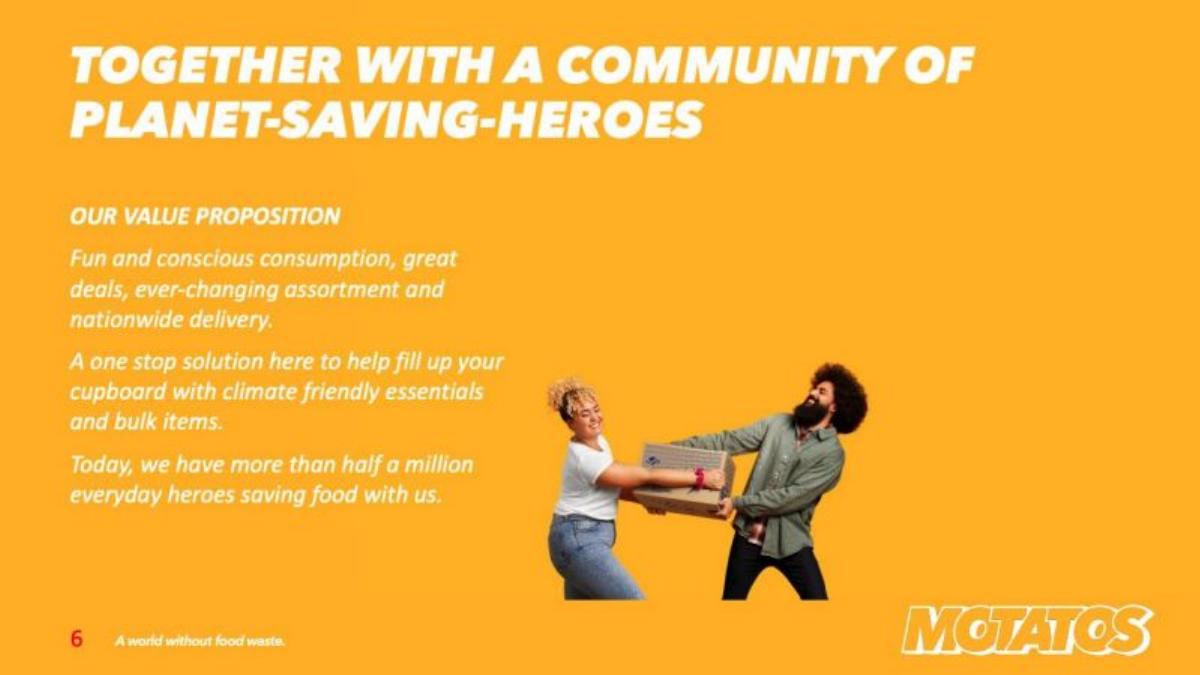
- The platform has reached a scale of more than half a million 'everyday heroes' or active customers (Slide 6).
- Logistics infrastructure is split between a Nordic Hub and a German Hub, supported by major partners like DHL and PostNord (Slide 7).
- Real-world case studies, such as the Coca-Cola 'fat can' transition, illustrate how the company solves specific manufacturing surplus issues (Slide 10).
The Narrative Strategy: Mission Meets Market Efficiency
The Motatos (Matsmart) pitch deck from November 2021 is a compelling example of how a growth-stage company can use environmental impact to reinforce a business model's defensibility. At the Series C level, investors are typically looking for scale and unit economics. While Motatos is light on the latter, it excels at proving the former through its logistics footprint and blue-chip supplier list. The deck uses a high-contrast, energetic visual style—bold reds, deep blues, and bright yellows—to move away from the 'drab' aesthetic often associated with sustainability and discount retail.
Slide 1: Title and Branding
The cover slide introduces the dual branding of Matsmart and Motatos. The imagery of a child in a superhero cape sets a tone of 'heroic' consumption, which is a recurring theme throughout the deck. It establishes the date as November 2021, placing this raise in a period of significant e-commerce tailwinds.
Slide 2: The Problem Statement
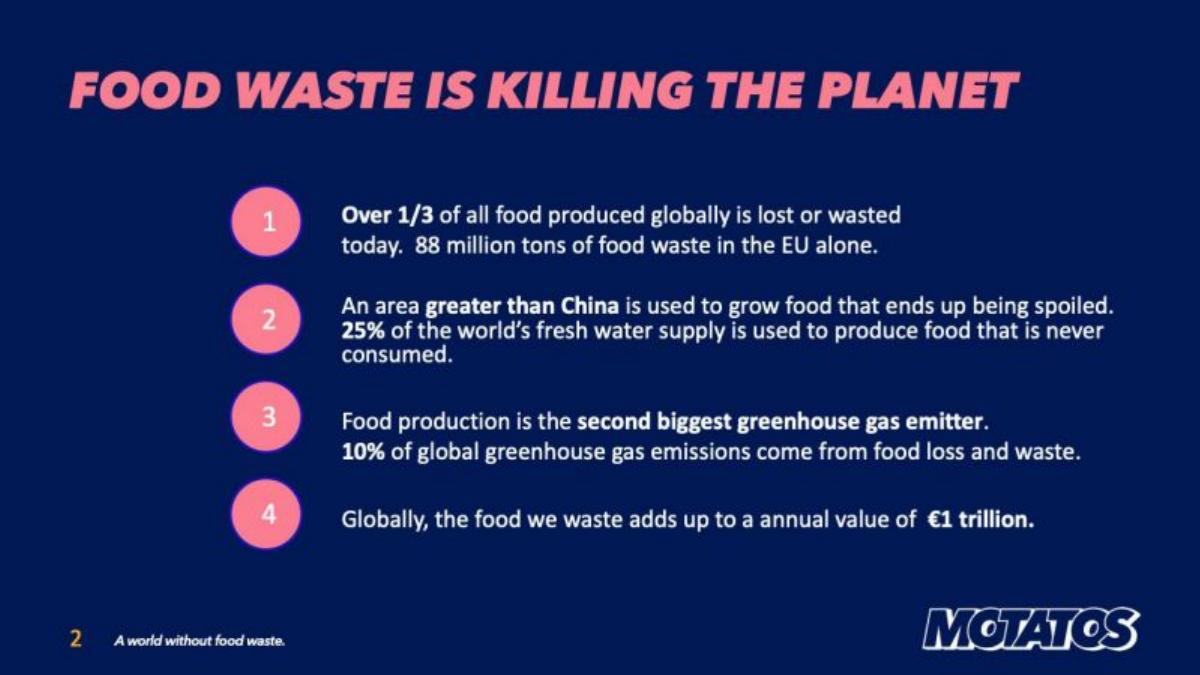
Motatos frames the problem globally. They cite that over 1/3 of all food produced globally is lost or wasted , amounting to 88 million tons in the EU alone. By noting that food waste adds up to an annual value of €1 trillion , they are not just identifying an environmental catastrophe but a massive economic inefficiency that their business is designed to capture. This slide successfully establishes the 'Why' with four distinct, high-impact data points regarding water usage, greenhouse gas emissions, and land use.
Slide 3: The Solution and Hierarchy
Slide 3 is perhaps the most important for impact-focused investors. It utilizes the WRAP waste management hierarchy to show that Motatos (labeled here as Matsmart) operates in the 'Redistribution to people' segment. This is positioned just below 'Prevention' and above 'Animal food' or 'Recycling.' The key metric here is over 25,000 tonnes of food saved . They also validate their impact with a third-party study from the Swedish Environmental Research Institute, claiming a 90% emission saving per order.
Slide 4: The Consumer Value Proposition
This slide transitions from the 'Why' to the 'How.' It defines the B2C e-commerce model: selling dry food and non-food products that would otherwise be discarded. The core hook for the consumer is the 20-90% discount on A-brands. The slide also notes their geographic footprint, stating they are currently operating in SE, FI, DK and DE (Sweden, Finland, Denmark, and Germany), proving they have successfully moved beyond their domestic Swedish market.
Slide 5: The B2B Supplier Proposition
While slide 4 was for the consumer, slide 5 is for the brands. Motatos positions itself as a partner to FMCG suppliers. They highlight a quick sell-off of average 30 days and less than 10 days for top-tier brands. The 'logo wall' is impressive, featuring Coca-Cola, Heinz, Barilla, Haribo, Nestlé, L'Oréal, and Unilever . This serves as a massive trust signal, indicating that the world's largest food companies trust Motatos to handle their surplus without damaging their primary brand equity.
Slide 6: Community and Scale
This slide focuses on the 'Planet-Saving-Heroes'—their customer base. The headline metric is that they have more than half a million everyday heroes saving food with them. This is the closest the deck gets to a user growth metric, suggesting a substantial and active customer base that views their purchases as both a financial win and a moral one.
Slide 7: Logistics and Infrastructure
For an e-commerce company, the 'moat' is often the supply chain. Slide 7 shows a map of Europe with two primary hubs: a Nordic Hub serving SE, FI, and DK, and a German Hub serving DE. They list logistics partners including Airmee, Budbee, PostNord, Posti, and DHL . This slide communicates that the business is 'ready to scale' and has moved past the experimental phase of local delivery into a multi-national logistics operation.
Slide 8: Social Proof and Press
This is a standard 'brag slide' but with high-caliber inclusions. They mention being among the fastest growing companies in Europe for 2 consecutive years according to the Financial Times 1000. Other logos include The Economist, Handelsblatt, and The BBC. This reinforces the idea that Motatos is a leader in the 'circular economy' conversation.
Slide 9 & 10: Case Studies (Kocken's and Coca-Cola)
These two slides provide concrete examples of the 'burden' they turn into 'assets.' Slide 9 describes a factory error where salad seasoning jars were fitted with 'white pepper' lids. Motatos sold these by telling the story, turning a manufacturing mistake into a marketing win. Slide 10 details a Coca-Cola transition from 'fat cans' to 'slim cans.' Motatos bought the remaining stock of the old format, allowing Coca-Cola to clear the market for their new product launch while Motatos customers got a deal. These stories are highly effective at explaining the specific utility they provide to FMCG giants.
Slide 11: The Team
The team slide shows a balance of entrepreneurial experience and industry-specific expertise. CEO Karl Andersson and Ulf Skagerström are noted as co-founders of GetOnBoard. Crucially, co-founder Erik Södergren was an ICA Supermarket owner for 15 years , which gives the company deep empathy for the retail side of food waste. The functional leads (Marketing, Tech, Finance, etc.) all boast 10-15+ years of experience in their respective fields.
Slide 12 & 13: The Close
The deck ends with a call to 'Join the Revolution' and a repeat of the superhero imagery. Slide 13 is a placeholder for the pitch deck library and contains no company information.
What Motatos Does Well
1. Clear B2B Utility: Most e-commerce decks focus entirely on the consumer. Motatos spends significant time explaining why they are a necessary partner for suppliers. The 'fat can' case study is a perfect example of a 'pain point' that investors can easily understand.
2. Impact as a Core Metric: By quantifying food waste in tonnes and emissions saved, they appeal to the growing pool of ESG (Environmental, Social, and Governance) capital. They don't just say they are 'green'; they provide the math (90% emission reduction) to back it up.
3. Geographic Validation: Showing the Nordic and German hubs proves that the model is not a 'Swedish anomaly.' It demonstrates that the supply chain and consumer demand for discounted surplus goods are transferable across borders.
What is Missing from the Deck
1. Financial Transparency: For a Series C deck, the absence of revenue figures, EBITDA margins, and growth rates is striking. While the listing states they raised $27M, the deck itself does not show the path to profitability or the historical revenue curve.
2. Unit Economics: E-commerce is a game of margins. There is no mention of Average Order Value (AOV), shipping costs as a percentage of revenue, or customer retention rates. Investors at this stage would typically demand to see how the 20-90% discounts affect the bottom line.
3. The Ask: The deck lacks a slide stating how much they are raising and exactly what the funds will be used for (e.g., new warehouses, marketing in Germany, or technology development). This information was likely handled in a separate document or during the live pitch.
Founder Takeaways
Use Case Studies to Explain Complex B2B Relationships: If your business model involves solving a 'back-end' problem for large corporations, don't just describe it—show a specific example like the Coca-Cola can transition. It makes the utility tangible. · Align with Global Standards: Motatos aligned their mission with the UN Sustainable Development Goals and used third-party research (Swedish Environmental Research Institute) to validate their claims. This adds a layer of professional credibility that self-reported metrics lack. · Leverage 'Insider' Team Experience: Highlighting that a co-founder owned a supermarket for 15 years is a powerful way to signal 'Founder-Market Fit.' It tells investors that the team understands the nuances of the industry they are trying to disrupt. · Visual Identity Matters: Motatos avoided the 'green and leafy' clichés of sustainability. Their bold, high-energy branding suggests a fast-growing tech company, not a non-profit, which is vital for attracting venture capital.
Frequently asked questions
- What is the primary business model of Motatos?
- Motatos operates a B2C e-commerce platform that sells surplus inventory from Fast-Moving Consumer Goods (FMCG) suppliers. They source products that would otherwise be discarded due to packaging changes, seasonality, or approaching best-before dates. According to slide 4, they offer these A-brand products to consumers at discounts ranging from 20% to 90%, providing nationwide delivery in Sweden, Finland, Denmark, and Germany.
- How does Motatos benefit its corporate suppliers?
- For suppliers like Heinz and Barilla, Motatos acts as a 'one-stop solution' for inventory inefficiencies. Slide 5 highlights that they provide quick sell-offs (averaging 30 days) and help generate brand equity by becoming part of the supplier's CSR strategy. They also provide data-driven insights, such as price elasticity and demographic analysis, turning what would be a financial burden (waste) into a recovered asset.
- What specific impact metrics does the company share?
- The deck emphasizes environmental impact as a core KPI. Slide 3 states the company has saved over 25,000 tonnes of food. It also cites research from the Swedish Environmental Research Institute, which found that saving food through their platform reduces emissions by approximately 90% compared to producing new food. They also align their mission with UN Sustainable Development Goals 1, 2, and 12.
- What is missing from this pitch deck?
- This is a Series C deck, yet it is surprisingly devoid of traditional financial metrics. There are no slides detailing Year-over-Year (YoY) revenue growth, Customer Acquisition Cost (CAC), Lifetime Value (LTV), or gross margins. Furthermore, the deck does not include a specific 'Ask' slide detailing how the $27M will be allocated, nor does it provide a forward-looking roadmap or financial projections.
- Who are the key people leading the company?
- The team is led by CEO Karl Andersson and co-founders Ulf Skagerström and Erik Södergren. Södergren’s background is particularly relevant, as he owned an ICA Supermarket for 15 years, providing the 'insider' perspective on grocery waste. The broader leadership team includes specialists with 10-15+ years of experience in FMCG marketing, logistics, and the grocery trade (Slide 11).