MSN Academy’s pitch deck addresses the critical skills gap in Nigeria, citing that 1.8 million graduates enter the job market annually with a 45% unemployment rate. The company, based in Lagos, positions itself as a practical alternative to traditional institutions, offering a '99% practical, 1% theory' curriculum. The deck emphasizes physical infrastructure—including a 'serene environment,' desktop computers, and uninterrupted power—as a core value proposition for students. While the mission is clear, the deck lacks essential financial data, a specific funding amount, and a team slide. It fu…
Key takeaways
- The deck identifies a massive market opportunity citing 1.8 million Nigerian graduates entering the job market every year (Slide 4).
- A reported 45% unemployment rate among Nigerian graduates serves as the primary problem statement (Slide 4).
- The business model relies on a physical facility located at 53-57 Odunfa Street, Ebute-Metta, Lagos (Slide 1).
- The curriculum is explicitly defined as 99% practical and 1% theory to ensure students become employable (Slide 8).
- Infrastructure is a key selling point, specifically highlighting 'uninterrupted power supply' as a critical resource for IT training in the region (Slide 9).
- The application process involves a four-step funnel: website visit, registration, career discussion, and class attendance (Slide 10).
- The 'Ask' is vague, requesting 'Mentorship' and 'Funding' without specifying a dollar amount or equity stake (Slide 11).
- There is a total absence of financial projections, current revenue, or a management team overview throughout the 12 slides.
Executive Summary: The Vocational Bridge
MSN Academy’s pitch deck is a mission-driven presentation focused on the Nigerian educational landscape. It identifies a systemic failure in the traditional university system, where high graduation rates are met with high unemployment due to a lack of practical skills. The deck proposes a physical training center in Lagos that prioritizes hands-on IT experience. While the social impact and problem-solution fit are clearly articulated, the deck lacks the financial and structural rigor required for a professional venture capital raise.
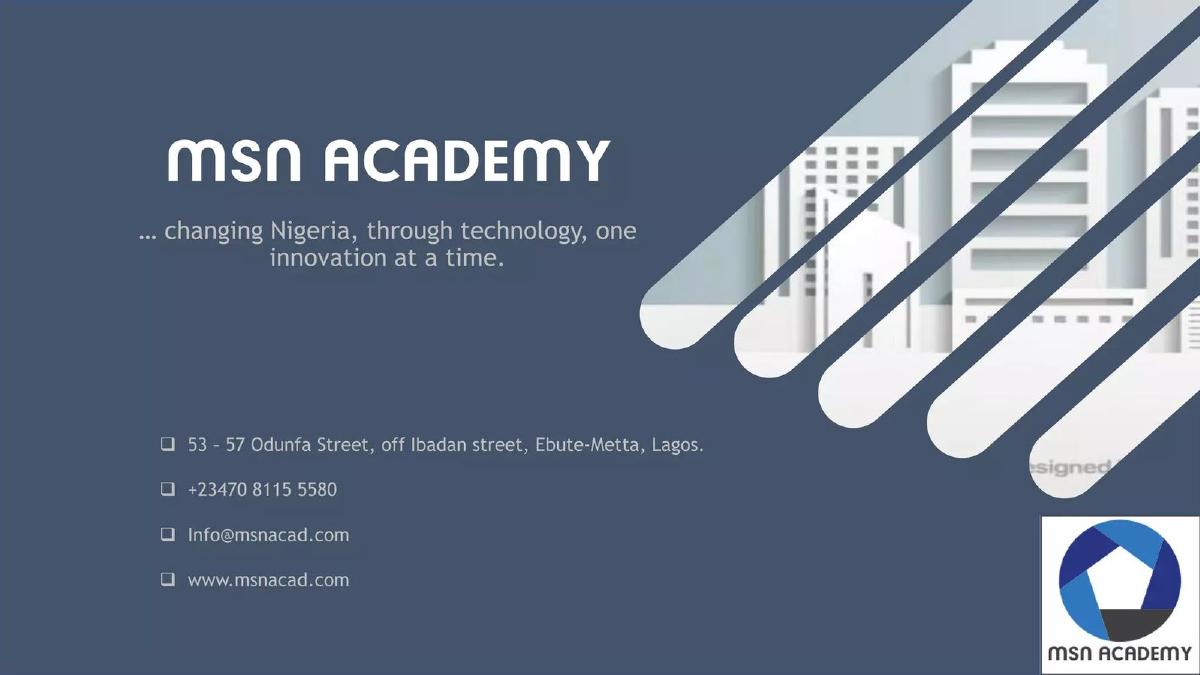
Slide 1: Title and Contact Information
The cover slide introduces MSN Academy with the tagline: "...changing Nigeria, through technology, one innovation at a time." It provides a physical address in Ebute-Metta, Lagos, alongside a phone number, email, and website. The inclusion of a physical address immediately establishes the company as a brick-and-mortar operation rather than a purely digital platform.
Slide 2: The Macro Context
Titled "Not Only Agriculture," this slide addresses the Nigerian government's push for citizens to return to farming. The text argues that while agriculture is important, the world is a "global village," implying that technology must not be neglected in the national economic strategy. This serves as a soft opening to justify the focus on IT training.
Slide 3: Technology's Ubiquity
This slide uses generic clip art to illustrate how modern technology has shaped communication, travel, and work. It is a filler slide that establishes a premise most investors already accept: technology is foundational to modern life. It adds little specific value to the business case but reinforces the "why now" of IT education.
Slide 4: The Problem - Unemployment in Nigeria
This is the most data-heavy slide in the deck. It cites Mrs. Okonjo-Iweala (former Finance Minister) stating that 1.8 million graduates enter the job market yearly. It also quotes SaharaReporters, claiming a 45% unemployment rate among these graduates. By anchoring the pitch in these figures, the founders establish a massive, underserved market of individuals desperate for employable skills.
Slide 5: The Skill Gap
Slide 5 identifies a "dearth of skills" among graduates and critiques existing training institutions for not being "as innovative as they should be." The visual of an archer missing a target reinforces the idea that current education is failing to hit the mark of employer requirements.
Slide 6: Who We Are
The company defines itself as Multi Server Network (R) Academy. The slide lists four value propositions: Learn anything, Get mentored, Get hired, and Co-work. This suggests a multi-revenue stream model encompassing tuition, placement fees, and co-working memberships, though these are not explicitly detailed as business lines.
Slide 7: Vision and Mission
The vision is to change Nigeria through technology. The mission is to make building a career in IT "AFFORDABLE." The emphasis on affordability is key, as it suggests the academy is targeting the mass market of unemployed graduates who may have limited capital for expensive private certifications.
Slide 8: Life in the Academy
This slide details the pedagogy: "99% practical, 1% theory." It emphasizes building projects and becoming employable. The mention of "excellent facilitators" and "training facilities" suggests a high-touch, in-person learning environment designed to produce immediate "real time" results.
Slide 9: The Physical Offering
Titled "What You Get," this slide is crucial for a localized play in Nigeria. It promises a "Serene environment," "Desktop computer for use," "Uninterrupted power supply," and a "Certificate of course completion." In a region where power outages and lack of hardware are barriers to learning, providing these resources is a significant part of the value proposition.
Slide 10: The Application Funnel
This slide outlines a simple four-step process for students: Visit website, Register for a course, Attend a Career Discussion, and Start classes. The "Career Discussion" step acts as a qualifying interview, ensuring that the academy maintains a level of quality or fit among its student body.
Slide 11: The Ask
The penultimate slide is remarkably brief. It states the company is looking for "Mentorship" and "Funding." The lack of a specific dollar amount, a breakdown of how funds will be used (e.g., more computers, marketing, new locations), or what the investor gets in return is a major omission for a pitch deck.
Slide 12: Closing
The final slide repeats the contact information and logo over a photo of a computer lab, reinforcing the physical nature of the business. It ends with a simple "THANK YOU."
What Works Well
Clear Problem Identification: The deck does an excellent job of quantifying the problem. By using specific figures like 1.8 million graduates and a 45% unemployment rate, the founders demonstrate that they are solving a real, large-scale social and economic issue in Nigeria.
Localized Value Proposition: The inclusion of "uninterrupted power supply" and "desktop computer for use" shows a deep understanding of the local student's pain points. In many emerging markets, the barrier to learning IT isn't just the curriculum, but the lack of basic infrastructure.
Focus on Outcomes: The "99% practical" approach and the "Get hired" goal align the academy's success with the student's success. This outcome-oriented messaging is highly effective for vocational training businesses.
What Is Missing
The Team Slide: This is the most glaring omission. Investors invest in people, especially at the early stage. There is no information on who is running the academy, their technical expertise, or their track record in education.
Financials and Unit Economics: The deck contains zero financial data. There is no mention of tuition costs, the cost of acquiring a student (CAC), the lifetime value of a student (LTV), or how long it takes for a single location to become profitable. Without these, it is impossible to evaluate the business as an investment.
Competitive Landscape: The deck mentions that existing institutions are not innovative, but it does not name competitors or explain why MSN Academy’s specific model is harder to replicate than a standard computer school.
A Specific Ask: Asking for "funding" without a number is a missed opportunity. A founder should always state how much they are raising and what milestones that money will help them achieve (e.g., "We are raising $100k to open two new locations and train 500 students").
Founder Takeaways
Quantify the Need: Like Slide 4, use reputable third-party data to prove your market exists. It moves the conversation from "I think this is a problem" to "This is a documented national crisis." · Address Infrastructure: If you are operating in a market with logistical challenges (power, internet, hardware), make it clear that your business handles those hurdles for the customer. · Show, Don't Just Tell: Slide 9 uses photos of the actual building and computer labs. For a physical business, showing the assets helps build credibility. · Always Include a Team Slide: Even if you are a solo founder, list your advisors or lead instructors. Anonymity is the enemy of fundraising. · Be Specific with the Ask: Never just ask for "funding." Provide a clear target and a high-level plan for that capital.
Frequently asked questions
- What is the primary problem MSN Academy is trying to solve?
- MSN Academy targets the 'dearth of skills' among Nigerian graduates. According to Slide 4, 45% of graduates are unemployed despite 1.8 million people entering the workforce annually. The deck argues that existing training institutions are not innovative enough to bridge the gap between academic theory and the practical requirements of the modern IT job market.
- What specific services does the academy provide?
- The academy offers four core pillars: learning, mentorship, job placement assistance ('Get hired'), and co-working spaces. As shown on Slide 6 and Slide 8, the focus is on building projects and ensuring students can use facilitators' knowledge in 'real time.' They also provide a certificate of completion to validate the student's skills to potential employers.
- How does the academy differentiate itself from traditional schools?
- The main differentiator is the '99% practical, 1% theory' approach mentioned on Slide 8. Additionally, Slide 9 highlights the provision of physical resources that may be scarce for individual students, such as a dedicated desktop computer for use and, crucially, an uninterrupted power supply, which is a significant logistical hurdle in Nigeria.
- Is there any information on the leadership team?
- No. The deck completely omits a team slide. There are no mentions of the founders, their backgrounds in education or technology, or the 'excellent facilitators' referenced on Slide 8. For investors, this is a significant red flag as the success of a vocational school depends heavily on the quality of its instructors and management.
- What are the financial requirements for this investment?
- The deck does not specify a funding goal. Slide 11 simply states they are looking for 'Mentorship' and 'Funding.' There are no details regarding the use of funds, current burn rate, student tuition costs, or projected revenue. This suggests the deck is in a very early 'concept' stage or intended for a general audience rather than institutional investors.