Multus Media’s 10-slide pitch deck is a masterclass in identifying a specific, high-value bottleneck within a massive emerging industry. By focusing on the 'growth media' required for cultivated meat, the company positions itself as the essential picks-and-shovels provider for the future of food. The deck effectively uses macro trends—like the $630bn projected market size by 2040—to frame the opportunity, while highlighting that current solutions rely on ethically problematic and expensive animal-derived serums. While the version analyzed contains several redacted data points regarding specif…
Key takeaways
- The deck identifies a $630bn market opportunity by 2040, representing a 35% share of the total meat industry (Slide 2).
- It highlights a significant consumer willingness to pay, citing that 58% of surveyed individuals would pay a 37% premium for cultured meat (Slide 2).
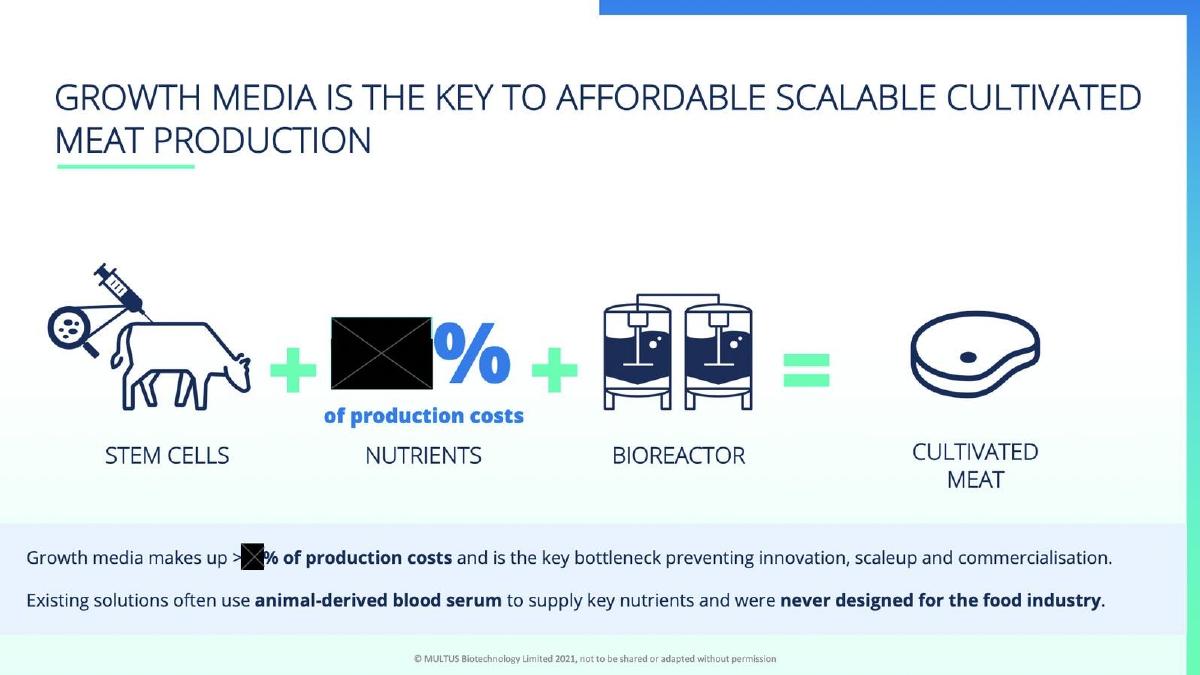
- The narrative centers on growth media as the 'key bottleneck' preventing commercialization, though the exact percentage of production costs is redacted (Slide 5).
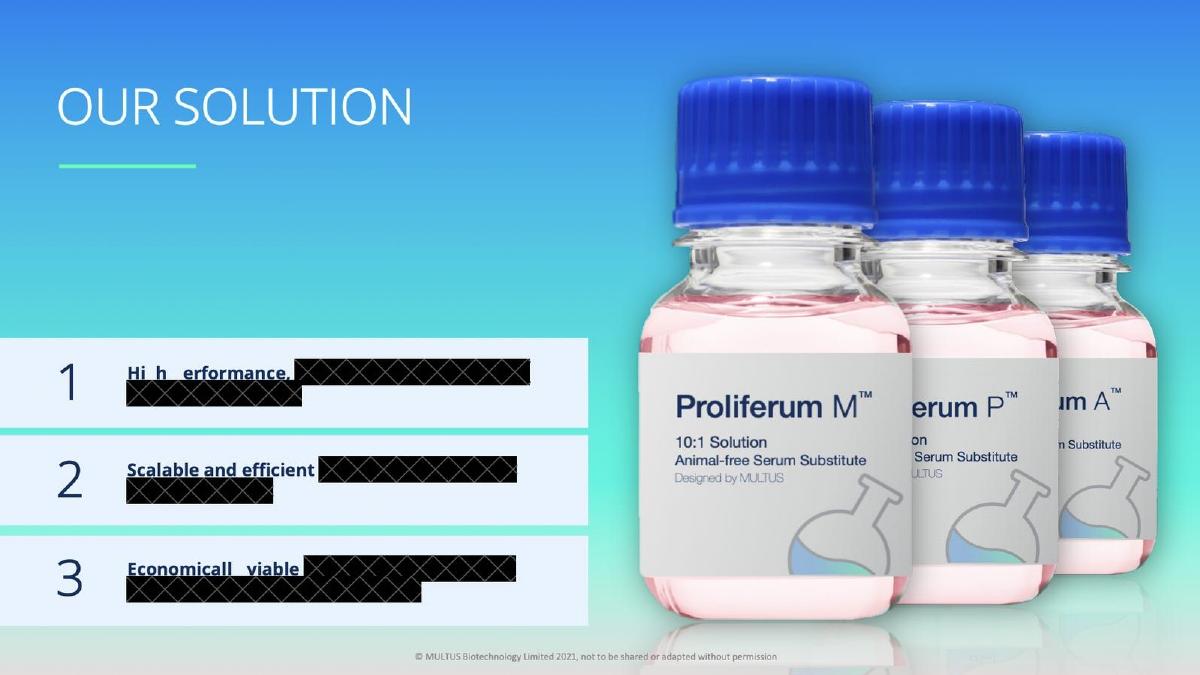
- Multus Media positions its product, Proliferum, as a high-performance, animal-free serum substitute (Slide 6).
- The deck uses a three-stage market evolution model: R&D, Scale-up (high-end restaurants), and Large-scale commercialization (Slide 7).
- The founders leverage significant institutional credibility, listing collaborations with Imperial College London, IndieBio, and Innovate UK (Slide 8).
- The deck lacks a specific financial 'Ask' slide or a detailed use-of-funds breakdown in this version.
- Environmental impact is a core pillar, claiming an 87% reduction in greenhouse gas emissions compared to traditional meat (Slide 2).
The Strategic Pivot from Product to Platform
Multus Media’s pitch deck is a focused argument for a B2B biotech play. Instead of trying to sell a lab-grown burger to consumers, they are selling the essential 'fuel' to the companies that do. This teardown explores how they framed the technical challenges of cultivated meat as a massive investment opportunity.
Slide 1: Title Slide
The deck opens with a clean, branded title slide featuring the Multus Media logo—a stylized laboratory flask—and the tagline 'Feeding the Future of Food.' The background uses a soft blue-to-green gradient over an image of laboratory well plates, immediately signaling that this is a life sciences or biotech venture. It is professional and sets a high-tech tone without being overly cluttered.
Slide 2: The Macro Opportunity
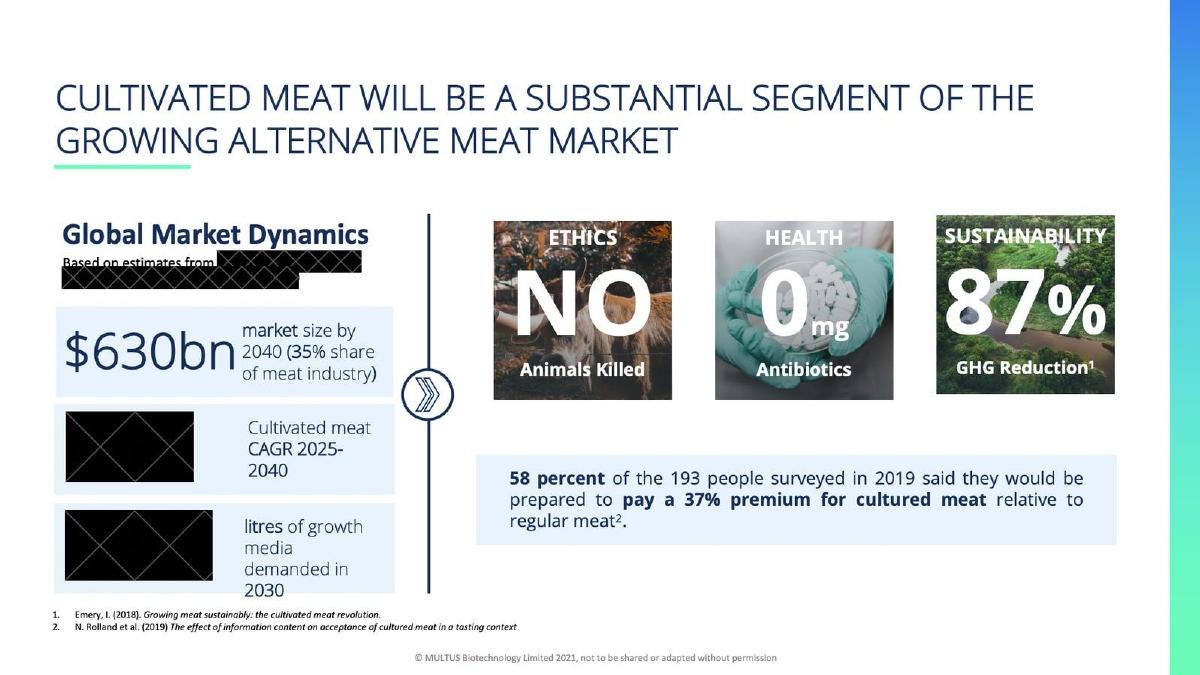
Slide 2 establishes the 'Why Now.' It frames cultivated meat as a 'substantial segment' of the alternative meat market. The slide is heavy on data, citing a $630bn market size by 2040 , which would represent 35% of the total meat industry. It also addresses the three main drivers for this shift: Ethics (No animals killed), Health (0mg antibiotics), and Sustainability (87% GHG reduction). Crucially, it includes a consumer validation point: 58% of 193 people surveyed in 2019 would pay a 37% premium for cultured meat. This helps de-risk the market demand for potential investors.
Slide 3: The Cost Barrier
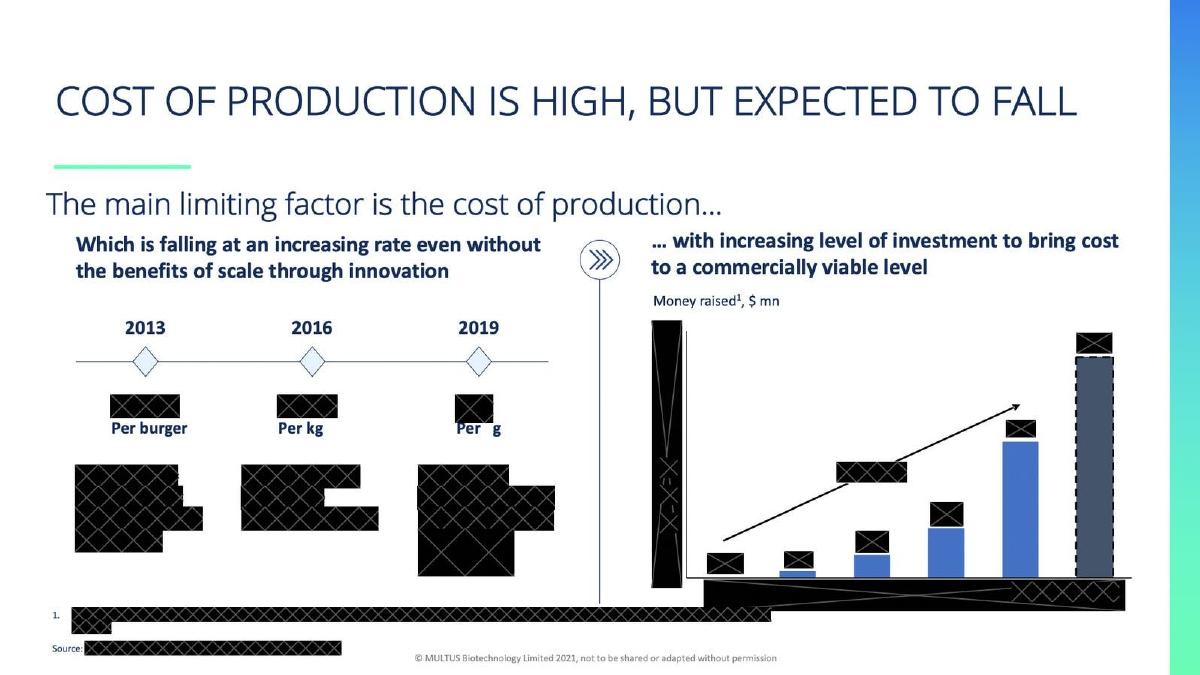
This slide addresses the 'Problem.' It notes that the cost of production is currently high but falling. It shows a timeline from 2013 to 2019, illustrating how costs have moved from 'Per burger' to 'Per kg' to 'Per g.' On the right side, a bar chart shows the 'increasing level of investment to bring cost to a commercially viable level.' While specific dollar amounts for the cost per gram are redacted in this version, the visual trend clearly communicates that the industry is at an inflection point where innovation is outpacing simple scale benefits.
Slide 4: Process Education
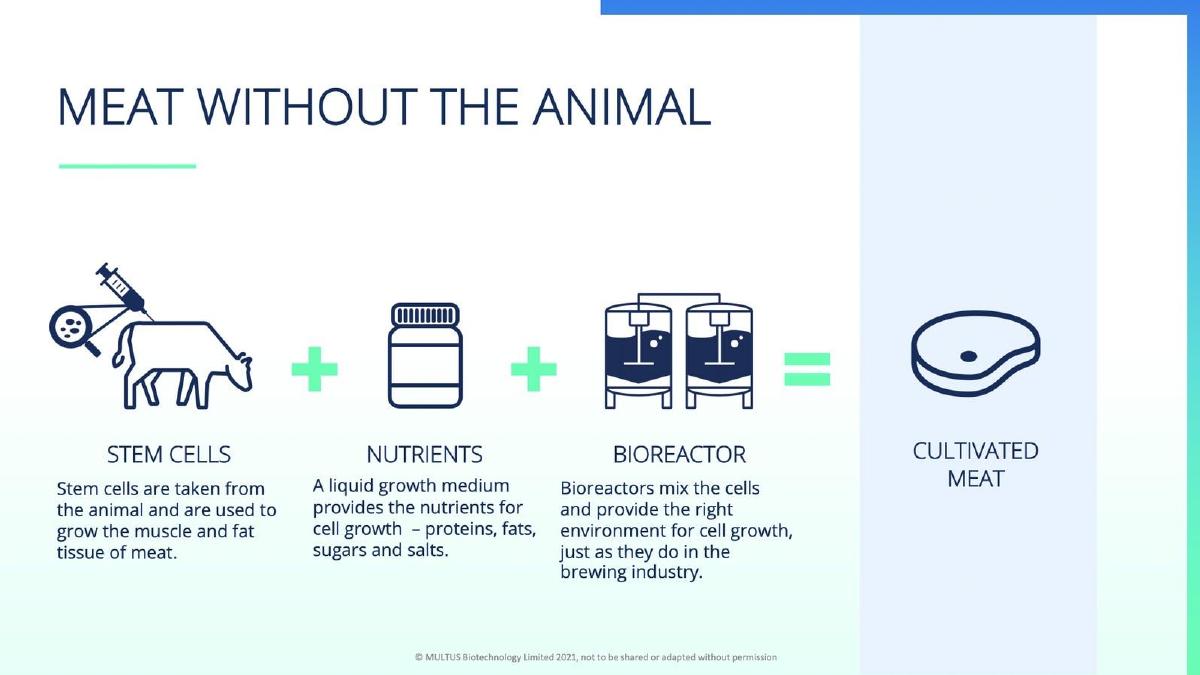
For investors who may not be biotech experts, Slide 4 provides a simple 'Meat Without the Animal' workflow. It breaks the process down into three components: Stem Cells + Nutrients + Bioreactor = Cultivated Meat . This simplicity is vital for a Seed round, as it ensures everyone in the room understands the manufacturing stack before the founders dive into their specific niche.
Slide 5: Identifying the Bottleneck
Slide 5 is the 'Aha!' moment of the deck. It repeats the graphic from Slide 4 but highlights the 'Nutrients' (growth media) as the core problem. The text states that growth media is the 'key bottleneck preventing innovation, scaleup and commercialisation.' It points out that existing solutions use animal-derived blood serum, which was 'never designed for the food industry.' By isolating this one variable, Multus Media justifies why their specific focus is the most important investment in the sector.
Slide 6: The Solution (Proliferum)
Here, the company introduces its product: Proliferum . The slide shows three bottles labeled Proliferum M, P, and A, described as '10:1 Solution Animal-free Serum Substitute.' The value proposition is summarized in three points: High performance , Scalable and efficient , and Economically viable . This slide moves the conversation from a theoretical problem to a tangible, branded product ready for market.
Slide 7: Market Adoption Curve
Slide 7 uses an 'Internal analysis' graph to show the demand for growth media over time. It segments the market into three phases: R&D (establishing production), Scale-up (high-end restaurants), and Commercialisation at large scale . The blue line represents the exploding demand for growth media as companies scale their core technologies. This slide is effective because it shows that Multus Media can generate revenue now (in the R&D phase) while positioned for exponential growth later.
Slide 8: The Co-Founders
The team slide features Reka Tron (COO), Cai Linton (CEO), and Kevin Pan (CTO). Rather than long bios, the slide relies on institutional logos to build credibility. They list collaborations with Imperial College London, IndieBio, Innovate UK, the Royal Academy of Engineering, and SynbiCITE. Mentioning support from the McKinsey & Co. Venture Academy adds a layer of business-side validation to their technical pedigree.
Slide 9: Advisory Board
Slide 9 is dedicated to the Advisory Board. In this version, the content is entirely redacted with a black box. In a live pitch, this slide would typically feature industry veterans, PhDs, or successful entrepreneurs who provide the 'adult supervision' and strategic network necessary for a young founding team to navigate the biotech landscape.
Slide 10: Contact Information
The deck concludes with a 'Get in touch!' slide, providing the website, a general email address, and social media handles (Twitter and LinkedIn). It maintains the visual consistency of the opening slide, reinforcing the brand identity one last time.
What Works in This Deck
The 'Picks and Shovels' Strategy: Investors often prefer B2B infrastructure plays over consumer-facing brands because they are less dependent on fickle consumer tastes. Multus Media successfully frames growth media as the essential infrastructure for an entire $630bn industry.
Logical Flow: The deck follows a perfect narrative arc: The market is huge (Slide 2) -> But it's too expensive (Slide 3) -> Here is how it's made (Slide 4) -> The nutrients are the specific reason it's expensive (Slide 5) -> We have the better nutrient (Slide 6).
Credibility by Association: By prominently featuring logos like IndieBio and Imperial College London, the founders overcome the 'young team' hurdle by showing they have been vetted by world-class institutions.
What Is Missing
The 'Ask': This version of the deck does not include a slide detailing how much money they are raising or how they plan to spend it. While this is often removed for public versions, it is a critical component of a fundraising deck.
Unit Economics: While the deck claims the product is 'economically viable,' it lacks a comparison chart showing the cost of Proliferum versus traditional Fetal Bovine Serum (FBS). Showing a 10x or 100x cost reduction is the standard for biotech decks in this space.
Competitive Landscape: There are other companies working on animal-free media. The deck does not address why Multus Media’s approach (e.g., specific yeast strains or molecular farming) is superior to competitors.
Founder Takeaways
Isolate the Bottleneck: If you are in a complex industry, don't try to solve everything. Do what Multus did on Slide 5: show the whole process, then put a big box around the one part you are fixing. It makes the investment thesis much easier to digest.
Use Third-Party Data for TAM: Don't just guess your market size. Multus cites specific studies (Emery 2018, Rolland 2019) to back up their $630bn claim. This makes the numbers feel like a reality rather than a founder's fantasy.
Visual Simplicity: Biotech can get bogged down in chemical structures and complex biology. Multus uses simple icons (cows, flasks, bioreactors) to keep the focus on the business case rather than the science experiment.
Frequently asked questions
- What is the primary problem Multus Media is solving?
- Multus Media is addressing the high cost and ethical issues associated with growth media in cultivated meat production. Currently, the industry often relies on fetal bovine serum, which is expensive and derived from animals. Multus provides an animal-free, scalable, and cost-effective substitute called Proliferum to enable mass-market commercialization.
- How large is the market opportunity according to the deck?
- Slide 2 cites a global market dynamic where the alternative meat market is projected to reach $630 billion by 2040. The company expects cultivated meat to capture a 35% share of the total meat industry by that time, driven by consumer demand for ethical and sustainable food sources.
- What is the 'Proliferum' product mentioned in the deck?
- Proliferum is Multus Media's flagship product line, described on Slide 6 as an animal-free serum substitute. The deck shows three variants: Proliferum M, P, and A. It is pitched as a high-performance, scalable, and economically viable solution for providing the nutrients (proteins, fats, sugars, salts) required for cell growth in bioreactors.
- Who are the founders and what is their background?
- The co-founding team consists of Cai Linton (CEO), Reka Tron (COO), and Kevin Pan (CTO). While their individual bios are not detailed, Slide 8 highlights their strong academic and accelerator ties, including Imperial College London, the Royal Academy of Engineering, and the well-known biotech accelerator IndieBio.
- What was the outcome of this fundraising round?
- As reported by Business Insider, Multus Media successfully raised a $2.1 million Seed round in 2022. This capital was intended to support their mission of developing animal-free growth media to replace fetal bovine serum in the cultivated meat industry.