Mustard’s pitch deck is a masterclass in leveraging founder pedigree and proprietary data to justify a technological solution. The company addresses the high cost and low quality of youth sports coaching by offering a mobile app that provides AI-driven motion analysis and mental performance training. The core value proposition rests on a database built over 40 years by founder Tom House, who has coached iconic athletes like Tom Brady and Drew Brees. While the deck is visually striking and heavy on team credentials, it notably lacks a specific financial 'Ask' slide, detailed unit economics, or…
Key takeaways
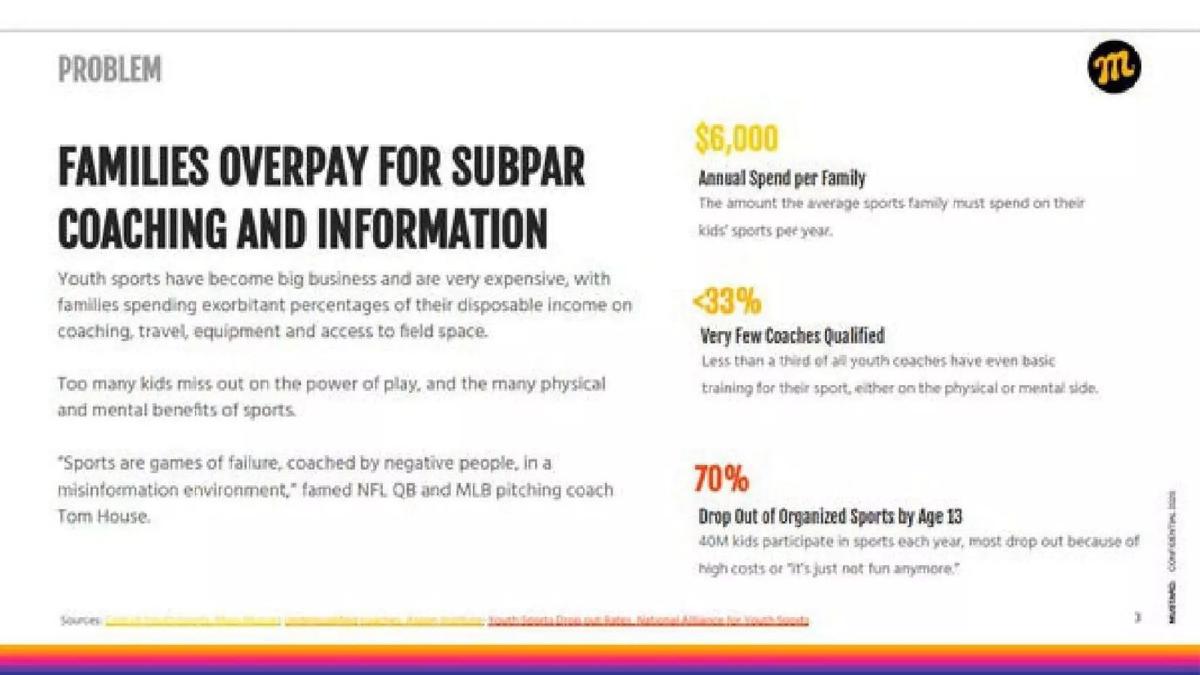
- The problem slide identifies that families spend an average of $6,000 annually on youth sports, yet 70% of kids drop out by age 13 (Slide 3).
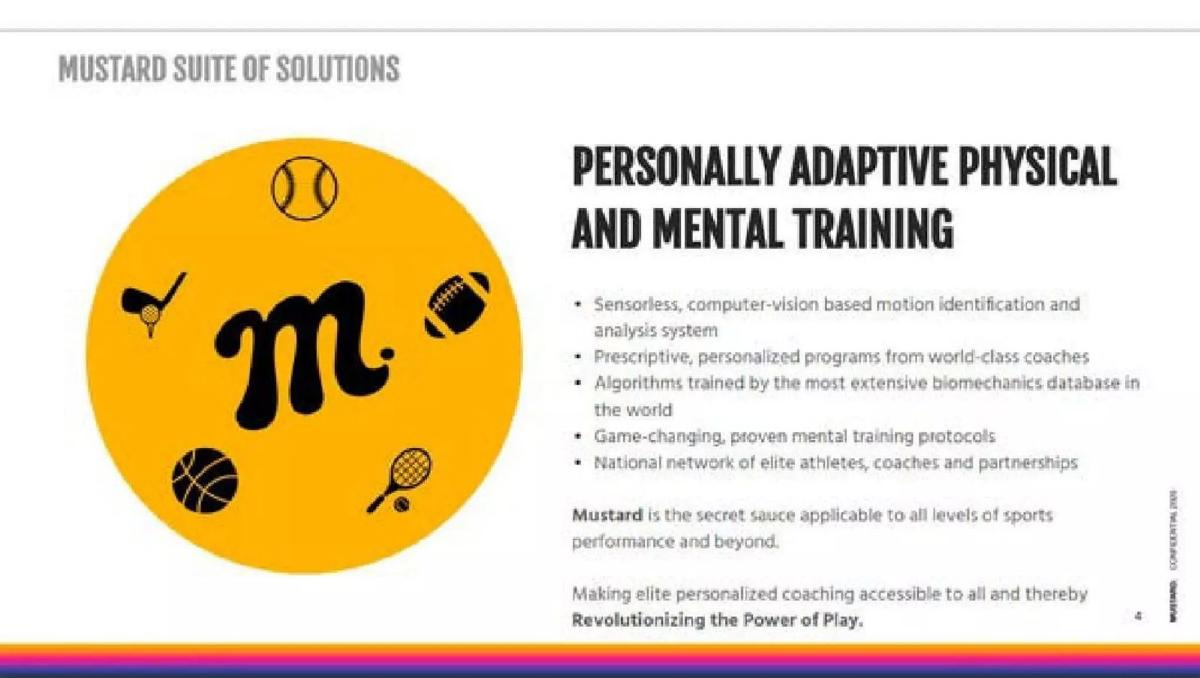
- Mustard uses a proprietary AI engine trained on the world's most extensive biomechanics database, spanning 40 years of data (Slide 4).
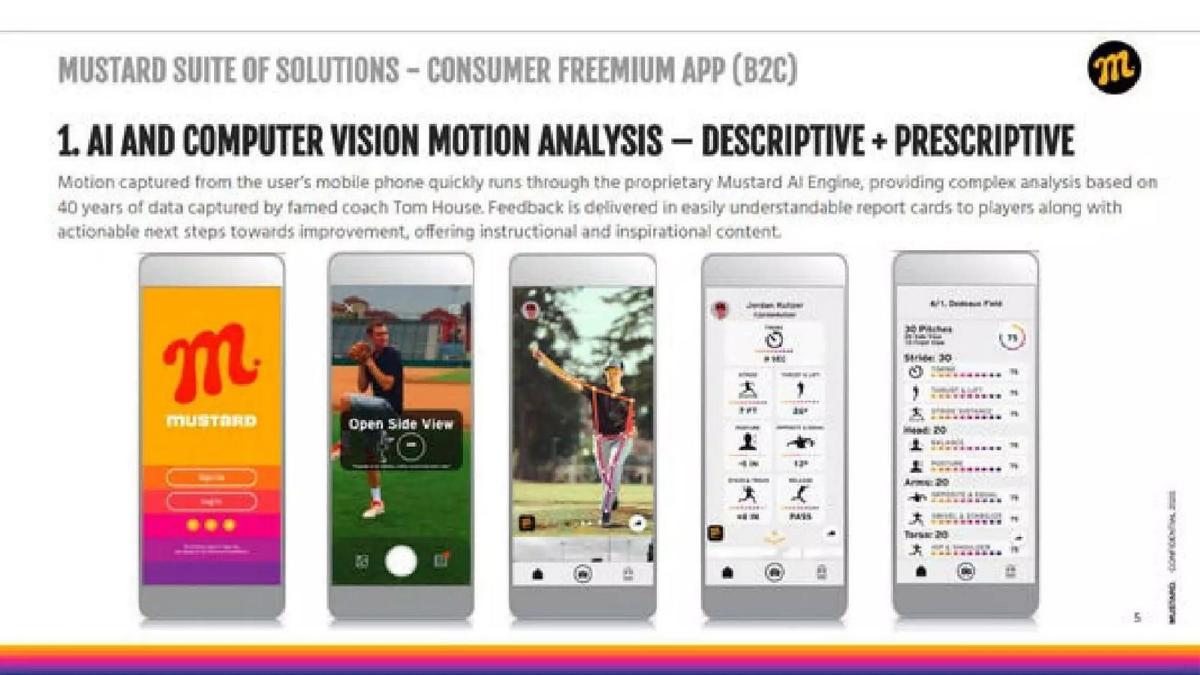
- The product suite includes a B2C freemium app featuring sensorless, computer-vision based motion identification (Slide 5).
- A unique mental performance component involves a partnership with FocusBand for real-time neurofeedback (Slide 6).
- The Total Addressable Market for youth sports is projected to reach $77.6B by 2026 (Slide 8).
- Founder Tom House brings unparalleled credibility, having coached Hall of Famers in baseball, football, and golf (Slide 9).
- The team includes deep technical expertise, such as Kevin Prince, former VP of MLB’s emerging technologies (Slide 12).
- The deck lists high-profile advisors including Mia Hamm, Drew Brees, and Nolan Ryan to bolster brand authority (Slides 9, 13).
Mustard: Democratizing Elite Coaching Through AI
Mustard enters the market with a bold claim: that the 'secret sauce' of elite athletic performance, once reserved for Hall of Famers, can be delivered to every child with a smartphone. The deck is less of a traditional business plan and more of a brand manifesto paired with a high-pedigree team validation. It relies heavily on the 'Tom House' effect—leveraging decades of elite coaching data to solve the accessibility and cost issues in youth sports.
The Vision and the Problem (Slides 1-3)
Slide 1: Title The deck opens with a vibrant, retro-inspired aesthetic. The tagline 'Be A Cut Above' sets a premium tone, while the 'm.' logo is prominent. It is styled as a 'Company Overview,' which explains why some traditional fundraising slides might be missing.
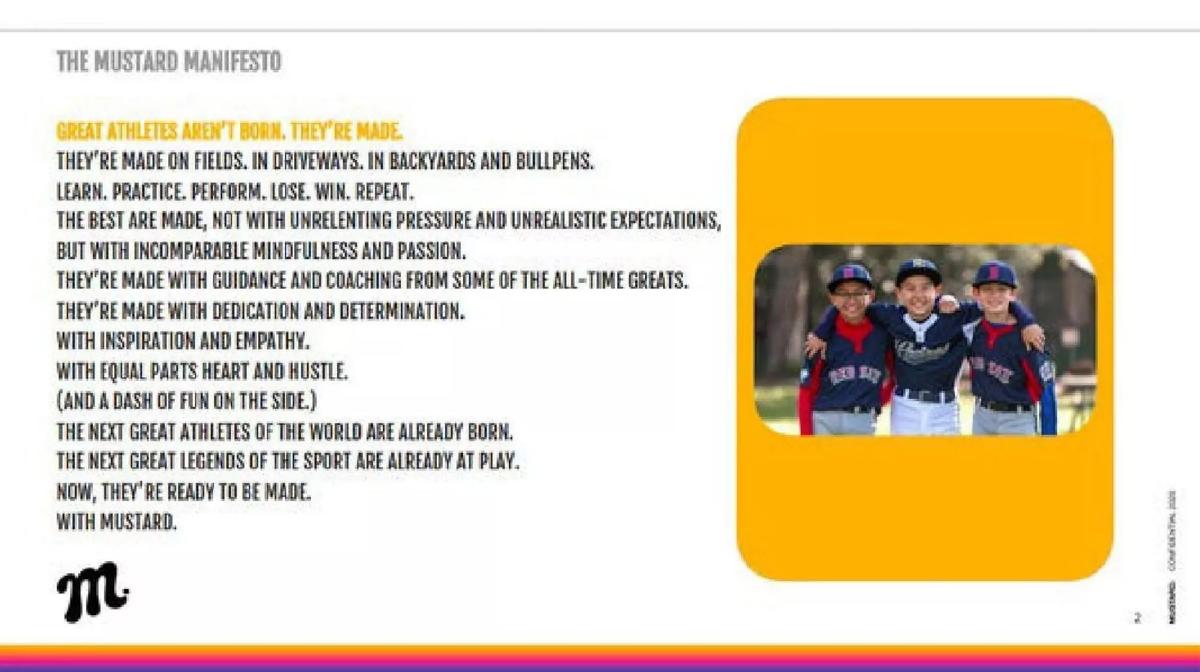
Slide 2: The Mustard Manifesto This is a narrative slide intended to build emotional resonance. It emphasizes that 'Great athletes aren't born. They're made.' It positions Mustard as the catalyst for this transformation, focusing on mindfulness, passion, and guidance from 'all-time greats.' It establishes the brand's 'why' before diving into the 'what.'
Slide 3: Problem Mustard identifies a clear market inefficiency. According to the slide, families spend an average of $6,000 annually on youth sports. Despite this high spend, <33% of coaches are considered qualified, and 70% of kids drop out by age 13. The slide uses a quote from Tom House to hammer home the point: 'Sports are games of failure, coached by negative people, in a misinformation environment.'
The Solution and Product Suite (Slides 4-7)
Slide 4: Mustard Suite of Solutions This slide introduces the 'Personally Adaptive Physical and Mental Training.' Key features listed include sensorless computer-vision motion identification, prescriptive programs from world-class coaches, and algorithms trained by the 'most extensive biomechanics database in the world.' It positions Mustard as the 'secret sauce' for all levels of performance.
Slide 5: Consumer Freemium App (B2C) This slide provides the first look at the product interface. It describes the AI engine as being based on 40 years of data . The app delivers 'report cards' to players with actionable next steps. The visuals show a 'Side View' capture mode and various metrics like 'Stride,' 'Balance,' and 'Release,' indicating a deep level of technical analysis performed via standard mobile hardware.
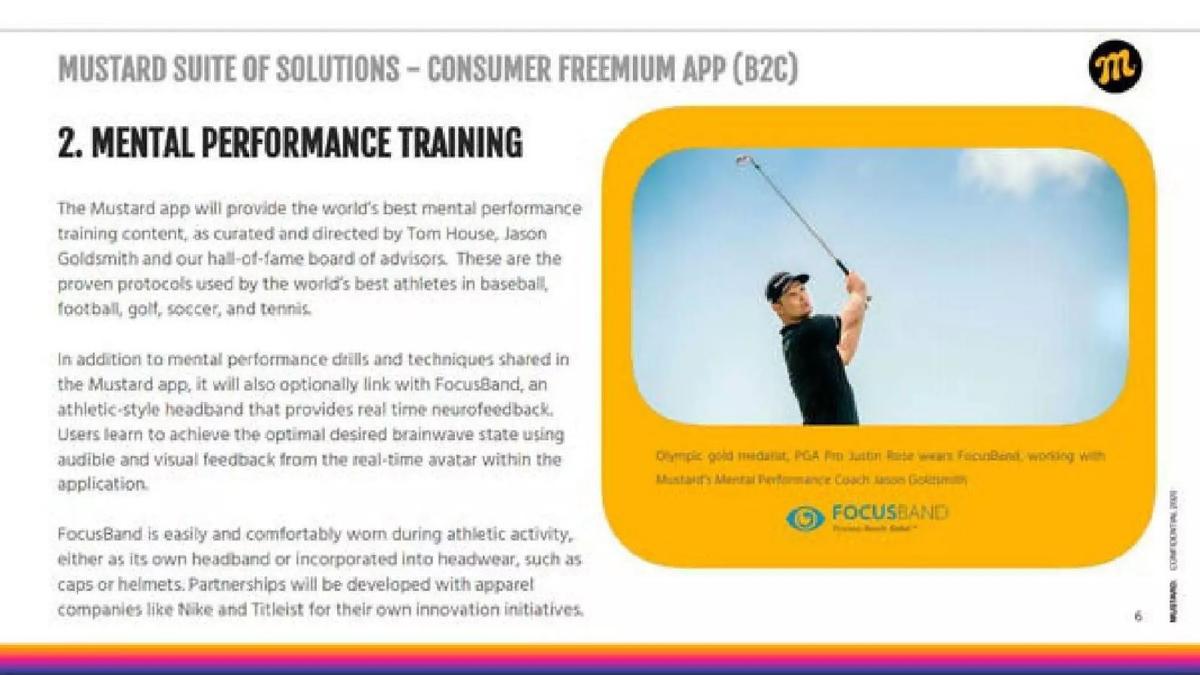
Slide 6: Mental Performance Training Mustard differentiates itself by including a mental component. The deck mentions protocols used by athletes in baseball, football, golf, soccer, and tennis. A notable technical partnership is highlighted: an optional link with FocusBand , a headband providing real-time neurofeedback. The slide features PGA Pro Justin Rose to validate this approach.
Slide 7: For Coaching Organizations (B2B2C) The strategy expands beyond the individual athlete to teams and leagues. Mustard aims to provide tools for training, scouting, and injury prevention. The slide mentions that data licensing will eventually be available, suggesting a future high-margin revenue stream by making third-party data (like Hawk-Eye) more actionable.
Market Opportunity and Team Pedigree (Slides 8-13)
Slide 8: Total Addressable Market The figures presented are large and forward-looking. Mustard cites a $77.6B Youth Sports Market size by 2026, a $14.7B annual spend on mobile app subscriptions for instruction by 2026, and a $4B sports analytics market by 2022. These numbers are intended to show that even a small percentage of market capture represents a massive business.
Slide 9: Tom House - Founder This is arguably the most important slide in the deck. House is described as the 'father of modern pitching mechanics' with 40+ years of MLB and NFL experience. The slide lists iconic clients: Tom Brady, Drew Brees, Nolan Ryan, and Randy Johnson . This level of founder-market fit is rare and serves as the primary 'moat' for the company's AI algorithms.
Slide 10: Jason Goldsmith - Founder & President Goldsmith brings the mental performance expertise. His resume includes coaching 6 Major champions in golf and Olympic Gold Medalist Justin Rose. His presence justifies the 'Mental Training' aspect of the product suite.
Slide 11: The Executive Team Rocky Collis (CEO) and Luke Collis (COO) provide the operational and legal backbone. Rocky's experience with the USWNT Players Association and Luke's background as a professional QB and field organizer for Stacey Abrams suggest a team capable of handling complex partnerships and scaling operations.
Slide 12: Technical and Product Team The deck highlights deep domain expertise. Kevin Prince (CTO) was the former VP of MLB’s emerging technologies and helped drive Statcast . Carlos Dietrich (Founding Engineer) also worked on Statcast. Jordan Kutzer (Product Designer) came from Strivr, a VR training company. This slide proves that the team has the technical chops to actually build the computer-vision engine they are promising.
Slide 13: Advisors The advisor list is a 'who's who' of American sports, including Mia Hamm, Drew Brees, and Reid Ryan . While advisors often have varying levels of actual involvement, these names provide significant brand equity and potential doors for B2B partnerships.
What Works in the Mustard Deck
The primary strength of this deck is Authority . By the time an investor reaches Slide 12, the technical and domain expertise of the team is unquestionable. They aren't just building an app; they are digitizing the life's work of the world's most successful coaches. The use of '40 years of data' is a powerful way to describe their algorithmic advantage, creating a perceived barrier to entry for competitors who might have the code but lack the underlying biomechanical truth.
The visual design is also highly effective. It avoids the sterile 'SaaS blue' and instead uses a warm, energetic palette that feels like a sports brand (Nike, Gatorade) rather than a software company. This is crucial for a B2C play where brand affinity drives user acquisition.
What is Missing from the Mustard Deck
Despite the strong narrative, the deck is missing several critical components for a late-stage investment, though it may suffice for a seed round. There is no 'Ask' slide. We do not know how much money they want or what they will do with it. There are no financial projections or current traction metrics (e.g., beta users, retention rates, or revenue). The Go-To-Market (GTM) strategy is also vague; while they mention partnerships, the specific plan to acquire users in a crowded app market is not detailed. Finally, there is no Competitor Analysis . Companies like Blast Motion, Diamond Kinetics, or even Whoop/Peloton could be seen as adjacent competitors, and the deck fails to address how Mustard wins against them.
What a Founder Should Copy
Founders should emulate how Mustard uses social proof and pedigree to validate a complex technical product. If you are building an AI tool, don't just talk about the code; talk about the data source. Mustard's focus on Tom House's 40-year database is a perfect example of identifying a 'proprietary insight' that investors love.
Additionally, the Problem/Solution alignment is very tight. Slide 3 sets up the 'high cost/low quality' problem, and Slide 5 offers the 'low cost/high quality' solution. The narrative arc is clean and easy to follow. Finally, the Advisory Board slide (Slide 13) is a great example of how to use names to build a 'halo effect' around a young company, provided those advisors are actually aligned with the mission.
Final Thoughts
Mustard's deck is a high-level vision document that succeeds in selling the 'dream' and the 'team.' It effectively positions the company at the intersection of sports heritage and future technology. While it leaves many business-operation questions unanswered, it provides a compelling enough 'Why' and 'Who' to secure a follow-up meeting with almost any sports-tech investor.
Frequently asked questions
- What is the core technology behind Mustard?
- Mustard utilizes a sensorless, computer-vision based motion identification and analysis system. According to Slide 5, this technology captures motion via a user's mobile phone and processes it through a proprietary AI engine. This engine is built upon 40 years of biomechanical data captured by founder Tom House, providing users with 'report cards' and actionable instructional content.
- How does Mustard plan to monetize its platform?
- The deck outlines a multi-pronged approach. Slide 5 mentions a 'Consumer Freemium App (B2C),' suggesting a tiered subscription model for individual athletes. Slide 7 details a B2B2C strategy targeting coaching organizations, teams, and leagues. Additionally, the company mentions future plans for data licensing to large organizations, making voluminous data from technologies like Hawk-Eye more actionable.
- Who are the key figures on the founding team?
- The team is led by Tom House (Founder), a legendary pitching and QB coach; Jason Goldsmith (Founder & President), a high-performance mental coach; Rocky Collis (Co-Founder & CEO), a former MLB draftee and startup attorney; and Luke Collis (Co-Founder & COO), a professional QB. Technical leadership includes Kevin Prince, who helped develop MLB's Statcast (Slides 9-12).
- What market opportunity does Mustard address?
- Mustard targets the massive youth sports market, which Slide 8 values at $77.6B by 2026. Specifically, they eye the $14.7B spent annually on mobile app subscriptions for sports instruction and the $4B sports analytics market. The deck argues that current coaching is often 'subpar' and 'expensive,' leading to high dropout rates among young athletes.
- What critical information is missing from the Mustard pitch deck?
- The deck is missing several standard venture components. There is no 'Ask' slide specifying the amount of capital being raised. It also lacks a detailed financial forecast, unit economics (CAC/LTV), a competitive landscape analysis, and a specific go-to-market timeline. While the team and vision are strong, the operational 'how' is largely absent from these 14 slides.