Fitness and Sports Problem Slide: Pitch Deck Examples
How fitness and sports startups present the problem in a pitch deck: skip the obesity statistic, show why people quit or overpay, and put a number on it.
Fitness and Sports Problem Slide: Real Pitch Deck Examples
Eight problem slides from fitness and sports startups, shown in full, compare whether each slide names who struggles, why they quit or overpay, and gives a number for it.
TL;DR
A fitness problem slide has to explain why people who want to exercise stop, or pay too much to keep going. Many open with obesity figures, which every investor has seen. The stronger slides name the moment people give up and size it. Mustard puts three sourced figures beside one headline, "Families overpay for subpar coaching and information": "$6,000" annual spend per family, "<33%" of youth coaches with basic training, and "70%" drop out of organized sports by age 13. Fitmove opens with "83% of Fitness Club members drop after 6 weeks" and lists the reasons. WeFitter's lone "$68B", with no label, is the weaker pattern.
Fitness and sports problem slides from real pitch decks
Each example shows the exact stored slide above its analysis and links to the full teardown. Claims are as shown on the slides; we have not verified them.
Mustard problem slide — slide 3
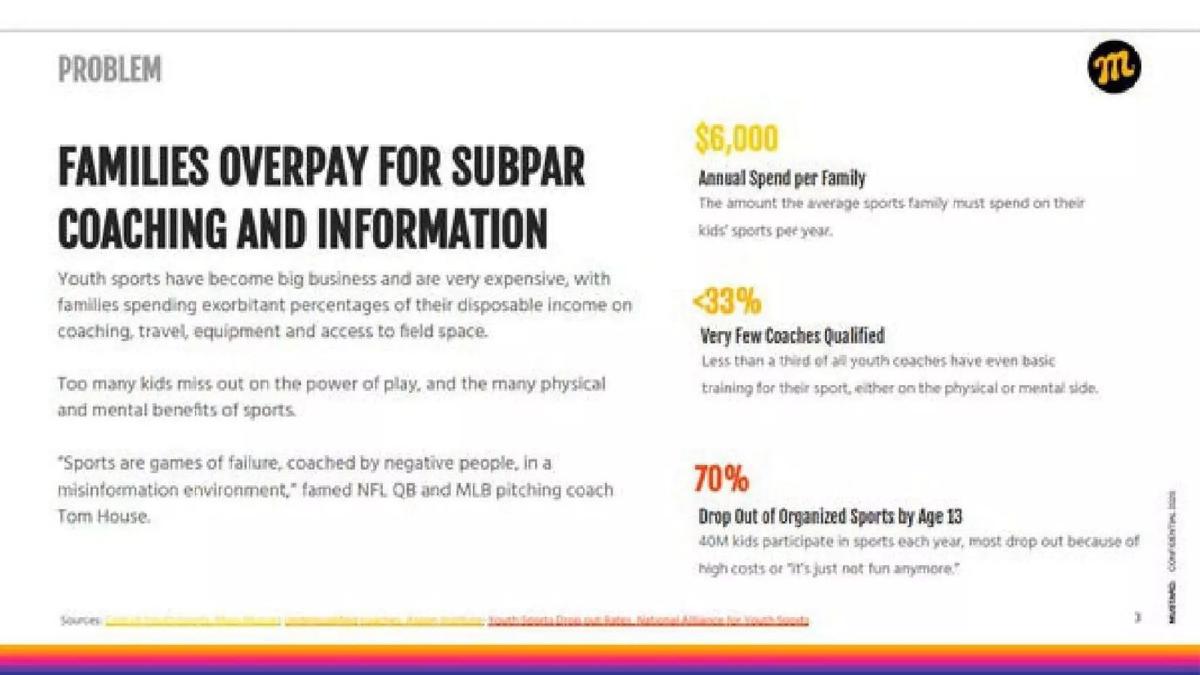
Coaching app for youth sports. A headline and short paragraph on the left, three figures on the right, sources at the bottom.
Mustard deck, slide 3. Exact stored slide matched to this analysis.
Our analysis: The strongest slide here: one buyer (sports families), one cause (untrained coaches) and three sourced numbers that connect cost, quality and drop-out.
Evidence and limitation: Three figures, each with a named source (Aspen Institute, National Alliance for Youth Sports).
What a founder can adapt: Write your problem as one sentence, then give one sourced figure for each part of it.
Supporting analysis
What the deck claims: "Families overpay for subpar coaching and information." "Youth sports have become big business and are very expensive..." "$6,000 Annual Spend per Family." "<33% Very Few Coaches Qualified: Less than a third of all youth coaches have even basic training for their sport." "70% Drop Out of Organized Sports by Age 13: 40M kids participate in sports each year, most drop out because of high costs or 'it's just not fun anymore.'"
Presentation choice: The headline is the whole argument; the figures back each word of it.
When it does not fit: The quote from a famous coach adds little next to the numbers; cut it if space is short.
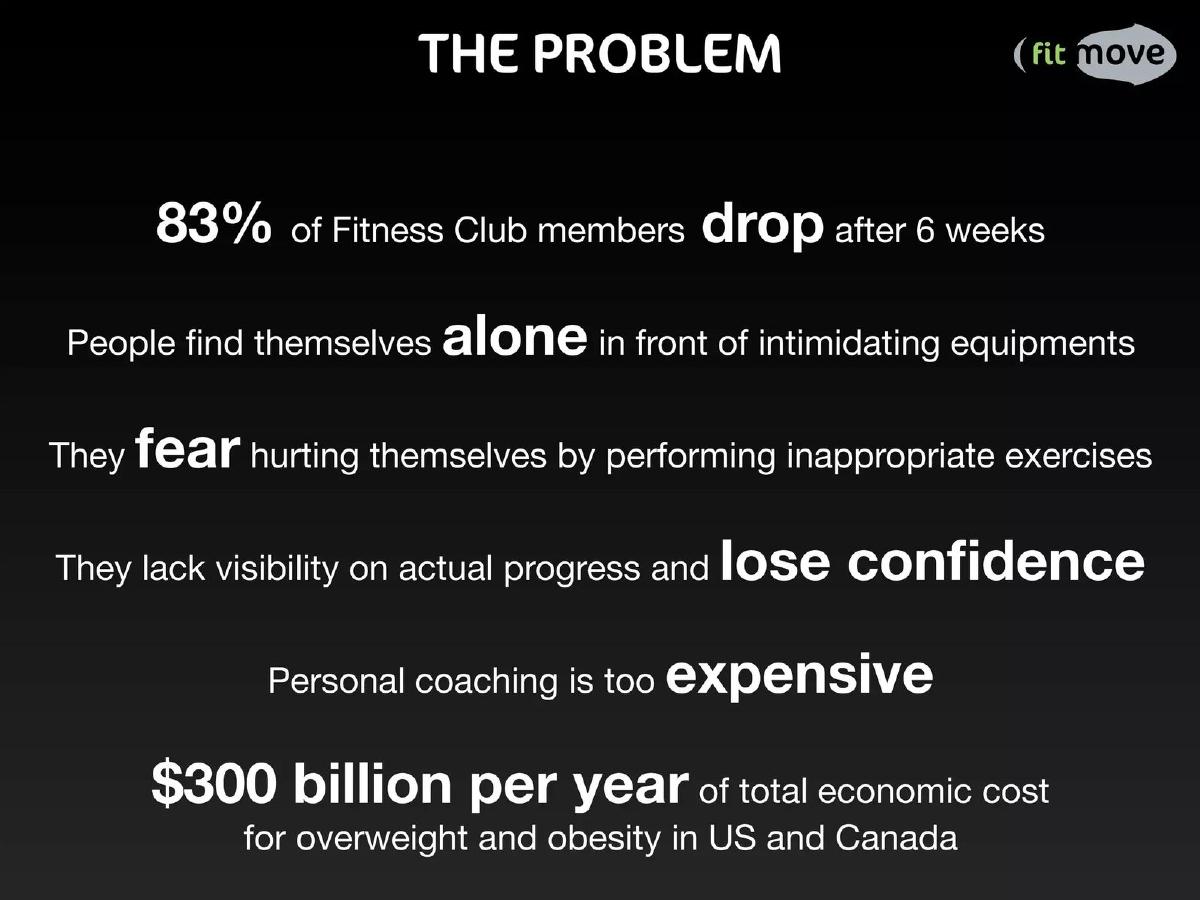
Guidance for gym members. Six lines on black, with key words enlarged.
Fitmove deck, slide 3. Exact stored slide matched to this analysis.
Our analysis: It names when members quit (six weeks) and four reasons, each a feeling a gym-goer will recognise.
Evidence and limitation: Two figures, no sources.
What a founder can adapt: Give the drop-off point, then the reasons in your user's words.
Supporting analysis
What the deck claims: "83% of Fitness Club members drop after 6 weeks." "People find themselves alone in front of intimidating equipments." "They fear hurting themselves by performing inappropriate exercises." "They lack visibility on actual progress and lose confidence." "Personal coaching is too expensive." "$300 billion per year of total economic cost for overweight and obesity in US and Canada."
Presentation choice: The enlarged words (drop, alone, fear, confidence, expensive) read in seconds.
When it does not fit: Source the 83%; the $300B obesity cost is background and weakens the close.
Swim coaching app. Three large figures on a pool photo.
MySwimPro deck, slide 2. Exact stored slide matched to this analysis.
Our analysis: Three lines make the case: most swimmers have no coach, a coach is expensive, and there are many swimmers.
Evidence and limitation: Three figures, no sources.
What a founder can adapt: Use one figure each for how many people lack help, what help costs, and how many people there are.
Supporting analysis
What the deck claims: "90% of swimmers train on their own without a coach." "$100 the cost to hire a personal swim coach for a 1 hour workout." "26M the number of fitness swimmers in the United States."
Presentation choice: Each number answers a different investor question: how common, how costly, how many.
When it does not fit: Add sources; 26M sits better on the market slide.
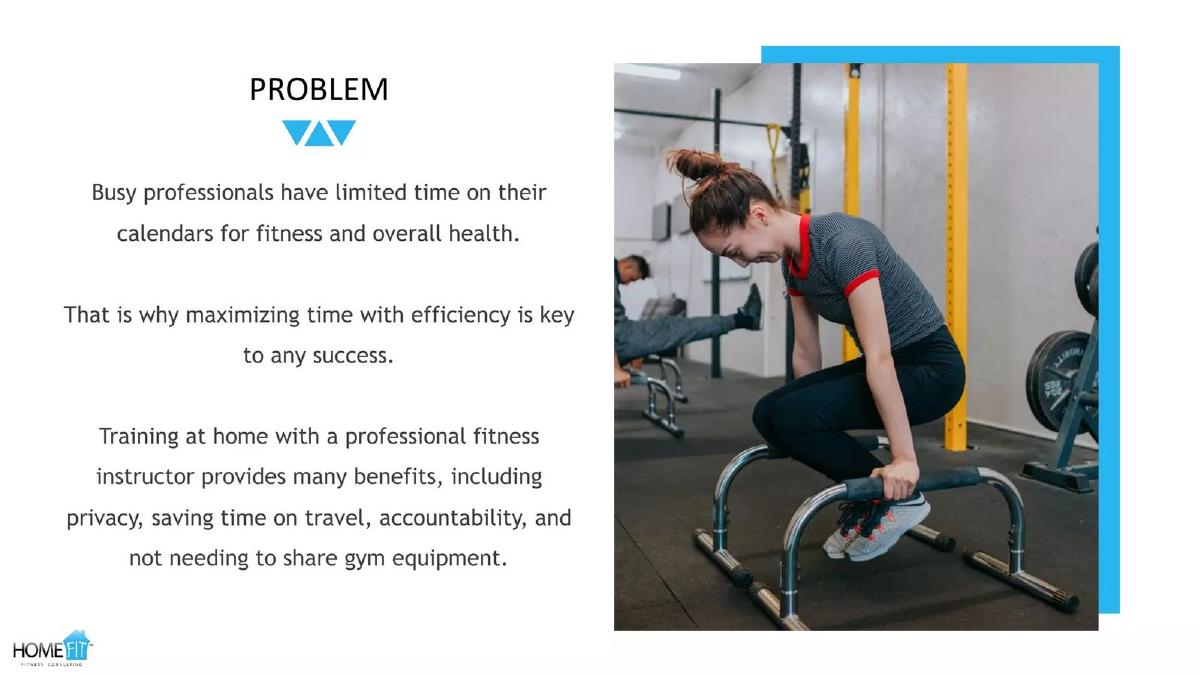
Personal trainers at home. Three short paragraphs beside a gym photo.
HomeFit deck, slide 2. Exact stored slide matched to this analysis.
Our analysis: A clear buyer and cause (no time), but the third paragraph is already the solution.
Evidence and limitation: No figures.
What a founder can adapt: Say how much time a gym visit takes and how often busy people skip it.
Supporting analysis
What the deck claims: "Busy professionals have limited time on their calendars for fitness and overall health." "That is why maximizing time with efficiency is key to any success." "Training at home with a professional fitness instructor provides many benefits, including privacy, saving time on travel, accountability, and not needing to share gym equipment."
Presentation choice: It shows how quickly a problem slide can slide into selling.
When it does not fit: Move the benefits of home training to the solution slide; the gym photo contradicts the message.
Premium bicycles for new riders. A heading and five bullet points.
iCycle deck, slide 2. Exact stored slide matched to this analysis.
Our analysis: A precise user (a new cyclist) with two points a business can fix: price and no chance to try before buying.
Evidence and limitation: No figures.
What a founder can adapt: Lead with the gap your product fills and give its cost, such as the price of a bike bought and abandoned.
Supporting analysis
What the deck claims: "Current challenges for newbie cyclists." "Budding fitness enthusiasts find high-end cycles to be expensive." "Lack of options for 'trial ride' of premium bicycles." "Negligible support for a newbie cyclist trying cycling for the first time." "Lack awareness about the benefits and advantages of cycling." "Current urban infrastructure very unfriendly to cycling."
Presentation choice: "Trial ride" is a specific, fixable gap.
When it does not fit: Road infrastructure isn't something a startup fixes; drop it.
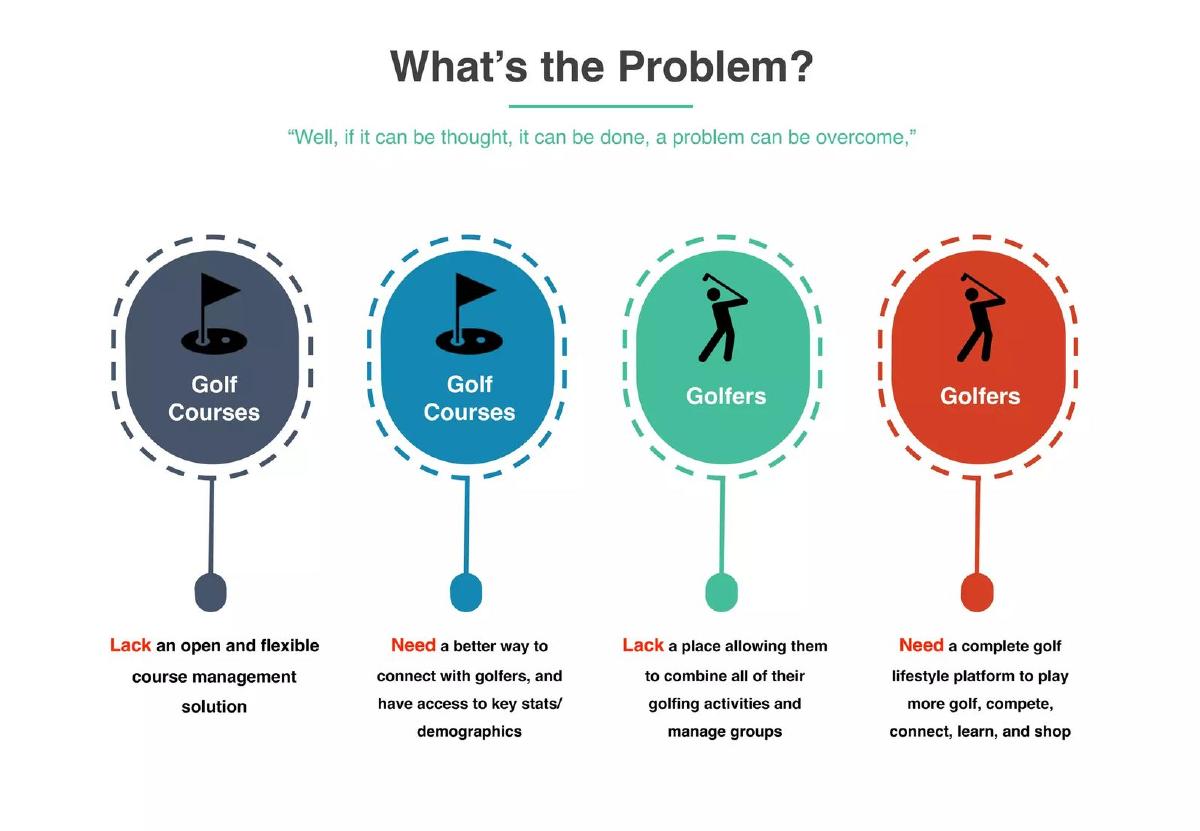
Golf platform linking courses and players. Four circles, two for courses and two for golfers.
Golfalong deck, slide 4. Exact stored slide matched to this analysis.
Our analysis: It shows both sides of a two-sided product clearly, but each point describes a missing product rather than a pain.
Evidence and limitation: No figures.
What a founder can adapt: For each side, say what goes wrong today: empty tee times, groups organised by text message.
Supporting analysis
What the deck claims: "What's the Problem?" Golf courses: "Lack an open and flexible course management solution", "Need a better way to connect with golfers, and have access to key stats/demographics". Golfers: "Lack a place allowing them to combine all of their golfing activities and manage groups", "Need a complete golf lifestyle platform to play more golf, compete, connect, learn, and shop."
Presentation choice: The two-audience layout makes the business model visible.
When it does not fit: "Need a complete golf lifestyle platform" is the solution; the opening quote takes space.
Health and activity platform. One large figure and a heart icon over a photo of pills. Weak on purpose.
WeFitter deck, slide 2. Exact stored slide matched to this analysis.
Our analysis: Without a label, the reader can't tell what $68B measures, who pays it, or how the product changes it. The next slide repeats the pattern with "10%".
Evidence and limitation: One unlabelled figure.
What a founder can adapt: Say what the $68B is, whose cost it is, and give the source.
Supporting analysis
What the deck claims: "Problem." "$68B" with a heartbeat icon.
Presentation choice: It shows what the stronger slides avoid: a number with no words.
When it does not fit: Don't rely on the speaker to explain a slide; decks are often read without the pitch.
Whether each slide names who struggles, why they quit or overpay, and a number.
Example
Who struggles
Why they quit or overpay
Number
Mustard
Sports families
Yes (untrained coaches, cost)
Yes (three, sourced)
Fitmove
Gym members
Yes (fear, no progress, cost)
Yes (83%, unsourced)
MySwimPro
Swimmers
Yes (coaching too expensive)
Yes (unsourced)
HomeFit
Busy professionals
Yes (no time)
No
iCycle
New cyclists
Yes (price, no trial ride)
No
Golfalong
Courses and golfers
Partly (missing tools)
No
FutbolFitClub
No
No
Global figure, sourced
WeFitter
No
No
Unlabelled
Key Takeaways
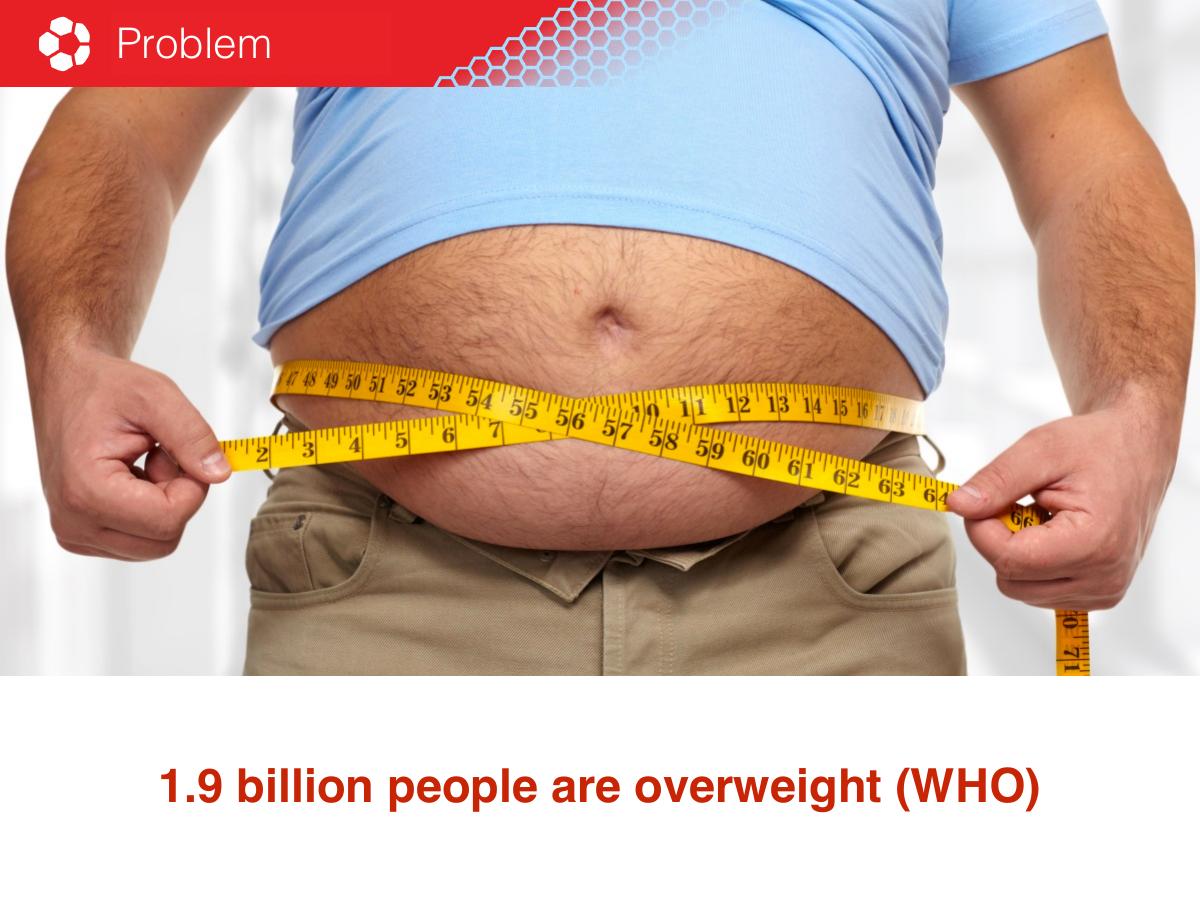
Skip "1.9 billion people are overweight"; investors know, and it doesn't point to your product.
Show the moment people quit: after six weeks, at age 13, when the gym feels intimidating.
Show what good help costs today: "$100" an hour for a swim coach, "$6,000" a year per sports family.
Name who struggles: busy professionals, new cyclists, swimmers training alone, parents of young athletes.
Every big number needs a label and a source; "$68B" alone says nothing.
Build your fitness problem slide
One person, the moment they quit, one number.
Person. Who: age, sport or activity, how often they train?
Moment. When do they stop, or when does it get too expensive?
Reason. Why, in their words: cost, time, fear, boredom, no progress?
Number. Drop-off rate or cost of the current option, with a source.
Copyable framework: [Who] stop [activity] after [time] because [reason]. The alternative, [current option], costs [amount]. (Source: [source].)
Illustrative example 1 — written by us
Before: Obesity is rising worldwide and people don't exercise enough.
After: Half of new runners stop within three months, most after a first injury; a physio-led running plan costs about $80 a session. (Source: our survey of 400 runners.)
What improved: Our illustrative rewrite; the figures are invented for the example. It names the person, the moment they quit and what help costs today.
What this guide adds
The consumer problem guide includes a few lifestyle decks. This guide looks only at startups in exercise, coaching and sport, where the investor's question is why people drop out and whether they'll pay to stay.
The slides range from gyms and home training (Fitmove, HomeFit) to single sports (MySwimPro, iCycle, Golfalong) and youth sports coaching (Mustard).
Three things a fitness problem slide proves
Who struggles: "Fitness Club members" (Fitmove), "Busy professionals" (HomeFit), "swimmers" training "without a coach" (MySwimPro), "newbie cyclists" (iCycle), sports families (Mustard).
Why they quit or overpay: intimidating equipment and fear of injury (Fitmove), no time (HomeFit), coaching too expensive (MySwimPro, Fitmove), poorly trained coaches (Mustard).
How much: "83%" drop after six weeks (Fitmove), "$100" per coached swim (MySwimPro), "70%" drop out by 13 (Mustard, sourced).
Common mistakes
Opening with obesity. Every fitness deck does it; start with your user.
Unlabelled numbers. "$68B" alone tells the reader nothing.
The solution on the problem slide. "Training at home provides many benefits" belongs on the next slide.
Problems nobody can fix. City roads or national health trends aren't yours to solve.
No drop-off point. Say when people quit; it's the moment your product must change.
Diagnostic checklist
It names a specific person or group.
It says when or why they quit, or what they overpay.
It gives one labelled number, with a source.
Obesity and global health are a line at most.
The product is on the next slide.
Frequently asked questions
How we chose these examples
Corpus: published pitch deck teardowns on StartupFundraising.com. Founder-uploaded private decks are excluded.
Selection (2026-09-25): we searched slides 2–6 for slides mentioning fitness, gyms, workouts, trainers, coaches, athletes or sports together with a problem. Twelve stored images were inspected. Lifestyler and ING Bags were excluded because they already appear in the consumer problem guide; Holly Health slide 5 was left out because it is a market map, not a problem slide; esports decks were skipped. FutbolFitClub is marked partial; WeFitter is kept as a weaker contrast.
Overlap check: none of these eight slides appears in another guide.
Review: all eight stored slide images were inspected on 2026-09-25 and matched to company, deck and slide number (editorial model review). No person has yet completed an editorial review of this page.
Claims are as shown on the slides; we have not verified them. We make no claim that any slide caused a fundraising outcome.