Golfalong is a golf lifestyle platform designed to bridge the gap between individual players and course operators. The deck highlights a significant market opportunity, citing 61.1 million golfers worldwide and a $69 billion direct spending market. By offering a social network for players and a data-rich backend for courses, Golfalong aims to solve the lack of psychographic data in existing solutions like GolfNow. The startup seeks $900,000 to fund an 18-month burn rate, focusing on product development and marketing. While the deck showcases strong early traction—including a $300,000 developm…
Key takeaways
- The company identifies a global market of 61.1 million golfers and 32,000 golf courses, with 26 million golfers located in the US (Slide 11).
- Golfalong positions itself against incumbents like GolfNow by claiming competitors provide no detailed analytics or psychographics to course owners (Slide 8).
- Traction includes being awarded SGI's Technology Accelerator with $300,000 in development funds in 2014 (Slide 13).
- The business model relies on a multi-tiered subscription for courses ranging from $99 to $399 per month, plus advertising revenue (Slide 12).
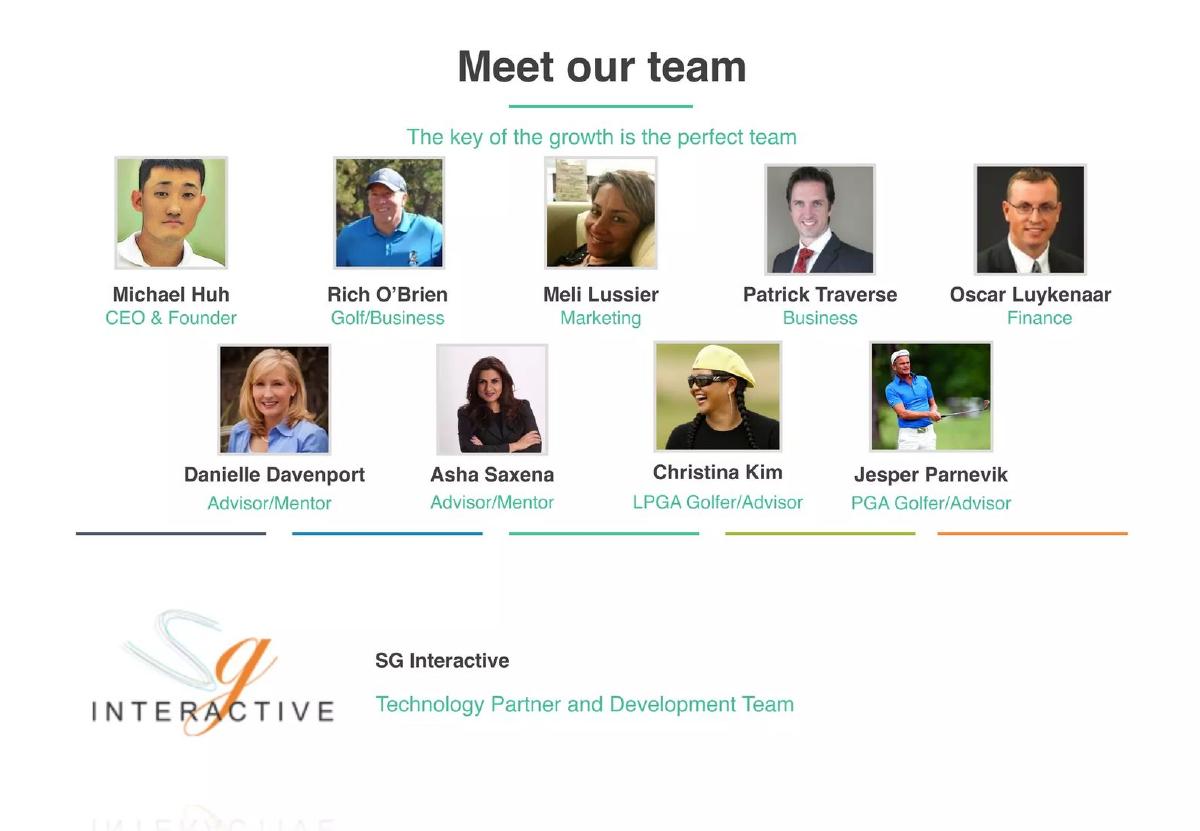
- The team includes professional golfers Christina Kim (LPGA) and Jesper Parnevik (PGA) as advisors (Slide 3).
- Financial projections are aggressive, forecasting a leap from a $1.46 million loss in Year 2 to $56.3 million in profit by Year 5 (Slide 12).
- The $900,000 ask is allocated across product development (30%), business development (25%), marketing (25%), and team (20%) (Slide 15).
- Strategic partnerships are a core pillar of their go-to-market, with 13 partners providing access to 200,000 golfers (Slide 13).
Executive Summary and Brand Identity
Slides 1-2: Introduction
The deck opens with a standard title slide featuring the Golfalong logo and the tagline "Connect. Share. Golf." The imagery is lifestyle-focused, showing a golfer on a green. Slide 2 reinforces the value proposition, labeling the company as "The Ultimate Golf Platform Solution for Golf Courses and Golfers." This immediately establishes the dual-sided nature of the business model.
Slide 3: The Team
The team slide lists five core members and four advisors. Michael Huh is identified as CEO & Founder. The core team covers Golf/Business, Marketing, Business, and Finance. Notably, the advisory board includes professional golfers Christina Kim (LPGA) and Jesper Parnevik (PGA), which lends significant industry credibility. The slide also mentions SG Interactive as the technology partner and development team, suggesting that the initial build was outsourced or handled by a partner firm.
Defining the Market Gap
Slide 4: The Problem
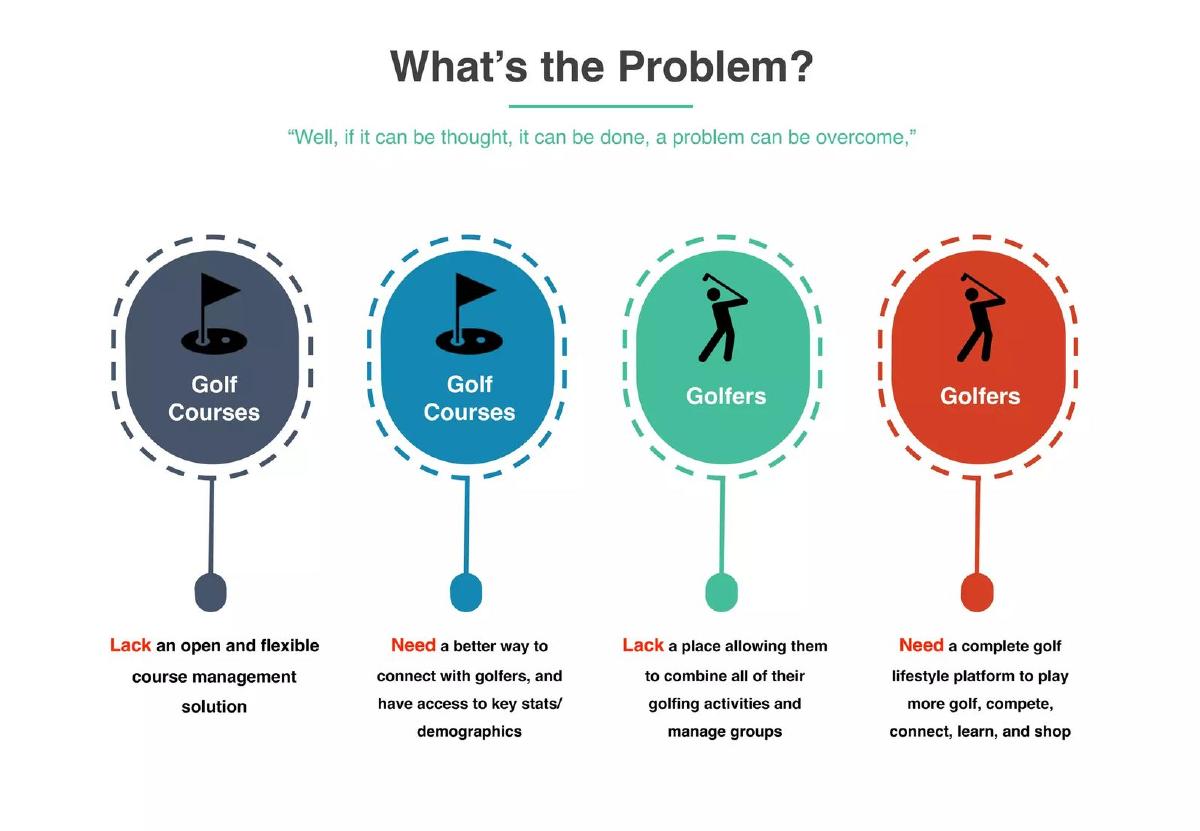
Golfalong breaks the problem down into four segments. For Golf Courses , the issues are a lack of flexible management solutions and a need for better golfer connectivity and data. For Golfers , the problem is the absence of a unified platform to manage groups and a lack of a "complete golf lifestyle platform" for shopping and social interaction.
Slides 5-6: The Solution and User Platform
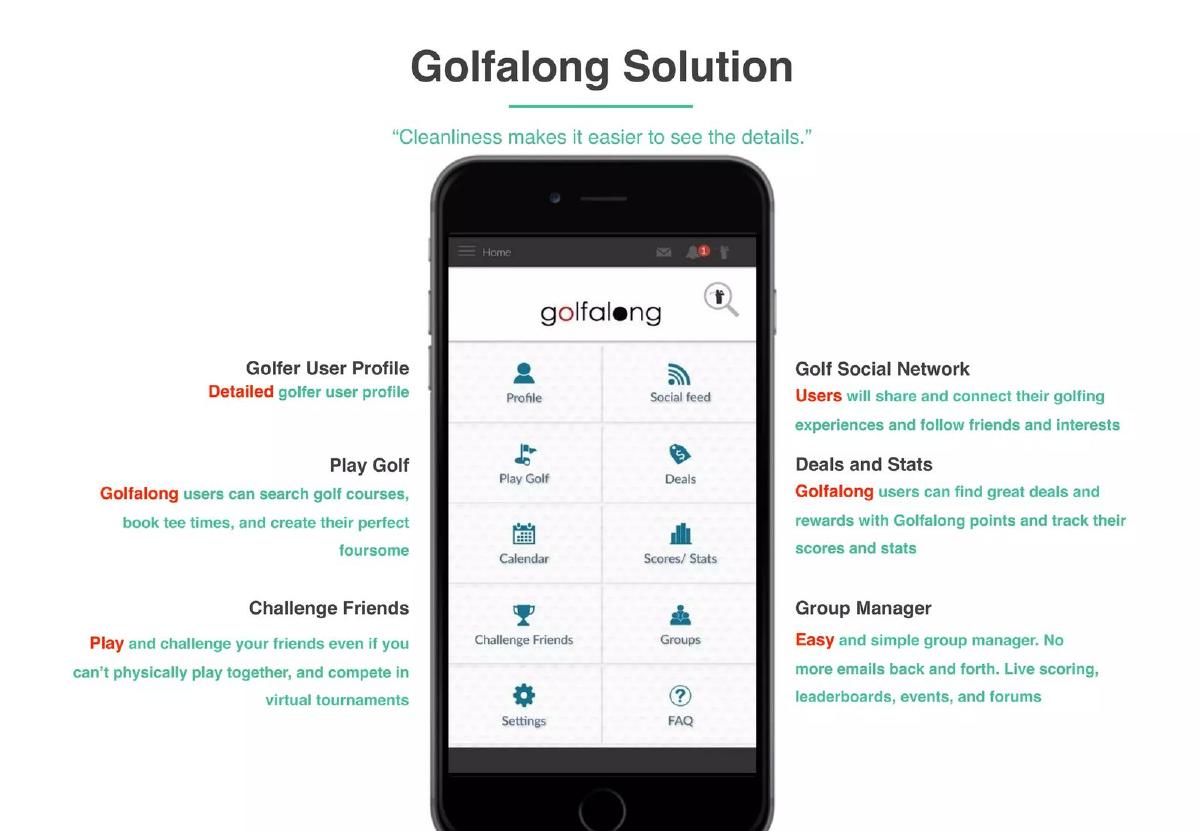
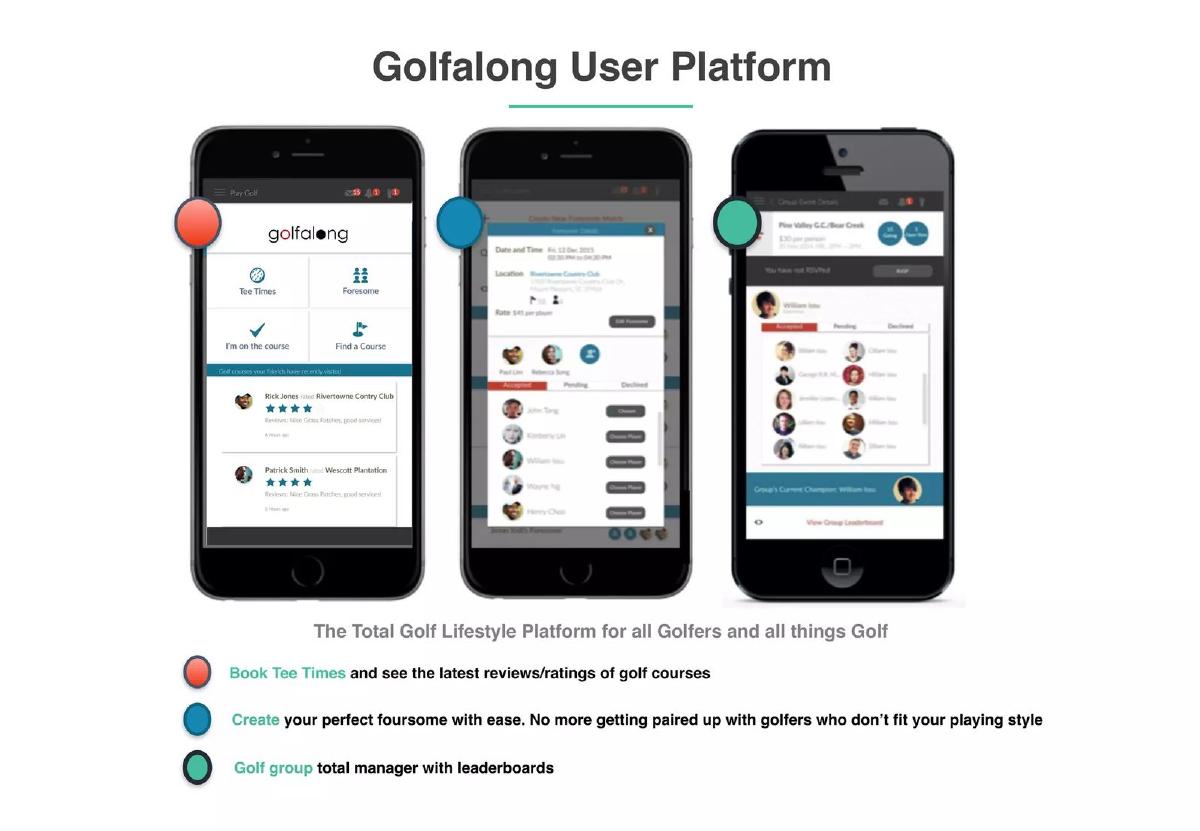
The solution is presented as a mobile-first application. Slide 5 highlights features such as user profiles, tee time booking, social feeds, virtual challenges, and group management. Slide 6 provides UI mockups, emphasizing the ability to "create your perfect foursome" and manage leaderboards. The focus here is clearly on the social and logistical friction points of amateur golf.
Competitive Landscape and Differentiation
Slide 7: Competitive Matrix
The competition slide uses a standard feature grid. Golfalong claims to be the only player offering a "Total Golf Lifestyle Platform" and a "Golf Course back end solution" simultaneously. It positions itself against GolfNow , Facebook , Golfmiles , and Twitter . The primary differentiator claimed is the combination of front-end social data with back-end course analytics.
Slide 8: The Attack on GolfNow
This is a highly specific slide targeting the market leader, GolfNow . It includes a photo of a physical GolfNow tee time confirmation to illustrate that courses only receive basic contact info. Golfalong argues that GolfNow's "aggressive pricing model and barter on cheap rounds" hurts course revenue. This is a classic "David vs. Goliath" pitch, positioning Golfalong as the course-friendly alternative.
Slides 9-10: The B2B Value Proposition
Slide 9 shows a desktop dashboard for course owners, featuring "Detailed Analytics tied to user psychographics." It promises to show courses exactly who is playing and, more importantly, why golfers chose not to book a tee time. Slide 10 uses the quote "Data is the new oil!" to emphasize that courses will receive info on playing styles, handicaps, and favorite brands.
Market Size and Financials
Slide 11: Total Addressable Market (TAM)
The market data is substantial. The deck cites 61.1 million golfers worldwide (26 million in the US) and 32,000 golf courses . It notes 465 million rounds of golf played in the US in 2014 and a $69 billion direct spending market. The target goal is stated as 40% market penetration, though the timeframe for this goal is not specified.
Slide 12: Business Model and Financial Projections
The revenue model is straightforward: a $99 to $399 monthly subscription for courses and advertising revenue from data aggregation. The financial table is highly optimistic. It projects $0 revenue in Year 1 , jumping to $2.59 million in Year 2 , and skyrocketing to $161 million by Year 5 . The projected profit in Year 5 is $56.38 million . These figures represent a massive scaling curve that would require near-perfect execution and rapid adoption.
Traction and Fundraising
Slide 13: Traction
This slide provides concrete evidence of progress. In 2014, the company received $300,000 in development funds from SGI's Technology Accelerator. By the first half of 2015, they had 13 strategic partners. By the second half of 2015, they had 20+ course LOIs and 5,000+ beta sign-ups. The beta launch is centered in Charleston, SC.
Slide 14: Strategic Partners
A logo wall featuring partners like Wild Dunes , Palmetto Dunes , and Rivertowne Country Club . This slide validates the company's ability to sign up actual golf properties, which is the hardest part of a B2B2C play in this sector.
Slide 15: The Ask
Golfalong is raising $900,000 to fund an 18-month burn rate . The allocation is balanced: 30% for product, 25% for business development, 25% for marketing, and 20% for the team. This indicates a shift from the initial development phase into a growth and sales phase.
Analysis: What Works and What is Missing
What Works
Industry Credibility: Having active PGA and LPGA pros as advisors is a major win for a sports-tech startup. · Specific Competitor Pain Points: Identifying exactly how GolfNow fails the course owners (lack of data, revenue cannibalization) gives the sales team a clear wedge. · Geographic Focus: Launching in a golf-heavy market like Charleston, SC, allows for high density and easier logistics during the beta phase.
What is Missing
Unit Economics: While the subscription price is listed, there is no mention of Customer Acquisition Cost (CAC) for courses or the Lifetime Value (LTV) of a golfer. · Technology Ownership: The mention of a "Technology Partner and Development Team" (SG Interactive) raises questions about whether the IP is owned in-house or if the company has a full-time CTO. · Churn Assumptions: In a subscription model, churn is the silent killer. The deck does not address how they plan to keep courses on the platform if tee-time volume doesn't immediately increase.
Founder Takeaway
Founders should note how Golfalong uses psychographic data as a competitive moat. Instead of just competing on booking volume, they are competing on insight . However, the financial projections in this deck are a cautionary tale; projecting a jump from zero to $161 million in five years requires extraordinary evidence that isn't fully present in the traction slide. If you use such aggressive numbers, be prepared for intense scrutiny on your sales velocity assumptions.
Frequently asked questions
- What is the primary problem Golfalong is trying to solve?
- According to Slide 4, the problem is two-fold. Golf courses lack flexible management solutions and a way to connect with golfers using key stats and demographics. Meanwhile, golfers lack a unified platform to combine their activities, manage groups, and access a complete 'lifestyle' platform for competing, learning, and shopping.
- How does Golfalong plan to make money?
- The business model detailed on Slide 12 is two-pronged. First, it charges golf courses a recurring monthly subscription fee between $99 and $399. Second, it generates revenue through data aggregation and targeted marketing/advertising, leveraging the 'psychographic' data collected from its user base.
- Who are the key competitors mentioned in the deck?
- Slide 7 lists GolfNow, Facebook, Golfmiles, and Twitter as competitors. The deck specifically targets GolfNow on Slide 8, criticizing their 'aggressive pricing model' and lack of data sharing, which Golfalong claims hurts golf course revenue and perceived value.
- What early milestones has the company achieved?
- As of the deck's publication, the company had secured a $300,000 development grant, signed 13 strategic partners, and completed a beta platform. They also reported 5,000+ beta sign-ups and over 20 golf courses signed via Letters of Intent (LOI), as shown on Slide 13.
- What is the specific fundraising ask and timeline?
- Slide 15 states the company is raising $900,000. This capital is intended to cover an 18-month burn rate. The largest portion of the funds (30%) is dedicated to product development, followed by business development and marketing at 25% each.