GoMoney’s pitch deck from 500 Startups Batch 21 focuses on disrupting the currency exchange market in Brazil by eliminating the 12% fee typically lost to banks and taxes. The presentation is unique in its heavy reliance on academic research to prove market readiness, specifically showing that 75% of respondents are comfortable using an app with a rating system for exchanges. While the deck clearly identifies the problem and a multi-pronged monetization strategy—including travel cards and lead generation—it lacks critical financial data. There are no mentions of current traction, user numbers,…
Key takeaways
- The deck identifies a specific pain point: travelers lose approximately 12% of their budget to bank fees and taxes (Slide 2).
- GoMoney positions itself as a P2P connector for buying and selling currencies to recapture that 12% margin (Slide 3).
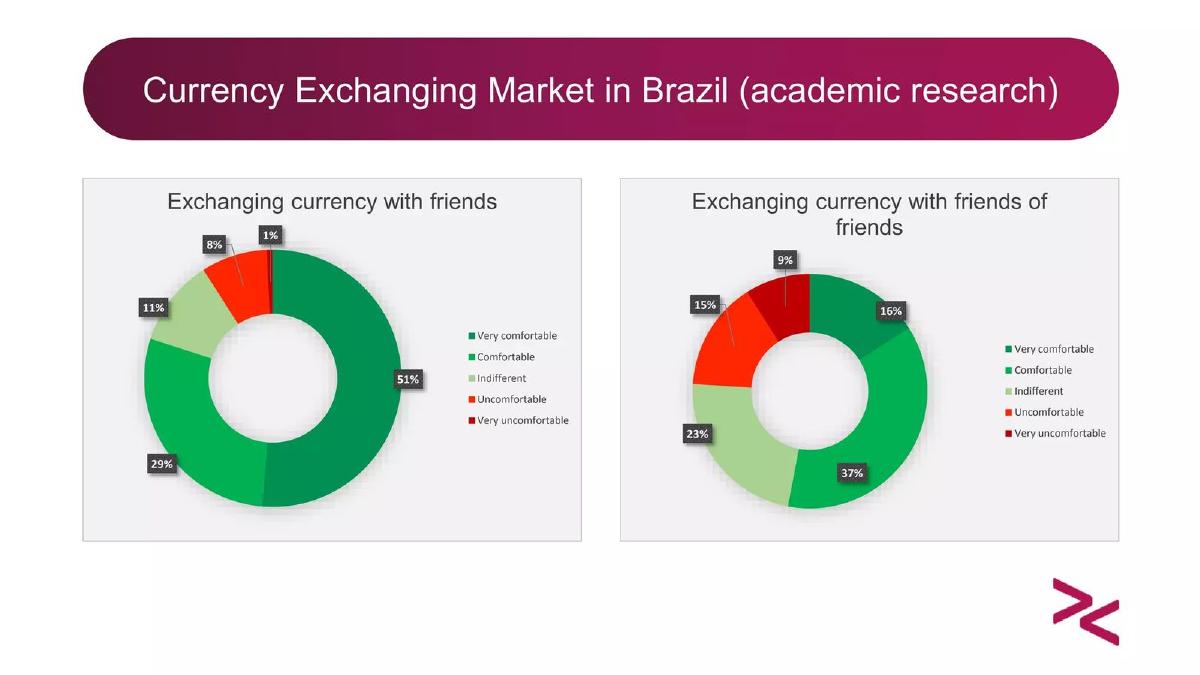
- Market validation is based on academic research showing 51% of people are 'very comfortable' exchanging currency with friends (Slide 4).
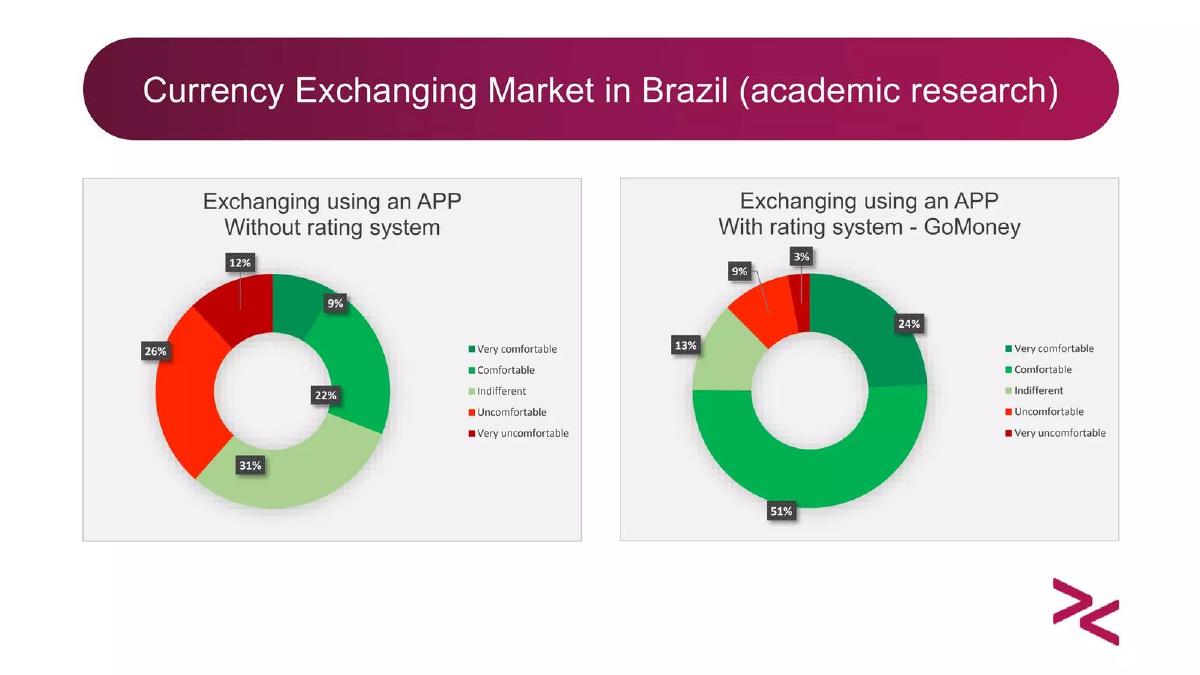
- The solution emphasizes a rating system, which increases user comfort from 9% to 24% for 'very comfortable' in an app setting (Slide 5).
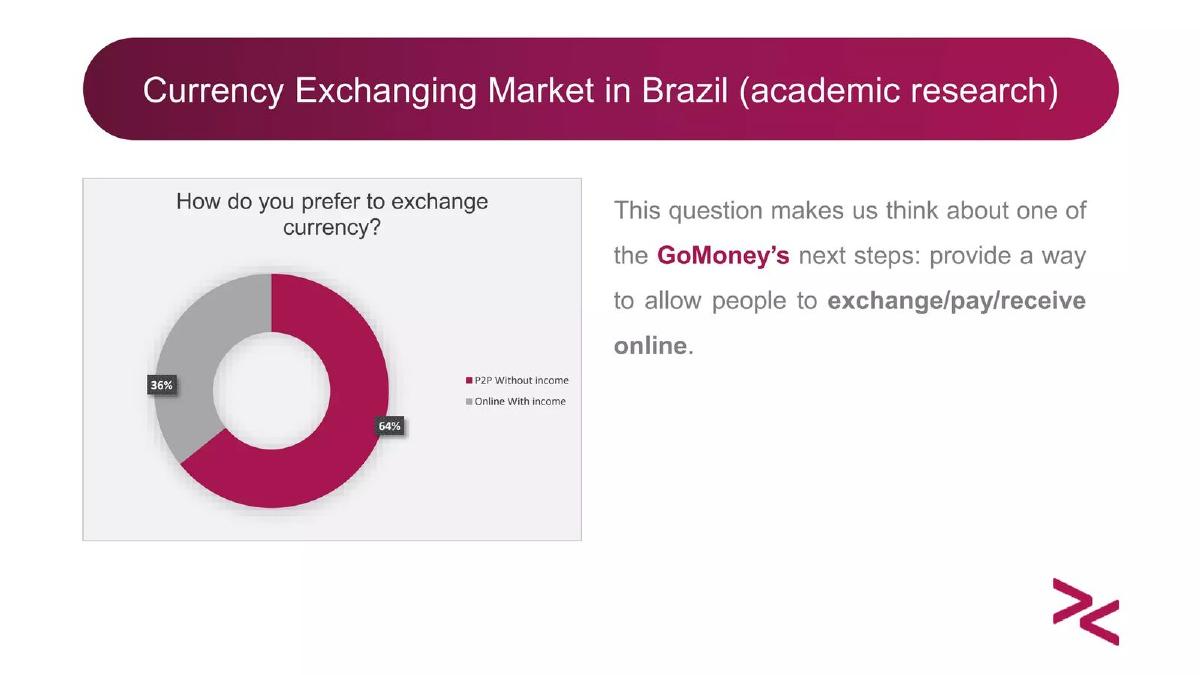
- The research indicates a 64% preference for P2P exchange without income over online exchange with income (Slide 6).
- Monetization is planned through three channels: travel cards, lead generation for advertisers, and enterprise transaction receipts (Slide 7).
- The founding team includes former bank security and bank professionals, providing relevant domain expertise (Slide 8).
- The deck completely omits traction metrics, competitive analysis, and a specific investment ask.
The Hook: A Relatable Travel Pain Point
Slide 1: Title and Visual Context
The deck opens with a lifestyle image of a traveler on a train or monorail, using a smartphone. Overlaid text bubbles simulate a conversation: 'I saw your GoMoney ad =)' followed by 'Great! How much do you need?'. This immediately establishes the product as a mobile-first, peer-to-peer (P2P) currency exchange platform. The branding is clean, featuring a stylized 'G' logo and the URL GoMoney.me.
Slide 2: The Problem Statement
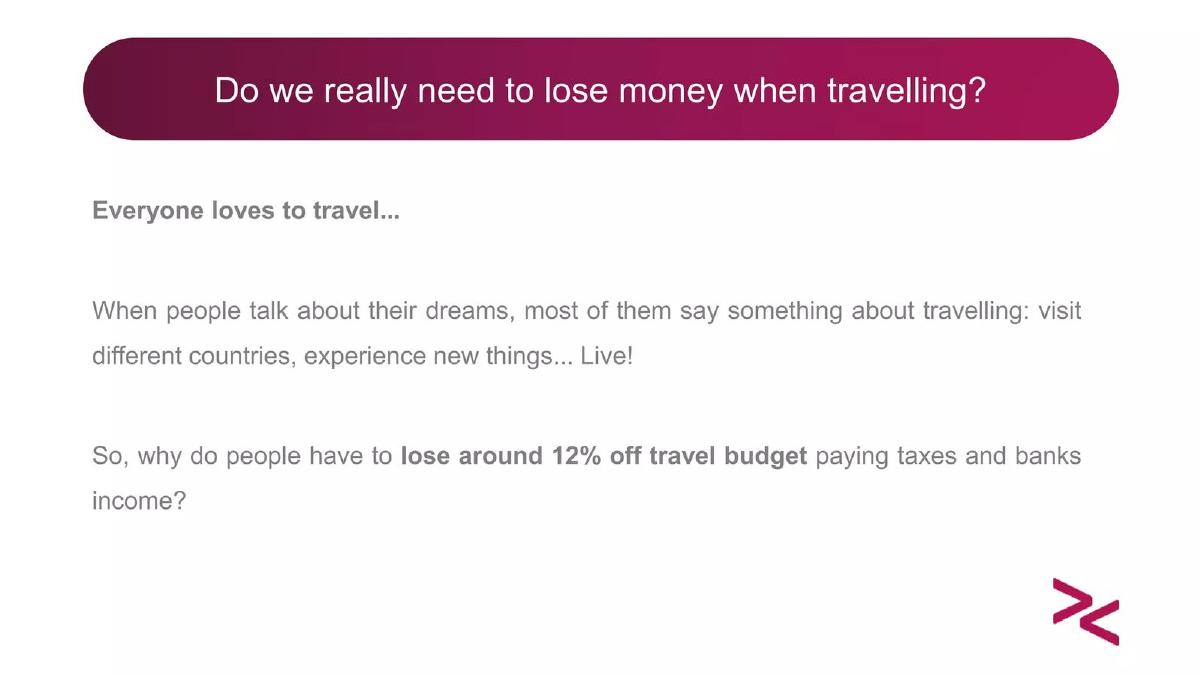
Slide 2 poses the question: 'Do we really need to lose money when travelling?' It quantifies the problem by stating that people 'lose around 12% off travel budget paying taxes and banks income.' This is a strong, specific figure that gives the investor a clear 'enemy'—the 12% inefficiency in the current market.
Slide 3: The Solution and Value Proposition
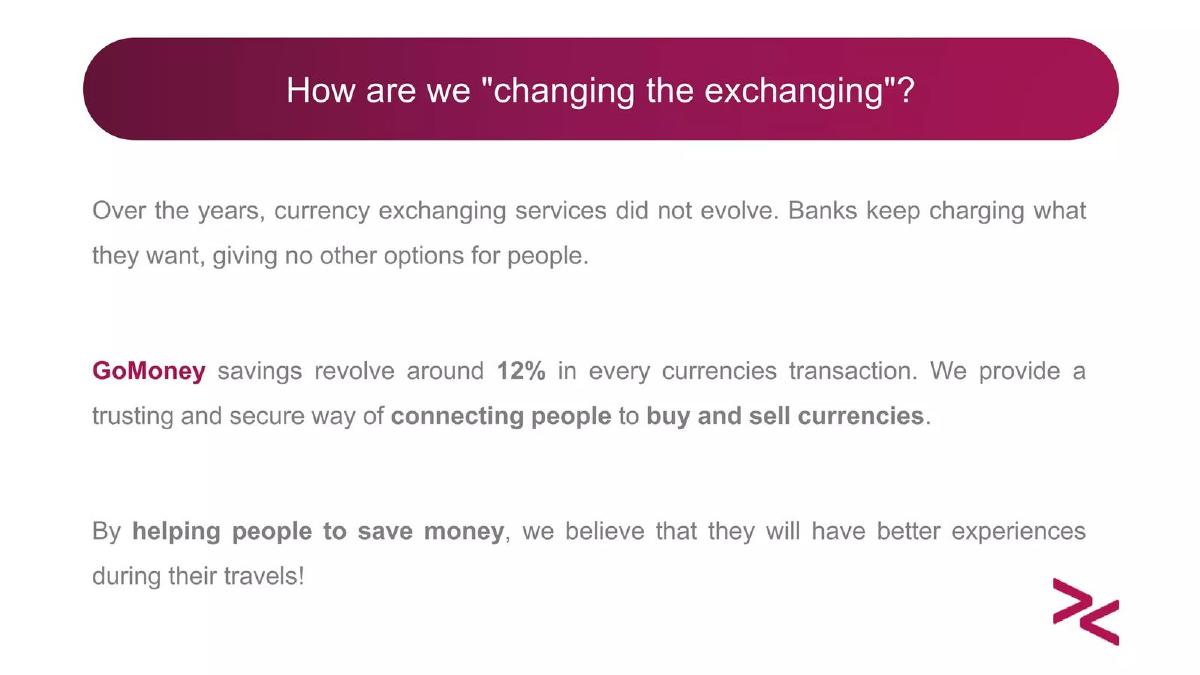
Titled 'How are we "changing the exchanging"?', this slide explains that bank services have not evolved. GoMoney's solution is to provide a 'trusting and secure way of connecting people to buy and sell currencies.' The value proposition is the recapture of that 12% savings for the user. It frames the company as a connector rather than a bank.
Market Validation Through Research
Slide 4: P2P Comfort Levels
GoMoney takes an unusual approach by dedicating three slides to 'academic research' regarding the Brazilian market. Slide 4 uses donut charts to show that 51% of respondents are 'very comfortable' exchanging currency with friends, but this drops significantly to 16% when dealing with 'friends of friends.' This establishes the 'trust gap' that the product needs to bridge.
Slide 5: The Importance of a Rating System
This slide validates GoMoney's specific product feature: the rating system. It compares user comfort in an app 'Without rating system' (9% very comfortable) versus 'With rating system - GoMoney' (24% very comfortable). Combined with the 'comfortable' segment, 75% of users are receptive to the app-based P2P model if a reputation system is in place. This is the core of their market validation strategy.
Slide 6: User Preferences
The final research slide asks, 'How do you prefer to exchange currency?' It reports that 64% prefer 'P2P Without income' (presumably meaning without the bank taking a cut) versus 36% for 'Online With income.' The slide concludes by stating GoMoney's next step is to allow people to 'exchange/pay/receive online,' suggesting a move toward a broader digital wallet or payment ecosystem.
Business Model and Team
Slide 7: Monetization Strategy
Titled 'How to "ComeMoney"?', this slide lists three revenue pillars: 1. Travelling card for transactions; 2. Qualified leads for advertisers; and 3. Low transaction costs for Enterprises requiring receipts. This indicates the founders are looking beyond simple transaction fees to build a more robust revenue model involving B2B services and advertising.
Slide 8: The Team
The team slide lists eight members. Key leadership includes Maurício Pires (CEO) and Susana Pires (CFO), both noted as former bank professionals. The team is rounded out by a COO, IT Infrastructure, two developers, and two marketing professionals. Notably, the headshots used are heavily distorted with a fish-eye effect, which is an unconventional choice for a fintech deck and may distract from the professional credentials listed.
Slide 9: Conclusion
The deck ends with a simple 'Thank you' on a purple gradient background with the company logo. There is no contact information or call to action on this final slide.
What Works in This Deck
Specific Problem Quantification: By citing the 12% loss on travel budgets, GoMoney gives investors a concrete number to anchor the market opportunity. It makes the 'pain' feel real and measurable.
Feature Validation: The use of research to prove that a rating system specifically increases user comfort is a smart way to justify a product roadmap. It shows the founders are thinking about the psychological barriers to P2P finance.
Domain Expertise: Having a CEO and CFO with 'Former Bank Professional' and 'Bank Security' backgrounds is critical for a fintech startup. It suggests the team understands the regulatory environment they are trying to disrupt.
What Is Missing from This Deck
Traction Data: This is the most glaring omission. As a 500 Startups Batch 21 company, investors would expect to see current user growth, transaction volume (GMV), or at least a pilot program's results. The deck relies entirely on 'what people say they would do' (research) rather than 'what people are doing' (data).
Competitive Landscape: The deck mentions 'Banks' as the primary incumbent but fails to address other fintech competitors like Revolut, Wise (formerly TransferWise), or local Brazilian competitors who might also be targeting P2P exchange.
The Ask: There is no slide detailing how much money the company is raising, the valuation, or how the funds will be allocated. This is a fundamental requirement for a pitch deck.
Unit Economics: While they list monetization methods, they do not explain the margins or the cost of customer acquisition (CAC) versus the lifetime value (LTV) of a traveler.
Founder Advice: What to Copy and What to Avoid
Copy the 'Problem' framing: If you are in a space with high fees (fintech, real estate, legal), find the exact percentage the consumer is losing and make that the centerpiece of your problem slide. It is a highly effective way to demonstrate value.
Avoid the 'Distorted' Imagery: The team slide is a place to build trust. Using 'funny' or distorted photos in a fintech deck can undermine the perceived seriousness of the founders, especially when dealing with people's money. Stick to professional, clear headshots.
Balance Research with Reality: Academic research is a great supplement, but it cannot replace traction. If you are pre-revenue, show a waitlist, a letter of intent from a partner, or results from a small beta test. Investors value behavior over intent.
Include a clear 'Next Steps' or 'Ask' slide: Never leave an investor wondering what you want from them. Even if you aren't actively raising at that exact second, a roadmap showing where the company is going provides necessary context for the pitch.
Frequently asked questions
- What is the core problem GoMoney aims to solve?
- GoMoney targets the high cost of currency exchange for travelers, specifically in the Brazilian market. According to slide 2, travelers lose roughly 12% of their travel budget to bank income and taxes. The company argues that currency exchange services have not evolved, leaving consumers with no choice but to pay these high fees to traditional banks.
- How does GoMoney plan to make money?
- Slide 7 outlines three distinct revenue streams: a traveling card for transactions between online buyers and sellers, selling qualified leads to advertisers, and providing low-cost transaction receipts for enterprises. This suggests a hybrid model combining fintech transaction fees with a B2B data/advertising component.
- What evidence does the deck provide for market demand?
- Instead of traditional traction metrics like user growth, GoMoney uses 'academic research' focused on the Brazilian market. Slides 4 through 6 show that while only 9% of people are very comfortable using an app without a rating system, that number jumps to 24% (and 51% for 'comfortable') when a rating system like GoMoney's is included.
- Who are the founders and what is their background?
- The team is led by Maurício Pires (Founder & CEO), a former Bank Security Professional, and Susana Pires (CFO), a former Bank Professional. The team also includes roles for COO, IT Infrastructure, Marketing, and Developers. Their background in banking suggests they understand the regulatory and security hurdles of the industry.
- What are the most significant omissions in this pitch deck?
- The deck lacks a 'Traction' slide, meaning there is no data on how many users or transactions the platform has processed. It also misses a 'Competition' slide, a 'Roadmap' for future development, and a 'The Ask' slide detailing how much capital they are raising and how it will be spent.