Goodword’s 11-slide deck is a masterclass in 'founder-market fit' storytelling. Raising a $4M Seed round in 2024, the New York-based startup avoids dense financial modeling in favor of high-level macro trends and a compelling team narrative. The deck identifies a specific psychological pain point—the 'loneliness epidemic' and the constraints of the human brain—and positions Large Language Models (LLMs) as the technical unlock for 80% of previously unreachable unstructured relationship data. By segmenting their market into 'Connectors,' 'Cultivators,' and 'Opportunists,' Goodword provides a cl…
Key takeaways
- The deck identifies that 80% of data generated today is unstructured, positioning LLMs as the primary catalyst for new relationship tools (Slide 3).
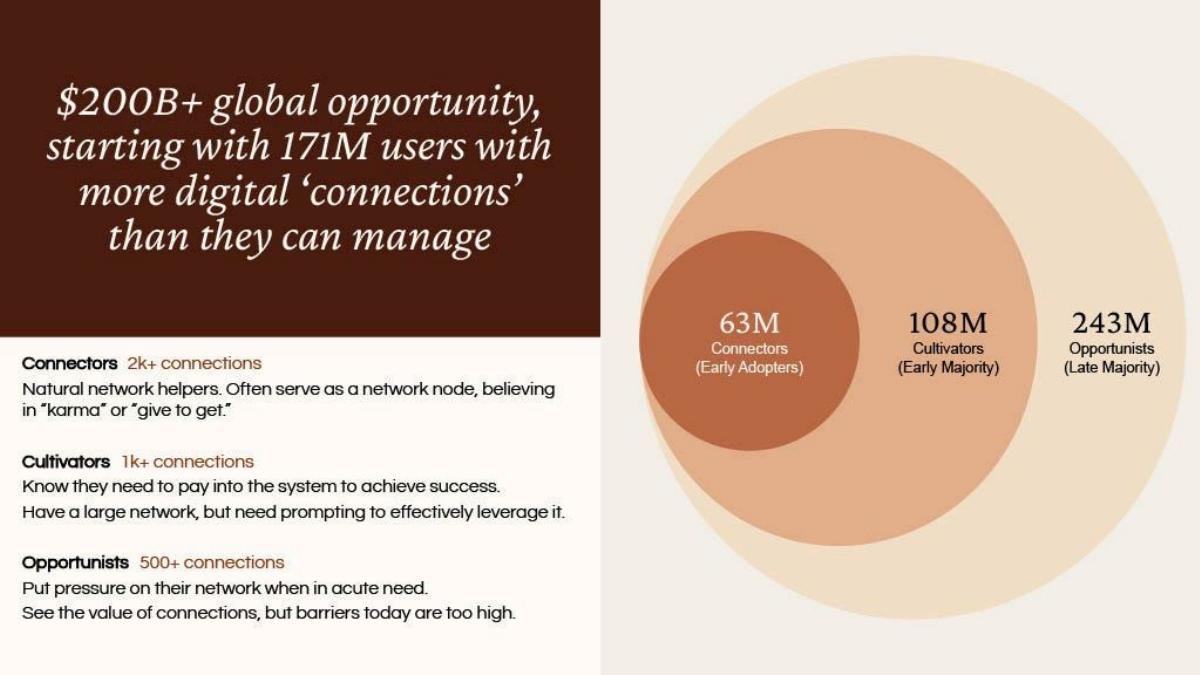
- Goodword targets a $200B+ global opportunity, specifically focusing on 171M users who have more digital connections than they can manage (Slide 5).
- Market segmentation is broken down by connection count: Connectors (2k+), Cultivators (1k+), and Opportunists (500+), providing a clear user persona framework (Slide 5).
- The founders emphasize 30+ years of combined operating experience, including scaling a company to $120M+ in ARR (Slide 7).
- The product is positioned as a 'networking copilot' that integrates across contacts, calendars, and social platforms (Slide 11).
- The deck leverages cultural trends, citing that 136M professionals suffer from a 'loneliness epidemic' (Slide 6).
- A quote from psychologist Robin Dunbar is used to validate the necessity of maintaining a broad network for 'big breaks' (Slide 9).
- The deck omits a specific fundraising ask, financial projections, or a detailed competitive landscape matrix.
The Narrative-First Approach to Seed Funding
Goodword’s pitch deck is a lean, 11-slide presentation that prioritizes vision and team over granular metrics. In a 2024 market that has become increasingly skeptical of 'AI-wrappers,' Goodword successfully raised $4M by framing their product not just as a tool, but as a solution to a biological and cultural crisis. The deck moves quickly from the 'Why Now' (the rise of LLMs) to the 'Who' (proven operators), creating a sense of inevitability around the project.
Slide 1: The Vision Statement
The title slide, 'Beyond Networking: The Future of Relationships,' sets a high-level tone. It avoids technical jargon, opting for a minimalist aesthetic and a logo that suggests intersection and connection. This is a classic 'vision' opening designed to signal that the company is building a category-defining platform, not just a utility.
Slide 2: The Biological Problem
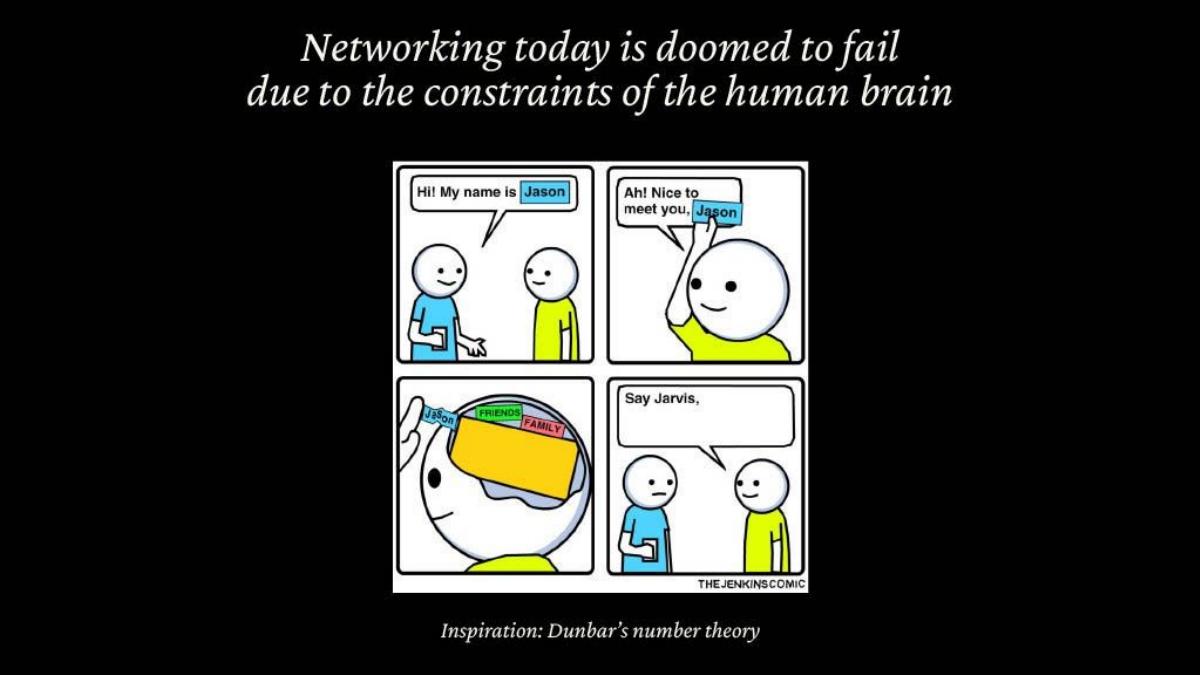
Slide 2 presents a bold thesis: 'Networking today is doomed to fail due to the constraints of the human brain.' By framing the problem as a biological limitation rather than a software bug, Goodword justifies the need for a sophisticated AI intervention. It suggests that humans are simply not equipped to handle the scale of modern digital networks without assistance.
Slide 3: The Technical Unlock
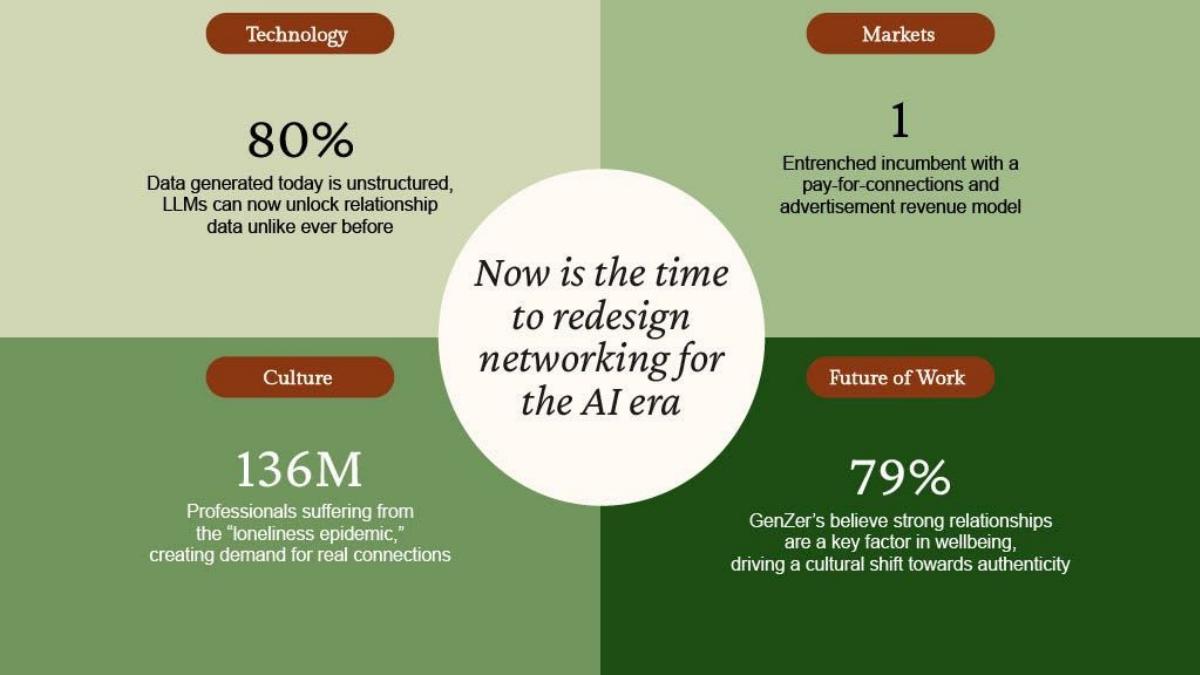
This slide addresses the 'Why Now?' question. It claims that '80% of data generated today is unstructured' and that 'LLMs can now unlock relationship data unlike ever before.' This is the technical backbone of the pitch. It tells investors that the technology finally exists to make sense of the mess of emails, calendar invites, and LinkedIn messages that define professional life.
Slide 4: Market Stagnation
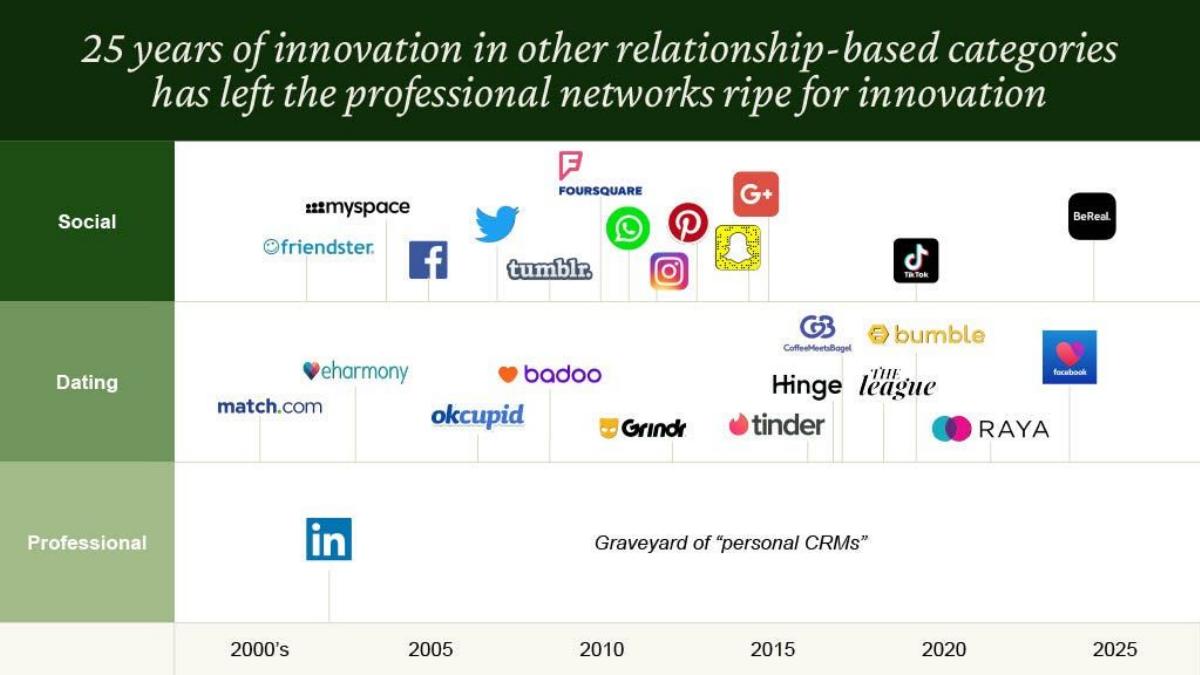
Goodword points out that '25 years of innovation in other relationship-based categories' (likely referring to dating apps like Tinder or social apps like Instagram) has left professional networking 'ripe for innovation.' This slide serves as a subtle critique of LinkedIn without naming the incumbent directly, suggesting that the professional space is stuck in the past.
Slide 5: Market Segmentation and TAM
Slide 5 provides the most concrete data in the deck. It identifies a '$200B+ global opportunity' and breaks down the user base into three distinct personas: 'Connectors' (2k+ connections), 'Cultivators' (1k+ connections), and 'Opportunists' (500+ connections). By quantifying these groups (63M, 108M, and 243M respectively), the founders show they have a clear understanding of their user acquisition funnel and who their 'power users' will be.
Slide 6: The Cultural Context
This slide leans into the 'loneliness epidemic,' noting that '136M professionals' are suffering from a lack of real connection. It positions Goodword as a tool to 'strengthen human relationships' in the AI era. This adds a layer of social impact to the pitch, which can be a powerful motivator for certain types of Seed investors.
Slide 7: The 'Right Duo' (Team Slide)
This is arguably the most important slide in the deck. Caroline Dell (CEO) highlights her experience scaling 'Chief to 20K members and $120M+ in ARR in four years.' Chris Fischer (CPTO) is presented as a 'Serial (8x) startup builder' with IPO experience. For a Seed round, these credentials do the heavy lifting. The 'Earned Secret' section for each founder adds a layer of intellectual depth, showing they aren't just building a product, but testing a specific hypothesis about network friction.
Slide 8: Product Functionality
Slide 8 explains the 'how.' It promises 'seamless integration' across platforms to 'intelligently organize your relationships.' It lists three core actions: organizing, surfacing, and acting. This is the first time the investor sees the actual workflow of the app, moving from the abstract 'future of relationships' to a concrete tool.
Slide 9: External Validation
The deck uses a quote from 'Renowned Psychologist Robin Dunbar' to validate the company's approach. Dunbar is famous for 'Dunbar’s Number' (the cognitive limit to the number of people with whom one can maintain stable social relationships). By citing a conversation between Dunbar and the founders, Goodword aligns itself with established social science.
Slide 10 & 11: The Copilot Reveal
The final slides introduce the term 'networking copilot.' Slide 11 lists key features like 'AI-Powered Copilot' (a chat-based assistant) and 'Curated Introductions.' The inclusion of a mobile UI mockup gives investors a visual anchor for the product, showing a clean, chat-centric interface that feels modern and accessible.
What Works in This Deck
1. Strong Founder-Market Fit: The team slide is exceptional. By highlighting specific ARR milestones ($120M+) and previous successful exits, the founders reduce the perceived risk of the investment. They aren't just 'AI enthusiasts'; they are proven operators in the networking and technology space.
2. Clear User Personas: The breakdown of Connectors, Cultivators, and Opportunists on Slide 5 is a smart way to show how the product will scale. It demonstrates that the founders have thought through the different ways people use their networks and how the product value proposition changes as a user's network grows.
3. The 'Why Now' is Compelling: The deck does a great job of linking the recent explosion in LLM capabilities to a specific, long-standing problem (unstructured relationship data). It makes the product feel like a natural evolution of technology rather than a solution looking for a problem.
What Is Missing from the Goodword Deck
1. The 'Ask' Slide: The deck, as presented, does not include a slide detailing how much money they are raising, the terms of the round, or the specific milestones they intend to hit with the capital. While Business Insider reported a $4M raise, a standard pitch deck usually includes these details to close the presentation.
2. Business Model: There is no mention of how Goodword intends to make money. Whether it is a subscription model (SaaS), a freemium model, or a transaction-based model for introductions, the lack of a 'Business Model' slide leaves a significant question for investors regarding the path to profitability.
3. Competitive Landscape: While the deck mentions an 'entrenched incumbent,' it does not provide a competitive matrix. In the crowded 'AI CRM' and 'Personal CRM' space (with competitors like Clay, Dex, or even traditional CRMs like Salesforce), investors would typically want to see how Goodword differentiates itself technically and strategically.
What Founders Should Copy
1. The 'Earned Secret' Format: On the team slide, Goodword includes an 'Earned Secret' for each founder. This is a brilliant way to demonstrate 'Founder-Market Fit.' It shows that the founders have a unique insight derived from years of experience that others in the space might lack. It moves the conversation from 'what we did' to 'what we learned.'
2. Macro-to-Micro Flow: The deck starts with massive global trends (loneliness, LLMs, $200B markets) and slowly narrows down to a specific mobile app interface. This helps investors buy into the 'big vision' before they start nitpicking the specific features of the app.
3. Psychological Anchoring: By using Robin Dunbar’s research and the concept of 'biological constraints,' the founders make their product feel necessary. Founders building in crowded spaces should look for similar psychological or scientific anchors to validate their problem statement.
Conclusion: Goodword’s deck is a high-signal, low-noise presentation. It relies heavily on the 'pedigree' of the founders to bridge the gap where financial data and business models are missing. For early-stage Seed rounds, this 'vision and team' approach is often enough to secure capital, provided the founders can prove they are the only ones capable of executing on the stated 'earned secrets.'
Frequently asked questions
- What is the core problem Goodword is trying to solve?
- Goodword argues that modern networking is failing because the human brain cannot manage the volume of digital connections we now possess. Slide 2 states networking is 'doomed to fail due to the constraints of the human brain,' while Slide 6 highlights a paradox where professionals are more digitally connected than ever but feel a growing gap in real human connection.
- How does Goodword plan to use AI specifically?
- According to Slide 3 and Slide 11, the company uses Large Language Models (LLMs) to unlock 'unstructured' relationship data. The product features an 'AI-Powered Copilot' chat interface to capture meeting details and a 'Relationship Intelligence' engine that automatically organizes contacts by context and provides personalized recommendations.
- Who are the founders and what is their background?
- The team consists of CEO Caroline Dell and CPTO Chris Fischer. Dell previously scaled Chief to 20k members and $120M+ in ARR. Fischer is described as a serial (8x) startup builder with experience taking companies from '0 to 1' through to IPO, including roles at Shutterstock and Reonomy (Slide 7).
- What is the size of the market Goodword is targeting?
- Slide 5 identifies a $200B+ global opportunity. They segment their initial target audience into 63M 'Connectors' (early adopters), 108M 'Cultivators' (early majority), and 243M 'Opportunists' (late majority), totaling over 400 million potential users across these tiers.
- Does the deck include a business model or revenue plan?
- No. The provided slides do not detail a specific pricing strategy or revenue model. However, Slide 6 mentions that the 'entrenched incumbent' currently uses a 'pay-for-connections and advertisement revenue model,' implying that Goodword may seek a different path, though the specific alternative is not outlined in this deck.