Fibery’s 15-slide Series A deck is a clinical exercise in identifying market fragmentation and offering a structural solution. The company, a spin-off from Targetprocess, leverages deep domain expertise to challenge incumbents like Jira and Notion. They frame the problem as a 'painful migration' cycle that occurs as startups scale, positioning Fibery as the tool that grows from a 4-person seed team to a 100+ person enterprise. With $350K ARR at the time of the deck and a clear path to $1M, the narrative focuses on 'connected spaces' rather than just features. The deck successfully balances hi…
Key takeaways
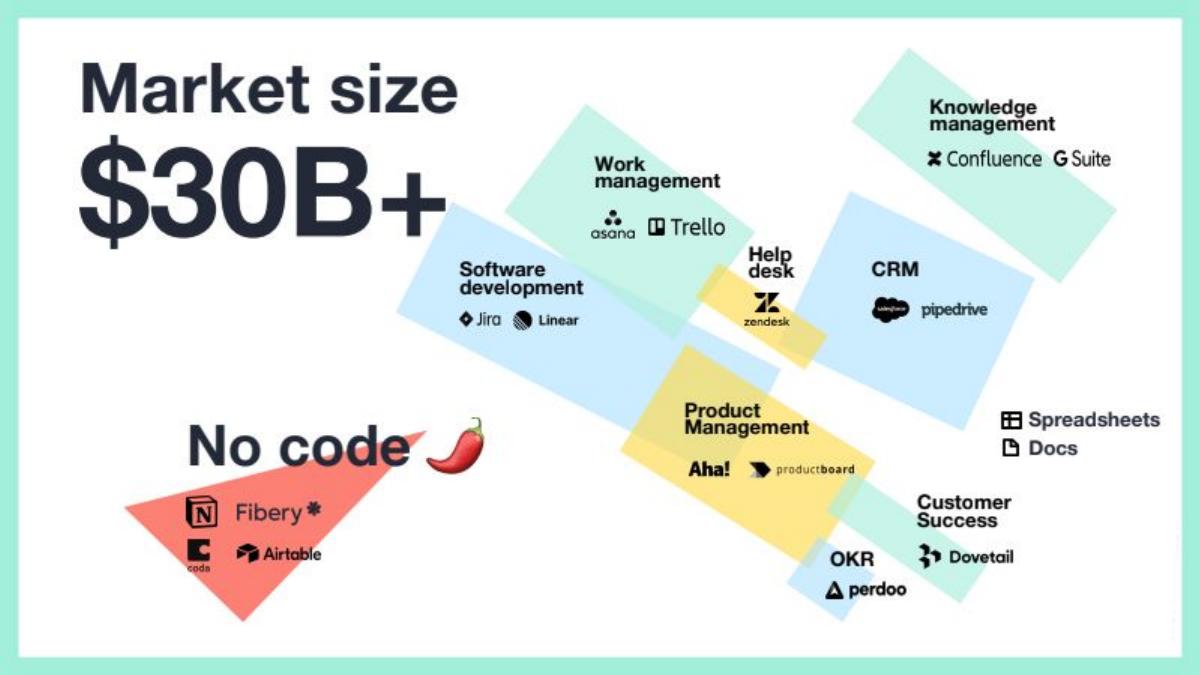
- The deck identifies a $30B+ market opportunity by aggregating fragmented categories like CRM, OKR tracking, and Software Development (Slide 4).
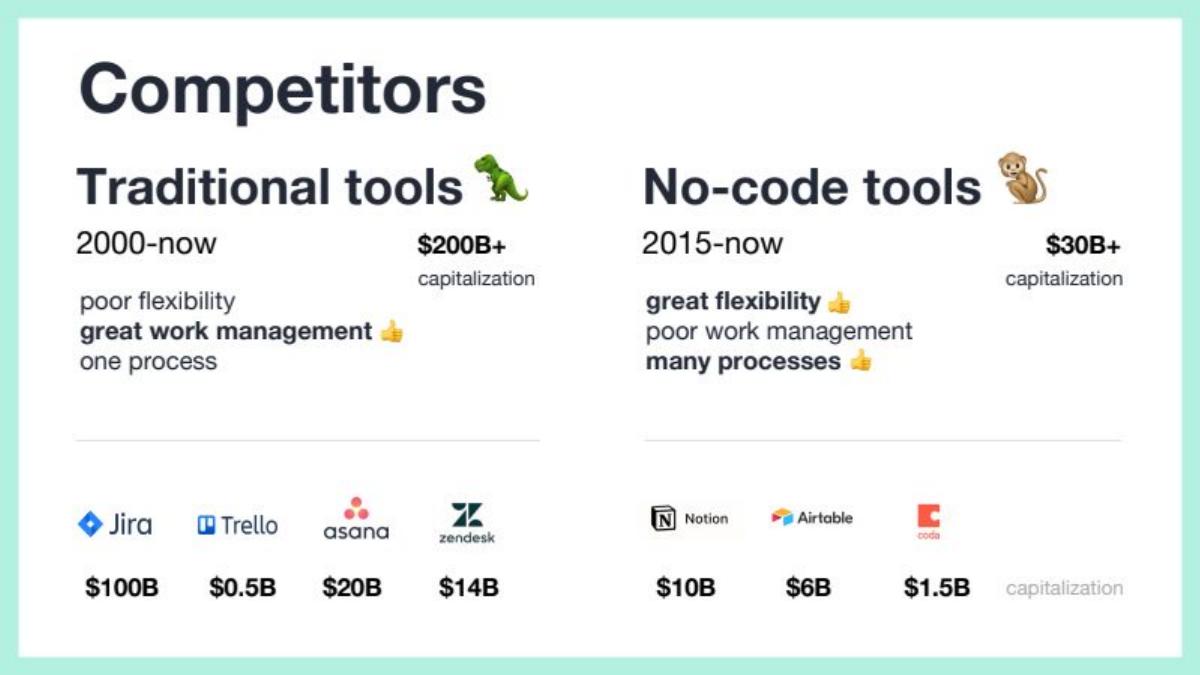
- Fibery positions itself as the middle ground between 'Traditional tools' (great management, poor flexibility) and 'No-code tools' (great flexibility, poor management) (Slide 5).
- The product narrative centers on 'Connected spaces' and 'Customizable business domains' to solve technical workplace management problems (Slide 7).
- The company reports a healthy 6-month revenue churn of only 4%, suggesting strong retention despite a crowded market (Slide 12).
- Fibery was a spin-off from Targetprocess, giving the team a decade of prior experience in the work management market (Slide 13).
- The founder, Michael Dubakov, brings significant credibility as the former founder and CEO of Targetprocess since 2004 (Slide 14).
- The 'Plans' slide explicitly states a goal of reaching $1M ARR by December 2023 and $2-3M by December 2024 (Slide 15).
- The business model targets an average account size of 20-30 users with a 3-year expected lifetime (Slide 11).
The Narrative Arc: From Fragmentation to Connection
Fibery’s pitch deck is a textbook example of a 'Category Challenger' narrative. It doesn't claim to invent a new behavior; instead, it promises to fix a broken one. The deck moves from the chaos of tool sprawl to the order of a unified workspace, using the company's heritage as a spin-off to provide a 'safe pair of hands' for venture capital investment.
Slide 1: Title Slide
The deck opens with a simple, clean brand identity. The tagline, 'Fibery is a connected workspace for startups,' immediately identifies the target audience and the primary value proposition. There is no ambiguity here; they are not building for everyone, they are building for startups.
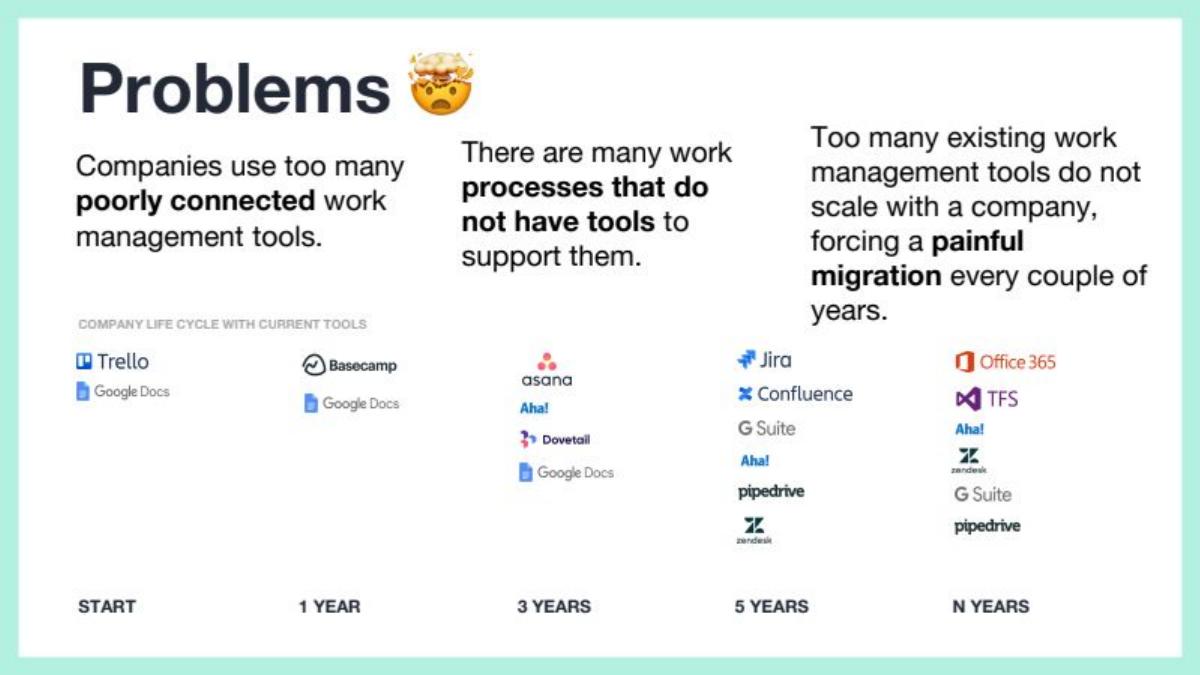
Slide 2: The Problem of Tool Sprawl
Slide 2 uses a chronological visualization to show how a company's tech stack becomes a 'mess' over time. It lists specific competitors like Trello, Google Docs, Asana, Jira, and Pipedrive. The core insight is that as a company grows from 'Start' to 'N Years,' the number of poorly connected tools increases, leading to a 'painful migration every couple of years.'
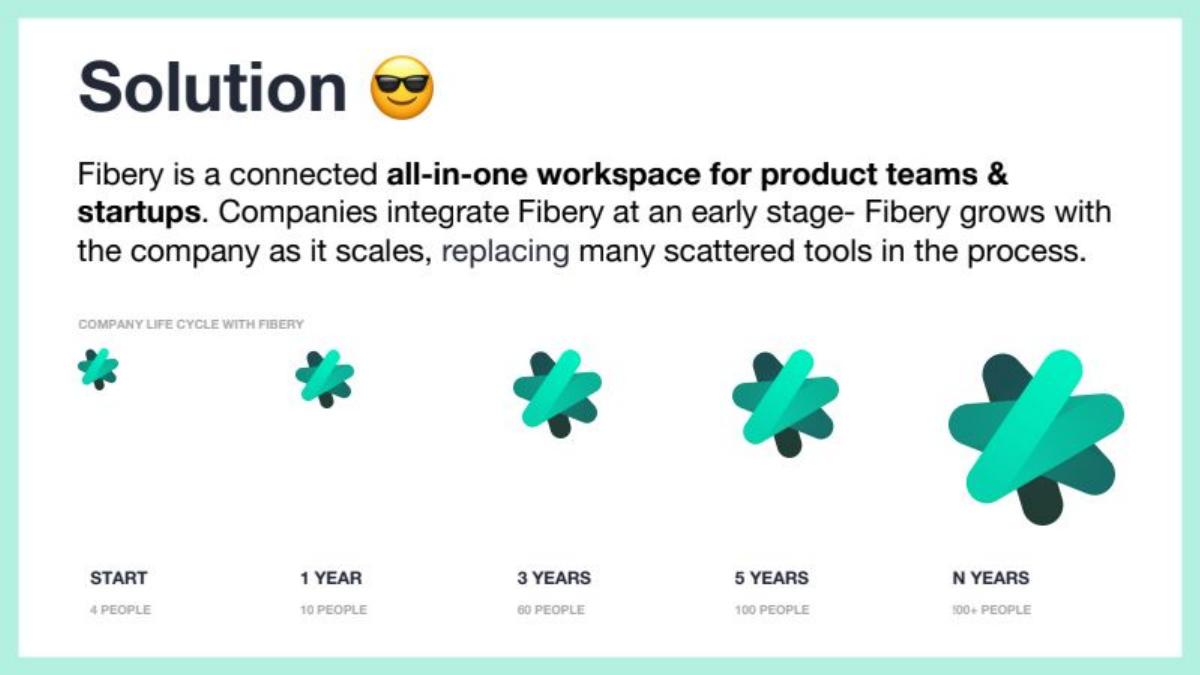
Slide 3: The Solution
The solution slide mirrors the problem slide. Instead of a growing list of logos, it shows the Fibery logo growing in size. The text emphasizes that Fibery is an 'all-in-one workspace' that replaces scattered tools. It explicitly mentions the company lifecycle, showing Fibery scaling from 4 people to 100+ people.
Slide 4: Market Size
Fibery defines its market as a $30B+ opportunity. Rather than a standard TAM/SAM/SOM circle, they use a map of overlapping software categories: Software Development, Knowledge Management, CRM, Product Management, and Customer Success. This visualizes their 'all-in-one' strategy, showing how they sit at the intersection of these established silos.
Slide 5: Competitive Landscape
This is one of the strongest slides in the deck. It categorizes competitors into two camps: 'Traditional tools' (2000-now, $200B+ capitalization) like Jira and Asana, and 'No-code tools' (2015-now, $30B+ capitalization) like Notion and Airtable. Fibery positions itself as the evolution that combines the 'great work management' of the old guard with the 'great flexibility' of the new guard.
Slide 6: Fibery vs. Competitors
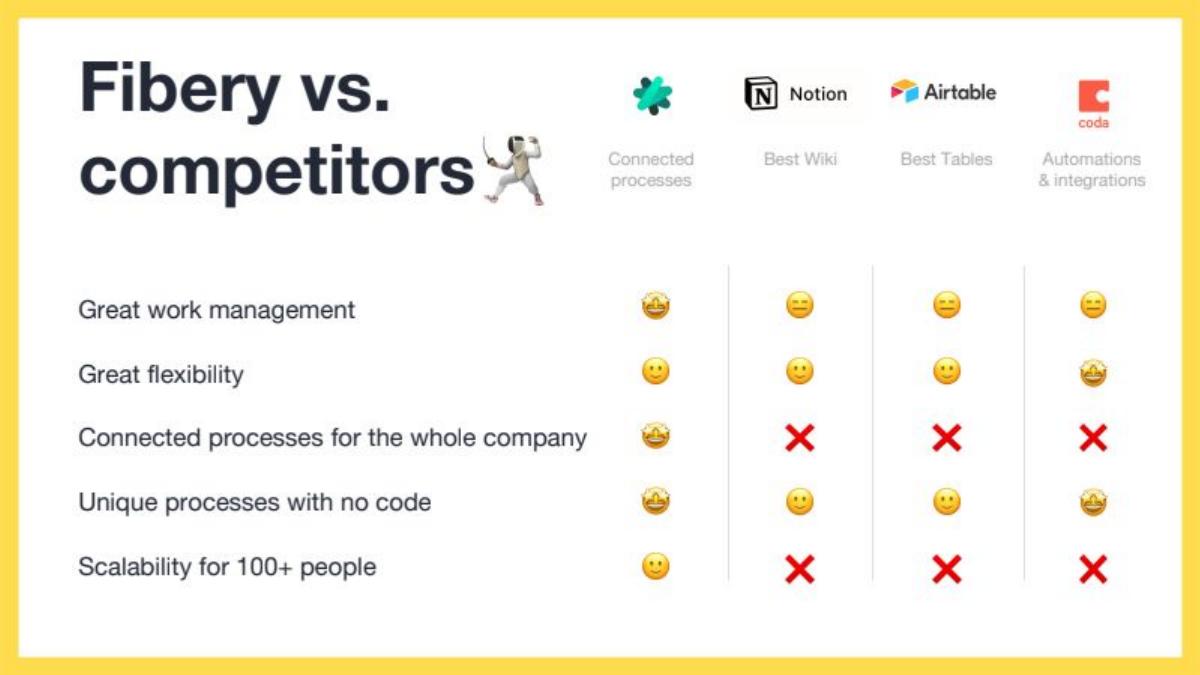
This feature-comparison matrix uses emojis to rank Fibery against Notion, Airtable, and Coda. It concedes that competitors are 'Best Wiki' or 'Best Tables' but claims the win on 'Connected processes for the whole company' and 'Scalability for 100+ people.' By acknowledging competitor strengths, the claims of their own unique advantages feel more credible.
Slide 7 & 8: Product and Building Blocks
Slide 7 shows a 'Workspace Map' which is a visual representation of their 'connected spaces' philosophy. It moves away from the standard list-view of most PM tools. Slide 8 uses an abstract diagram to show 'Building Blocks'—Views, Spaces with Databases, and Automations/Integrations—explaining how the flexibility is achieved technically.
Slide 9: Feedback and Social Proof
The feedback slide includes quotes from COOs and CSOs. One notable quote mentions replacing 'Jira, Confluence, and Trello-style tools.' It also highlights a 4.8 rating on G2 , providing external validation of the product's quality.
Slide 10: Go-to-market Strategy
The GTM strategy is focused on product teams. They list specific use cases: Customer discovery, Product management, Software development, Growth hacking, and Goal tracking. They also list integration partners like GitLab, GitHub, Intercom, and Figma, acknowledging that they must live within an existing ecosystem even as they replace other parts of it.
Slide 11: Business Model
This slide provides hard unit economics. They target SMBs at ~$10 per user per month . They disclose an expected average account size of 20-30 users and an expected LTV of ~$7K based on a 3-year lifetime. This level of detail is exactly what Series A investors look for to model out the potential return.
Slide 12: Current Metrics
The metrics slide is transparent. It shows $350K ARR , 180 paid accounts, and 400 active company accounts. The most impressive figure here is the 6-month revenue churn of 4% , which is quite low for the SMB SaaS segment and indicates high product stickiness.
Slide 13: History
This slide explains that Fibery was a Targetprocess spin-off started in Jan 2017. It provides a timeline from private beta (2019) to official launch (2020) and their $3.1M Seed round in 2021. This history explains why a relatively young company has such a mature product and deep market insights.
Slide 14: Team
The team slide focuses on experience. With 25 employees, they highlight a 'strong R&D team' of 15 people with 10+ years of experience in work management. Founder Michael Dubakov’s history as the founder of Targetprocess since 2004 is the centerpiece of the team's credibility.
Slide 15: Plans and The Ask
The final slide outlines the ~$4.5M round . The goals are specific: build a marketing team, improve acquisition channels, and launch Fibery 2.0. They set clear milestones: ~$1M ARR by Dec 2023 and $2-3M ARR by Dec 2024 . This gives investors a clear yardstick to measure future success.
What Works in This Deck
1. Structural Differentiation: Instead of listing features, Fibery explains why the architecture of their competitors fails as companies scale. This is a much higher-level and more persuasive argument for a Series A round.
2. Honest Competitive Analysis: By admitting that Notion is a better Wiki and Airtable has better tables, they gain the trust of the investor. It makes their claim of being better at 'connected processes' much more believable.
3. Deep Domain Expertise: The 'spin-off' narrative is powerful. It tells investors that this isn't a group of founders guessing at a problem; it's a group that has spent 15+ years in the trenches of work management software.
What Is Missing
1. Detailed Churn Breakdown: While they provide a 6-month churn figure, a cohort analysis would have been more powerful to show if retention improves as accounts age.
2. Sales Efficiency Metrics: The deck mentions CAC (Customer Acquisition Cost) indirectly through marketing plans, but explicit CAC or Magic Number figures are absent. Given the $10/user price point, investors would want to know if they can acquire these customers profitably at scale.
3. Use of Funds Breakdown: While they mention building a marketing team, a more granular breakdown of how the $4.5M is allocated (e.g., % to R&D vs. % to S&M) is missing.
Founder Takeaways: What to Copy
The 'Problem vs. Solution' Visualization: Copy the way Slide 2 and Slide 3 mirror each other. It is a visually effortless way to show how your product simplifies a complex status quo.
The Market Map: If you are an 'all-in-one' tool, don't use a standard TAM circle. Use a map of the categories you are disrupting (Slide 4). It shows you understand the ecosystem you are entering.
Specific Unit Economics: Don't just say you are a SaaS company. Provide the expected account size, LTV, and churn (Slide 11 & 12). It shows you are running a business, not just building a product.
Frequently asked questions
- What is Fibery's primary value proposition?
- Fibery positions itself as a 'connected workspace' specifically designed for startups and product teams. Its core value is eliminating the need for multiple, poorly connected tools (like Jira, Trello, and HubSpot) by providing a single platform that scales with a company from 4 to 100+ employees without requiring a painful migration.
- How does Fibery compare itself to Notion and Airtable?
- On Slide 6, Fibery claims superiority in 'Connected processes for the whole company' and 'Scalability for 100+ people.' While it acknowledges that Notion is the 'Best Wiki' and Airtable has the 'Best Tables,' it argues these tools lack the robust work management and cross-functional connectivity required for larger, scaling teams.
- What are Fibery's key financial metrics in this deck?
- At the time of the presentation, Fibery reported $350K in ARR with 180 paid accounts. Their average paid account size was 15 users, generating approximately $2,000 in ARR per account. They also highlighted a low revenue churn rate of 4% over six months.
- What is the background of the founding team?
- The team has deep roots in the industry. Fibery is a spin-off from Targetprocess, an enterprise agile planning tool. Founder and CEO Michael Dubakov previously founded Targetprocess in 2004. The R&D team consists of 15 developers and designers with an average of over 10 years of experience in work management software.
- How does Fibery plan to use the Series A funds?
- According to Slide 15, the company sought ~$4.5M to build a strong marketing team and improve acquisition channels including partner networks, community, and content marketing. They also planned to launch 'Fibery 2.0' in late 2023 to streamline use cases for product teams.