Anfin's pitch deck presents a compelling case for a digital brokerage in the underserved Vietnamese market, leveraging a 59% 6-year CAGR in daily trading volume. The founding team brings significant experience from major regional players like Ahamove, Beenext, and Tiki. The deck clearly outlines a 'flywheel' product strategy combining education, research, and trading to engage new retail investors. Notably, Anfin uses a partnership model with established brokers like VNDIRECT and SSI to operate before acquiring its own license, capturing a 0.11% net spread. While the roadmap is ambitious, aim…
Key takeaways
- Vietnam's stock exchange daily trading volume reached a peak of $2.1B in H2 2021, representing a 59% 6-year CAGR (Slide 7).
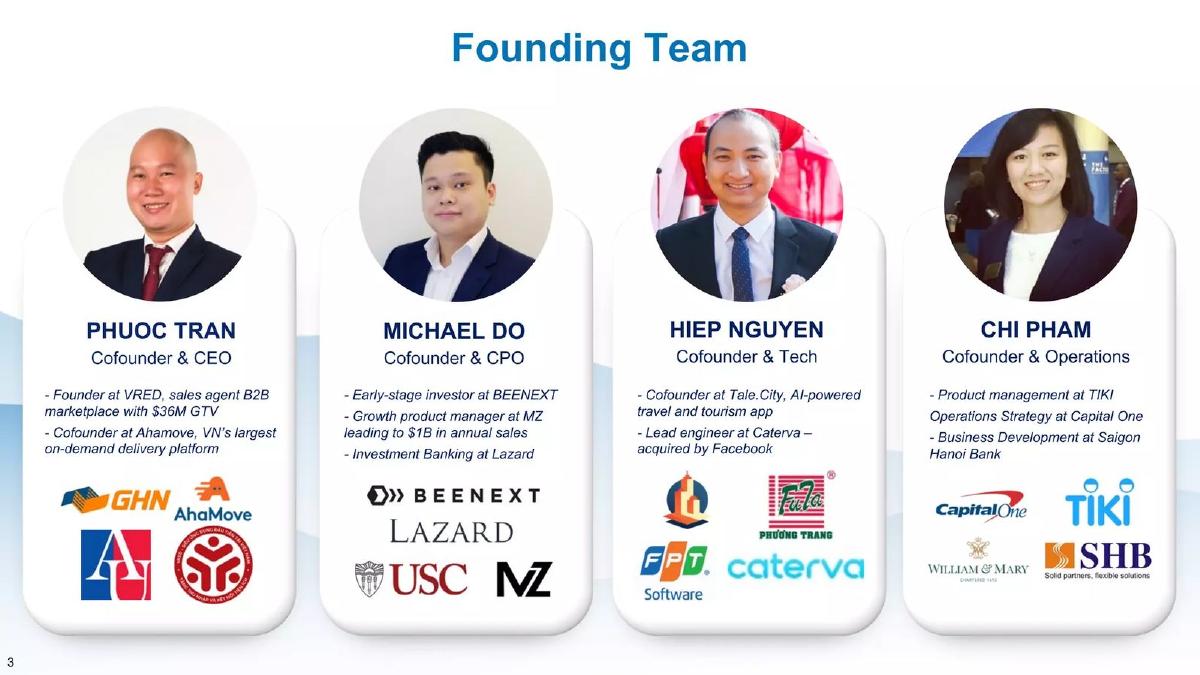
- The founding team includes veterans from Ahamove, Beenext, Lazard, and Capital One, providing a mix of local operational and global financial expertise (Slide 3).
- Anfin identifies a $30B opportunity if Vietnam achieves mutual fund adoption levels similar to India (Slide 9).
- The business model relies on a 0.25% gross spread, with 0.14% shared with partners, resulting in a 0.11% net spread (Slide 17).
- Current operational partners include VNDIRECT, SSI, and Dragon Capital, allowing the platform to function before obtaining a full brokerage license (Slide 17).
- The product strategy focuses on a 'flywheel' of behavior: education, research, and trading to hook retail users (Slide 11).
- Anfin projected reaching 80,000 funded accounts by Q4 2022, coinciding with a planned Series A raise (Slide 25).
- The revenue run-rate calculation assumes an average account value of $300 and a 1.5x monthly turnover (Slide 25).
Executive Summary and Team
Slide 1: Title Slide
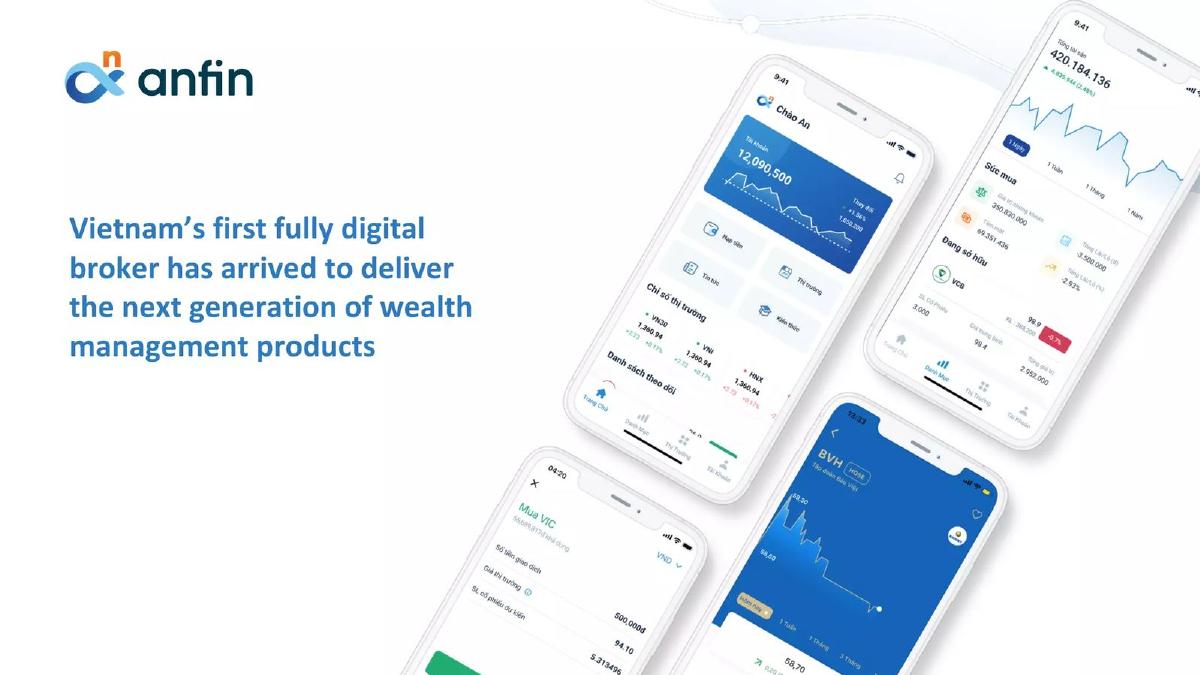
The cover slide features the Anfin logo and two mobile device mockups showing the app interface. The interface displays a portfolio balance of 12,090,500 (presumably VND), market indices like VN30 and HNX, and a watchlist. The design is clean and emphasizes a mobile-first user experience.
Slide 3: Founding Team
Anfin presents a four-person founding team with diverse backgrounds. Phuoc Tran (CEO) is noted as a co-founder of Ahamove, a major Vietnamese delivery platform, and founder of VRED. Michael Do (CPO) brings venture capital and investment banking experience from Beenext and Lazard. Hiep Nguyen (Tech) has a background in AI and was a lead engineer at Caterva, which was acquired by Facebook. Chi Pham (Operations) has experience at TIKI, Capital One, and Saigon Hanoi Bank. The slide uses logos from these former employers to establish immediate credibility.
Market Opportunity and Problem Statement
Slide 5: The Status of the Market
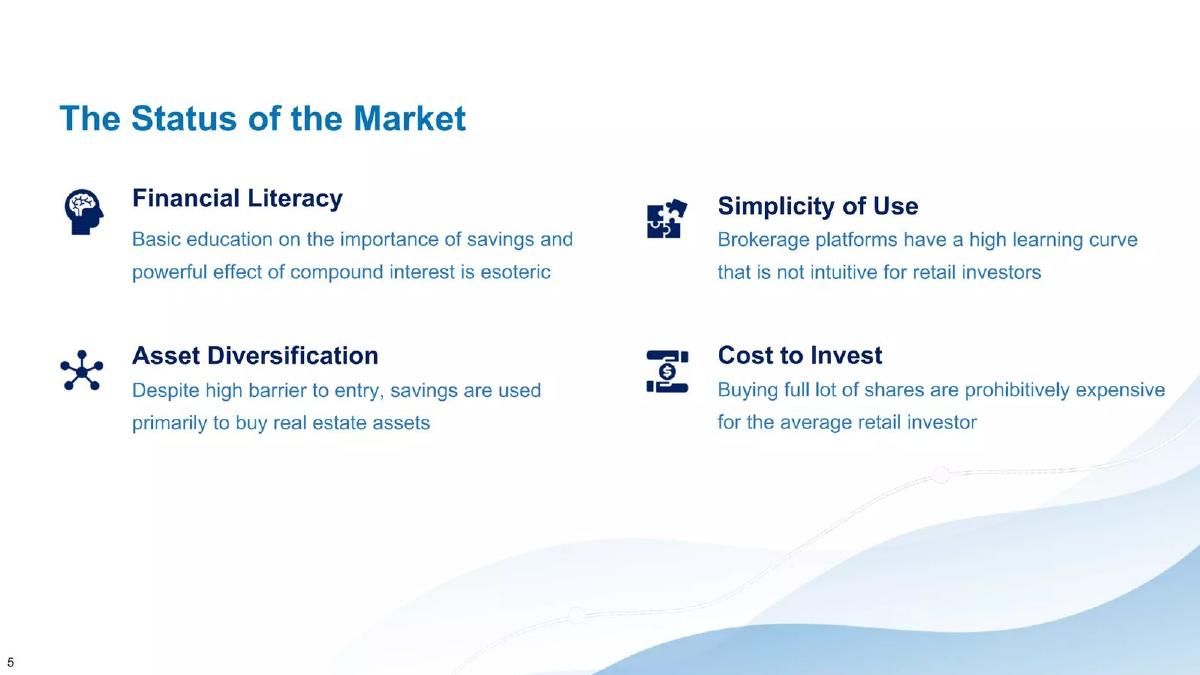
This slide identifies four primary barriers to retail investing in Vietnam: Financial Literacy (lack of education on compound interest), Asset Diversification (over-reliance on real estate), Simplicity of Use (high learning curves on existing platforms), and Cost to Invest (prohibitive pricing for full lots of shares). This sets the stage for Anfin's solution as a democratizing force.
Slide 7: Market Growth Metrics
Anfin highlights a massive surge in market activity. Daily trading volume on Vietnam's stock exchanges grew at a 59% CAGR over six years. The chart shows volume rising from $132M in 2016 to a peak of $2.1B in H2 2021 . This data point is crucial for proving that the market is currently at an inflection point.
Slide 9: Regional Comparison
The deck compares Vietnam's mutual fund assets as a percentage of GDP (0.3%) to other nations like Thailand (28.9%) and the USA (118.0%). It claims that achieving adoption levels similar to India (10.8%) would represent a $30B opportunity . The slide also lists tailwinds such as rising GDP per capita and high internet penetration.
Product Strategy and User Experience
Slide 11: Product Made Simple
This slide illustrates the 'flywheel' of the Anfin app. It connects four key functions: Portfolio , Stocks , Invest , and Education . The text emphasizes that the combination of trading, research, and learning is designed to 'hook' users into a repeatable cycle of behavior.
Slide 13: Company Discovery through Research
Anfin showcases its research tools, including a live feed of popular news and advanced metrics explained for retail users. The goal is to train users to 'examine like a professional trader.' The mockups show financial metrics like P/E, EPS, and industry rankings, suggesting a level of depth beyond simple execution.
Execution and Business Model
Slide 15: Execution Divider
A transition slide featuring isometric graphics of a professional standing on a growth chart, signaling the shift from market theory to operational reality.
Slide 17: Partnership Model
This is a critical slide explaining how Anfin operates. It uses a partnership model to enable operations before acquiring its own brokerage license. The revenue breakdown is shown as a 0.25% Gross Spread minus a 0.14% Partner Share , resulting in a 0.11% Net Spread . Listed partners include VNDIRECT , SSI , and Dragon Capital .
Slide 19: The Landscape Divider
A transition slide leading into the competitive and regional context.
Slide 21: Regional and Global Trends
Anfin points to successful peers in other markets to validate their model. Regional examples include Ajaib (Indonesia, $153M raise), Bibit (Indonesia, $30M raise), and Groww (India, $30M raise). Global mentions include Robinhood and Cash App . The takeaway is that Vietnam lacks a modern mobile app to address similar demand.
Slide 23: Future Opportunities
This slide outlines a roadmap for expansion. Beyond stocks, Anfin eyes NFTs , Derivatives , and Crypto in the brokerage space. It also envisions moving into Passive investments (copy trading, retirement), Banking (lending, checking), and Regional Expansion into Thailand, the Philippines, and Cambodia.
Slide 25: Projected Timeline
The final slide in the set provides a growth forecast. It targets 80,000 funded accounts by Q4 2022 . The revenue math is explicitly stated: 80k accounts $300 account value 1.5 monthly turnover 0.25% commission 12 months = $1.1M run-rate . It also marks Q4 2022 as the target for a Series A raise.
What Works in the Anfin Deck
Strong Team-Market Fit: The founders' backgrounds in high-growth Vietnamese startups (Ahamove, Tiki) and global finance (Lazard, Capital One) directly address the operational and regulatory hurdles of the sector. · Clear Revenue Math: Slide 25 provides a transparent look at how the company intends to reach its revenue targets, breaking down the assumptions for account value and turnover. · Validation via Proxy: By citing the success of Ajaib and Groww, Anfin makes a strong case that the 'Robinhood of [Country]' model is a proven winner in emerging markets. · Operational Pragmatism: The partnership model on Slide 17 shows an understanding of regulatory friction and a viable path to market without waiting for a full license.
What is Missing from the Anfin Deck
Unit Economics: While the net spread is shown, there is no data on Customer Acquisition Cost (CAC) or Lifetime Value (LTV), which are critical for evaluating the sustainability of the 80k account growth target. · Competitive Matrix: The deck mentions that no mobile apps 'adequately' address the demand, but it does not name or analyze local competitors or legacy banks that might be developing their own digital tools. · Funding Ask: The provided slides do not include a specific dollar amount being raised or a breakdown of how the funds will be allocated. · Regulatory Roadmap: While partnerships are a good start, the path to obtaining a full independent license is not detailed, which is a significant long-term risk.
Founder Takeaways
Use Regional Success as a Benchmark: If you are building in an emerging market, show investors that your model has already worked in similar economies (e.g., comparing Vietnam to Indonesia or India). · Quantify the 'Why Now': The 59% CAGR in trading volume on Slide 7 is a powerful way to show that the market is ready for a new solution today, not five years from now. · Visualize the Flywheel: Instead of just listing features, show how those features interact to keep the user engaged, as seen in the 'Product Made Simple' slide. · Be Transparent About Partnerships: If you are 'renting' a license or infrastructure, show the exact margin split. It builds trust and shows you have a handle on your gross margins.
Frequently asked questions
- What is Anfin's core value proposition for the Vietnamese market?
- Anfin aims to lower the barriers to entry for retail investors in Vietnam by addressing low financial literacy, high costs of full-lot share buying, and unintuitive legacy brokerage platforms. Their mobile-first app integrates educational content and professional-grade research metrics to simplify the investment process for a demographic that has historically favored real estate over equities.
- How does Anfin generate revenue without a full brokerage license?
- According to slide 17, Anfin operates through partnerships with established entities like VNDIRECT, SSI, and Dragon Capital. They capture a 0.25% gross spread on trades. After paying a 0.14% share to their brokerage partners, Anfin retains a 0.11% net spread. This allows them to scale their user base and operations while working toward independent licensing.
- What market tailwinds is Anfin leveraging?
- The deck cites several macro factors: rising GDP per capita shifting toward discretionary spending, capital controls limiting foreign asset ownership, and a young demographic favorable to long-term equity strategies. Slide 7 specifically highlights the explosive growth in daily trading volume on Vietnam's exchanges, which jumped from $330M in 2020 to $2.1B in late 2021.
- What are the key milestones in Anfin's projected timeline?
- The timeline on slide 25 shows a progression from a limited release with 2,000 accounts in Q4 2021 to a full release with 8,000 accounts in Q1 2022. By Q3 2022, they aimed for 30,000 accounts through partnership programs, culminating in a target of 80,000 funded accounts and a Series A raise in Q4 2022.
- Who are the key members of the founding team?
- The team consists of Phuoc Tran (CEO, co-founder of Ahamove), Michael Do (CPO, formerly of Beenext and Lazard), Hiep Nguyen (Tech, lead engineer at Facebook-acquired Caterva), and Chi Pham (Operations, formerly of Tiki and Capital One). This combination of local startup scaling experience and international finance/tech background is a central pillar of their pitch.