Anima raised $12.6 million with a deck that excels in clarity and strategic positioning. The presentation identifies a specific friction point in software development—manual image-to-code translation—and proposes a 'single-click' solution. With a community of 100,000 members and a blue-chip customer list including Bloomberg, Samsung, and Walmart, the deck demonstrates significant market validation. Notably, Anima avoids the common pitfall of attacking incumbents like Figma or Sketch, instead framing them as 'allies' that feed their ecosystem. While the deck is light on financial specifics and…
Key takeaways
- The company identifies a massive $8B/year market opportunity based on 5M designers and 15M front-end developers (Slide 5).
- Anima utilizes a bottom-up B2B SaaS GTM strategy, leveraging a community that was already 100k strong at the time of the deck (Slide 5).
- The 'Competitive Landscape' slide strategically rebrands major design tools (Sketch, Figma, Adobe XD) as 'allies' rather than competitors (Slide 9).
- The product vision is distilled into a simple 'Where Figma meet Github' analogy to explain its role as a continuous design-to-development platform (Slide 7).
- The deck showcases impressive enterprise social proof with logos from Bosch, Google (YouTube), Walmart, and Bloomberg (Slide 6).
- The 2020 roadmap includes a specific hiring target of 20 new team members (5 + 15) to scale operations (Slide 8).
- The deck omits a specific 'Ask' slide, leaving the exact funding goal and valuation expectations out of the primary presentation (Slide 11).
The Anima Series A Teardown
Anima’s 2019 investor deck is a study in brevity. At only 11 slides, it manages to cover the essential narrative of a Series A startup: a clear problem, a validated solution, and a massive market. According to catalogue facts, the company raised $12.6 million in total, with this deck serving as a key artifact from their YCombinator S18 post-graduation growth phase.
The Opening: Problem and Solution (Slides 1-4)
Slide 1: Title Slide The deck opens with a clean, dark-themed title slide. It establishes the brand identity immediately and includes the tagline: "Design to Code, Automated." It also notes their YCombinator S18 pedigree in the bottom right corner, a high-signal indicator for Silicon Valley investors.
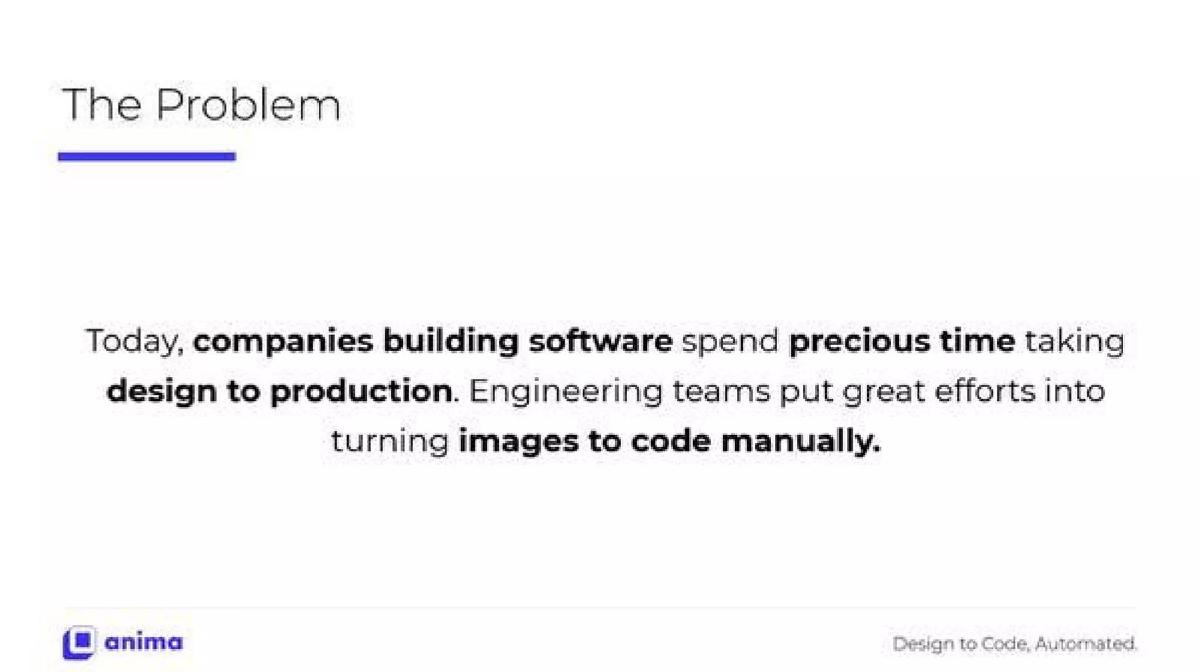
Slide 2: The Problem Anima identifies a friction point in the software development lifecycle. The text states: "Today, companies building software spend precious time taking design to production. Engineering teams put great efforts into turning images to code manually." By highlighting the word "manually," they emphasize the inefficiency they intend to solve.
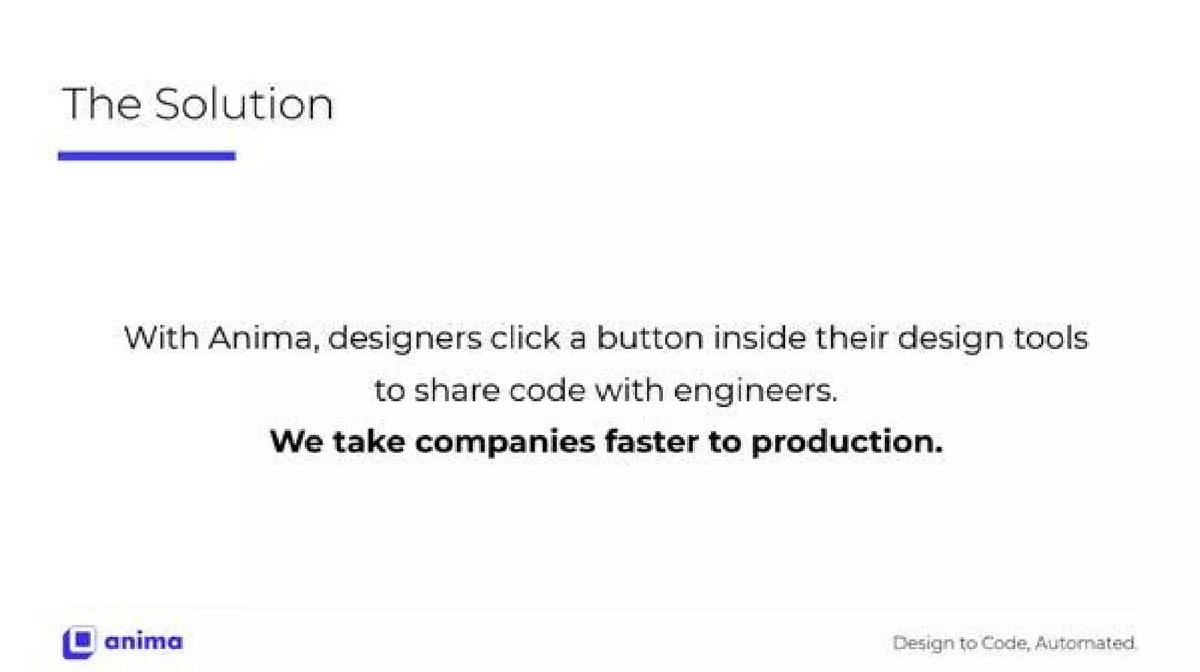
Slide 3: The Solution The solution is presented as a simple workflow improvement: "With Anima, designers click a button inside their design tools to share code with engineers." The value proposition is distilled into a single bold sentence: "We take companies faster to production."
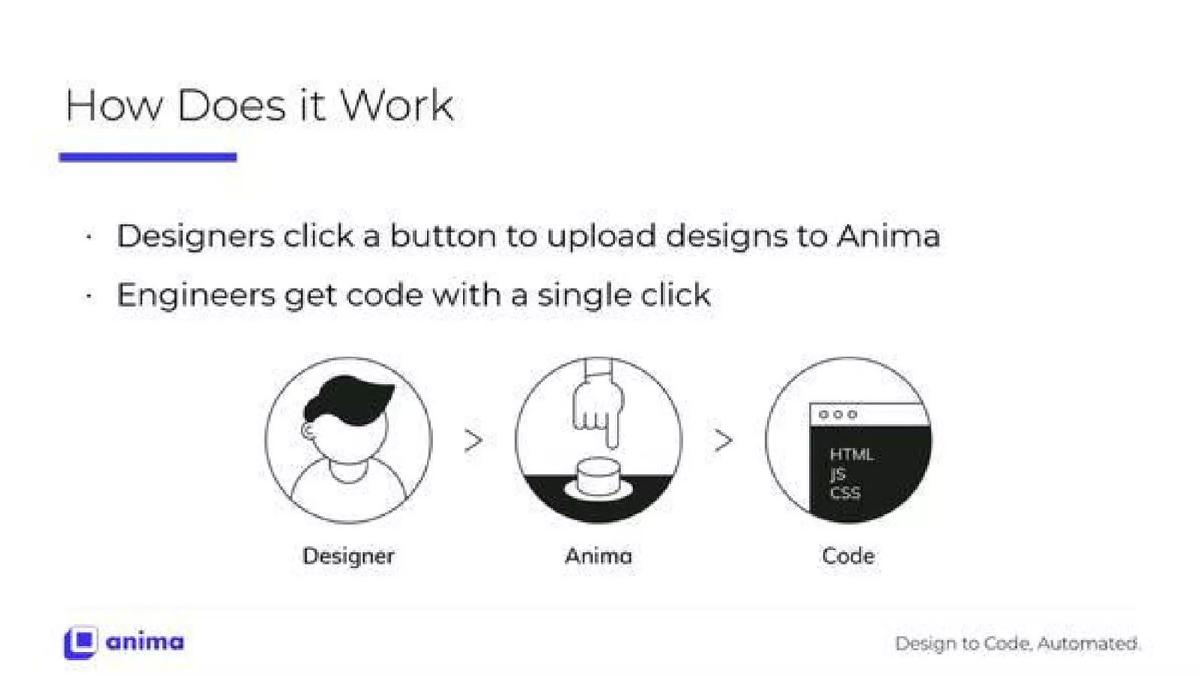
Slide 4: How Does it Work This slide uses a simple three-step diagram. 1. Designer clicks a button. 2. Anima processes the design. 3. Engineers get code (HTML, JS, CSS). The simplicity of this slide is intentional; it avoids the "how" of the underlying AI or compiler logic to focus on the "what" of the user experience.
Market Opportunity and Traction (Slides 5-6)
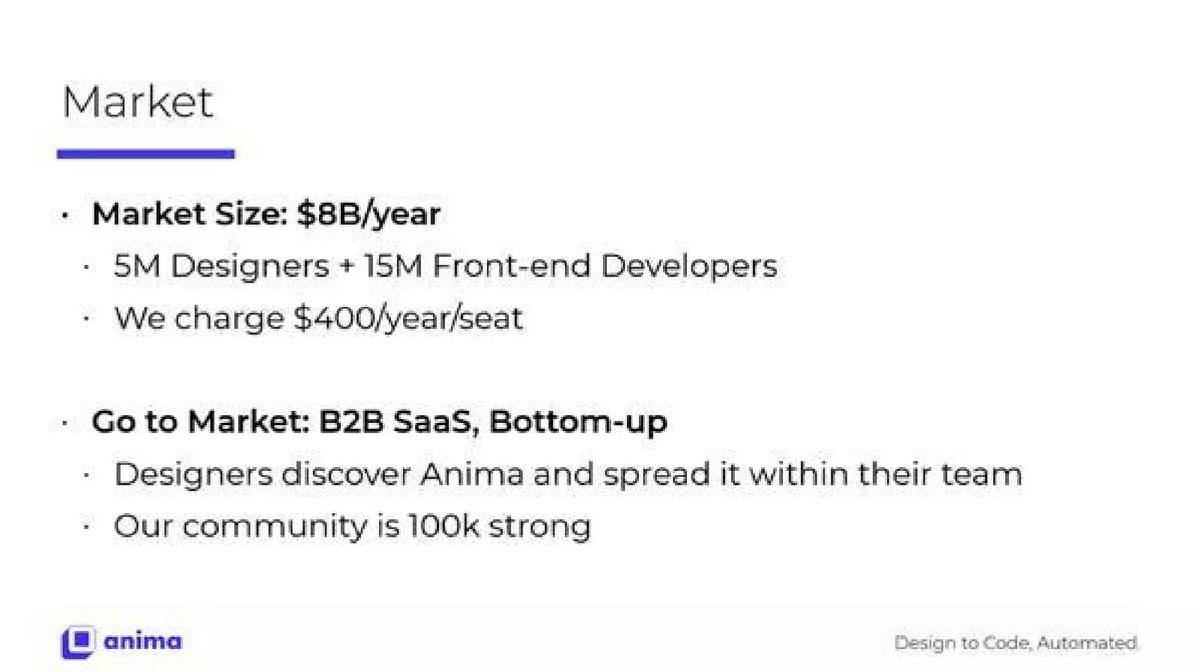
Slide 5: Market Anima provides a very specific calculation for their TAM. They cite a Market Size of $8B/year . This is derived from 5M Designers and 15M Front-end Developers, multiplied by a price point of $400/year/seat . They also introduce their Go-to-Market strategy: "B2B SaaS, Bottom-up," noting that their community is already "100k strong." This is a critical slide for a Series A, as it proves there is a large enough ceiling for venture-scale returns.
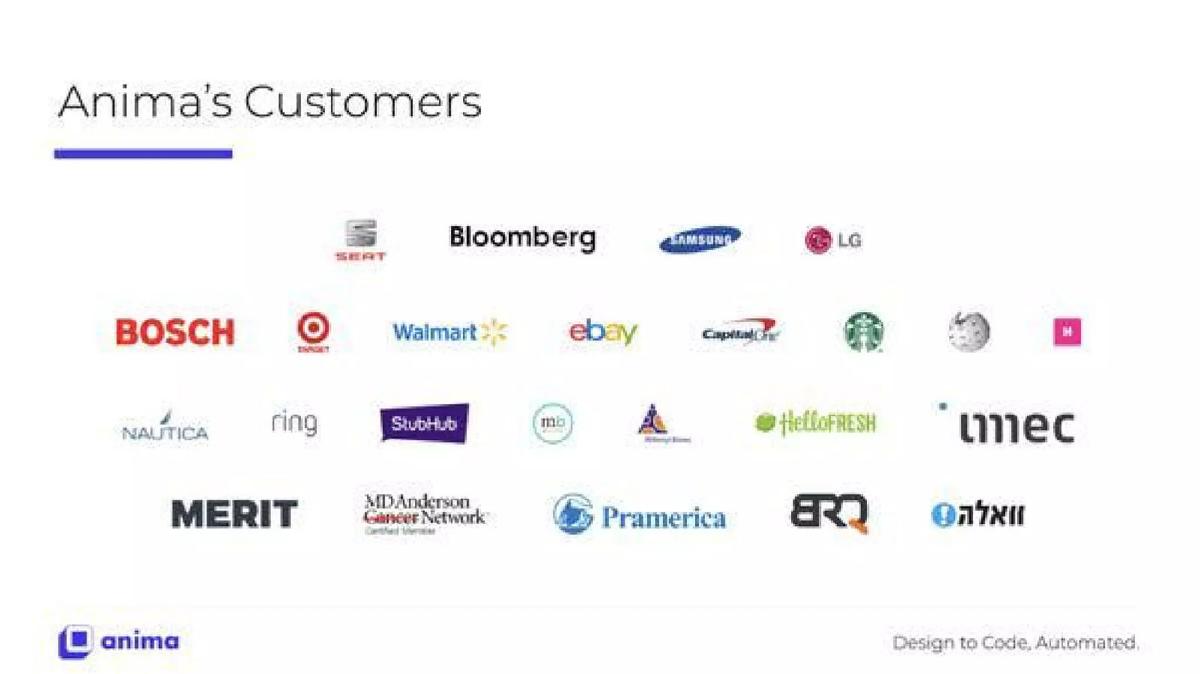
Slide 6: Anima's Customers The customer slide is a "logo wall" that carries significant weight. It includes massive global brands: Bloomberg, Samsung, LG, Bosch, Walmart, eBay, Starbucks, and YouTube . For a startup at this stage, having this level of enterprise penetration—likely through bottom-up adoption—is a powerful validator of product-market fit.
Vision and Roadmap (Slides 7-8)
Slide 7: Roadmap This slide shifts from what the product is to what it will become. The goal is to be a "continuous design-to-development platform." They use a powerful analogy: "Where Figma meet Github." This positioning helps investors categorize Anima not just as a plugin, but as a fundamental piece of infrastructure.
Slide 8: 2020 Company Focus The roadmap is split into H1 and H2 of 2020. Key milestones include:
Hiring: 5 + 15 team members. · Adobe XD & Figma integrations. · Beginning paid marketing. · Targeting Developers with "Developer-friendly code & React code."
This shows a clear plan for how the investment capital will be deployed to expand the product's reach and technical capabilities.
Competition and Team (Slides 9-11)
Slide 9: Competitive Landscape Anima uses a standard 2x2 matrix, with the axes being "Marketing Teams vs. Product Teams" and "Image-based Handoff vs. Developer-friendly Code." They place themselves in the top-right quadrant. Interestingly, they address the "Big Three" (Sketch, Figma, Adobe XD) by stating: "These are our allies, not competition." They differentiate from Zeplin and InVision by noting those tools do not generate "runnable code."
Slide 10: Founders The team slide features the three founders: Avishay Cohen (CEO), Michal Cohen (CPO), and Or Arbel (CTO). While it includes LinkedIn icons, it lacks the typical "past company" logos (e.g., Google, Facebook, previous exits) often seen in these decks. It relies instead on the mission statement: "We believe that great UX is essential."
Slide 11: Contact The deck ends with a simple "Keep in touch" and an investor-specific email address. There is no "Ask" slide in this version of the deck.
What Works in the Anima Deck
1. Strategic Positioning of Competitors: By labeling Figma and Adobe XD as "allies," Anima removes the biggest objection an investor might have: "What if Figma builds this?" They frame their existence as a value-add to the existing ecosystem rather than a threat to it.
2. Clear Bottom-Up Evidence: Mentioning a 100,000-member community on Slide 5 is a massive signal for a Series A. It suggests that the product has viral characteristics and that the $12.6M investment will be used to monetize an existing, hungry audience rather than finding one from scratch.
3. The "Figma meets Github" Analogy: Investors love "The X for Y" or "The intersection of A and B" analogies. It provides an instant mental model for the company's long-term potential as a platform rather than just a tool.
What is Missing from the Anima Deck
1. Financial Metrics: There is a total absence of revenue figures, ARR growth, or churn rates. While the 100k community is impressive, a Series A deck usually requires a deeper dive into the conversion rate from community member to paying customer.
2. Unit Economics: The deck mentions a $400/year/seat price point, but it doesn't show the Cost of Acquisition (CAC) or the Lifetime Value (LTV). Without these, it's hard to judge the efficiency of the "Bottom-up" GTM strategy.
3. The Ask: There is no slide stating how much money they are raising or how that specific dollar amount will be allocated across the 2020 roadmap. This information was likely handled in the verbal pitch or a separate data room.
What a Founder Should Copy
1. The 2x2 Matrix Logic: If you are building a tool that integrates with incumbents, use Slide 9 as a template. Don't fight the giants; show how you make the giants more valuable to their users.
2. The Market Calculation: Slide 5 is a perfect example of a "Bottom-Up" market sizing. Instead of quoting a generic Gartner report, they calculated their TAM based on the actual number of professionals in their target roles and their own planned pricing.
3. Minimalist Design: The deck is visually consistent and extremely easy to read. It doesn't use cluttered charts or dense paragraphs. Each slide has one job and does it quickly, which is essential for keeping an investor's attention during a first review.
Frequently asked questions
- How does Anima define its target market?
- Anima defines its market by the intersection of design and engineering. On Slide 5, they calculate an $8B/year TAM by combining 5 million designers and 15 million front-end developers, assuming a price point of $400 per year per seat. This broad definition allows them to claim a massive opportunity while maintaining a specific product focus.
- What is Anima's competitive advantage according to the deck?
- Their primary advantage is the generation of 'Developer-friendly Code' rather than just 'Image-based Handoff.' Slide 9 places Anima in the top-right quadrant of their competitive matrix, contrasting them against tools like Zeplin and InVision, which they claim do not generate runnable code, and Webflow, which they argue focuses on marketing rather than product teams.
- How does Anima handle the threat of Figma or Adobe XD building similar features?
- Anima takes a collaborative stance. Slide 9 explicitly states that because 90% of UI designers use Sketch, Figma, or Adobe XD, Anima will integrate with all of them. They label these giants as 'allies,' positioning Anima as the essential bridge that turns those designs into production-ready code.
- What traction does the deck show?
- Traction is demonstrated through three pillars: a 100k-strong community (Slide 5), a roadmap showing the transition to 'Anima 4.0' (Slide 8), and a dense logo wall featuring global enterprises like Samsung, LG, Starbucks, and eBay (Slide 6). This suggests high organic adoption and enterprise-level interest.
- What key fundraising information is missing from this deck?
- The deck is missing several standard Series A components: there is no slide detailing current Revenue/ARR, no breakdown of Unit Economics (LTV/CAC), no 'Use of Funds' slide, and no specific 'Ask' regarding the amount they are looking to raise. It functions more as a high-level vision and traction overview.