APDealFlow is a specialized database and networking platform targeting the corporate finance and venture capital sectors in the Asia Pacific region. The deck positions the company as a central hub for 'Agents'—intermediaries who source, vet, and place deals. By connecting companies seeking capital with a network of agents, angel investors, and private equity firms, APDealFlow aims to solve the inefficiencies of traditional deal sourcing. The business model relies on a 5% success fee for deal placement and consulting fees ranging from USD 3,000 to 5,000 for investor-readiness services. While t…
Key takeaways
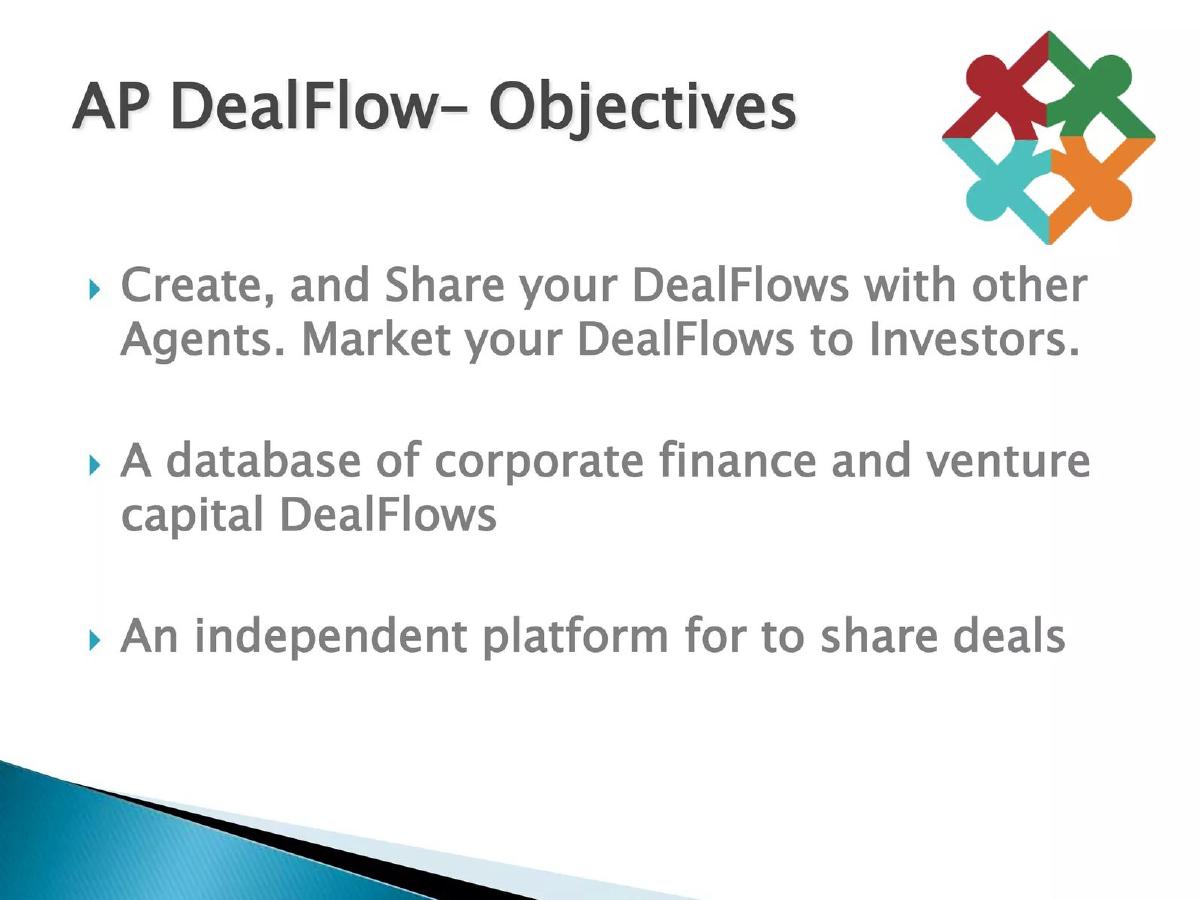
- The company defines itself as a database of corporate finance and venture capital deal flows specifically for the Asia Pacific market (Slide 1).
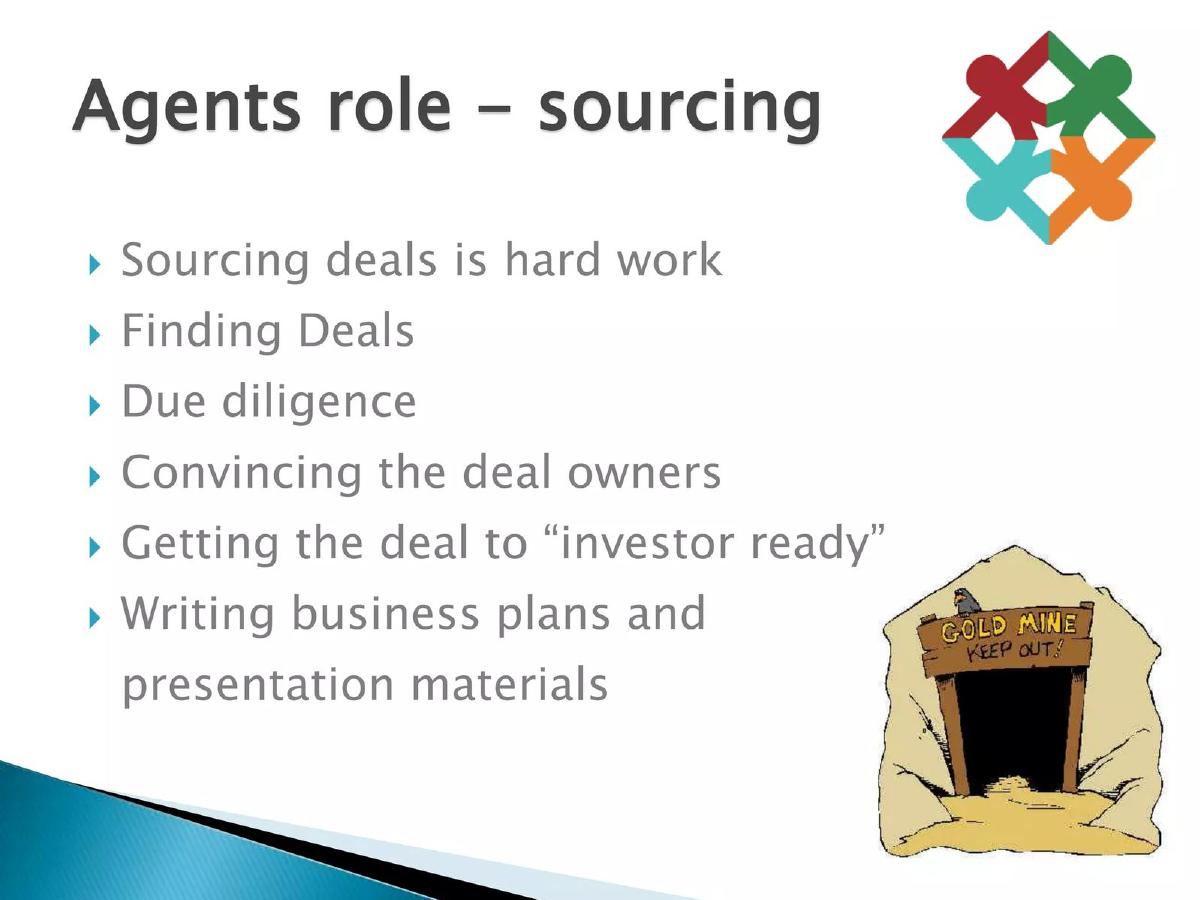
- The platform targets 'Agents' whose role includes sourcing deals, due diligence, and preparing companies to be 'investor ready' (Slide 2).
- APDealFlow acts as a central node, pulling deals from companies and intermediaries to distribute them to agents (Slide 3).
- The ecosystem includes a diverse network of dealmakers, including VC, Private Equity, Angel Investors, and 'Zetland Clients' (Slide 4).
- Revenue is generated through a typical 5% success fee for sourcing and placing deals, which can be split between agents (Slide 6).
- The company charges consulting fees of USD 3,000 to 5,000 for preparing companies for investment (Slide 6).
- APDealFlow identifies a gap in the market where existing funding websites like angelsoft.net do not specifically target intermediaries (Slide 7).
- The strategy for angel investors involves building clubs and networks to provide 'safety in numbers' and a path to VC funds (Slide 8).
Executive Summary: The Intermediary-First Approach
APDealFlow positions itself not as a direct crowdfunding platform, but as a specialized tool for the 'middlemen' of the financial world. By focusing on the Asia Pacific region, the deck attempts to carve out a niche in a high-growth market where relationship-based deal-making is the norm. The presentation focuses heavily on the mechanics of the network and the specific roles of agents, rather than the technology itself.
Slide 1: Title and Value Proposition
The deck opens with a clear, albeit generic, title: "Asia Pacific DealFlow." The subtitle, "A database of corporate finance and venture capital DealFlows," immediately identifies the product category. The logo features a four-person interlocking knot, reinforcing the theme of networking and collaboration that persists throughout the deck.
Slide 2: The Agent's Burden
Slide 2, titled "Agents role – sourcing," defines the problem space by listing the difficulties agents face. It notes that sourcing is "hard work" and involves finding deals, due diligence, and convincing deal owners. Crucially, it mentions the task of getting a deal to be "investor ready," which includes writing business plans. An illustration of a "Gold Mine" with a "Keep Out" sign suggests that high-quality deals are currently hidden or difficult to access.
Slide 3: The Pull Mechanism
This slide introduces the functional flow of the platform. It shows "companies" and "intermediaries" feeding into the "DealFLow" central hub (represented by the company logo), which then pushes those deals to the "AGENT." The use of the phrase "PULLING DEALS" in a highlighted orange box suggests that the platform's primary value is aggregation—bringing disparate opportunities into a single, accessible stream for professional dealmakers.
Slide 4: The Network Map
Slide 4 expands the scope of the platform to show a "network of dealmakers." The diagram places the "AGENT" at the center, connected to the DealFlow hub. The hub, in turn, connects to "INVESTEE COMPANIES" and "VC and PRIVATE EQUITY." The agent is also shown interacting with "OTHER AGENTS," "ZETLAND CLIENTS," and "ANGEL INVESTORS." This slide is critical because it illustrates the platform's ambition to be the connective tissue for the entire APAC private finance ecosystem.
Slide 5: Value for Companies
Titled "AP DealFlow – for Companies," this slide shifts focus to the supply side of the marketplace. It claims companies can find agents, input fundraising requirements, and find "complementary services" such as legal, accounting, PR, and marketing. This suggests that APDealFlow intends to be a full-service portal for startups, not just a matching engine.
Slide 6: The Revenue Model
Slide 6 provides specific figures for the business model. It cites a "Typically charge 5% success fee for sourcing and placing deals." It also notes that commissions can be split between sourcing and placing agents. Furthermore, it identifies a consulting revenue stream: "consulting fee of USD3–5K" for preparing companies to be investor-ready. This indicates a hybrid revenue model combining transactional success fees with service-based retainers.
Slide 7: Market Gap and Solutions
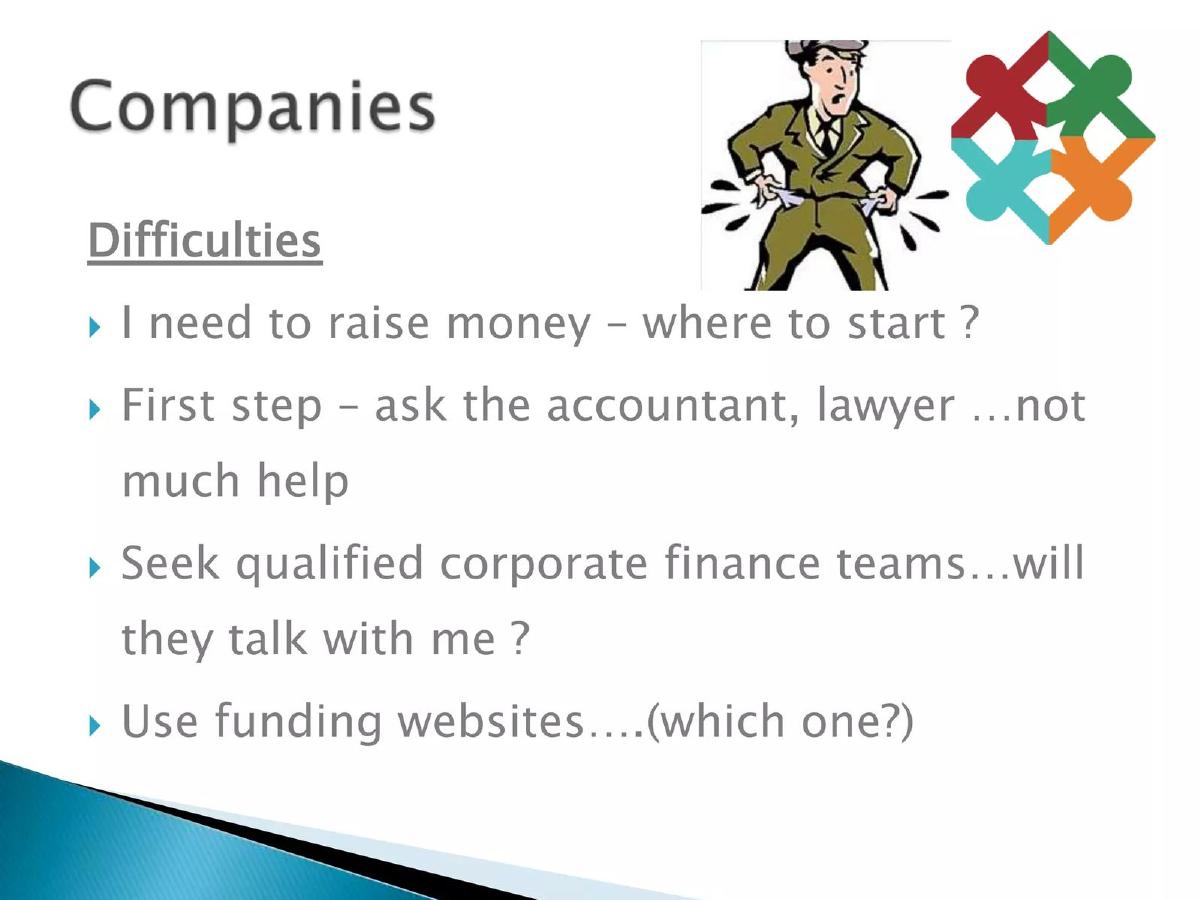
Under "Companies – solutions," the deck addresses the frustrations of founders. It notes that accountants and lawyers are often "not much help" for fundraising. It explicitly names competitors like Investmentnetwork.hk and angelsoft.net, but dismisses them by stating "None target intermediaries." This is the deck's primary competitive differentiator: it is a tool for professionals, not a self-service board for amateurs.
Slide 8: Engaging Angel Investors
The final provided slide focuses on the investor side. It suggests that "Real wealth is hidden" behind lawyers and private bankers and that the platform can provide a source of deals to these intermediaries. It also mentions "Building investor clubs and networks" to provide "safety in numbers," positioning the platform as a bridge for wealthy individuals to eventually participate in Venture Capital funds.
What Works in This Deck
Clear Role Definition: The deck does an excellent job of defining who the "Agent" is and why they are the central figure in this ecosystem. By focusing on the professional intermediary, APDealFlow avoids the "noise" associated with general crowdfunding platforms.
Specific Monetization: The inclusion of exact percentages (5%) and dollar amounts (USD 3-5K) on Slide 6 gives investors a clear understanding of how the company intends to make money. It moves beyond vague "transaction fee" descriptions.
Regional Focus: By explicitly targeting the Asia Pacific region, the company limits its scope to a specific geographic market where deal-sourcing norms may differ from Western markets, potentially making their specialized database more valuable.
What is Missing
The Team: There is no information regarding who is building APDealFlow. In a business built on trust and financial networking, the pedigree of the founders is paramount. Without a team slide, it is impossible to judge the company's ability to execute.
Traction and Data: The deck is entirely conceptual. There are no metrics regarding how many agents are currently on the platform, the volume of deals processed, or the total dollar value of successful placements to date. Citing a "database" without stating the size of that database is a significant omission.
The Ask: The slides provided do not include a funding request. A pitch deck should clearly state how much capital is needed, what the milestones for that capital are, and what the current valuation or deal structure looks like.
Technology Overview: While the deck mentions a "database," it doesn't explain how the technology works. Is it a manual directory, or is there a proprietary algorithm for matching deals to agents? The lack of technical detail makes it difficult to assess the scalability of the platform.
Founder's Guide: What to Copy
Use a Network Map: Slide 4 is a strong visual representation of a complex ecosystem. Founders building marketplaces or platforms with multiple stakeholders should use similar diagrams to show how value flows between different user groups.
Identify the 'Unserved' User: APDealFlow's best strategic move is identifying that existing platforms (like AngelSoft) ignore intermediaries. If you are entering a crowded market, identifying a specific user type that your competitors are neglecting is a powerful way to frame your entry strategy.
Be Transparent About Fees: Don't hide your pricing. By stating the 5% success fee and the consulting fees upfront, the founders demonstrate that they have a firm grasp on the economics of their industry and aren't afraid to discuss the 'bottom line' with potential investors.
Frequently asked questions
- What is the primary problem APDealFlow is trying to solve?
- APDealFlow addresses the difficulty and 'hard work' associated with deal sourcing and due diligence in the corporate finance sector. According to Slide 2 and Slide 7, companies often don't know where to start when raising money, and traditional intermediaries like accountants or lawyers are often unhelpful. The platform aims to provide a structured market for these intermediaries to find and screen deals efficiently.
- How does APDealFlow generate revenue?
- The business model, detailed on Slide 6, is two-fold. First, it utilizes a 5% success fee for the sourcing and placement of deals, which can be split among participating agents. Second, it generates immediate cash flow through consulting fees of USD 3,000 to 5,000 per company for 'investor readiness' services, such as writing business plans and presentation materials.
- Who are the primary users of the APDealFlow platform?
- The primary users are 'Agents'—professional intermediaries who handle the heavy lifting of deal-making. However, the network also includes investee companies, venture capital firms, private equity groups, angel investors, and specific groups like 'Zetland Clients,' as illustrated in the network map on Slide 4.
- Does the deck mention any competitors?
- Slide 7 mentions several 'funding websites' including Investmentnetwork.hk, angelsoft.net, and cmypitch.com. However, the deck distinguishes APDealFlow by stating that 'none target intermediaries,' suggesting that these existing platforms focus on direct company-to-investor connections rather than the agent-led model APDealFlow proposes.
- What is missing from the APDealFlow pitch deck?
- The provided slides lack several critical components for a professional fundraise: there is no team slide introducing the founders, no slide detailing current traction or historical deal volume, no clear financial projections, and no specific 'ask' regarding the amount of capital being raised or the valuation of the company.