The July 2016 Apifier pitch deck is a lean, technical-first presentation used to raise a $250,000 seed round. Following their participation in the inaugural Y Combinator Fellowship in Fall 2015, founders Jan Čurn and Jakub Balada focused on the technical limitations of existing web scrapers. The deck reports $2,495 in Monthly Recurring Revenue (MRR) and a user base of 2,800. While the visual design is minimalist—relying on bulleted lists rather than data visualizations—the deck clearly defines a dual-revenue model consisting of SaaS subscriptions ($19–$999/month) and professional services. It…
Key takeaways
- The company sought a $250,000 seed investment to accelerate product development and user acquisition (Slide 8).
- Both founders hold PhDs and have a 15-year history of working together, including participation in the Y Combinator Fellowship (Slide 2).
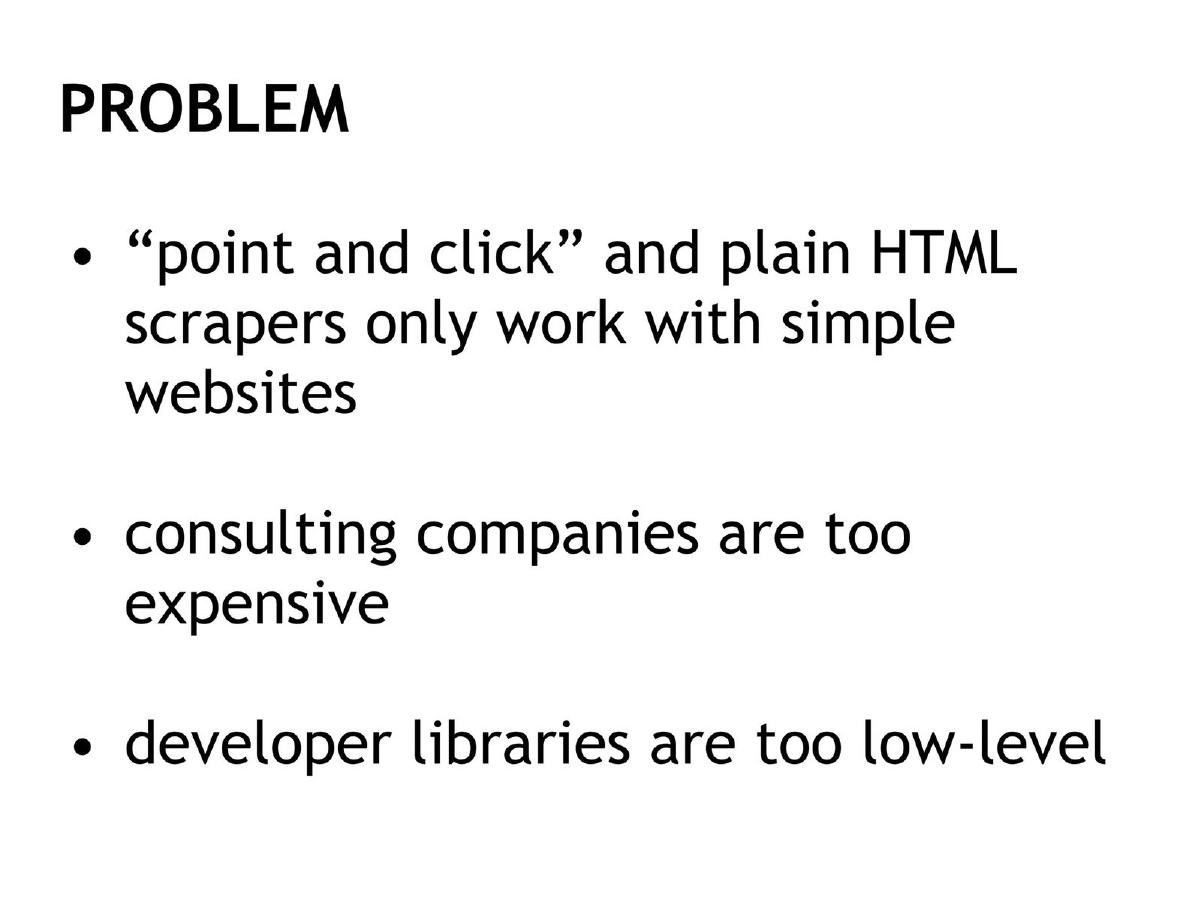
- The product is positioned against three specific market gaps: simple scrapers, expensive consultants, and low-level libraries (Slide 3).
- Revenue is generated through SaaS subscriptions ranging from $19 to $999 per month, plus one-time configuration fees (Slide 4).
- At the time of the deck, the company had 2,800 users and 5,100 crawlers in operation (Slide 5).
- Traction included a 7% weekly revenue growth rate and $2,495 in subscription MRR (Slide 5).
- The marketing strategy relied heavily on 'hacks' targeting developers on Upwork and GitHub (Slide 6).
- The technical moat is defined by the ability to handle AJAX, infinite scroll, and authenticated web actions like online purchases (Slide 7).
Introduction
The Apifier pitch deck from July 2016 represents a classic early-stage technical founder presentation. At the time, the company was fresh out of the Y Combinator Fellowship program and looking to bridge the gap between a side project and a scalable SaaS business. The deck is functional, focusing heavily on the technical capabilities of the product and the pedigree of the founders, while keeping financial projections and market sizing to a minimum.
Slide 1: Title Slide
The cover slide introduces the company name, Apifier, and a clear, one-sentence value proposition: "Web crawler that works on every website." The inclusion of the date, July 2016, provides immediate context for the metrics that follow. The branding is simple, featuring a cartoon robot, which suggests a developer-friendly, approachable tool rather than a stiff enterprise solution.
Slide 2: Team
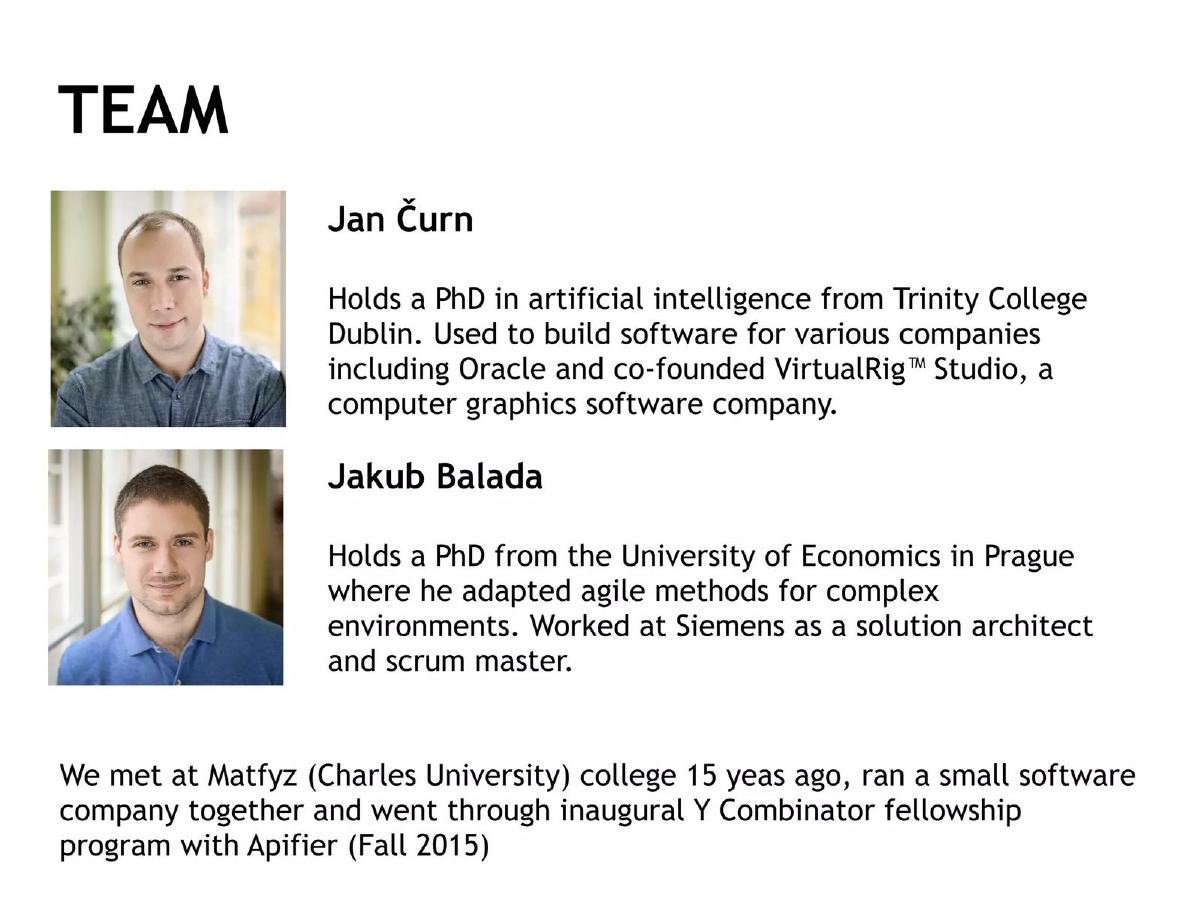
Apifier leads with its team, which is a common strategy for technical startups where the 'how' is as important as the 'what.' The slide highlights two founders, Jan Čurn and Jakub Balada. Jan Čurn is noted for a PhD in AI from Trinity College Dublin and experience at Oracle. Jakub Balada holds a PhD in Economics and worked as a solution architect at Siemens. Crucially, the slide mentions they met 15 years ago at Charles University, establishing a long-term working relationship. They also cite their participation in the inaugural Y Combinator fellowship program (Fall 2015) , which serves as a significant trust signal for Silicon Valley investors.
Slide 3: Problem
The problem slide identifies a fragmented market. It lists three primary pain points:
"Point and click" and plain HTML scrapers only work with simple websites. · Consulting companies are too expensive. · Developer libraries are too low-level.
This positioning suggests that Apifier is the "Goldilocks" solution—more powerful than basic tools, cheaper than consultants, and easier to use than raw code libraries.
Slide 4: Business Model
The business model is straightforward SaaS. It lists monthly subscriptions ranging from $19 to $999 . Interestingly, it also includes a service component: consulting fees for crawler configuration ($100 - $300) . This indicates that in 2016, the product still required some manual setup for customers. The slide also teases future scalability through a marketplace with a 20% fee , though this is explicitly labeled as "TBD."
Slide 5: Metrics
This slide provides the hard data to back up the pitch. As of July 2016, Apifier had:
2,800 users and 5,100 crawlers. · 7% weekly revenue growth. · $2,495 MRR from subscriptions. · $496 in July fees for consulting.
While the MRR is low in absolute terms, the 7% weekly growth rate is the metric intended to catch an investor's eye, as it suggests rapid adoption.
Slide 6: Marketing Approach & Strategy
The marketing slide reveals a highly tactical, developer-focused growth strategy. It mentions "PR stunts" and "public APIs," but the most interesting points are the "hacks." Specifically, they mention a "freelancer.com/upwork.com hack" and a "direct email marketing (github.com hack)." This implies the team was actively scraping these platforms to find people looking for scraping services and pitching them Apifier as a solution. For non-technical users, they planned to use Zapier and IFTTT integrations.
Slide 7: Competitive Advantages
This slide doubles down on the technical moat. It specifies that the crawler navigates complex and dynamic websites , specifically mentioning AJAX, complex pagination, and infinite scroll . It also notes the ability to perform actions like authentication, form submission, and online purchases . By highlighting these features, the founders are addressing the specific technical failures of their competitors mentioned on Slide 3.
Slide 8: Financial / The Ask
The final slide in this set contains the "Ask." The company was looking for a $250,000 seed investment . The stated goals for the funding were to speed up product development and user acquisition. They also note that they expect to reach "ramen profitability" (where the business earns just enough to pay the founders' basic living expenses) within the next few months, suggesting a low burn rate and a relatively safe investment for a seed-stage participant.
What Apifier Did Well
The deck excels at defining a specific technical niche. By explicitly naming AJAX and infinite scroll as hurdles their competitors can't clear, they prove they understand the technical landscape of 2016 web development. The team slide is also a strong point; two PhDs who have worked together for 15 years and gone through a YC program is a very high-quality signal for a $250k seed round. The transparency regarding their "hacks" for user acquisition shows a scrappy, growth-oriented mindset that investors typically appreciate in early-stage founders.
What Was Omitted
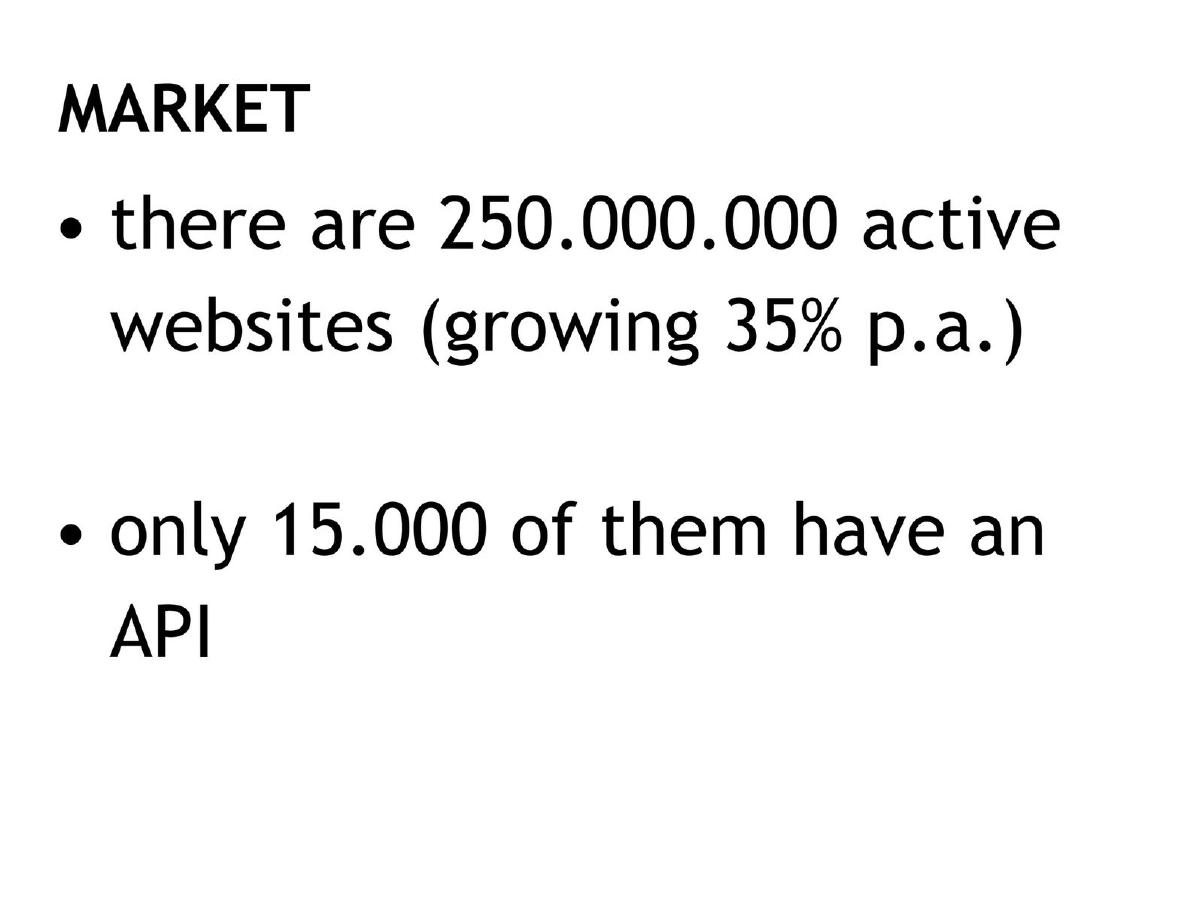
The most glaring omission in this 8-slide selection is a clear Market Size (TAM/SAM/SOM) slide. While they mention the problems with consultants and low-level libraries, they don't quantify how large the web scraping or data extraction market is. There is also no Competition slide that names specific rivals (e.g., Import.io or Scrapinghub), which were active at the time. Finally, the deck lacks Unit Economics ; while they show MRR, they don't show Customer Acquisition Cost (CAC) or Lifetime Value (LTV), though this is common for a seed deck at this revenue level.
Founder's Playbook: What to Copy
Founders should look at Slide 5 (Metrics) as a model for honesty. They don't hide the fact that their revenue is small ($2,495 MRR); instead, they highlight the growth rate (7% weekly). In early-stage fundraising, the slope of the line is often more important than the starting point. Additionally, the use of a "Team" slide that emphasizes long-term collaboration is a powerful way to de-risk the investment. Investors fear founder breakups; 15 years of history effectively eliminates that concern. Finally, the "Problem" slide (Slide 3) is a masterclass in succinctness—it identifies exactly who they are replacing and why those current options fail, using only three bullet points.
Frequently asked questions
- What was the primary goal of the Apifier pitch deck?
- The primary goal was to secure $250,000 in seed funding. According to Slide 8, these funds were intended to 'speed up product development and user acquisition.' At the time, the company was nearing 'ramen profitability,' suggesting the capital was for growth rather than survival.
- How did Apifier differentiate itself from other web scrapers?
- Apifier focused on technical complexity. Slide 7 notes that unlike 'point and click' tools, their crawler handles AJAX, complex pagination, infinite scroll, and can perform actions like form submissions and online purchases. They positioned themselves between low-level developer libraries and high-cost consulting firms.
- What were the key traction metrics reported in 2016?
- Slide 5 lists 2,800 users and 5,100 crawlers. Financial traction included $2,495 in subscription MRR and $496 in consulting fees for July. Most notably, they reported a 7% weekly revenue growth rate, which is a significant indicator of early-stage momentum.
- What was the background of the founding team?
- The team consisted of two PhDs: Jan Čurn (AI, Trinity College Dublin) and Jakub Balada (Economics, Prague). Slide 2 emphasizes their long-term professional relationship, noting they met 15 years prior at Charles University and had previously run a software company together.
- What was the proposed business model for scaling?
- Beyond direct SaaS subscriptions and consulting, Slide 4 mentions a 'marketplace' model with a 20% fee. This was marked as 'TBD,' indicating a plan to allow third-party developers to monetize their own crawlers on the Apifier platform, shifting from a service to a platform play.