Aphea.Bio’s 13-slide deck is a highly professional example of a late-stage AgTech pitch. It successfully bridges the gap between deep-science R&D and commercial viability. By focusing on a 'fully integrated approach,' the company demonstrates how it moves from a library of over 100,000 microbial strains to market-ready biostimulants and biocontrols. The deck is particularly strong in its use of data visualization, specifically the product pipeline and launch calendars, which provide a clear roadmap for investors. While it lacks a traditional competitor slide, it compensates with rigorous fiel…
Key takeaways
- The company positions itself as Europe's leader in microbial solutions, citing regulatory pressure and fertilizer prices as tailwinds (Slide 3).
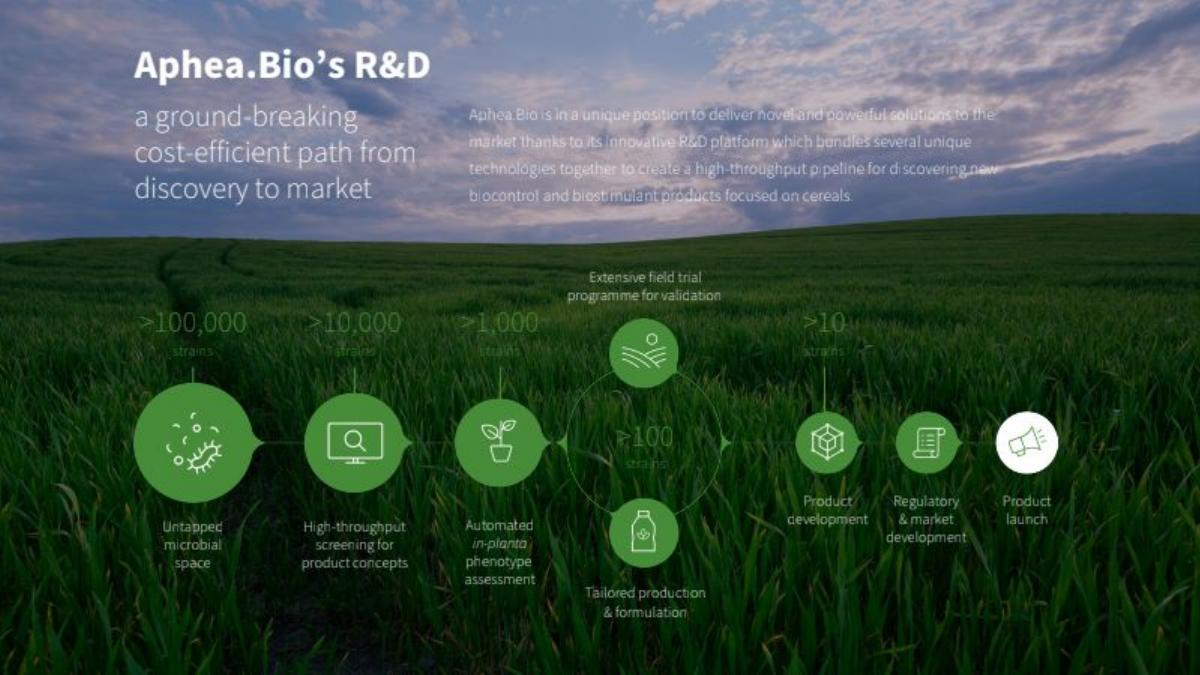
- Aphea.Bio utilizes a high-throughput R&D platform that screens over 100,000 microbial strains to identify market-ready leads (Slide 5).
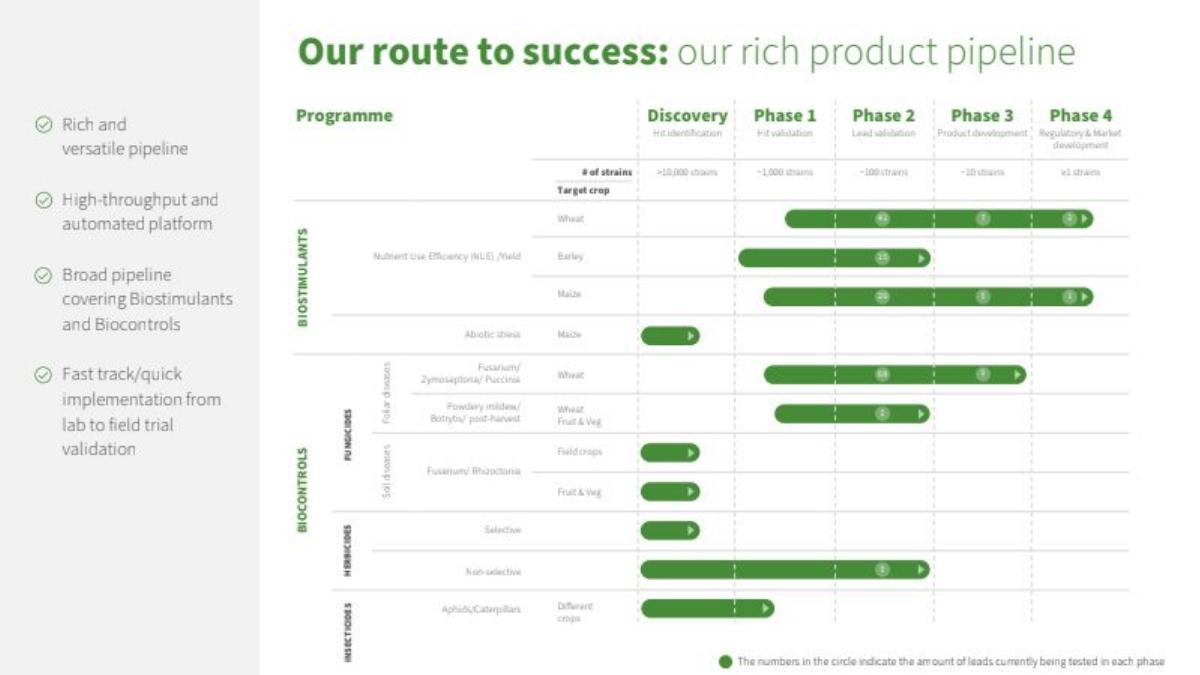
- The product pipeline is exceptionally detailed, showing leads across biostimulants, fungicides, herbicides, and insecticides (Slide 6).
- Field trial data for their wheat biostimulant shows a yield increase of 2.7% to 6.3% with a 100% win rate in South-East Europe (Slide 7).
- Maize biostimulant trials demonstrated a significant 22% yield increase in North-East climatic zones (Slide 8).
- The commercial strategy includes a 'Product launch calendar' planning for 30 market introductions by 2031 (Slide 9).
- The financial forecast is probability-weighted and projects EBITDA positivity by 2026 (Slide 10).
- The management team boasts 150 years of joint experience, featuring alumni from Bayer, Syngenta, and BASF (Slide 11).
Executive Summary and Mission
Slides 1-3: The Vision for a Biological Revolution
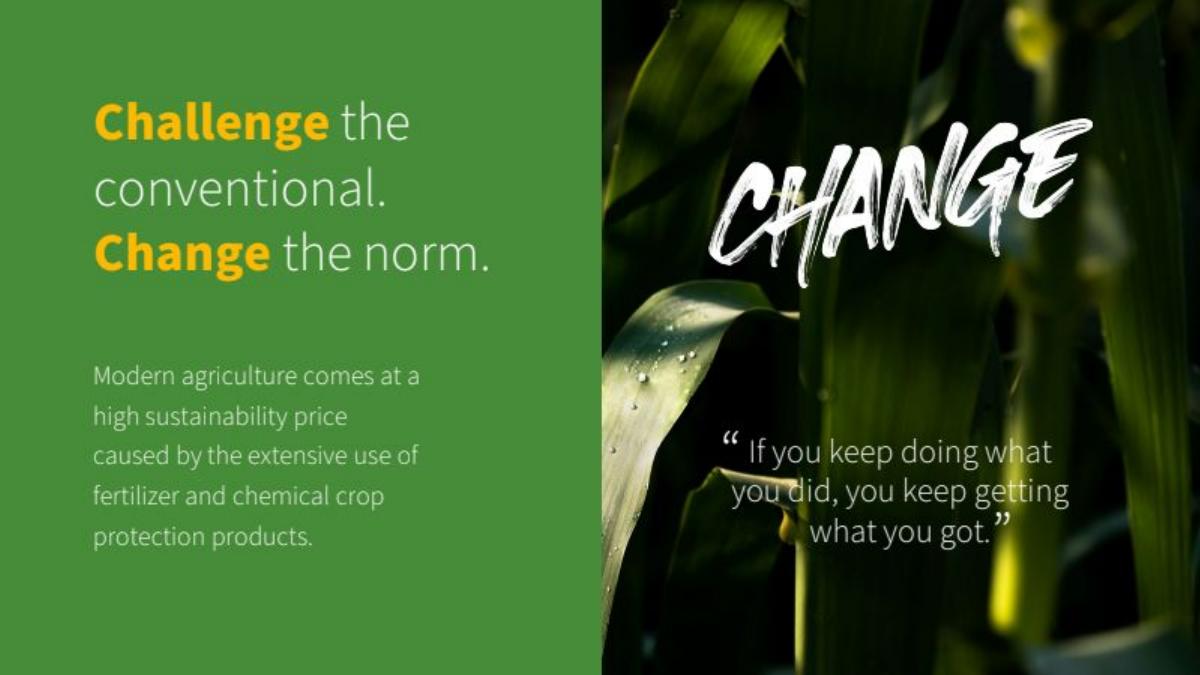
Aphea.Bio opens with a high-impact title slide (Slide 1) dated May 2022, using the tagline "Driving the Revolution in Biologicals." The imagery is grounded and agricultural, immediately establishing the sector. Slide 2 serves as a philosophical bridge, framing the problem: modern agriculture's high sustainability price due to chemical fertilizers and crop protection. It uses a quote—"If you keep doing what you did, you keep getting what you got"—to justify the need for a paradigm shift.
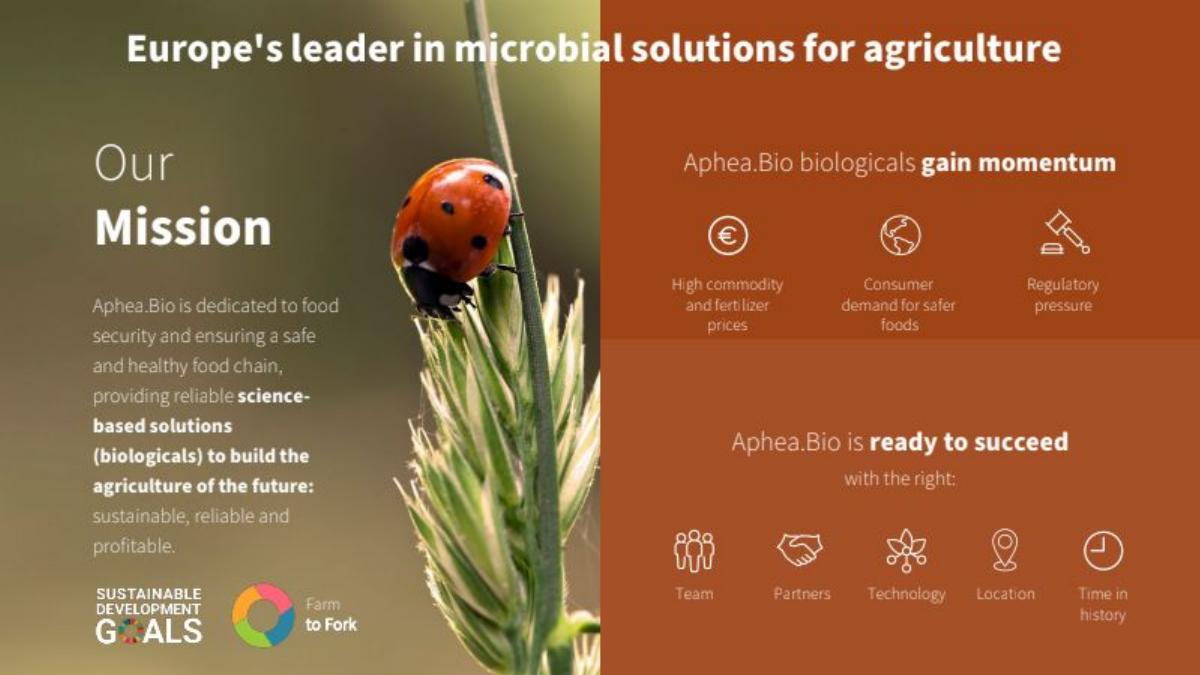
Slide 3 defines the company's identity as "Europe's leader in microbial solutions for agriculture." This slide is critical for a Series C deck as it aligns the company with global trends: high fertilizer prices, consumer demand for safer food, and regulatory pressure (specifically citing the EU's "Farm to Fork" strategy). By including the Sustainable Development Goals (SDGs) logo, they signal their eligibility for ESG and impact-focused capital, which is reflected in their investor list (e.g., the Bill & Melinda Gates Foundation).
The R&D Engine
Slides 4-5: From Discovery to Market
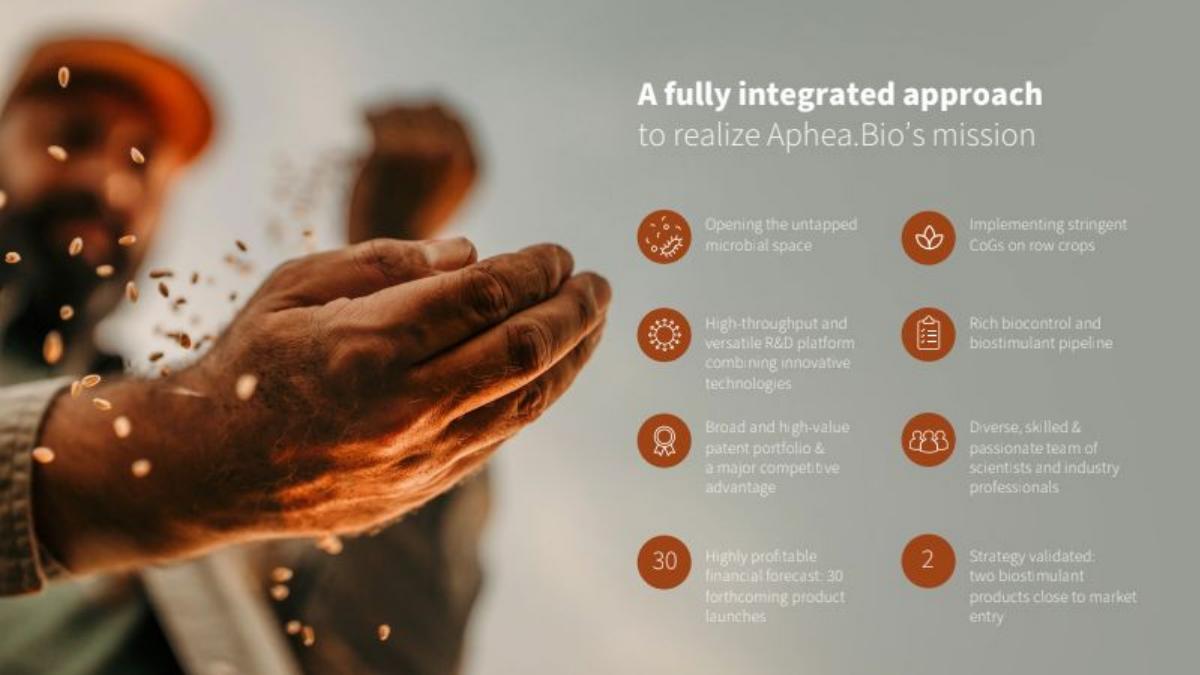
Slide 4 introduces the "fully integrated approach." This is a key value proposition for a biotech company; they aren't just a research lab, but a product development company. The slide lists eight pillars of their strategy, including a "high-throughput and versatile R&D platform" and a "broad and high-value patent portfolio." Two specific metrics are highlighted here: a forecast of 30 forthcoming product launches and two biostimulant products already close to market entry.
Slide 5 visualizes the R&D funnel. This is one of the most effective slides in the deck for demonstrating scale. It shows the journey from ">100,000 strains" in the untapped microbial space, down to ">10,000 strains" for screening, ">1,000 strains" for phenotype assessment, and finally ">100 strains" for field trials and production. This funnel provides a quantitative sense of the company's "intellectual property factory" and how they mitigate the risk of R&D failure through sheer volume.
Product Pipeline and Performance
Slides 6-8: Proving the Science
Slide 6 is a dense, technical "Route to success" chart. It maps out their pipeline across Biostimulants and Biocontrols (Fungicides, Herbicides, and Insecticides). The chart uses a four-phase development cycle. Investors can see that while many products are in Discovery (Phase 1), they have significant clusters in Phase 2 (Lead validation) and Phase 3 (Product development). This slide proves that Aphea.Bio is not a "one-trick pony" but has a diversified portfolio of assets.
Slides 7 and 8 provide the "proof in the pudding." For their wheat biostimulant (Slide 7), they show a timeline from 2018 to a 2024 launch. They report yield increases of 2.7% to 6.3% . Notably, they include a "Win rate" metric—showing that in the South-East zone, the product worked 100% of the time. Slide 8 follows the same format for maize , showing a massive 22% yield increase in North-East Europe. For an AgTech investor, these specific geographic performance figures are essential for calculating Total Addressable Market (TAM) based on regional crop yields.
Commercialization and Financials
Slides 9-10: The Path to €800M+
Slide 9 presents a "Product launch calendar" through 2031. It is an ambitious roadmap planning for 30 market introductions. This slide transitions the deck from a science story to a commercial story. It shows a clear sequence: Biostimulants launch first (2023-2024), followed by Biofungicides (2025), and eventually Bioherbicides and Bioinsecticides (2027+). This staggered approach suggests a strategy of using early wins to fund later, more complex regulatory hurdles.
Slide 10 contains the "Finance & use of proceeds." The sales and EBITDA chart is bold, showing a probability-weighted forecast that reaches roughly €850M in sales by 2033 . The company expects to reach EBITDA positivity by 2026. The financing need is stated as €50m , with a clear pie chart for the use of proceeds: 67% for R&D Expenses & Capex , 18% for Sales & Marketing, and 15% for G&A. This allocation is typical for a R&D-heavy Series C, where the goal is to finalize product development and clear regulatory hurdles.
Team and Traction
Slides 11-13: Leadership and History
Slide 11 showcases a "strong management team, with 150 years of joint relevant experience." The pedigree is high, with PhDs in biotechnology and agronomy and former roles at industry giants like Bayer, BASF, and Syngenta. This level of industry experience is a prerequisite for a €50M+ round in this sector.
Slide 12 provides a "journey to success" timeline. It tracks the company from its 2017 founding through its Series A (€7.7m) and Series B (€19.8m) rounds. It sets clear future milestones: First sales and B-Corp certification in 2023 , Break even in 2026, and a Potential exit in 2027 . This explicit mention of an exit timeline is rare in early-stage decks but appropriate for a Series C where investors are looking for a liquidity horizon.
What Aphea.Bio Does Well
Pipeline Visualization: Slide 6 and Slide 9 are masterclasses in showing how a complex R&D portfolio translates into a multi-year commercial roadmap. · Geographic Specificity: By breaking down yield increases by EU climatic zones (Mediterranean, South-East, North-East), they show a sophisticated understanding of their market and product efficacy. · Risk Mitigation: The use of "probability-weighted" financial forecasts and "win rates" in field trials demonstrates a disciplined, data-driven approach that appeals to institutional VCs. · Clear Use of Proceeds: The €50M ask is tied directly to the R&D funnel and the launch calendar, making the capital requirement feel justified rather than arbitrary.
What is Missing from the Deck
Competitor Analysis: There is no slide comparing Aphea.Bio to other microbial companies (like Indigo Ag or Pivot Bio) or traditional chemical incumbents. They rely on their yield data to imply superiority. · Unit Economics: While they show total sales and EBITDA, there is no detail on the cost per hectare or the pricing model for farmers. · Regulatory Detail: Given that biologicals face significant regulatory hurdles, more detail on the status of their dossiers with the EFSA (European Food Safety Authority) would have been beneficial.
What Other Founders Should Copy
The R&D Funnel (Slide 5): If you are a deep-tech company, show the scale of your discovery process. It proves your technology is a platform, not just a single product. · The Launch Calendar (Slide 9): This is the best way to show long-term value. It helps investors visualize the "compounding" effect of multiple product lines hitting the market over a decade. · Pedigree Alignment: Notice how every team member's bio (Slide 11) includes a "Former [Big Industry Name]" tag. This builds immediate trust that the team knows how to compete with the incumbents.
Frequently asked questions
- What is Aphea.Bio's core technology?
- Aphea.Bio develops 'biologicals'—microbial-based solutions for agriculture. Their core asset is a high-throughput R&D platform that screens an untapped microbial space of over 100,000 strains. This platform uses automated in-planta phenotype assessment and tailored production formulations to move products from discovery to market-ready status efficiently.
- How does the company prove its products actually work?
- The deck provides specific field trial data for two lead products. Their wheat biostimulant showed yield increases between 2.7% and 6.3% across different EU climatic zones. Their maize biostimulant performed even better, showing a 22% yield increase in North-East Europe. Crucially, they report 'win rates' (consistency of performance), which reached 100% in several tested regions.
- What is the commercial roadmap for Aphea.Bio?
- The company has a very aggressive launch schedule. Slide 9 outlines a plan for 30 market introductions based on 16 distinct active substances. This includes biostimulants for wheat and maize launching between 2023 and 2024, followed by biofungicides, bioherbicides, and bioinsecticides entering the US and EU markets through 2031.
- What are the financial projections presented in the deck?
- Aphea.Bio presents a long-term 'probability weighted' forecast. They expect to remain EBITDA negative through 2025 as they scale R&D and regulatory efforts. They project a break-even point in 2026, with sales rapidly accelerating thereafter to surpass €800M by 2033. The Series C ask of €50M was intended to bridge the company to this commercial inflection point.
- Who is behind the company?
- The management team is led by CEO Isabel Vercauteren (PhD, 20 years experience) and includes specialists with backgrounds at major industry incumbents like Bayer, BASF, Syngenta, and DevGen. Collectively, the seven-person leadership team represents 150 years of relevant experience in biotechnology, agronomy, and finance.