Aphea.Bio, a Belgian agtech firm, utilized this deck to secure a €70M Series C round, positioning themselves as Europe's leader in microbial solutions for agriculture. The deck excels at distilling a complex, multi-year R&D process into a digestible visual pipeline, moving from a library of over 100,000 strains to a handful of market-ready products. By highlighting specific yield increases—up to 6.3% in North-East EU zones—and a product launch calendar extending to 2031, the company provides the long-term visibility required for capital-intensive biotech investments. While the deck lacks expl…
Key takeaways
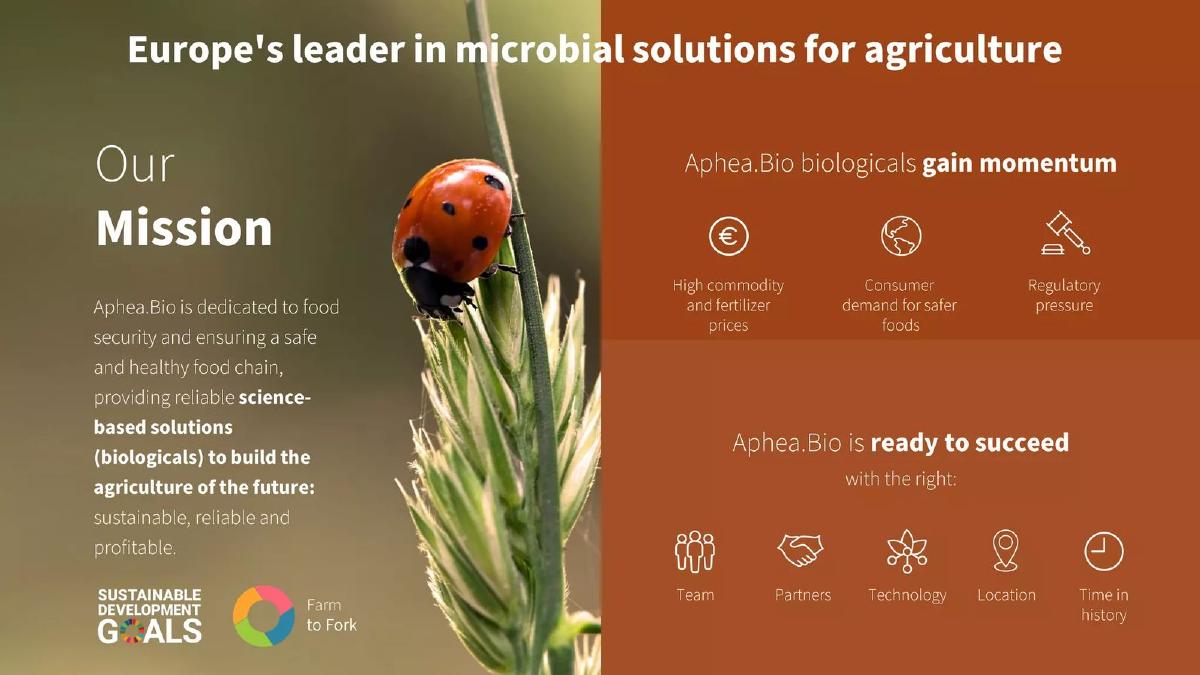
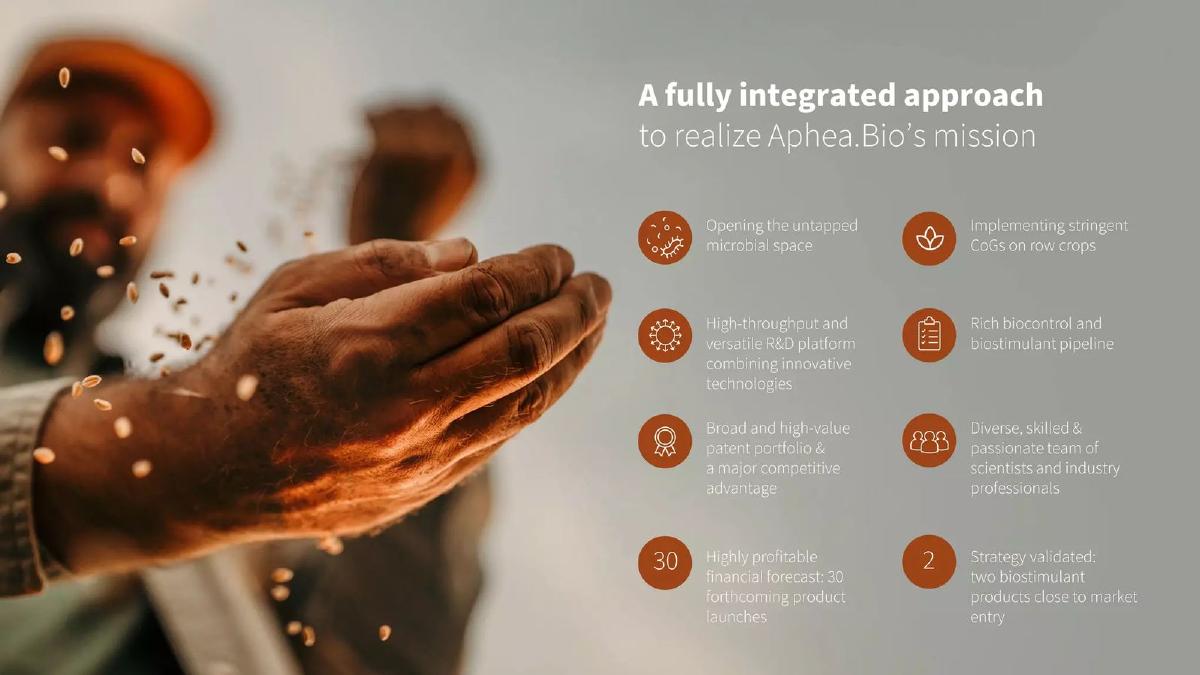
- The company positions itself as the European leader in microbial solutions, aligning with UN Sustainable Development Goals (Slide 2).
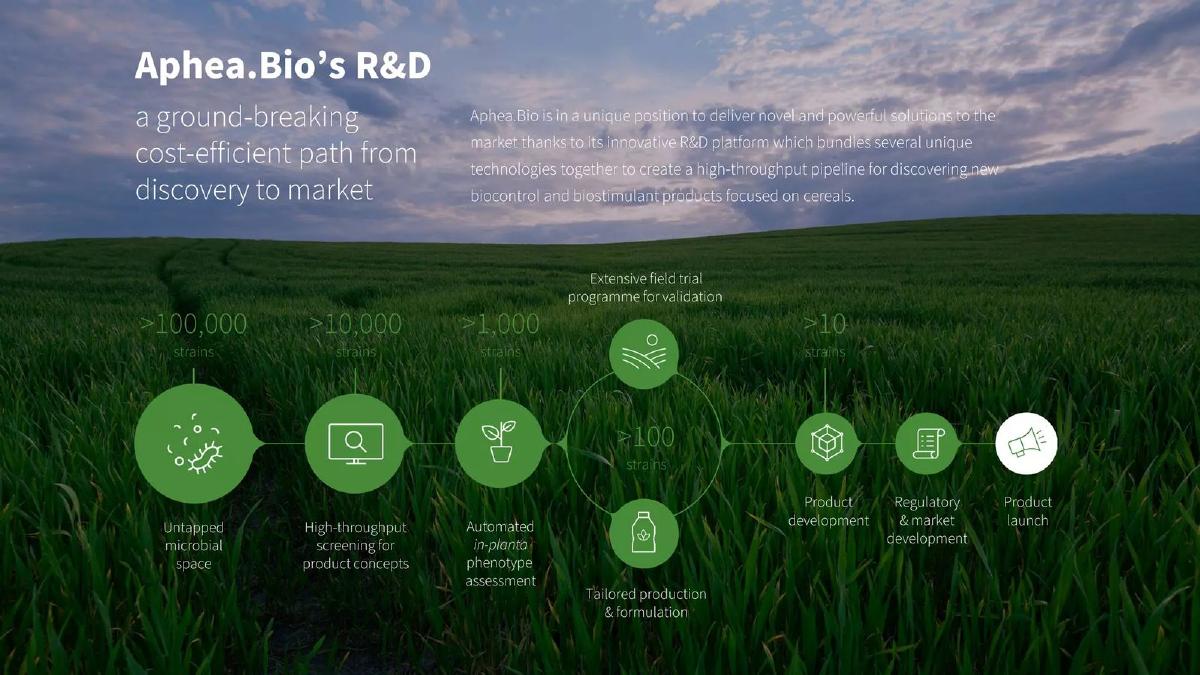
- Aphea.Bio manages a massive R&D funnel starting with over 100,000 untapped microbial strains (Slide 3).
- The R&D process is visualized as a linear progression from high-throughput screening to automated in-planta phenotype assessment (Slide 3).
- Field trial data for their first wheat biostimulant shows a yield increase between 2.7% and 6.3% depending on the region (Slide 4).
- The company claims a 100% win rate for yield increases in South-East EU climatic zones (Slide 4).
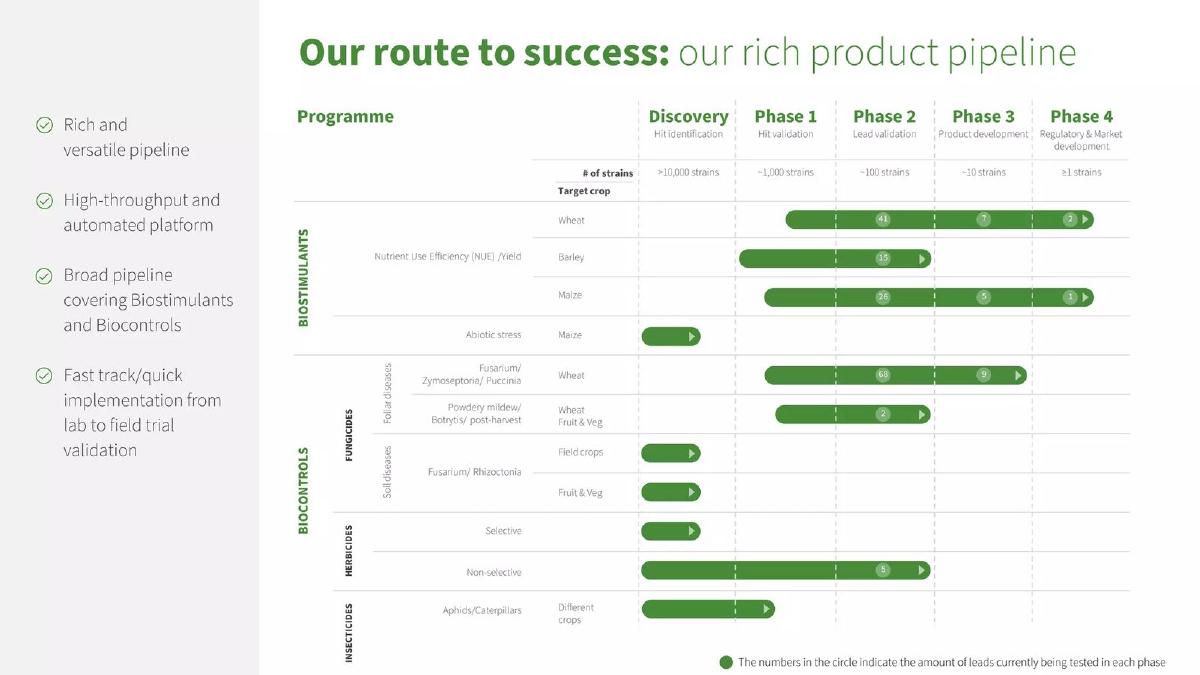
- A comprehensive product launch calendar outlines 30 market introductions across biostimulants, biofungicides, herbicides, and insecticides through 2031 (Slide 5).
- The management team is anchored by deep industry expertise, including former executives from Bayer, Syngenta, and BASF (Slide 6).
- The deck emphasizes 'Time in history' as a key success factor, citing high fertilizer prices and regulatory pressure as tailwinds (Slide 2).
Executive Summary: The Biological Revolution
Aphea.Bio’s Series C deck is a masterclass in how to present a high-capex, long-timeline biotech venture to sophisticated investors. In the world of agricultural technology (AgTech), the path from discovery to commercialization is notoriously long and fraught with regulatory hurdles. This deck, dated May 2022, successfully raised €70M by focusing on three pillars: a massive proprietary microbial library, validated field trial results, and a management team with deep institutional pedigree. By framing their mission around global food security and the UN Sustainable Development Goals, they elevate the company from a simple R&D shop to a critical infrastructure player in the future of the global food chain.
Slide 1: Title and Branding
The cover slide sets a rugged, practical tone. The imagery of mud-caked boots in a field, combined with the high-energy font for "Driving the Revolution in Biologicals," suggests that while the company is science-based, its impact is felt on the farm. It avoids the sterile, laboratory-only aesthetic common in biotech decks, immediately signaling that this is a product intended for real-world agricultural application. The date, May 2022, places this deck in a period of significant global concern regarding fertilizer supply chains and food prices.
Slide 2: Mission and Market Momentum
Slide 2 establishes Aphea.Bio as "Europe's leader in microbial solutions for agriculture." This is a bold claim that sets a high bar for the rest of the presentation. The slide is split into two halves: the "Why Now" (Momentum) and the "Why Us" (Ready to Succeed). Key market drivers cited include high commodity and fertilizer prices, consumer demand for safer foods, and regulatory pressure. By explicitly linking their mission to the UN Sustainable Development Goals and the "Farm to Fork" initiative, they align themselves with the prevailing regulatory winds in the European Union. The bottom right of the slide lists five assets: Team, Partners, Technology, Location, and "Time in history," the last of which is a clever way to emphasize market urgency.
Slide 3: The R&D Funnel
This is arguably the most important slide for a biotech investor. It visualizes the "ground-breaking cost-efficient path from discovery to market." The funnel is impressive: it starts with >100,000 strains in the untapped microbial space, narrows to >10,000 strains through high-throughput screening, then to >1,000 strains for automated in-planta phenotype assessment. The process continues through field trials ( >100 strains ) and product development ( >10 strains ) before reaching a product launch. This visualization provides a clear logic for how the company manages R&D risk and why a massive initial library is necessary to yield a handful of commercial successes.
Slide 4: Validated Results for Wheat Biostimulant
Slide 4 moves from theory to proof. It focuses on the company's first wheat biostimulant, claiming a "consistent and substantial yield increase under reduced fertilizer use." The data is granular, showing yield increases of 2.7% in the Mediterranean, 4.2% in the South-East, and 6.3% in the North-East EU zones . Crucially, they include a "Win rate" metric—the percentage of trials that showed a positive result. A 100% win rate in the South-East is a powerful statistic for a biological product, which are often criticized for inconsistent performance across different environments. The timeline at the top shows a six-year journey from lead selection in 2018 to a projected launch in 2024.
Slide 5: The 2031 Product Launch Calendar
For a Series C round, investors need to see a path to a multi-product portfolio, not just a single-hit wonder. Slide 5 delivers a comprehensive roadmap through 2031. It outlines 30 market introductions based on 16 distinct active substances . The chart categorizes products into Biostimulants (NUE and Abiotic stress), Biofungicides, Bioherbicides, and Bioinsecticides. It also shows a clear geographic expansion strategy, with initial launches in the EU (G1 EU) followed by entries into the US market (G1 US). This slide demonstrates the massive scale of the company's ambitions and justifies the €70M capital injection required to sustain such a broad pipeline over the next decade.
Slide 6: The Management Team
In deep tech and biotech, the team is the primary collateral. Aphea.Bio showcases a management team with 150 years of joint relevant experience . The pedigree is undeniable: CEO Isabel Vercauteren and others bring experience from Bayer, Syngenta, BASF, and Lallemand . Every member listed has a PhD or Master's degree in a relevant field (Biotechnology, Agronomy, Biology). This slide is designed to de-risk the execution of the complex 2031 roadmap shown on the previous slide. If the R&D funnel is the engine, this team is presented as the expert pilots capable of navigating the regulatory and commercial turbulence of the AgTech sector.
Slide 7: Contact and Closing
The final slide is a standard contact page but maintains the high-quality visual branding of the rest of the deck. It provides the company's headquarters in Gent, Belgium, reinforcing their position as a European leader. The imagery of wheat grains falling emphasizes the end product of their technology: increased agricultural output.
What Aphea.Bio Does Well
The deck is exceptionally strong at visualizing the R&D lifecycle . Biotech can often feel like a "black box" to investors who aren't scientists. By using a clear, linear flow for their R&D funnel (Slide 3) and a color-coded, multi-year launch calendar (Slide 5), they make the complex process of microbial discovery feel manageable and predictable. Furthermore, the inclusion of specific yield percentages and win rates (Slide 4) provides the hard evidence needed to move past the "hype" phase of biologicals. They don't just say the product works; they show exactly where it works best and by how much.
What Is Missing from the Deck
While this is a strong technical and strategic deck, several key financial elements are missing from this version:
Unit Economics: There is no mention of the cost to produce these biologicals versus the price farmers are expected to pay. In AgTech, the "Green Premium" is a major hurdle; if the biological costs more than the fertilizer it replaces without a massive yield boost, adoption will stall. · Competitive Landscape: The deck claims Aphea.Bio is the leader in Europe but does not name or analyze competitors like Indigo Ag, Joyn Bio, or established giants' internal biological divisions. · Detailed Use of Funds: While we know they raised €70M, the deck doesn't specify how that capital is allocated between R&D, regulatory filings, and commercial sales teams. · Revenue Projections: There are no financial forecasts. While Slide 5 shows launches, it doesn't translate those launches into projected market share or top-line revenue.
Lessons for Founders
1. Quantify Your 'Win Rate': If you are in a space where performance varies (like agriculture or medicine), don't just show the best-case scenario. Showing a "win rate" across different environments builds immense credibility with technical due diligence teams.
2. Build a 'Horizon 3' Roadmap: Aphea.Bio didn't just show what they are launching next year. They showed a decade-long vision. For Series B and C rounds, you must demonstrate that your platform is capable of producing a stream of products, not just a single successful pilot.
3. Leverage Institutional Pedigree: If your team comes from the "Big 4" of your industry (in this case, Bayer, BASF, etc.), highlight it prominently. It signals to investors that you understand the regulatory and corporate hurdles that usually kill startups in your sector.
4. Align with Macro Trends: The "Time in history" section on Slide 2 is a great way to create urgency. By linking their success to fertilizer prices and EU regulations, they make the investment feel like a logical response to global events rather than a speculative bet on a new technology.
Frequently asked questions
- What is the core technology behind Aphea.Bio?
- Aphea.Bio develops 'biologicals,' which are microbial-based solutions for agriculture. Their R&D platform uses high-throughput screening and automated in-planta phenotype assessment to identify specific microbial strains that can act as biostimulants, biofungicides, bioherbicides, or bioinsecticides. They currently maintain a library of over 100,000 strains to fuel this pipeline.
- How does the company validate its product efficacy?
- The company relies on an extensive field trial program. For their lead wheat biostimulant, they presented data from 2019-2021 across three EU climatic zones. The results showed consistent yield increases even under reduced fertilizer use, with a 'win rate' (frequency of positive results) ranging from 67% to 100% depending on the geography.
- What does the long-term product roadmap look like?
- Aphea.Bio has a very long-term horizon, typical for biotech. Their launch calendar extends to 2031, targeting 30 market introductions based on 16 distinct active substances. This includes expansion from their initial wheat biostimulant into maize, barley, fruits, and vegetables, as well as moving into the US market starting around 2025.
- Who is leading the company?
- The team is led by CEO Isabel Vercauteren, who holds a PhD in Plant Biotechnology and has 20 years of experience, including time at Bayer. The broader management team includes specialists in research, development, and finance with backgrounds at major industry players like Syngenta, BASF, and Deutsche Bank, totaling 150 years of joint experience.
- Why is now the right time for this investment according to the deck?
- Slide 2 identifies three specific market drivers: high commodity and fertilizer prices making biological alternatives more attractive, consumer demand for safer (chemical-free) foods, and increasing regulatory pressure on traditional synthetic pesticides and fertilizers. They frame this as a unique 'time in history' for biologicals to gain momentum.