ANYbotics AG utilized this 19-slide deck to secure a $50M Series B round, focusing on the transition from manual industrial inspection to fully autonomous robotic workforces. The deck is notable for its heavy emphasis on the 'ANYmal' hardware platform's unique certifications, specifically the Ex-certification for hazardous environments like oil and gas plants. By framing their solution as a bridge for the 1.5 million unfilled plant operator positions expected in the EU by 2030, the company successfully moved the conversation from 'cool robotics' to 'essential infrastructure.' The presentation…
Key takeaways
- The deck identifies a massive labor gap, citing 1.5 million unfilled plant operator positions in the EU by 2030 on slide 3.
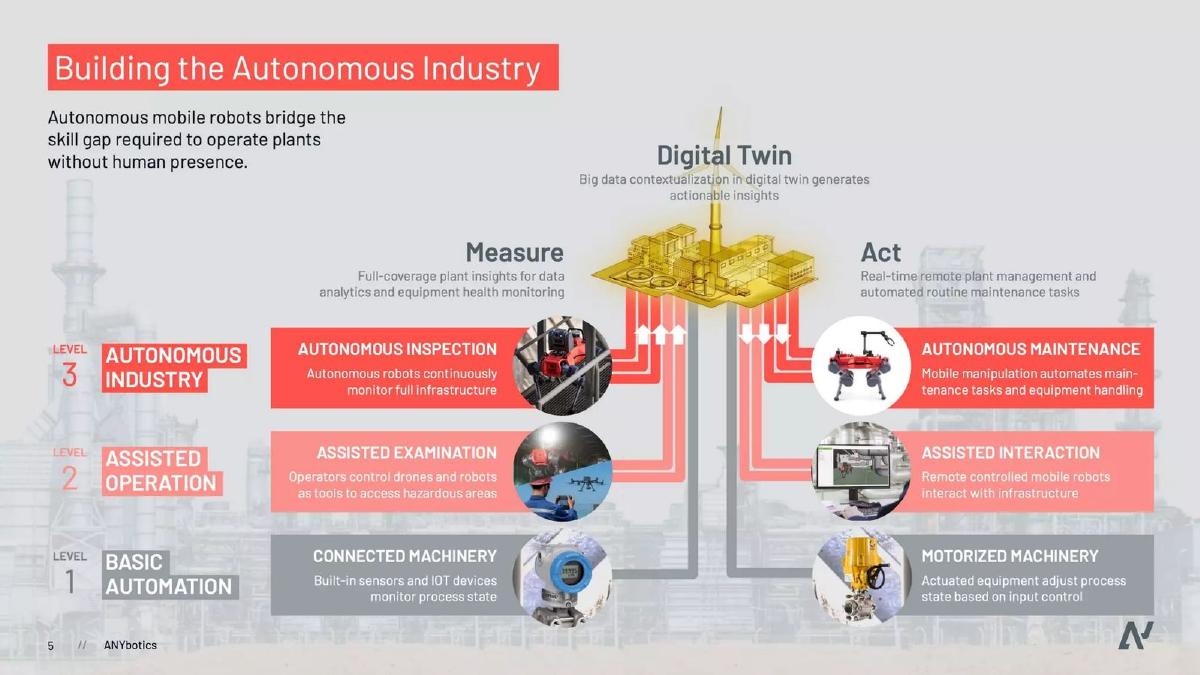
- ANYbotics positions its technology as a 'Level 3' autonomous industry solution, moving beyond basic automation and assisted operation (slide 5).
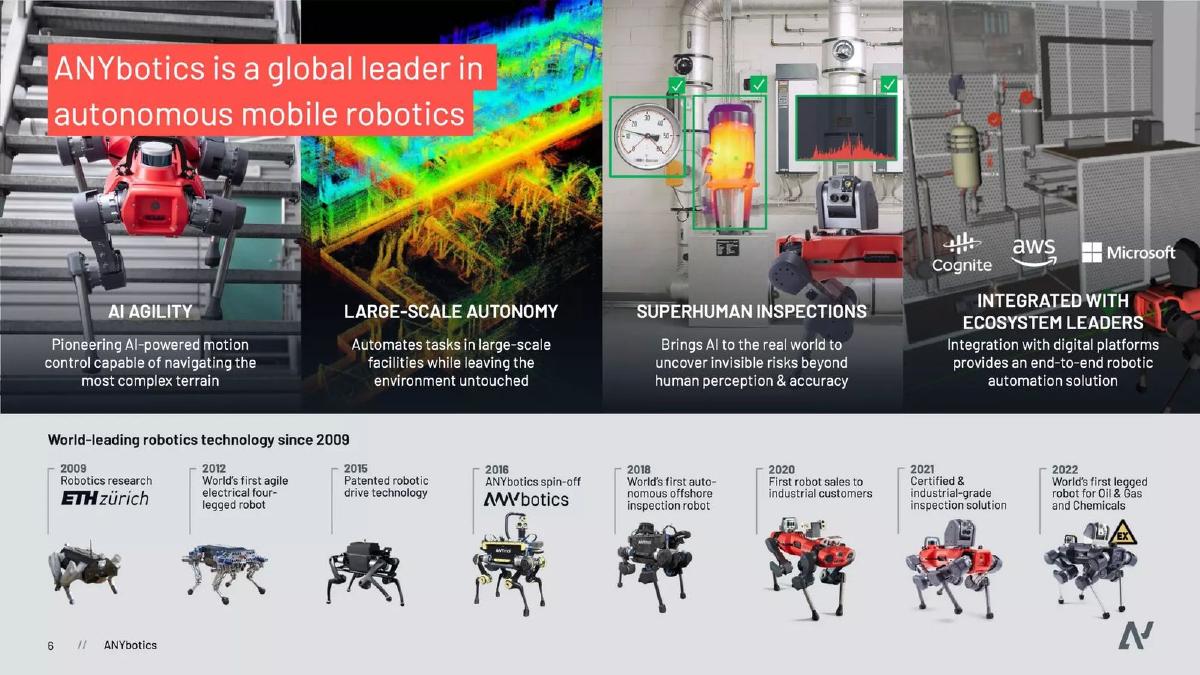
- The company emphasizes a long R&D pedigree, tracing its roots back to 2009 robotics research at ETH Zurich (slide 6).
- A critical competitive advantage is highlighted on slide 7: the ANYmal X is the world's only legged robot with Ex-certification for Oil & Gas environments.
- The deck provides specific customer value cases, such as preventing $0.5M to $1.5M in asset damage per incident through regular thermal inspection (slide 9).
- Commercial momentum is demonstrated via a >$150M LOI volume signed for the ANYmal X Early Adopter Program (slide 10).
- The Total Addressable Market (TAM) is estimated at >$30bn, based on 150,000 qualified industrial sites globally (slide 11).
- The team slide (14) showcases a high concentration of technical expertise, noting that 35% of the 90 FTE staff hold PhDs in R&D.
Introduction: The Shift to Autonomous Industry
ANYbotics AG, a spin-off from ETH Zurich, produced this Series B pitch deck to raise $50M. The deck focuses on the transition from manual, human-led industrial inspections to a fully autonomous robotic workforce. By targeting high-stakes environments like offshore rigs and chemical plants, the company moves beyond the 'novelty' phase of robotics into mission-critical infrastructure.
Slide 1: Title and Opportunity
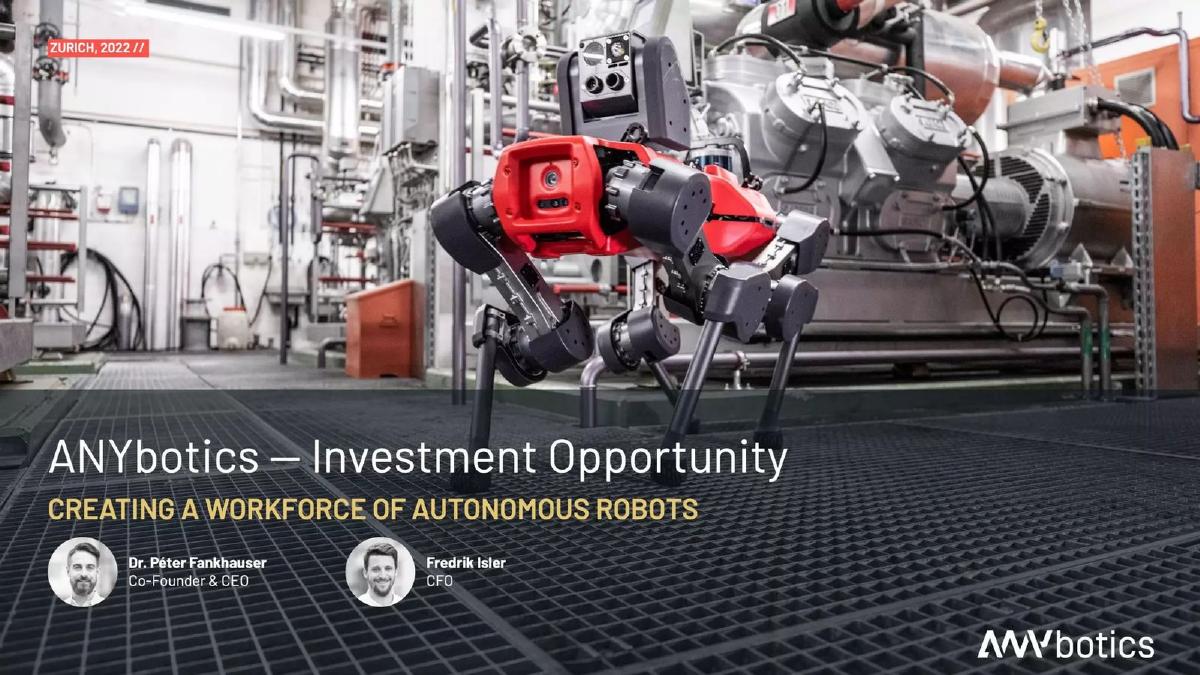
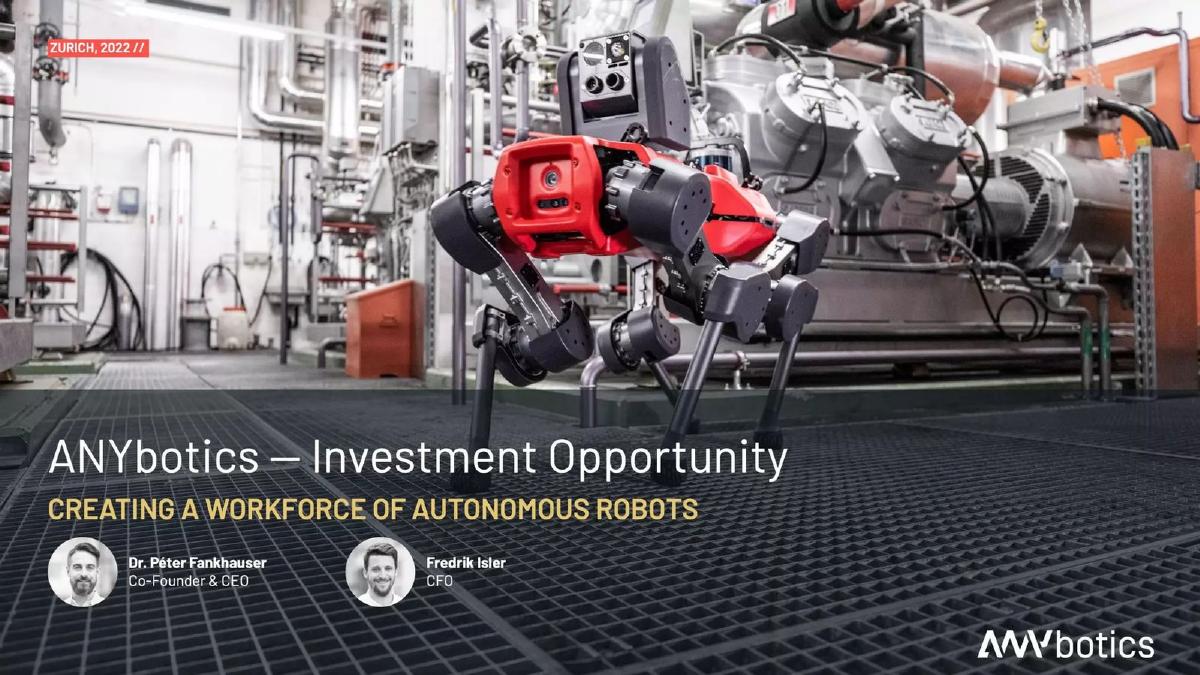
The cover slide establishes the company's core mission: "Creating a workforce of autonomous robots." It features the ANYmal robot in a dense industrial setting, immediately signaling the target market. The slide introduces the key presenters, CEO Dr. Péter Fankhauser and CFO Fredrik Isler, and notes the location and year as Zurich, 2022.
Slide 2: The Vision
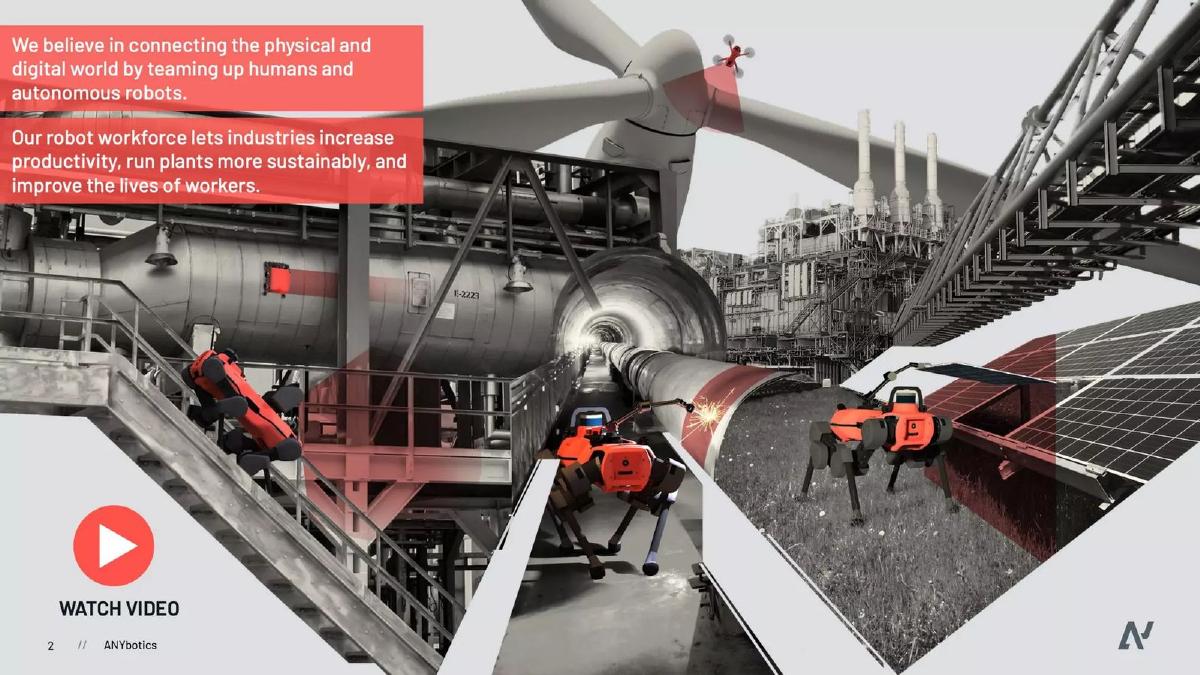
This slide serves as a high-level vision statement. It emphasizes "teaming up humans and autonomous robots" to increase productivity and sustainability. The visual collage shows the robot operating in diverse environments: tunnels, wind turbines, and solar farms, suggesting a versatile platform.
Slide 3: The Industrial Problem
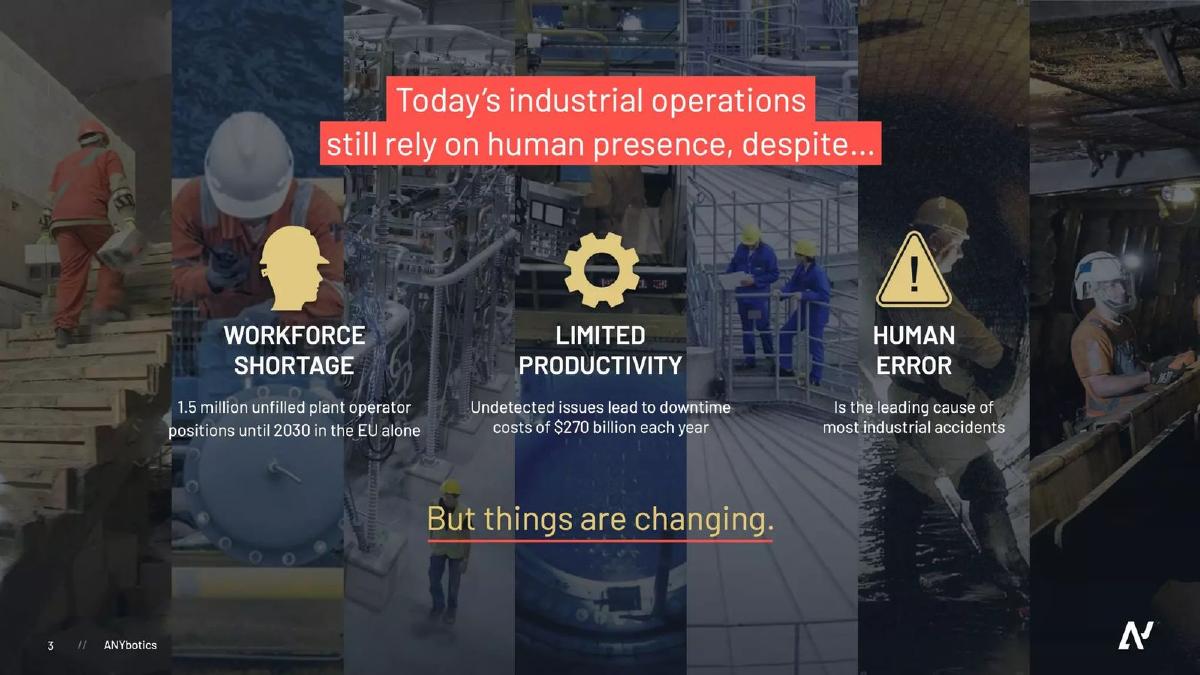
ANYbotics identifies three macro-drivers for their business. First, a Workforce Shortage , citing 1.5 million unfilled plant operator positions in the EU by 2030. Second, Limited Productivity , noting that undetected issues lead to $270 billion in annual downtime costs. Third, Human Error , which they claim is the leading cause of most industrial accidents. This slide effectively quantifies the pain points for potential investors.
Slide 4: The Robotic Revolution
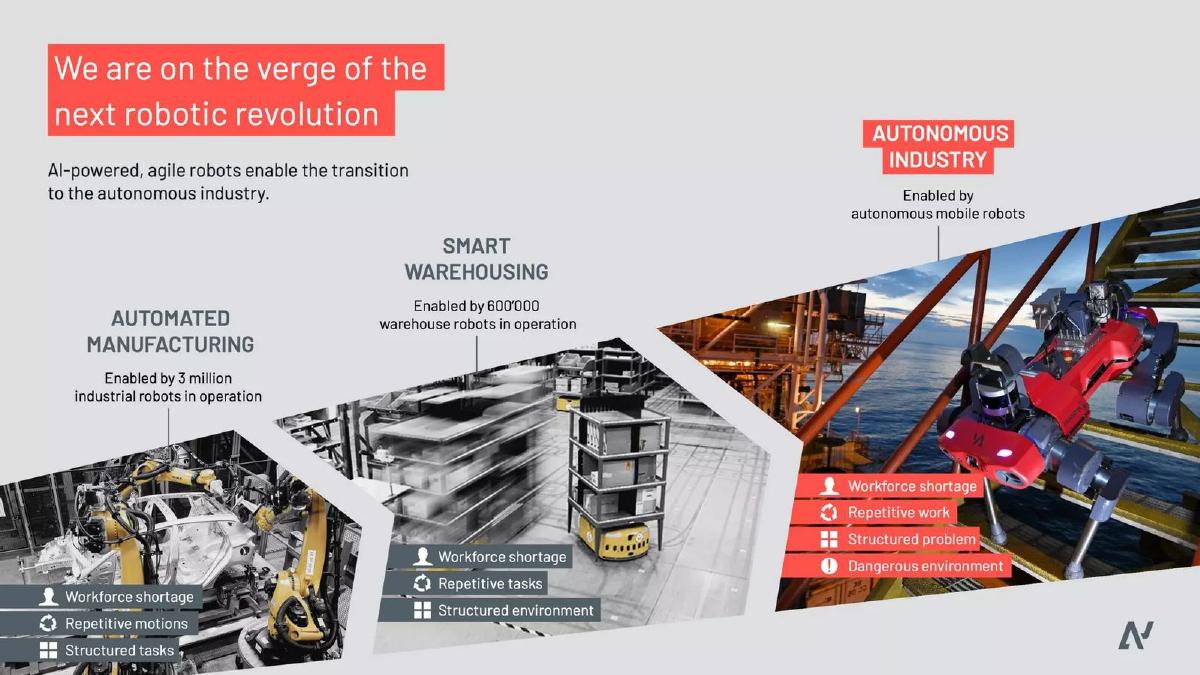
This slide contextualizes ANYbotics within the history of robotics. It moves from "Automated Manufacturing" (3 million industrial robots) to "Smart Warehousing" (600,000 robots) and finally to the "Autonomous Industry." The distinction is that while previous revolutions handled structured tasks in controlled environments, ANYbotics handles structured problems in dangerous environments .
Slide 5: Building the Autonomous Industry
The company introduces a three-level maturity model for automation. Level 1 is Basic Automation (connected machinery). Level 2 is Assisted Operation (remote-controlled tools). Level 3, where ANYbotics operates, is the Autonomous Industry , characterized by autonomous inspection and maintenance. The slide introduces the concept of a "Digital Twin," where robot data generates actionable insights for plant management.
Slide 6: Company Heritage and Timeline
Traction is built on a long history of R&D. The timeline starts in 2009 with research at ETH Zurich, leading to the world's first agile electrical four-legged robot in 2012, the company spin-off in 2016, and the first sales to industrial customers in 2020. By 2022, they claim the "world's first legged robot for Oil & Gas and Chemicals." This establishes deep technical credibility.
Slide 7: The Robotic Platform
This slide details the hardware. It highlights the ANYmal (IP67 water and dust protected) and the ANYmal X (the only legged robot with Ex-certification). Crucially, it mentions that production is outsourced to Zollner Electronics, a partner with 12,000 employees, demonstrating that the company has a scalable manufacturing strategy rather than just a lab prototype.
Slide 8: Integration and Workflow
The deck explains the three-step operational process: 1) Plan inspection missions via a one-day setup, 2) Schedule and execute with auto-battery recharging and 2-hour run times, and 3) Process and issue tracking, where visual, thermal, and acoustic data is integrated into existing plant management systems via API.
Slide 9: Customer Value Cases
This is one of the most important slides for a Series B investor. It breaks down the ROI across different sectors. For example, in Power , they claim to prevent $0.5M-$1.5M in costs per incident through asset damage prevention. In Offshore , they save $30k-$50k per trip by reducing the need for human interaction. These specific dollar amounts move the product from a 'nice-to-have' to a cost-saving necessity.
Slide 10: Commercial Traction
The traction slide shows a logos of end customers and strategic sales partners (though many are blurred in this version). It highlights an install base of robots in the field and a "Sales Order History" chart showing exponential growth in total orders. The standout metric is >$150m in LOI volume signed for the scaling period of 2023-2025.
Slide 11: Market Size
ANYbotics estimates a >$30bn TAM for autonomous inspection robotics. This is based on 150,000 qualified sites across offshore, power, processing, mining, and construction. They cite a 35% CAGR for mobile robots through 2030, supported by data from ABI Research.
Slide 12: The Artificial Brain
This slide focuses on the software stack. It mentions "Deep Learning Robot Control" for navigating complex terrain and "Fleet Intelligence" for robot-to-robot communication. The company positions itself as a software-first entity that develops the "brain" to power a connected fleet of autonomous robots.
Slide 13: Research Network
To reinforce their technical lead, ANYbotics lists its research partners, including Oxford, NVIDIA, UCL, and McGill. They also highlight being a DARPA Challenge Winner , which is a significant accolade in the robotics community, proving their algorithms can handle the most difficult subterranean environments.
Slide 14: Team and Leadership
The leadership team is presented with a mix of technical and business backgrounds. CEO Dr. Péter Fankhauser has 12 years in robotics, while CFO Fredrik Isler brings 9 years of M&A and finance experience. The slide notes that 35% of the 90-person team hold PhDs, emphasizing the high barrier to entry for their R&D.
Slide 15: Competitive Landscape
The competitive matrix is clear. ANYbotics places itself in the top-center, combining "superior mobility" with "industrial-grade certification." They contrast themselves with Boston Dynamics (which they claim lacks Ex-certification and has weaker ingress protection) and Unitree (which they label as a low-cost platform with no autonomy).
Slide 16: Go-To-Market Strategy
The company uses a hybrid sales model. Direct sales are used for key customer contact, while indirect sales (resellers, system integrators, and industrial service providers) are used to scale internationally. They offer two revenue models: CAPEX & SaaS and Robot-as-a-Service (RaaS) , allowing customers to choose between owning the asset or paying for the service.
Slide 17: Financials and Fundraising
This slide contains charts for Sales & Profitability and CAPEX. While the specific numbers are redacted in this public version, the visual trend indicates a significant ramp-up in sales following the Series B. The slide also lists milestones for 2023 and 2024, showing a clear roadmap for the use of funds.
Slide 18: Voice of the Customer
The penultimate slide features testimonials and endorsements from industry leaders. Although the specific quotes are blurred, the layout suggests strong social proof from the very companies (Oil & Gas, Chemicals) mentioned in the value case slide.
Slide 19: Conclusion
The deck ends with a simple contact slide, reiterating the founders' details and inviting the viewer to subscribe to their newsletter. It maintains the clean, professional branding seen throughout the presentation.
What ANYbotics AG Does Well
The ANYbotics deck is exceptionally strong at defining a niche . While many robotics companies try to be everything to everyone, ANYbotics focuses relentlessly on "Industrial Inspection." By highlighting the Ex-certification on slide 7 and slide 15, they effectively build a moat around their business. Investors understand that in industries like Oil & Gas, you cannot simply use a consumer-grade robot; the certification is the product.
Furthermore, the quantification of ROI on slide 9 is a masterclass in B2B pitching. Instead of talking about 'efficiency,' they talk about '$200-500k cost per incident' for unplanned downtime. This speaks directly to the bottom line of the industrial giants they are targeting.
What is Missing from the ANYbotics AG Deck
While the deck is comprehensive, it omits detailed unit economics . We see that they have a RaaS model, but we don't see the CAC (Customer Acquisition Cost) or the LTV (Lifetime Value) of a single robot unit. For a Series B hardware company, investors would typically want to see the payback period for a single robot, especially given the high R&D and manufacturing costs associated with specialized hardware.
Additionally, the regulatory roadmap is implied but not detailed. While they mention Ex-certification, they don't discuss the challenges of international regulatory variations or the timeline for achieving these certifications in new markets like the US or Asia, which could be a significant hurdle for global scaling.
What Other Founders Can Copy
Founders should emulate the problem-solution-proof structure used here. ANYbotics starts with a massive macro problem (labor shortage), offers a specific technical solution (ANYmal X), and then provides overwhelming proof (DARPA wins, ETH Zurich heritage, $150M in LOIs). This logical flow makes the $50M ask feel like a natural next step rather than a risky bet.
The competitive matrix on slide 15 is also worth copying. Instead of a generic 'check-box' grid where the startup has all the checks and competitors have none, ANYbotics uses a nuanced map that acknowledges the strengths of others (e.g., Boston Dynamics' mobility) while highlighting a specific, unaddressed need (industrial certification) that only they fill. This level of honesty builds significant trust with sophisticated investors.
Frequently asked questions
- What is the primary problem ANYbotics is solving?
- According to slide 3, the company addresses three main industrial pain points: a workforce shortage (1.5 million unfilled roles by 2030), limited productivity due to $270 billion in annual downtime costs, and human error, which is the leading cause of industrial accidents. They position autonomous robots as the solution to these systemic inefficiencies.
- How does ANYbotics differentiate itself from competitors like Boston Dynamics?
- Slide 15 explicitly compares ANYbotics to Boston Dynamics, Unitree, ExRobotics, and Taurob. The key differentiator is 'industrial-grade certification.' While Boston Dynamics is described as a 'market-agnostic mobility platform' with weak ingress protection (IP54), ANYbotics offers an IP67-rated, Ex-certified solution specifically designed for hazardous industrial environments where competitors cannot legally operate.
- What is the scale of their commercial traction?
- Slide 10 shows significant commercial progress, reporting an install base of robots already in the field and a sales order history with a steeply upward-curving trend line. Most notably, they claim over $150 million in Letter of Intent (LOI) volume signed with Early Adopter Program (EAP) customers for scaling between 2023 and 2025.
- What is the 'ANYmal X' and why is it important?
- The ANYmal X, featured on slide 7, is the company's specialized hardware variant. It is highlighted as the world's only legged robot with Ex-certification, meaning it is safe to use in potentially explosive atmospheres common in the Oil & Gas and Chemical industries. This certification is a high barrier to entry that protects their market share in heavy industry.
- What does the team composition look like?
- The leadership team, detailed on slide 14, is heavily academic and technical. It includes CEO Dr. Péter Fankhauser (Robotics PhD, ETH Zurich) and several other PhDs. The broader team consists of 90 FTEs, with 35% of the R&D staff holding PhDs, emphasizing a 'world-class' technical foundation for their AI and hardware development.