AnyRoad’s Series B deck is a masterclass in category creation. By coining the term 'Experience Relationship Management' (ERM), the company successfully differentiated itself from traditional CRM and survey tools like Qualtrics or Medallia. The deck highlights a massive $700 billion market for experiential marketing that was previously unmeasured. Despite redacting specific revenue figures in this public version, the narrative remains strong by showcasing a 'skyrocketing' recovery of in-person events post-pandemic and a roster of enterprise clients like Coca-Cola, Budweiser, and Lululemon. The…
Key takeaways
- AnyRoad identifies a $700 billion annual spend on experiential marketing as the only top marketing spend that is currently not measured (Slide 8).
- The company positions itself against 'outdated' NPS metrics, claiming to better predict LTV through brand conversion and purchase surveys (Slide 9).
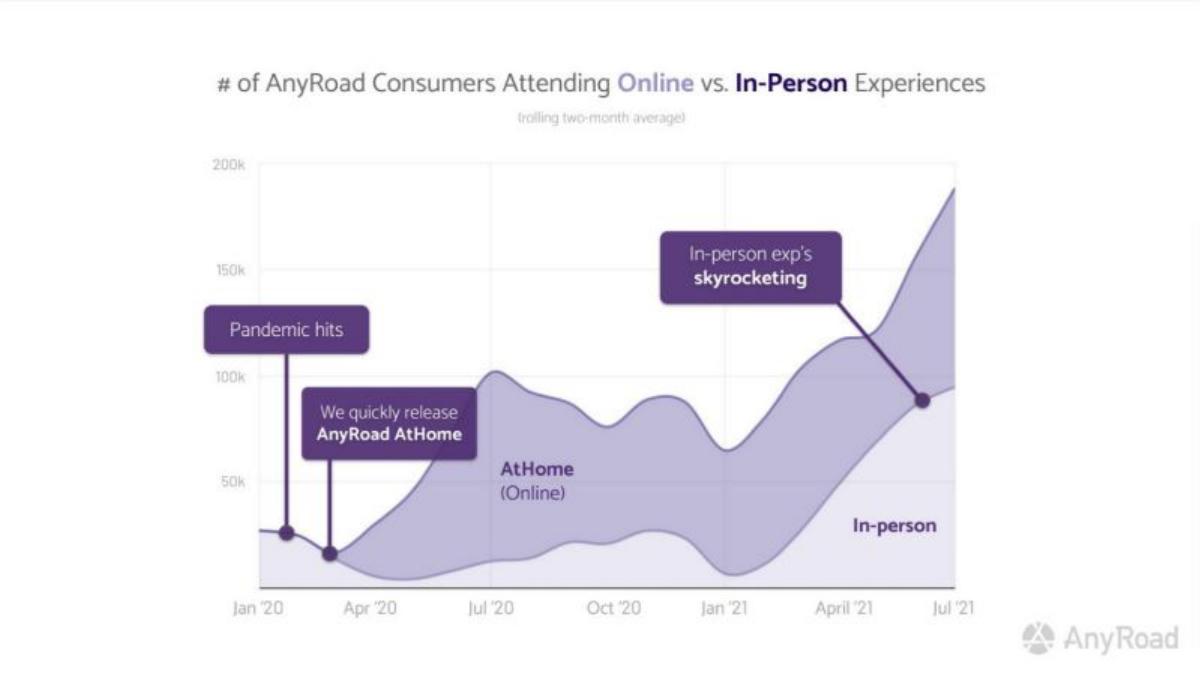
- A critical pivot during the pandemic is shown via a graph where 'AnyRoad AtHome' sustained guest volume until in-person experiences began 'skyrocketing' in early 2021 (Slide 6).
- The deck defines a new software category: Experience Relationship Management (ERM), which integrates operational, customer experience, and data analytics (Slide 10).
- AnyRoad claims to have 250 million proprietary data points deeply embedded in the customer journey (Slide 11).
- The platform is composed of three core products: Experience Manager, Data Manager, and Atlas (Slide 13).
- The company reports having over 400 live customers as of the 2022 Series B round (Slide 20).
- The team slide highlights significant scaling experience, including a Chief Sales Officer who took Gainsight from $0 to $100M (Slide 19).
The Narrative: From Product to Experience
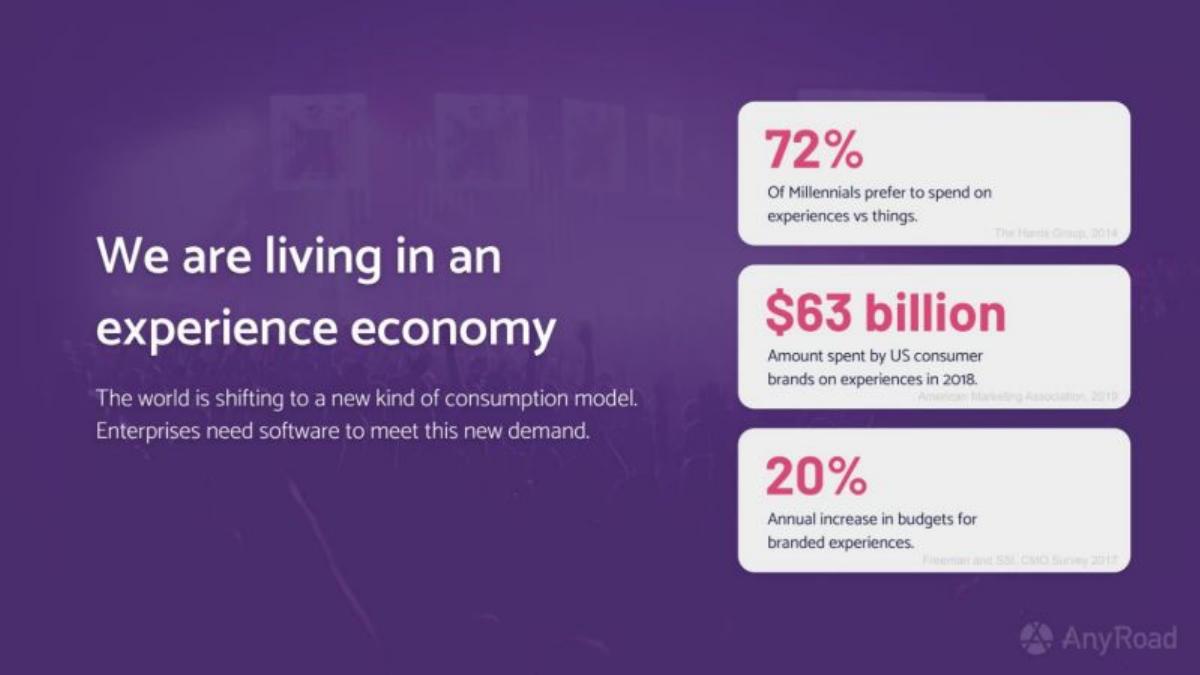
AnyRoad’s Series B deck, used to secure $47M in 2022, is built on a foundational shift in consumer behavior. The deck argues that we have moved from a product-based economy to an 'Experience Economy.' This isn't just a marketing fluff piece; the founders use data to show that 72% of Millennials prefer spending on experiences over things (Slide 5). By framing the problem as a lack of measurement for a $700 billion spend, AnyRoad makes the case that they aren't just a 'nice to have' tool, but a critical piece of the enterprise marketing stack.
Slides 1-3: The Hook and Visual Identity
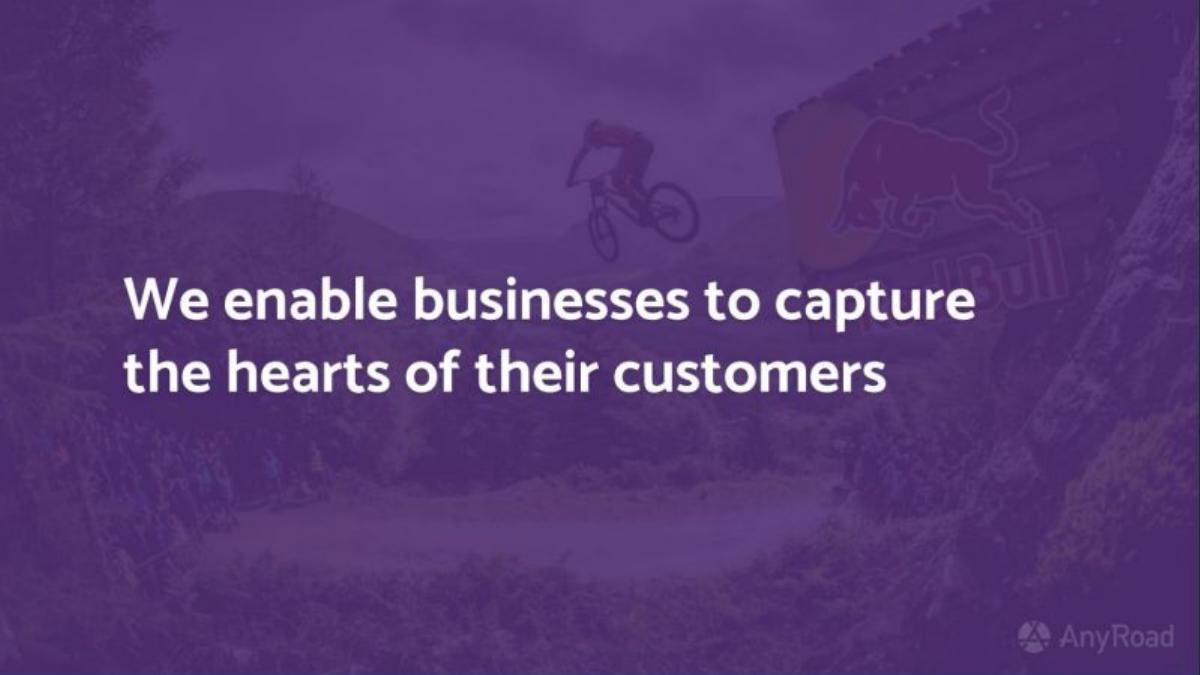
The deck opens with a clean, high-contrast title slide featuring CEO and Co-founder Jonathan Yaffe. Slide 2 and 3 use high-energy imagery—specifically a Red Bull soapbox race—to immediately ground the software in the real world. The mission statement, 'We enable businesses to capture the hearts of their customers,' is aspirational, but the following slides quickly move into the technical 'how.'
Slide 4: The Redacted Traction
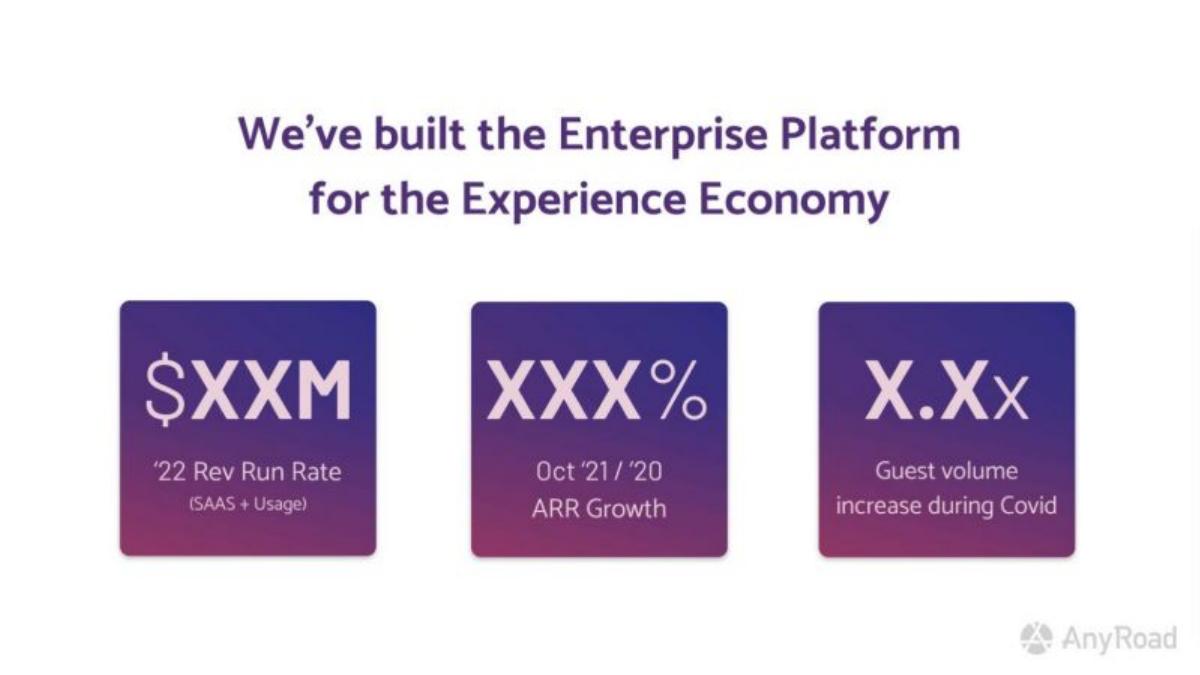
Slide 4 is a standard traction slide, though in this public version, the specific figures for 2022 Revenue Run Rate and ARR Growth are redacted as '$XXM' and 'XXX%.' However, the placeholders indicate that the company was measuring three specific pillars: total revenue (SaaS + usage), year-over-year ARR growth, and guest volume increase during Covid. The inclusion of 'usage' in the revenue model suggests a scalable pricing strategy tied to the volume of experiences managed.
Slides 5-8: Market Opportunity and Timing
Slide 5 establishes the 'Experience Economy' with three key stats: the Millennial preference for experiences, the $63 billion spent by US brands on experiences in 2018, and a 20% annual increase in branded experience budgets. Slide 6 is perhaps the most important for a 2022 fundraise. It shows a rolling two-month average of consumers attending experiences. It visualizes the 'AnyRoad AtHome' pivot during the pandemic and the subsequent 'skyrocketing' of in-person events starting in early 2021. This proves market resilience. Slide 8 puts a fine point on the 'Why Now?': experiential marketing accounts for 7.5% of total marketing spend ($700B), yet it is the only top spend category that is not measured.
Slides 9-12: Category Creation (ERM)
AnyRoad spends significant time differentiating itself from the 'Net Promoter Score' (NPS) crowd. Slide 9 boldly states 'NPS is Outdated,' arguing that AnyRoad’s behavioral data better predicts Lifetime Value (LTV). Slide 10 introduces their new category: Experience Relationship Management (ERM). They position themselves as the umbrella that sits over operational tools (Eventbrite), survey tools (Qualtrics), and analytics tools (Tableau). Slide 11 claims they have 250 million proprietary data points, emphasizing that their data is 'deeply embedded' rather than dependent on survey response rates.
Slides 13-18: Product Deep Dive
The deck transitions into the 'How it Works' section. Slide 13 breaks the platform into three products: Experience Manager, Data Manager, and Atlas. Slide 14 shows the software in the wild—embedded booking on a Johnnie Walker website and a front-desk tablet. Slides 15, 16, and 17 provide UI screenshots of the dashboard, data explorer, and Atlas insights. These slides prove the product is mature and enterprise-ready. Slide 18 is a technical architecture diagram showing how AnyRoad captures, standardizes, analyzes, and activates data across the enterprise ecosystem (ERP, CRM, Marketing Automation).
Slide 19: The Team
For a Series B, the team slide is crucial. AnyRoad showcases a 46-person full-time equivalent (FTE) team based in San Francisco. The executive roster is impressive: a CEO who was an early Red Bull marketer, a CPO from Palm/Nokia/Samsung, and a VP of Finance who saw Snowflake grow from $0 to $100M in revenue. This slide signals to investors that the company has the 'grown-up' leadership required to manage a $47M injection of capital.
Slide 20: The Summary
The deck concludes with a summary of the investment thesis: a massive $700B market, proven traction with over 400 live customers, a 'land and expand' sales model, and a unique position as the only end-to-end ERM platform. It reinforces the 20% yearly industry growth mentioned earlier in the deck.
What AnyRoad Does Well
Category Definition: AnyRoad doesn't just call itself 'event software.' By coining 'Experience Relationship Management,' they move the conversation away from feature comparisons and toward a strategic business need. This allows for higher enterprise pricing and better defensibility against smaller competitors.
Addressing the Pandemic: Many travel or event-adjacent startups struggled to raise in 2021-2022. AnyRoad’s slide 6 directly addresses this 'elephant in the room' by showing how they adapted and how the market rebounded stronger than before.
Social Proof: The deck is littered with logos like Coca-Cola, Lululemon, and Budweiser. For enterprise SaaS, showing that you can pass the security and procurement hurdles of a Fortune 500 company is half the battle.
What is Missing from the AnyRoad Deck
Unit Economics: While the deck mentions a 'land and expand' model, it lacks specific data on Net Revenue Retention (NRR) or Customer Acquisition Cost (CAC) ratios. For a Series B, investors usually want to see the efficiency of the sales engine in granular detail.
Competitive Landscape: The deck mentions Qualtrics and Medallia as 'outdated' or 'basic,' but it doesn't provide a traditional competitive matrix. It assumes the investor agrees that ERM is a distinct category from CRM or Marketing Automation.
The Ask: This version of the deck does not include a specific 'Use of Funds' or 'The Ask' slide. While the catalogue listing confirms they raised $47M, the deck itself doesn't outline how that capital will be allocated between R&D, sales, and international expansion.
Founder Takeaways
Create your own category: If you are in a crowded space (like marketing tech), don't compete on features. Define a new category (like ERM) that makes your competitors look like a subset of what you do. · Use 'Why Now' data: AnyRoad’s use of the Gartner marketing spend chart (Slide 8) is a perfect example of using third-party data to validate a massive, unaddressed problem. · Show, don't just tell, the pivot: If your business was affected by a global event like COVID, use a graph to show exactly how you navigated it. Transparency about the dip and the recovery builds trust with investors. · Leverage executive pedigree: If your team has 'been there, done that' at companies like Snowflake or Gainsight, highlight the specific milestones they achieved (e.g., 'Took Gainsight 0 -> 100M').
Frequently asked questions
- What is the primary problem AnyRoad is solving?
- AnyRoad addresses the lack of measurement in experiential marketing. According to slide 8, brands spend $700 billion annually on experiences, yet it remains the only major marketing category without standardized ROI metrics. AnyRoad provides the data layer to capture behavioral data and link it to long-term customer lifetime value (LTV), moving beyond simple surveys.
- How did AnyRoad handle the COVID-19 pandemic?
- Slide 6 shows that AnyRoad quickly released 'AnyRoad AtHome' to handle online experiences when the pandemic hit in early 2020. This allowed them to maintain guest volume until April 2021, when in-person experiences began to grow rapidly. This slide demonstrates the platform's flexibility and the resilience of the 'Experience Economy' even during global lockdowns.
- What is 'Experience Relationship Management' (ERM)?
- ERM is the category AnyRoad created to describe its 360-degree view of the customer journey. As shown on slide 10, it combines operational and payment data (like Eventbrite), customer experience data (like Qualtrics), and data analytics (like Tableau) into a single platform to understand long-term loyalty rather than just immediate feedback.
- Who are AnyRoad's typical customers?
- The deck highlights major enterprise brands including Coca-Cola, Budweiser, REI, Michaels, and Lululemon. Slide 7 features quotes from these leaders, such as the Lululemon CEO stating they are now an 'experience company.' Slide 20 confirms the company has over 400 live customers using the platform.
- What are the core components of the AnyRoad platform?
- According to slide 13, the platform consists of three main modules: Experience Manager (for managing activations and capturing 1st party data), Data Manager (for centralizing data via APIs), and Atlas (an analytics engine for deriving insights into brand impact and customer behavior).