The Button City pitch deck is a specialized gaming presentation designed to secure late-stage 'add-on' financing. Unlike traditional SaaS decks that lead with problem/solution, this deck leads with aesthetics and gameplay mechanics, reflecting the content-driven nature of the gaming industry. With 23 slides, it provides an exhaustive look at the game's features, including three internal mini-games, technical specifications using Unity 2018.4LTS, and a clear localization strategy costing approximately $4,550 per language. The deck successfully leverages social proof from the 'Wholesome Direct'…
Key takeaways
- The game is positioned as a 'narrative adventure' with a focus on a low-poly art style (Slide 1).
- The project includes three distinct internal arcade games: Gobabots, rEVolution Racer, and Prisma Beats (Slides 5-6).
- Technical stability is emphasized through the use of Unity 2018.4LTS for long-term support and portability (Slide 7).
- The deck identifies a specific target demographic of ages 8-35, citing 'Steven Universe' and 'Night in the Woods' as cultural touchstones (Slide 7).
- Development status is clearly defined as 'feature complete' and nearing 'content complete' as of late 2020 (Slide 8).
- Localization costs are granularly estimated at $0.13 per word for a 35,000-word script (Slide 10).
- Market validation is provided by the game's appearance in the 'Wholesome Direct' which had 8,000 concurrent viewers (Slide 12).
- Financial projections target 100,000 units sold at a $19.99 price point (Slide 12).
The Narrative and Aesthetic Hook
The Button City pitch deck begins not with a market problem, but with an invitation into a world. For indie games, the 'problem' is often a lack of high-quality content in a specific sub-genre. Subliminal addresses this by immediately establishing the tone and visual identity of the project.
Slides 1-2: Summary and Key Features
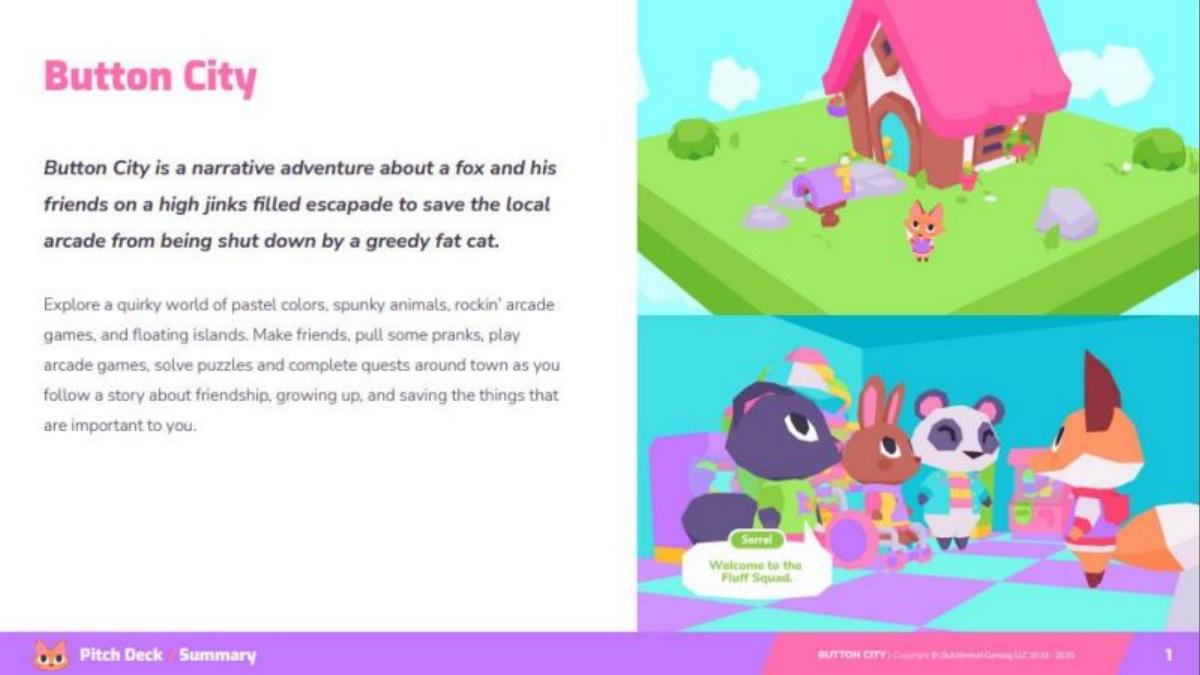
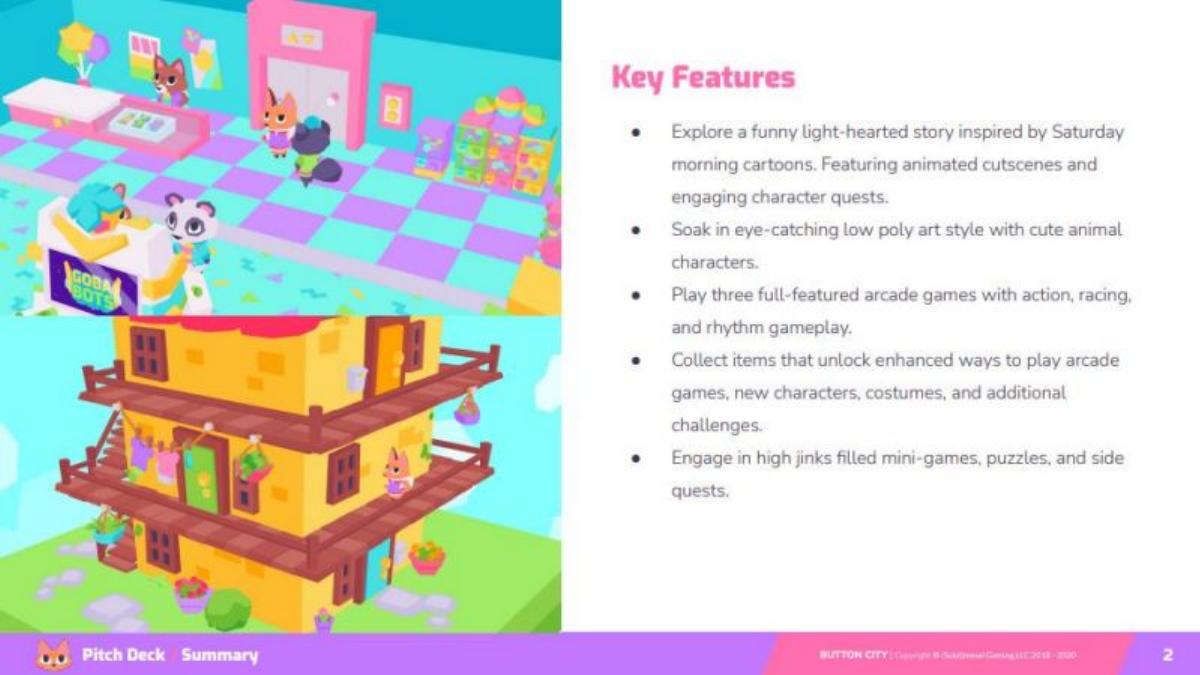
Slide 1 introduces Button City as a "narrative adventure about a fox and his friends." The primary conflict is established: saving a local arcade from a "greedy fat cat." This narrative simplicity is paired with high-contrast, pastel-colored 3D dioramas. Slide 2 lists the key features, emphasizing the "Saturday morning cartoon" inspiration and the inclusion of three full-featured arcade games within the main game. This 'game-within-a-game' structure is a significant value proposition, suggesting a higher depth of content than a standard narrative walker.
Slides 3-4: Gameplay Mechanics
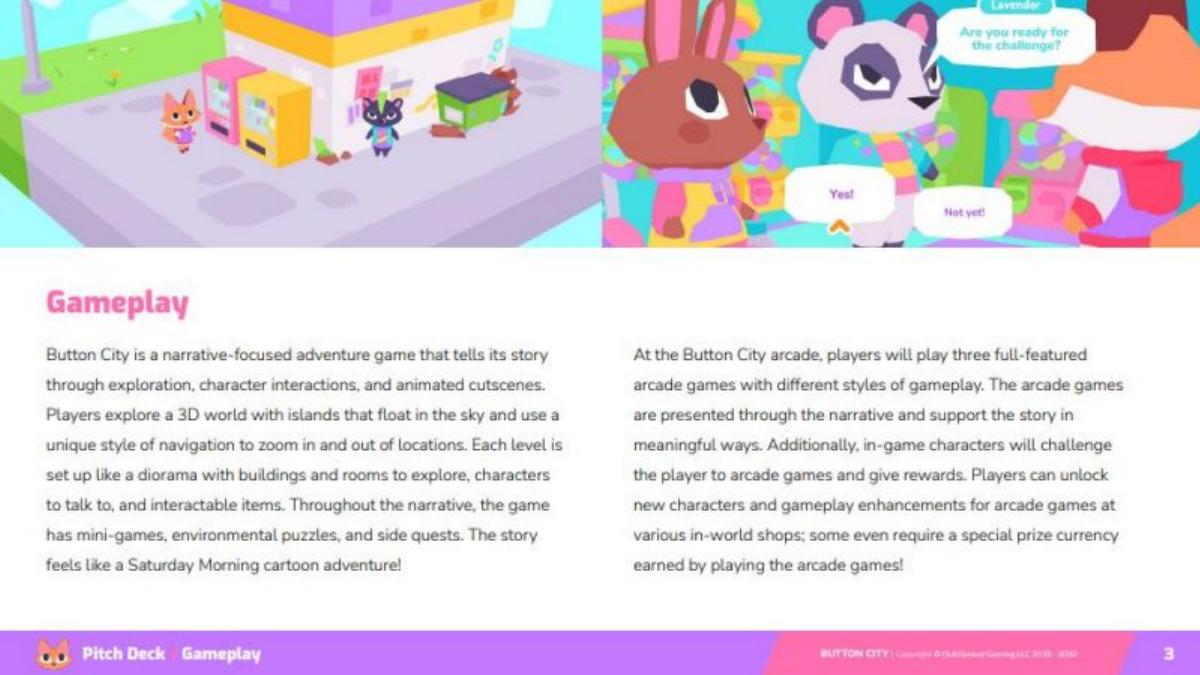
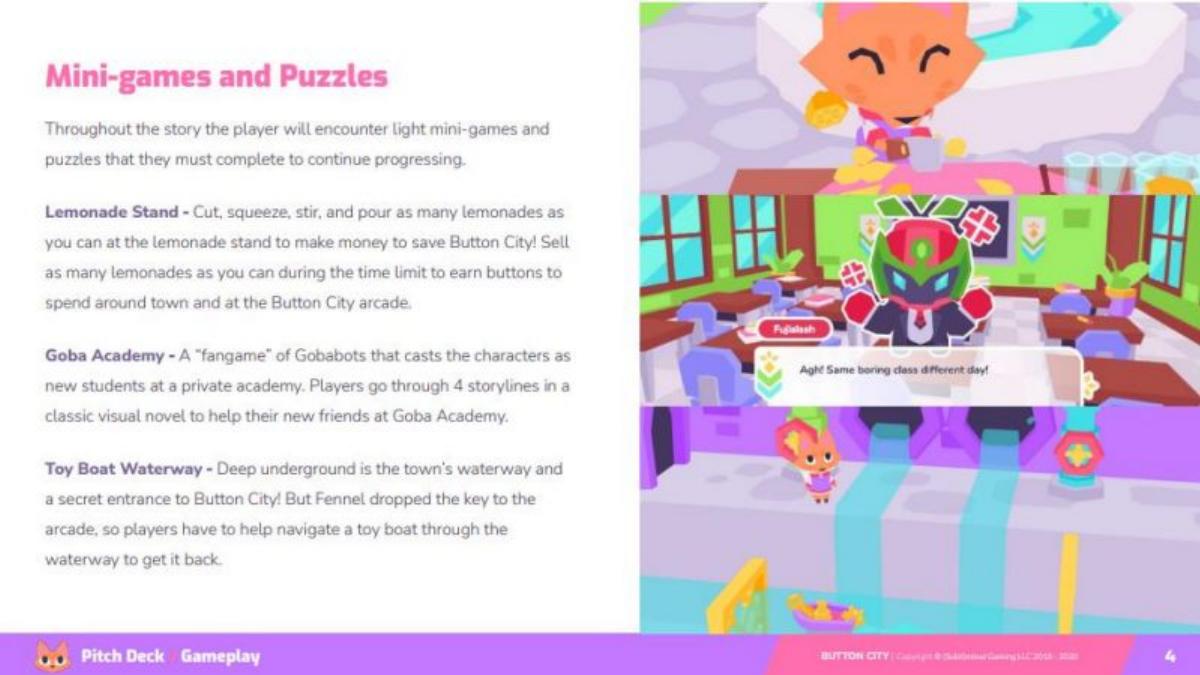
Slide 3 details the 3D world navigation, describing levels as "dioramas with buildings and rooms to explore." This is a critical technical distinction for investors, as it defines the scope of asset production. Slide 4 breaks down the mini-games and puzzles, including a 'Lemonade Stand' and a 'Goba Academy' visual novel. By diversifying the gameplay types, the developers show they are targeting a broad engagement loop beyond just dialogue trees.
Deep Dive into the Arcade Mini-Games
A significant portion of the deck is dedicated to the internal arcade games, which function as the core 'fun' loop of the Button City universe.
Slides 5-6: Gobabots, rEVolution Racer, and Prisma Beats
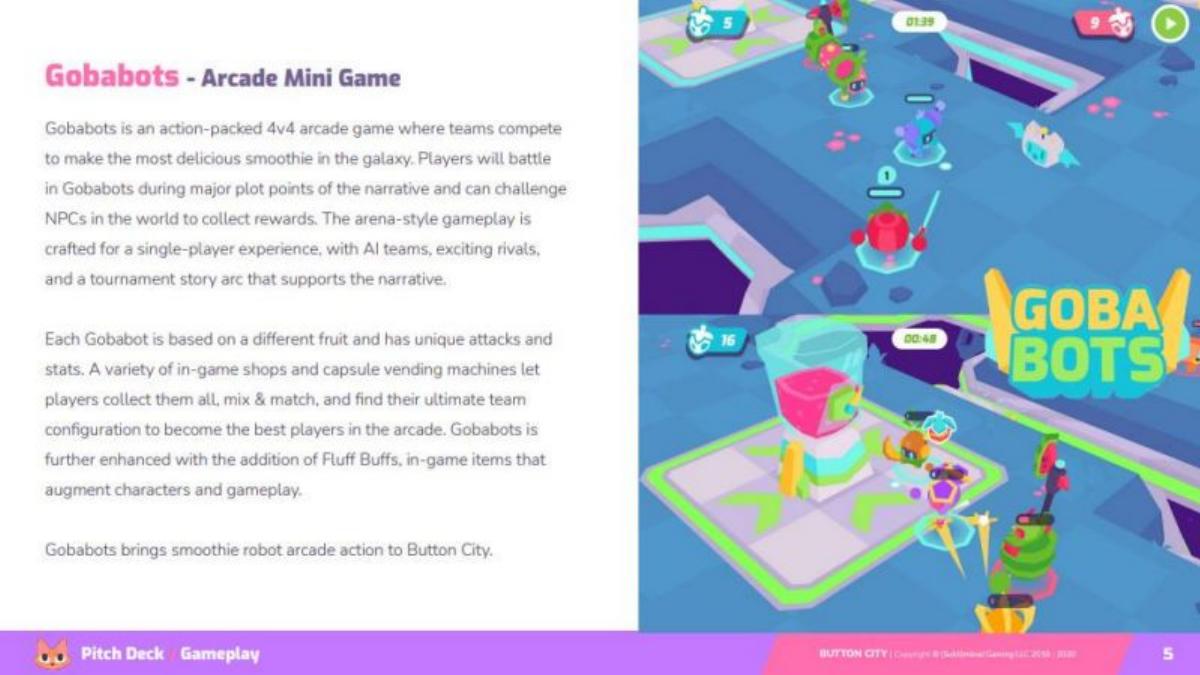
Slide 5 introduces Gobabots , a 4v4 action game. The deck specifies that this is an "arena-style gameplay" crafted for a single-player experience with AI teams. Slide 6 covers rEVolution Racer (a drift-racing game) and Prisma Beats (a rhythm game). By including three distinct genres—action, racing, and rhythm—the developers demonstrate a high level of technical versatility and a robust content offering for the $19.99 price point mentioned later in the deck.
Technical Specifications and Platform Strategy
For a game to be a viable investment, it must be portable and performant. The deck spends several slides addressing the 'how' of the development process.
Slide 7: Technical and Platform Fit
There are four variations of Slide 7 in this deck, likely used for different pitch targets. The core message across them is the use of Unity 2018.4LTS . The "LTS" (Long Term Support) designation is a signal to investors that the game is built on a stable version of the engine, reducing the risk of breaking changes during the porting process. The deck also highlights that the low-poly art style is "optimized" to run on both low-end and high-end hardware, maximizing the total addressable market (TAM).
Slide 8: Development Status
Slide 8 provides a transparent look at the project's timeline. The game is described as "nearing beta phase" and "feature complete." The distinction between "feature complete" (all mechanics are in) and "content complete" (all levels/story are in) is vital in game development. The developers state they need access to development kits in the August/September timeframe to begin porting for a Q1 2021 target release .
Budgeting and Localization
The deck transitions from the creative to the operational, providing a breakdown of how the add-on financing will be utilized.
Slides 9-10: Budget and Localization
Slide 9 is a budget table with placeholder figures ($XX,XXX). It categorizes expenses into Production, Music and Sound, Administrative, and PR. Slide 10 is perhaps the most impressive slide for a savvy investor: a detailed Localization breakdown. It estimates a 35,000-word count at $0.13 per word, totaling $4,550 per language . This level of granularity shows the team has moved past the 'dreaming' phase and into the 'execution' phase.
Market Validation and Projections
To justify the investment, the deck provides a comparative analysis of the indie gaming landscape in 2020.
Slides 11-12: Comparable Games and Trends
Slide 11 lists 'Comparable Games' to provide a valuation and sales benchmark. It cites Night in the Woods (417,000 sales) and Arcade Spirits (10,000 sales). By using a formula (Steam reviews x 50), they provide a transparent methodology for their data. Slide 12 leverages the "Wholesome Games" trend, noting that Button City started the Wholesome Direct showcase, which had 120,000+ views. This social proof is used to back a 100,000-unit sales projection at a $19.99 price point, representing a potential $2M gross revenue opportunity.
The Team and Studio Philosophy
The final section of the deck focuses on the people behind the pixels.
Slides 13-14: About Us and Meet the Team
Slide 13 introduces Subliminal , a studio based in Albuquerque, NM, guided by "hope-punk" ideals. This cultural positioning is relevant in the indie space, where studio identity drives community loyalty. Slide 14 introduces the core team: Shandiin Yazzie Woodward (Co-founder/Artist) with experience at Meow Wolf, and Ryan Woodward (Co-founder/Programmer) with experience at Ideum and the Smithsonian. The team’s background in interactive museum exhibits and high-profile art installations (Meow Wolf) provides strong evidence of their ability to deliver polished visual experiences.
What Works and What is Missing
What Works
Visual Consistency: The deck uses actual game assets and a color palette that mirrors the product, creating a seamless brand experience. · Granular Costs: The localization slide is a masterclass in showing an investor that you understand your unit costs. · Market Alignment: By aligning with the 'Wholesome Games' movement, the team tapped into a specific, growing zeitgeist in 2020. · Technical Realism: Explicitly naming the Unity version and dialogue engines (YarnSpinner) reduces technical due diligence friction.
What is Missing
Specific Ask: While the budget categories are listed, the actual dollar amount requested is obscured in this version of the deck. · Marketing Plan: Beyond mentioning the Wholesome Direct, there is little detail on how they will reach their 100,000-unit goal (e.g., influencer strategy, ad spend, or platform featuring). · Burn Rate: For an add-on round, investors usually want to see the current runway and how the new capital extends it.
Founder's Guide: What to Copy
The 'Comparable Games' Slide: Copy the methodology of using Steam reviews multiplied by a factor (usually 30-50) to estimate competitor sales. It shows you are data-driven. · The 'Technical' Slide: Don't just say "we use Unity." Say which version and why (e.g., LTS for stability). It matters for porting and long-term maintenance. · The 'Localization' Slide: If your game is narrative-heavy, show the word count and the cost-per-word. It proves the project is scoped and ready for international markets. · Platform Specificity: If you are pitching for console kits, list the target platforms clearly (PC, Mac, Switch, PS, Xbox) as seen on Slide 8.
Frequently asked questions
- What is 'add-on' financing in the context of this deck?
- Add-on financing typically refers to capital raised after the initial development phase to cover final production costs, porting to multiple consoles, marketing, or localization. In the case of Button City, the deck specifies a need for funding to cover development labor, console dev kits, and entry into European and Japanese markets.
- How does the deck justify its sales projections?
- The deck uses 'Comparable Games' (Slide 11) to benchmark success. It cites 'Night in the Woods' with 417,000 Steam sales and 'Frog Detective' with 35,000. By positioning Button City between these benchmarks and projecting 100,000 units, the founders provide a data-backed middle-ground estimate rather than an arbitrary figure.
- Why are there multiple versions of Slide 7 and Slide 8?
- The deck includes variations of the same slides likely tailored for different platform holders or investors. For example, one version of Slide 7 focuses on 'Why Platform?' while another is titled 'Perfect for Platform.' This suggests the deck was used for both publisher pitches and console-specific partnership discussions.
- What technical information is included for investors?
- The deck specifies the engine (Unity 2018.4LTS), the dialogue engine (YarnSpinner), and text support (SuperTextMesh). This level of detail assures investors that the game is built on industry-standard, maintainable architecture that supports easy porting and localization.
- Is there a specific 'Ask' in the deck?
- While the 'Budget' slide (Slide 9) uses placeholders ($XX,XXX), the 'Development Status' slide (Slide 8) explicitly states the needs: financial support for production, a multiplatform release in 2021, development labor costs, and console development kits.