The Button City pitch deck is a highly visual, 23-slide document (8 slides analyzed here) that prioritizes art style and gameplay variety to attract investors or publishers. Developed by Subliminal Gaming LLC, the game centers on a 'Saturday Morning cartoon' narrative style combined with three distinct arcade mini-games: rEVolution Racer and Prisma Beats. The deck excels at defining its technical stack (Unity 2018.4LTS) and development roadmap, targeting a Q1 2021 release across five major platforms. While it provides specific sales benchmarks for comparable titles like Night in the Woods (41…
Key takeaways
- The game is positioned as a narrative-focused adventure with a 'Saturday Morning cartoon' feel (Slide 3).
- Gameplay is diversified through three full-featured arcade mini-games integrated into the story (Slide 3).
- Technical stability is highlighted by the use of Unity 2018.4LTS for multi-platform portability (Slide 7).
- Development was nearing the beta phase at the time of the deck, with a target release of Q1 2021 (Slide 8).
- The ask is for 'financial support' to cover labor, dev kits, and localization, though no specific figure is listed (Slide 8).
- Market validation is provided through Steam sales estimates for comparable indie titles (Slide 11).
- The team slide emphasizes prior experience at Meow Wolf and the Smithsonian to establish creative credibility (Slide 14).
- The deck uses a consistent low-poly art style throughout, mirroring the in-game aesthetic (Slide 1, 23).
Button City: A Visual and Narrative Deep Dive
The Button City pitch deck is a prime example of how indie game developers can communicate both creative vision and technical readiness. The deck, produced by Subliminal Gaming LLC, covers the period between 2018 and 2020. It uses a vibrant, low-poly aesthetic that mirrors the game itself, ensuring that the 'vibe' of the product is felt on every slide. This teardown focuses on the 8 key slides provided, which cover gameplay, development status, market comparables, and team biography.
Slide 1 and 23: The Aesthetic Bookends
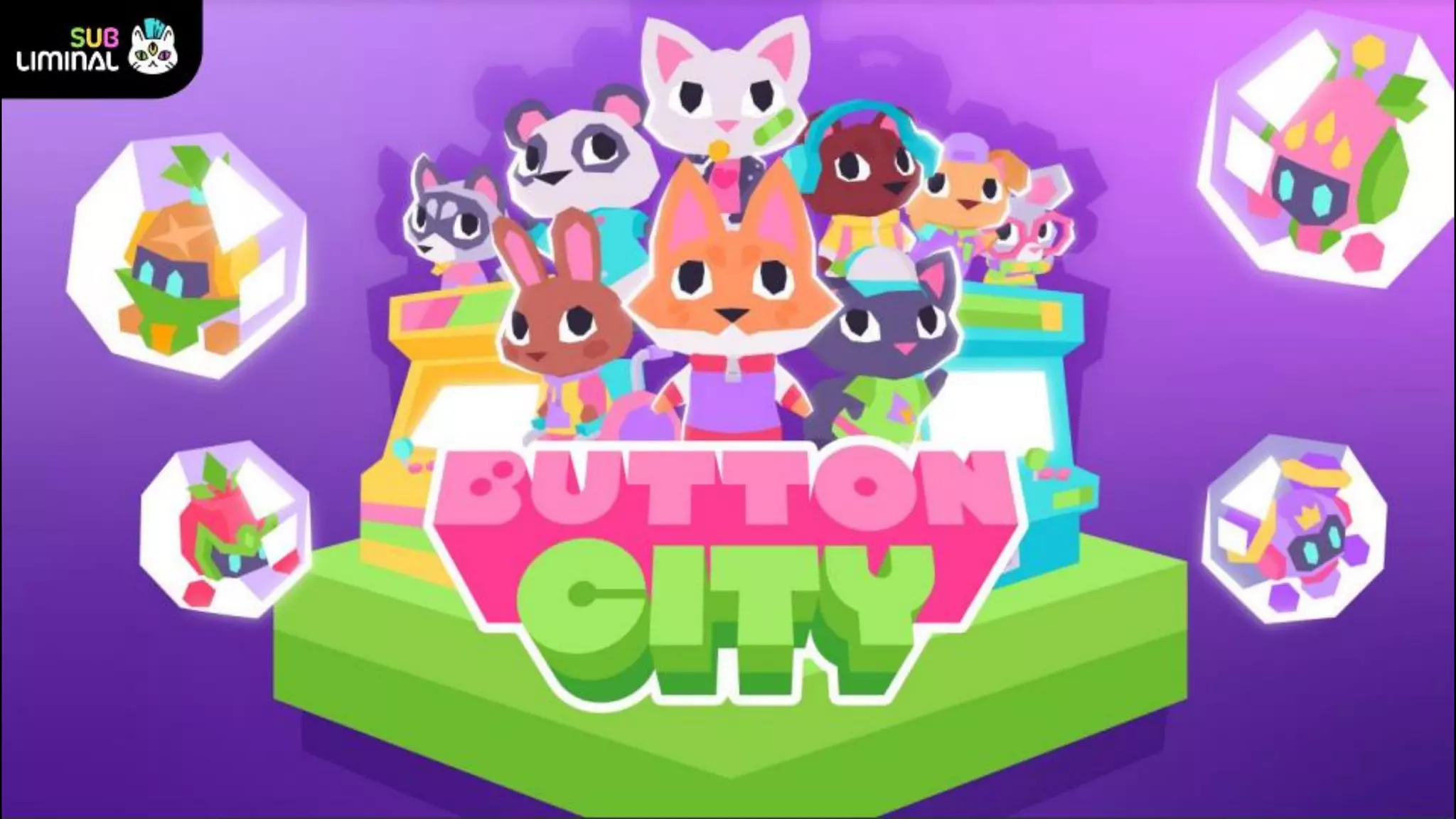
Slide 1 serves as the title card, featuring the game's logo and a cast of animal characters. The branding for 'Subliminal' is visible in the top left corner. This slide immediately establishes the target audience: fans of cozy, character-driven games. Slide 23 acts as a closing visual, showing four main characters in a shop environment, reinforcing the 'diorama' feel mentioned later in the deck. These slides are light on text but heavy on brand identity, which is crucial for a creative project seeking funding.
Slide 3: Defining the Gameplay Loop
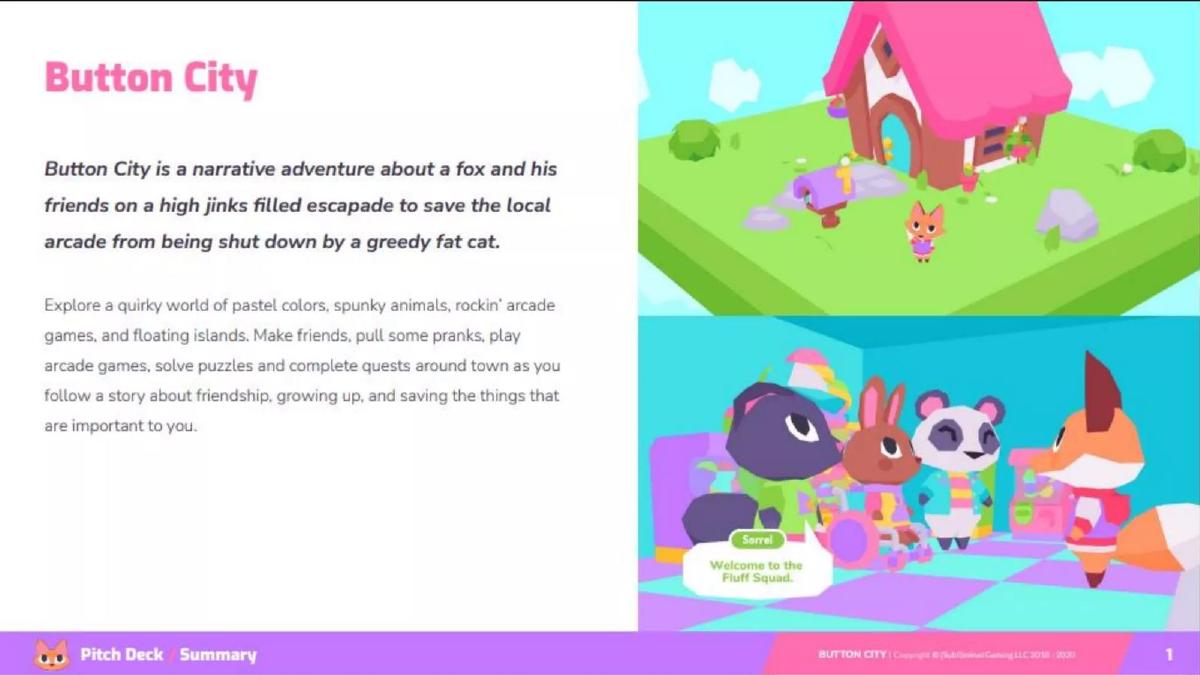
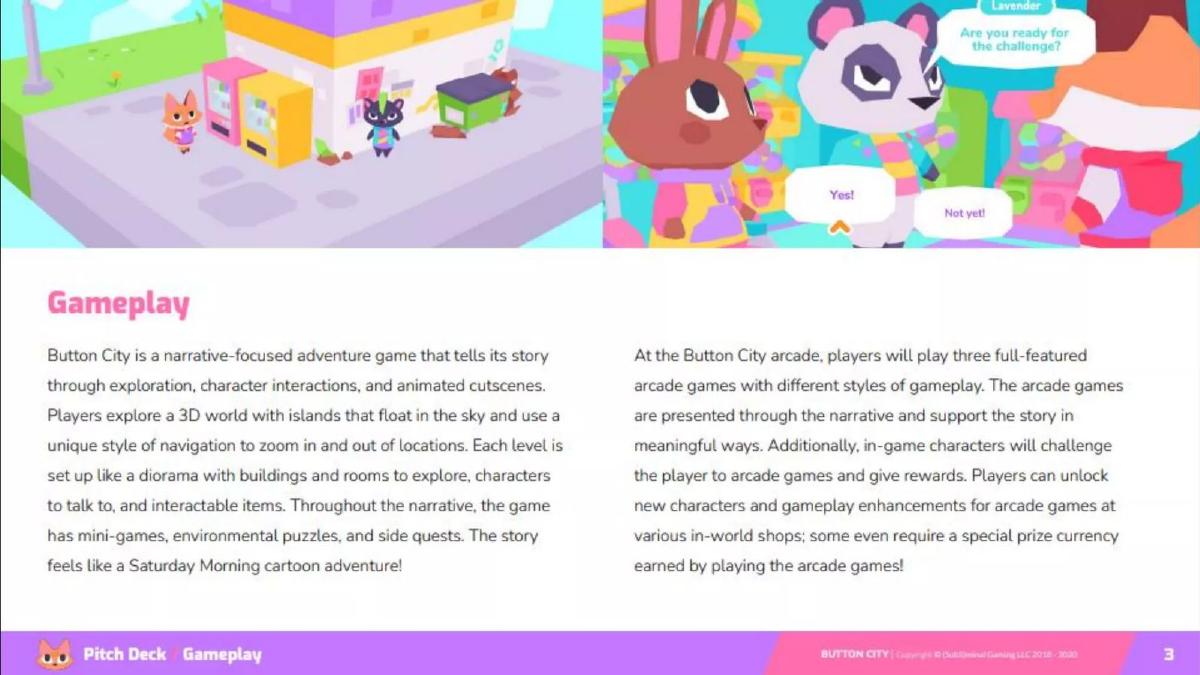
Slide 3 is the most text-heavy slide in the gameplay section. It defines Button City as a 'narrative-focused adventure game.' Key features listed include:
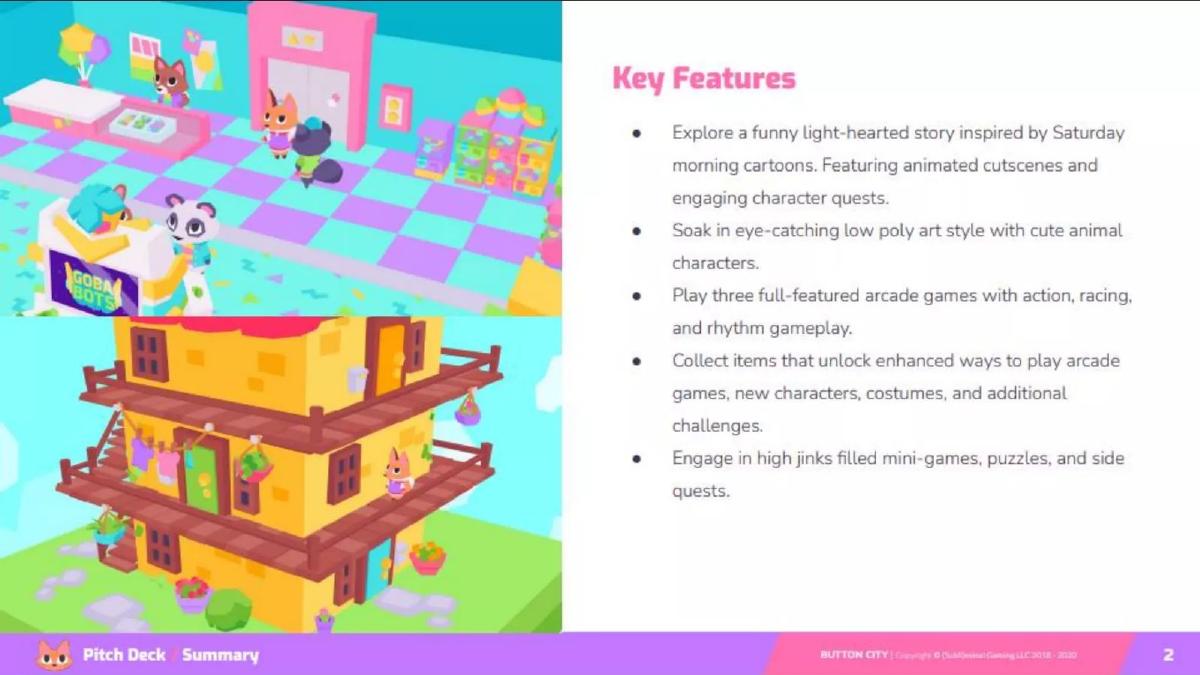
Exploration: A 3D world with floating islands and diorama-style levels. · Navigation: A unique style that allows players to zoom in and out of locations. · Mini-games: The inclusion of environmental puzzles, side quests, and specifically, three 'full-featured' arcade games.
The slide also introduces the economy of the game, mentioning a 'special prize currency' earned through arcade play that can be spent at in-world shops for enhancements and new characters. This demonstrates a clear understanding of player retention and progression mechanics.
Slide 6: The Mini-Game Showcase
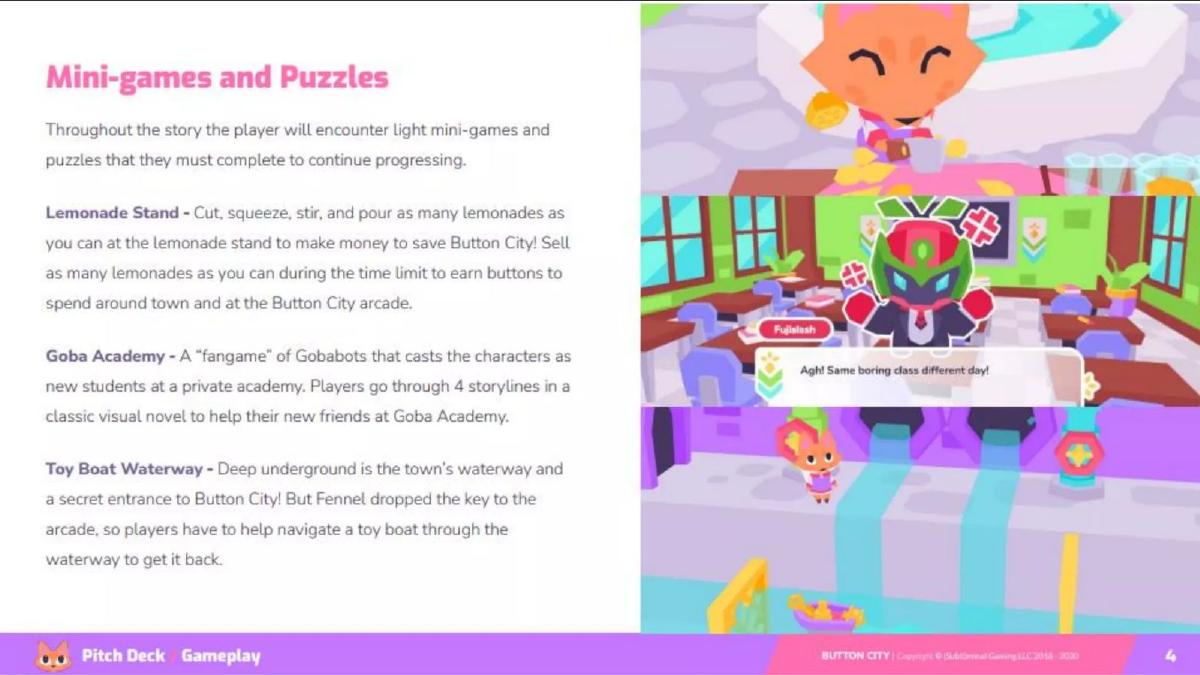
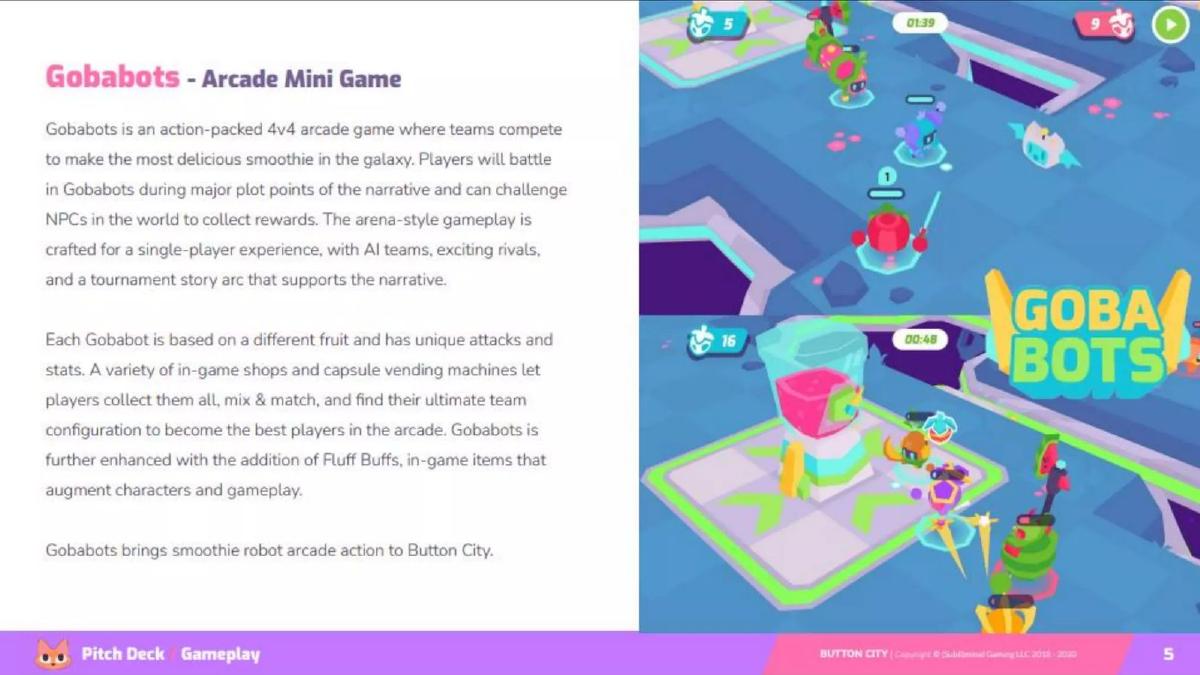
Slide 6 breaks down two of the three arcade games mentioned previously. rEVolution Racer is described as a drift-racing game where players charge a battery to speed past rivals, featuring a global leaderboard. Prisma Beats is a rhythm game inspired by classic arcade titles, allowing players to unlock songs and costumes. By detailing these mini-games, the developers show that Button City isn't just a walking simulator; it has mechanical depth and variety that can appeal to different player archetypes.
Slide 7: Technical Foundations
Slide 7, titled 'Perfect for Platform,' addresses the technical feasibility of the project. It notes the use of Unity 2018.4LTS . The choice of an 'Long Term Support' version of Unity is a signal to investors that the team values stability and portability. The slide explicitly mentions that the low-poly art style is 'optimized' to run well in both docked and handheld modes, a clear nod to the Nintendo Switch, which is a primary target for indie titles of this genre.
Slide 8: Development Status and The Ask
Slide 8 provides the 'Where we're at' and 'What we need' breakdown. At the time of the deck, the game was 'nearing beta phase' and was 'feature complete.' The target release was set for Q1 2021 . The 'What we need' section is specific about the utility of the funds but vague on the amount. They require support for:
Finishing production and content. · Multiplatform release costs. · Development labor. · Console development kits. · Localization for European and Japanese markets.
For a venture capital pitch, the lack of a specific dollar amount would be a red flag, but for a publisher pitch, this often serves as a conversation starter for a larger publishing deal.
Slide 11: Market Validation through Comparables
Slide 11 is a strong 'Comparable Games' slide. It doesn't just name games; it provides data. The team uses a formula (Steam reviews x 50) to estimate sales, a common industry heuristic. They list:
Night in the Woods: 417,000 sales at $19.99. · The Haunted Island, a Frog Detective Game: 35,000 sales at $4.99. · Arcade Spirits: 10,000 sales at $19.99.
By including both 'breakout successes' and 'moderate successes,' the team presents a realistic view of the market, showing that even a mid-tier performance can justify the development costs of an indie project.
Slide 14: The Team
The 'Meet the Team' slide (Slide 14) focuses on four key members. The co-founders, Shandiin Yazzie Woodward and Ryan Woodward , bring significant prestige. Shandiin’s work with Meow Wolf (a major immersive art installation company) and Ryan’s work for the Smithsonian and National Portrait Gallery suggest a high level of professional execution. The inclusion of Benjamin Hanken (Programmer) and Valentina Hawes (Artist) rounds out the core competencies needed to ship a game: art and code.
What Works in This Deck
The Button City deck succeeds because it is visually cohesive . The art style of the slides matches the art style of the game, which reduces the cognitive load on the reader and reinforces the brand. Furthermore, the technical transparency regarding the Unity version and the optimization for handheld platforms shows that the team isn't just 'dreaming'—they are building with hardware constraints in mind. Finally, the comparable sales data provides a grounded financial context that many indie decks lack.
What Is Missing
The most glaring omission in these slides is a specific financial ask . While they list what they need the money for, they don't state if they are looking for $50,000 or $500,000. Additionally, there is no marketing or community plan shown in these slides. For an indie game, the 'wishlist' count on Steam is a vital metric that is absent here. Lastly, while they mention 'three full-featured arcade games,' only two are detailed in the provided slides, leaving a gap in the product description.
Founder's Playbook: What to Copy
Founders should emulate the 'Comparable Games' structure on Slide 11. Instead of just saying 'we are like Animal Crossing,' this deck finds smaller, realistic indie comps and provides estimated sales numbers and price points. This shows a sophisticated understanding of the market. Additionally, the Team Slide is excellent; it focuses on 'award-winning' work and 'museum-grade' interactives, which elevates the team's status from 'hobbyist' to 'professional creators.' If you have worked for a recognizable brand or institution, even outside of gaming, highlight it as this deck does with the Smithsonian and Meow Wolf.
Frequently asked questions
- What is the core gameplay loop of Button City?
- According to slide 3, the game is a narrative adventure where players explore a 3D world composed of floating islands and diorama-style levels. The loop involves character interaction, exploration, and playing three 'full-featured' arcade games that support the story. Players earn a special prize currency in these mini-games to unlock new characters and gameplay enhancements in various in-world shops.
- Which platforms did the developers target for release?
- Slide 8 explicitly lists the target platforms as PC, Mac, Nintendo Switch, PlayStation, and Xbox. The deck emphasizes that the game's low-poly art style is optimized for both docked and handheld modes, specifically catering to the Nintendo Switch's hardware constraints while maintaining an 'aesthetically pleasing' look (Slide 7).
- How does the deck justify the market potential for this game?
- Slide 11 uses a 'Comparable Games' analysis. It cites 'Night in the Woods' with 417,000 Steam sales at a $19.99 price point as a breakout success. It also lists 'The Haunted Island, a Frog Detective Game' (35,000 sales) and 'Arcade Spirits' (10,000 sales) to show a range of outcomes within the narrative adventure genre, using a formula of 'Steam reviews x 50' to estimate sales.
- What specific needs does the funding request cover?
- Slide 8 outlines four primary needs: finishing production, covering development labor costs, purchasing game console development kits, and localizing the game for European and Japanese markets. While the deck mentions needing 'financial support,' it does not state a specific investment goal or valuation, which is common in publisher-facing pitch decks.
- What is the background of the founding team?
- Slide 14 highlights co-founders Shandiin Yazzie Woodward and Ryan Woodward. Shandiin's background includes graphic and interactive design for Meow Wolf, while Ryan has created award-winning interactives for the Smithsonian. This emphasizes a pedigree in high-end interactive art and museum-grade software, lending credibility to the game's aesthetic and technical execution.