BuzzFeed’s 2008 pitch deck illustrates the company's evolution from a niche editorial site to a data-driven media powerhouse. The deck focuses heavily on the 'Optimization' of viral content, using internal dashboards to measure 'Contagiousness' and 'Viral Effects' (Slide 4). By positioning themselves as the 'YouTube/Wikipedia for Buzz and Viral Media' (Slide 7), the founders successfully argued that the future of advertising was not banners, but 'Ads as Content' (Slide 5). This teardown examines how the team leveraged early algorithmic detection and custom widgets to prove that word-of-mouth…
Key takeaways
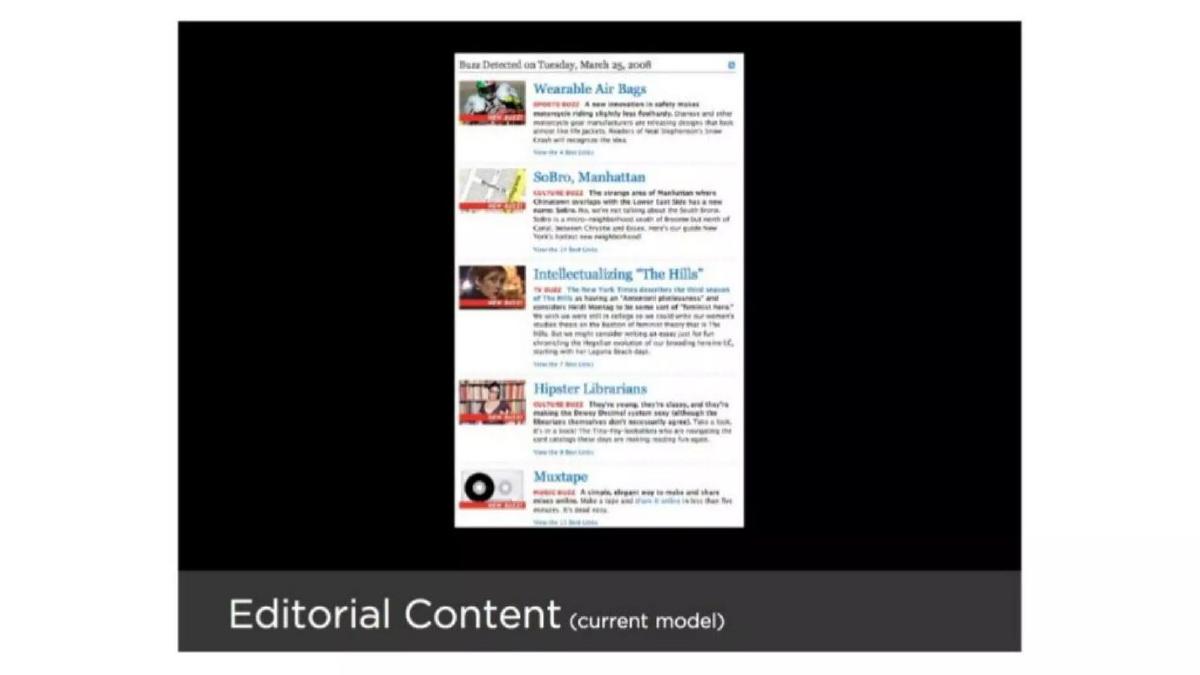
- The deck explicitly labels its starting point as the 'current model' of editorial content before pitching a technology-driven expansion (Slide 2).
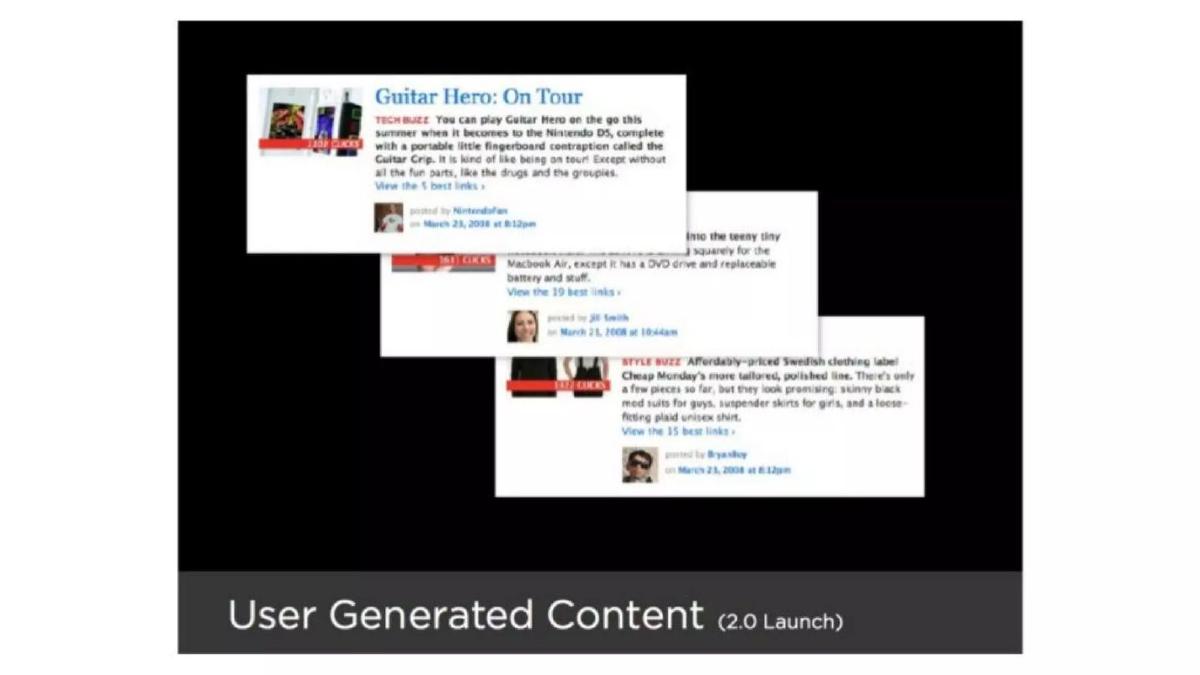
- BuzzFeed categorized its value proposition into three distinct buckets: Editorial, Algorithmically Detected, and User Generated Buzz (Slide 3).
- A custom dashboard was showcased to prove they could measure 'Contagiousness' and 'Viral Effects' in real-time (Slide 4).
- The core thesis of the business model was 'Market Direction: Ads as Content,' comparing their approach to Google and YouTube's native ad placements (Slide 5).
- The product offering included 'Custom-Skinned BuzzFeed Microsites' and widgets for client landing pages, demonstrating a clear B2B revenue path (Slide 6).
- The vision slide positions the company as a 'global technology platform' rather than just a media site (Slide 7).
- The deck lacks a formal team slide, financial projections, or a specific 'Ask' in the provided 8-slide sequence.
- The branding is consistent, using the signature red and white color scheme that remains synonymous with the brand today (Slide 1).
The 2008 BuzzFeed Vision: Engineering Virality
The BuzzFeed pitch deck is a significant artifact in the history of digital media. At a time when traditional publishing was struggling to adapt to the social web, Jonah Peretti and his team presented a vision that treated 'buzz' as a measurable, algorithmic commodity. This teardown examines the 8 slides provided from the original 22-slide deck, focusing on how they framed a media company as a technology platform.
Slide 1: Title Slide
The deck opens with the iconic red background and the original BuzzFeed logo. The tagline, "What's Buzzing on the Web?" (Slide 1), is simple and interrogative. It establishes the company's core function immediately: discovery. There is no mention of news, journalism, or reporting; the focus is entirely on the 'Web' and 'Buzzing' trends.
Slide 2: Editorial Content (Current Model)
Slide 2 serves as the baseline. It shows a screenshot of the site as it existed on Tuesday, March 25, 2008 . The content featured includes 'Wearable Air Bags,' 'SoBro, Manhattan,' and 'Hipster Librarians.' By labeling this the "current model," the founders are signaling to investors that what they see today is merely the starting point, not the final product. It anchors the pitch in a functional, live product while promising a future evolution.
Slide 3: The New Front Page
This slide introduces the technical complexity that justifies a VC-level valuation. It breaks down the content sources into three categories: Editorial Buzz, Algorithmically Detected Buzz, and User Generated Buzz (Slide 3). This is a crucial distinction. It tells investors that the company isn't just hiring writers; it is building a 'publishing platform for trend-spotters and marketers.' The right-hand column of the slide explains the 'How BuzzFeed Works' loop: Link, Promote, Big Seed, Track, and Optimize. This circular logic suggests a self-reinforcing growth engine.
Slide 4: Optimization and Viral Metrics
Slide 4 is perhaps the most important for a technology-focused investor. It shows the 'BuzzFeed Terminal,' an internal dashboard. The slide uses red arrows to point out specific capabilities: "Measure Viral Effects," "Widget Traffic with Stats," "Landing Page Performance Metrics," and "Search Engine & Referrer Optimization." The dashboard prominently displays a "Contagiousness" score (Slide 4). This framing moves the conversation away from 'content' and toward 'data science,' suggesting that BuzzFeed has a proprietary way to understand why things go viral.
Slide 5: Market Direction: Ads as Content
In Slide 5, BuzzFeed addresses the monetization strategy by identifying a shift in the broader market. They use screenshots of Google and YouTube to show the difference between "Organic Content" and "Sponsored Content." The thesis is clear: "Ads as Content." By aligning themselves with the way Google and YouTube successfully monetized, BuzzFeed positions its future ad products as native and non-disruptive, which was a highly attractive proposition in the era of declining banner ad effectiveness.
Slide 6: Custom Promotion
This slide provides concrete examples of how the 'Ads as Content' strategy works in practice. It showcases a "Custom BuzzFeed Widget on Client's Landing Page" and a "Custom-Skinned BuzzFeed Microsite" for the movie Cloverfield (Slide 6). This demonstrates that the company already had high-profile brand partnerships and a productized way to sell its viral technology to third parties. It moves the business model from theoretical to proven.
Slide 7: How Big Can This Get?
The 'Vision' slide (Slide 7) attempts to define the company's total addressable market and long-term potential. It uses bold comparisons, calling BuzzFeed the "YouTube/Wikipedia for Buzz and Viral Media." The slide lists four key pillars:
A global technology platform for trend-centric advertising. · The most advanced network-aware, social media-aware system for publishing. · The top outlet for every major brand wanting word-of-mouth.
By using the term "global technology platform," the founders are justifying a tech-multiple valuation rather than a media-multiple valuation.
Slide 8: The Call to Action (External)
Slide 8 is not part of the original BuzzFeed deck but is a promotional slide for the agency that compiled the deck. It provides no information about BuzzFeed's financials, team, or ask. As noted in the teardown, the absence of these slides in the provided set means we cannot evaluate the specific terms of the $3.5M round or the backgrounds of the team members beyond Jonah Peretti, whose email is visible on Slide 7.
What Works in This Deck
The Transition from Content to Tech: The deck successfully moves from showing 'Hipster Librarians' (Slide 2) to showing a 'Contagiousness' dashboard (Slide 4). This is a masterclass in how to pitch a media company to VCs. If they had pitched as a blog, they would have received a much lower valuation. By pitching as a 'network-aware system,' they became a tech play.
Native Advertising Before It Was a Buzzword: Slide 5 ('Ads as Content') was ahead of its time. It correctly identified that the future of web monetization was not in the margins of the page, but in the feed itself. This foresight likely gave investors confidence that the team understood the long-term trajectory of the internet.
Proof of Concept: Including the Cloverfield case study (Slide 6) was vital. It proved that their 'Buzz' wasn't just for fun—it was something a movie studio would pay for. It validated the B2B side of the business early on.
What Is Missing
The Team: In the provided 8 slides, there is no mention of the team's pedigree. While Jonah Peretti's name is on Slide 7, his history with The Huffington Post or the MIT Media Lab is not highlighted here. In a seed or Series A round, the team is often the most important factor.
Unit Economics: There is no mention of the cost to acquire a user versus the revenue generated per user. While the 'Optimization' slide hints at efficiency, there are no hard numbers regarding margins or burn rate.
The Competition: The deck does not address other news aggregators or emerging social platforms. It exists in a vacuum where BuzzFeed is the only entity measuring 'contagiousness.'
Founder Takeaways
Sell the System, Not the Product: If you are building a content-heavy business, don't just show the content. Show the proprietary tools, algorithms, or distribution methods that make your content more successful than others. BuzzFeed didn't just pitch articles; they pitched a "social media-aware system" (Slide 7).
Align with Winners: By comparing their ad model to Google and YouTube (Slide 5), BuzzFeed made their unproven model feel inevitable. If you can show that your business is following the same 'Market Direction' as the giants, you reduce the perceived risk for the investor.
Define Your Own Metrics: BuzzFeed didn't just use 'Hits' or 'Pageviews.' They used "Contagiousness" and "Viral Effects" (Slide 4). By creating their own vocabulary for success, they forced investors to evaluate them on their own terms rather than comparing them directly to traditional newspapers.
Frequently asked questions
- What was BuzzFeed's primary business model in this deck?
- BuzzFeed’s model was built on the concept of 'Ads as Content.' As shown on Slide 5, they aimed to blur the lines between organic and sponsored content, similar to how Google integrates search ads. They offered brands 'Custom Promotion' through widgets and microsites (Slide 6) that leveraged BuzzFeed's viral detection technology to ensure the ads were as engaging as the editorial content.
- How did BuzzFeed differentiate itself from traditional media outlets?
- Unlike traditional outlets that relied solely on editors, BuzzFeed pitched a hybrid model. Slide 3 highlights 'Algorithmically Detected Buzz' and 'User Generated Buzz' alongside editorial work. They positioned themselves as a 'technology platform' (Slide 7) that used data to identify trends before they peaked, allowing them to capture traffic more efficiently than manual newsrooms.
- What metrics did BuzzFeed prioritize to impress investors?
- The deck emphasizes 'Optimization' and 'Viral Effects.' Slide 4 shows a dashboard tracking 'Contagiousness,' 'Page Quality,' and 'Widget Traffic.' By focusing on these technical metrics rather than just raw pageviews, they signaled to investors that their growth was scientific and repeatable, not just a series of lucky viral hits.
- What is missing from this version of the BuzzFeed deck?
- Based on the 8 slides provided, the deck is missing several standard VC requirements: a team slide detailing founder backgrounds, a competition slide, detailed financial history or projections, and a clear 'Ask' slide stating how much capital they were raising and for what purpose. These may have been in the 14 slides not included in this set.
- How did BuzzFeed define its market scale?
- BuzzFeed used a 'How Big Can This Get?' slide (Slide 7) to define its ceiling. They didn't just want to be a website; they aimed to be the 'YouTube/Wikipedia for Buzz.' By claiming to be the 'top outlet for every major brand that wants to grow buzz,' they targeted the entire global advertising market rather than a specific media niche.