The Caala pitch deck is a concise, 10-slide presentation that leans heavily on visual storytelling and industry context. It begins by establishing the massive environmental impact of the built environment—citing 53 Gt of CO2-eq—before introducing the problem through the lens of architects who lack the necessary tools for sustainable design. The deck successfully showcases a functional beta interface that integrates life-cycle assessment (LCA) into the design process. However, it is notably missing standard venture capital components, including a dedicated team slide, business model, market si…
Key takeaways
- The deck uses a progressive disclosure strategy to highlight that the built environment is a primary driver of global emissions (Slides 2-4).
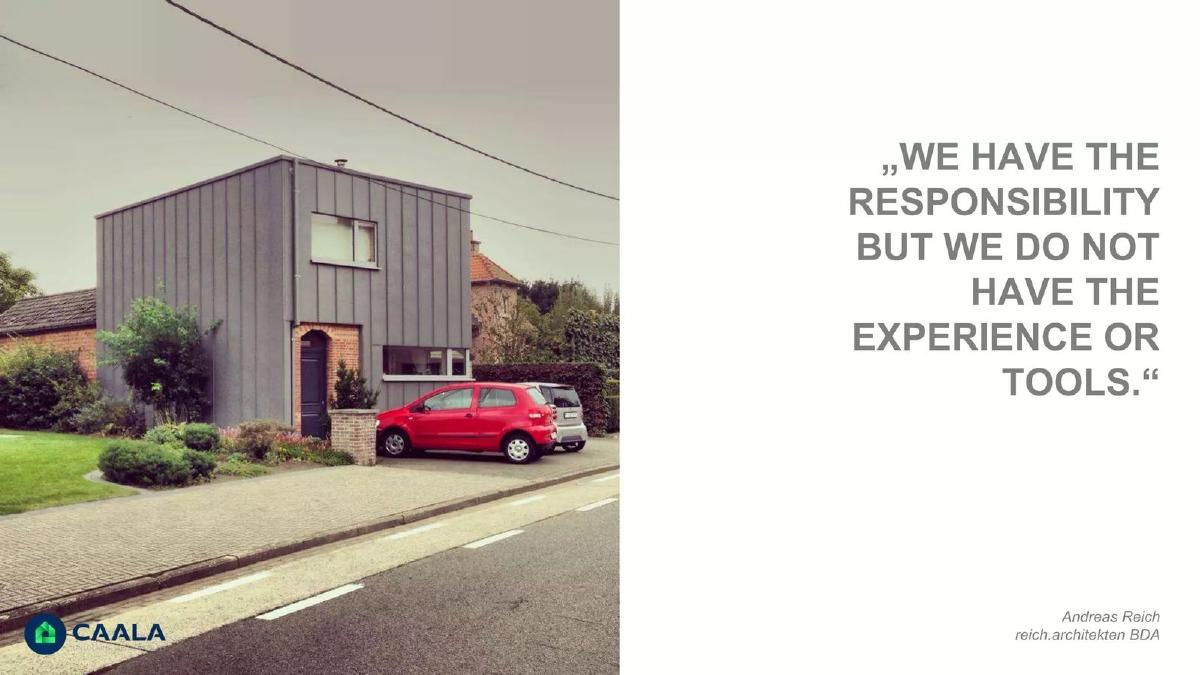
- A quote from an architect on Slide 6 identifies the core problem: a lack of experience and tools to meet sustainability responsibilities.
- Slide 7 provides a detailed screenshot of the software interface, showing real-time energy and LCA metrics like 94 kWh/(m2a).
- The product workflow on Slide 8 demonstrates a transition from 'CAALA Software' in early design to 'CAALA Expert' for technical stages.
- The value proposition is quantified on Slide 9 as a 40% saving in greenhouse gas emissions and a 30% saving in life cycle costs.
- The deck omits critical investor information, including the business model, team backgrounds, and the funding amount requested.
- Social proof is established early via nine industry and startup award logos on the title slide (Slide 1).
Slide-by-Slide Analysis
Slide 1: Title and Social Proof
The title slide features the Caala logo with the tagline 'Unlocking Sustainability.' The most significant element here is the row of nine logos at the bottom. These represent accelerators, government grants, and industry awards, including Climate-KIC , EXIST , DGNB (German Sustainable Building Council), and the Green Innovation and Investment Forum . This immediately establishes the company as a recognized player in the European Greentech ecosystem, even before the product is explained.
Slides 2, 3, and 4: The Macro Problem
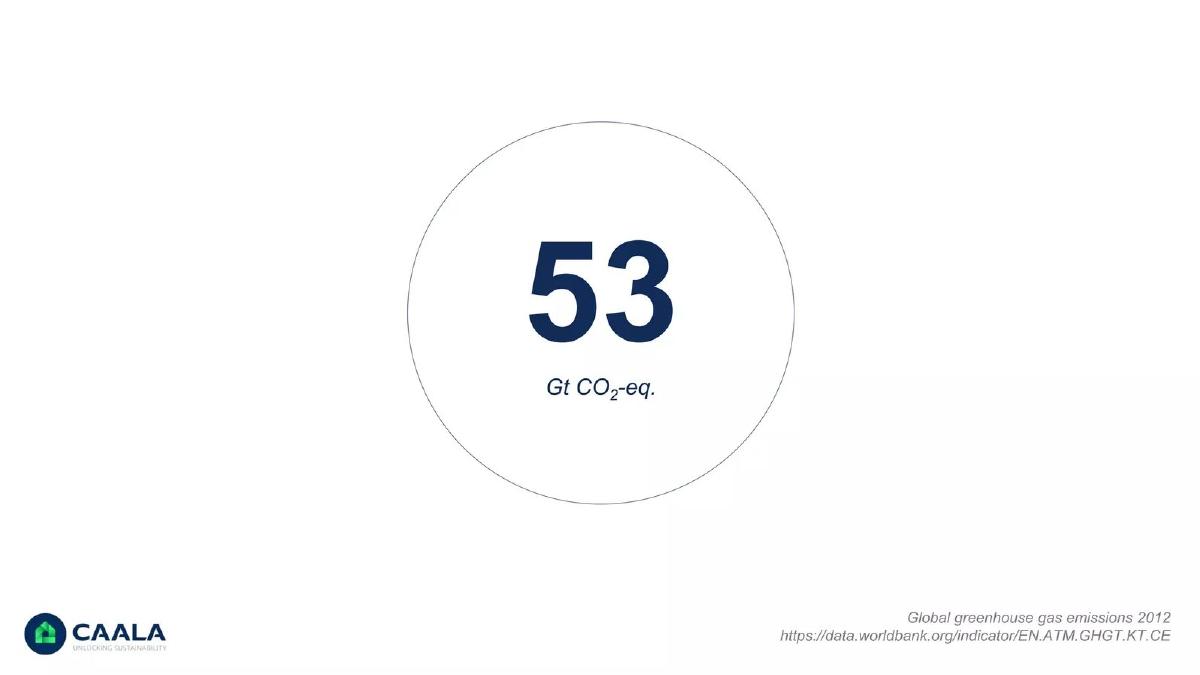
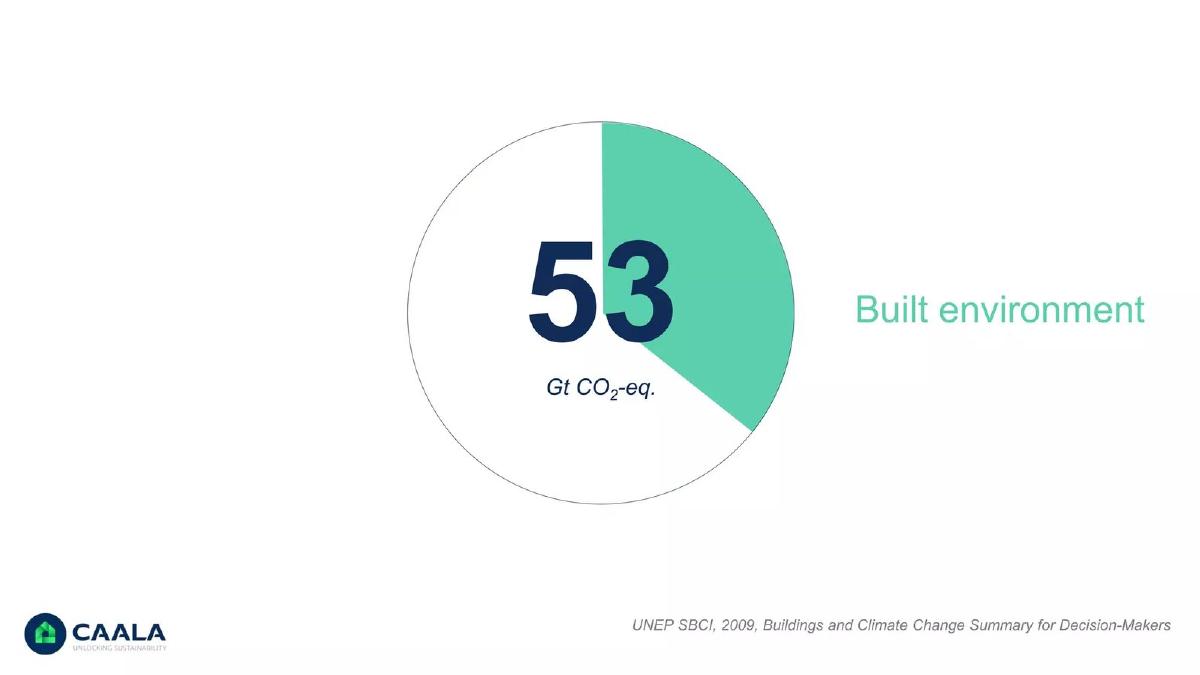
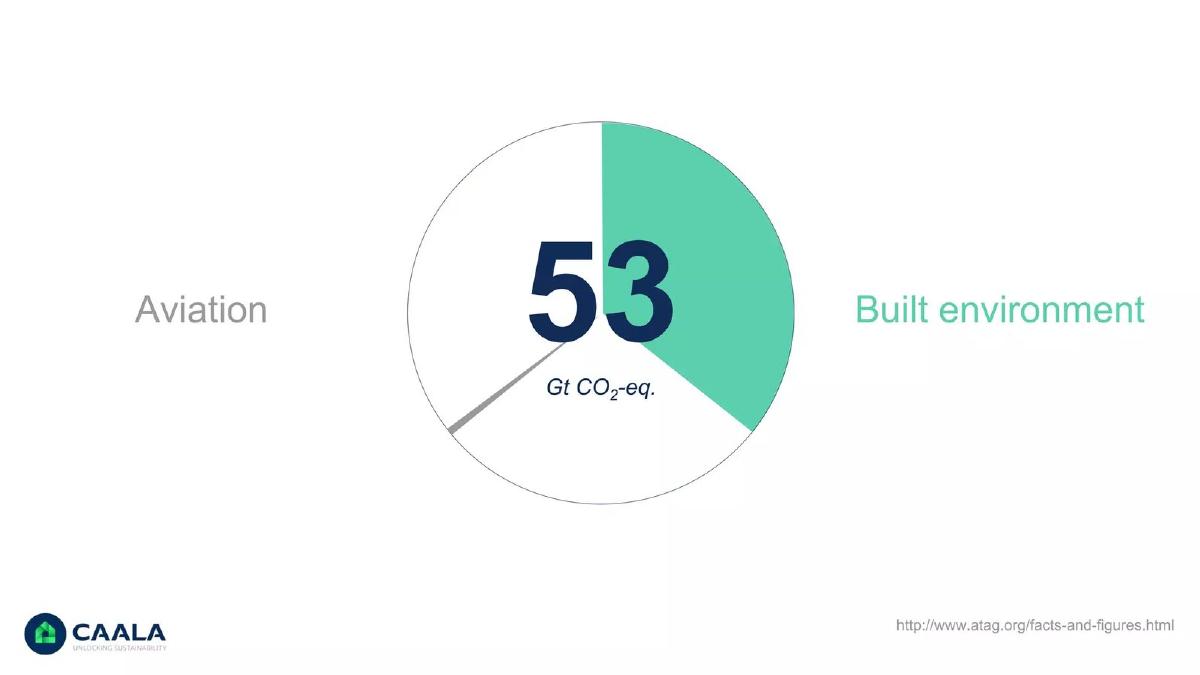
These three slides function as a single narrative unit using a build-up technique. Slide 2 shows a large number: 53 Gt CO2-eq. , citing the World Bank. Slide 3 adds a green segment to a pie chart representing the 'Built environment,' citing UNEP SBCI 2009 . Slide 4 adds a tiny sliver for 'Aviation' to provide scale, emphasizing that buildings are a far larger contributor to emissions than the often-criticized aviation sector. This is a classic 'Big Problem' opening designed to create a sense of urgency.
Slide 5: The Industry Face
This slide features a portrait of Bjarke Ingels , a world-renowned architect. While there is no text explaining his presence, his inclusion serves as a 'persona' anchor. It suggests that the software is designed for high-caliber architectural firms or that the company aligns itself with the forward-thinking design philosophy Ingels represents. It is a visual shorthand for the target user base.
Slide 6: The User Pain Point
Slide 6 moves from the macro problem to the micro user experience. It features a photo of a modern building and a quote from Andreas Reich of reich.architekten BDA: 'We have the responsibility but we do not have the experience or tools.' This is the most effective slide in the deck because it identifies a specific market gap: the lack of accessible software that allows architects to quantify sustainability during the design process.
Slide 7: Product Interface (The Beta)
This slide shows the software in action. On the left is a 3D modeling environment (resembling SketchUp), and on the right is the Caala dashboard. The dashboard displays 'Primärenergiebedarf im Betrieb' (Primary energy demand in operation) at 94 kWh/(m2a) . It also shows a 'Lebenszyklusbetrachtung' (Life cycle assessment) with a GWP of 28 kgCO2-e/(m2NGFA) . The presence of a 'BETA' tag and a specific date (16.10.2017) suggests this was a functional prototype at the time of the presentation.
Slide 8: Workflow Integration
This slide explains how the product fits into the standard architectural timeline. It lists four stages: Preliminary design , Conceptual design , Technical design , and Building permit . It shows 'CAALA Software' covering the first two stages and 'CAALA Expert' covering the latter two, connected by 'Automatic Data Transfer.' This addresses a common pain point in AEC (Architecture, Engineering, and Construction): the loss of data when moving between different software tools as a project matures.
Slide 9: The Value Proposition
Slide 9 quantifies the impact of using the software. It claims that 'Quality Architecture' can save 40% Greenhouse gas emissions and 30% Life cycle costs . These are bold claims, though the slide does not provide the specific methodology or case study used to arrive at these percentages. It serves as the 'hook' for the economic and environmental benefits of the platform.
Slide 10: Closing
The final slide shows the software on an iMac in a clean, professional office setting. It repeats the 'Thank You' message and includes the Climate-KIC logo again. Notably, there is no contact information, no call to action, and no summary of the investment opportunity.
What Works Well
Visual Minimalism: The deck avoids the 'wall of text' trap. It uses high-quality imagery and clear, large-font data points to tell a story. The use of a pie chart to compare the built environment to aviation (Slide 4) is a particularly effective way to contextualize the market opportunity without using a standard TAM/SAM/SOM slide.
Problem Validation: Using a direct quote from a practicing architect (Slide 6) provides immediate validation. It moves the conversation from 'carbon is bad' to 'architects want to help but can't,' which defines a clear product-market fit.
Workflow Clarity: Slide 8 is excellent for technical buyers or industry-specific investors. It shows exactly where the software sits in the value chain, which is often a point of confusion in complex B2B software pitches.
What Is Missing
The Business Model: There is no mention of how Caala makes money. Is it a SaaS subscription for firms? A per-project fee? A licensing model for other software providers? Without this, it is impossible to evaluate the company as a business rather than a tool.
The Team: This is a major omission. Investors back people, especially in the early stages. The deck does not list the founders, their backgrounds in architecture or software engineering, or their advisors. Even the Bjarke Ingels slide (Slide 5) is a reference to a persona, not a team member.
Market Size and Competition: The deck establishes that the problem is big, but it doesn't establish how much of that problem Caala can capture. It also ignores competitors like Tally, One Click LCA, or Cove.tool, which would be a primary concern for a professional investor.
The Ask: A pitch deck is a tool to get a meeting for an investment. By omitting the funding goal and the intended use of funds, the deck feels more like a product demo or a conference presentation than a fundraising document.
What a Founder Should Copy
The 'Build' Narrative: Founders should emulate the way Slides 2 through 4 build a narrative. Starting with a shocking number and then providing a relatable comparison (aviation) is a great way to ensure the audience understands the scale of the opportunity.
Quantified Value Props: Even if they are estimates, having clear 'X% saving' figures (Slide 9) gives investors a 'north star' metric to remember. It makes the benefit of the product tangible.
Interface Transparency: Showing a real screenshot of the software (Slide 7) rather than a stylized mockup builds credibility. It proves that the 'magic' described in the earlier slides actually exists in code.
Final Verdict
The Caala deck is a visually stunning presentation that excels at defining a problem and a product solution within the architectural niche. However, as a fundraising document, it is incomplete. It lacks the 'business' half of the equation—team, financials, and market strategy. It is best viewed as a 'teaser' deck designed to pique interest in the product's mission rather than a full investment memorandum.
Frequently asked questions
- What is the primary problem Caala aims to solve?
- Caala addresses the gap between an architect's responsibility to design sustainably and their lack of tools to do so effectively. Slide 6 features a quote from Andreas Reich stating, 'We have the responsibility but we do not have the experience or tools.' The deck suggests that current design processes do not adequately integrate life-cycle assessments early enough to make a significant environmental impact.
- How does the software integrate into the architectural workflow?
- According to Slide 8, the solution spans from preliminary design to the building permit stage. It utilizes 'CAALA Software' for the preliminary and conceptual design phases, then uses 'Automatic Data Transfer' to move information into 'CAALA Expert' for technical design and final permitting. This suggests a seamless transition from creative modeling to technical compliance.
- What specific environmental metrics does the software track?
- Slide 7 shows the interface tracking 'Primärenergiebedarf im Betrieb' (Primary energy demand in operation) measured in kWh/(m2a). It also displays 'Lebenszyklusbetrachtung' (Life cycle assessment) including non-renewable primary energy (PENRT) and Global Warming Potential (GWP), the latter measured in kgCO2-e/(m2NGFA). This indicates a focus on both operational and embodied carbon.
- Is there evidence of market traction in the deck?
- The deck does not provide revenue figures, user counts, or growth metrics. The only evidence of traction is the collection of nine logos on Slide 1, which include 'Climate-KIC,' 'EXIST,' 'StartGreen Award,' and 'DGNB.' These suggest the company has participated in accelerators and won industry awards rather than demonstrating commercial sales volume.
- What is missing from this deck for a formal Series A round?
- This deck is missing almost all standard financial and operational slides. There is no team slide showing founder expertise, no business model explaining how they charge (SaaS vs. per project), no market size analysis, and no competitive landscape. Most importantly, there is no 'Ask' slide detailing how much capital is being raised and how it will be deployed.