The Blanche & Cab Calloway House deck proposes a 'cross generational culture factory' that functions as a creative cooperative. The business model relies on a high-touch service for recording artists, who pay a '5-figure fee' for 15 hours of studio time and a comprehensive suite of marketing, merchandising, and distribution services. While the deck leverages the significant cultural legacy of Cab Calloway and his daughter Camay Calloway Murphy, it lacks critical financial projections, a specific funding ask, and a detailed team slide beyond the foundation's namesake. The market opportunity sl…
Key takeaways
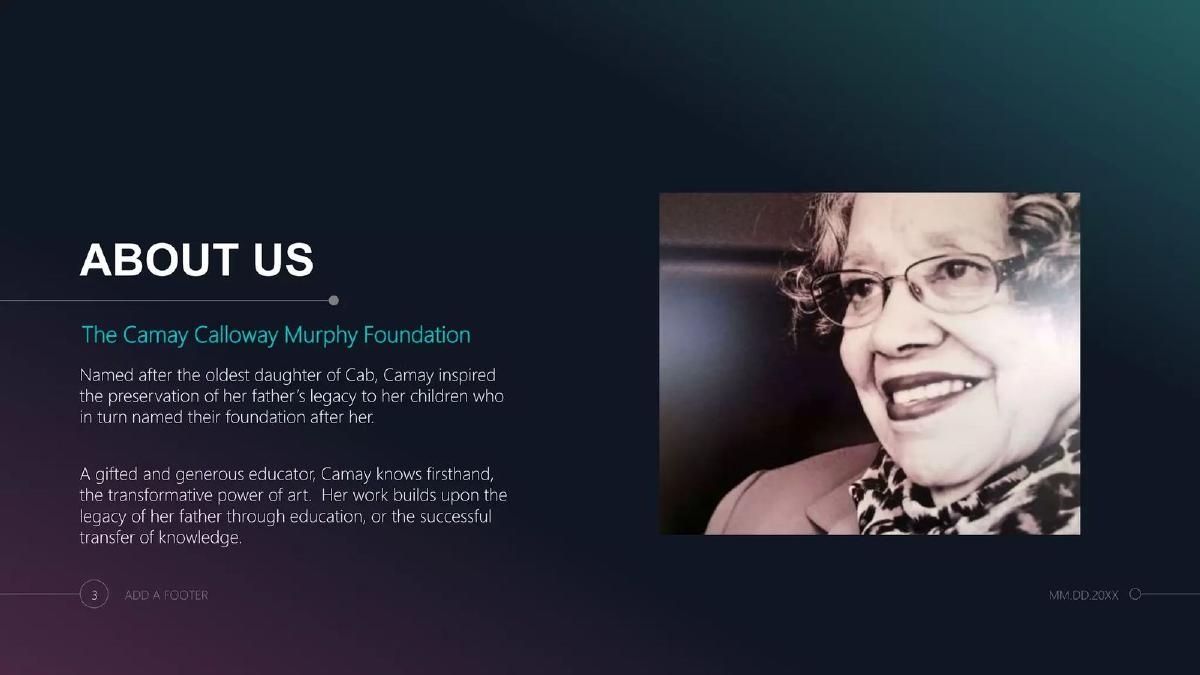
- The project is managed by The Camay Calloway Murphy Foundation, named after Cab Calloway’s oldest daughter (Slide 3).
- The core offering is described as a 'cross generational culture factory' where locals, visitors, and professionals interact (Slide 7).
- The business model is a four-step process where recording artists pay a '5-figure fee' for 15 hours of studio time and access to the space (Slide 9).
- Artists are responsible for bringing all their own personnel for creative work despite the high entry fee (Slide 9).
- The cooperative claims a stable financial foundation by operating across five markets: music recording, apparel, media/entertainment, merchandising, and digital marketing (Slide 11).
- Market data is presented as broad global aggregates, including a $2.6 trillion figure for the entire entertainment and media industry (Slide 11).
- The competitive matrix positions the 'Calloway Cooperative' as the most convenient and least expensive option compared to traditional studios or DIY marketing (Slide 13).
- The deck omits a specific financial ask, use of funds, or a detailed breakdown of the management team (General Observation).
Executive Summary: The Legacy-Driven Cooperative
The Blanche & Cab Calloway House pitch deck is a hybrid of a cultural preservation project and a commercial creative agency. It utilizes the high-profile branding of the Calloway family to anchor a 'culture factory' concept. While the aesthetic is professional, the deck functions more as a conceptual overview than a rigorous investment proposal, lacking the granular financial data and specific 'ask' typically required by institutional investors.
Slide 1: Title and Vision
The deck opens with a clear title: 'PITCH DECK Blanche & Cab Calloway House.' It includes a quote attributed to the era: 'I went way out west, and I did my best, then I came back east to spend my grease.' This sets a historical and cultural tone immediately, signaling that the project is rooted in the jazz age legacy of Cab Calloway. The visual design uses a dark, bokeh-style background which is maintained throughout the presentation.
Slide 3: About Us - The Foundation
This slide introduces The Camay Calloway Murphy Foundation . It explains the lineage of the organization, noting it was named after Cab Calloway’s oldest daughter, Camay. The text describes her as a 'gifted and generous educator' and states that the foundation’s work is built upon the 'successful transfer of knowledge.' This slide establishes the emotional and historical credibility of the project but does not list a board of directors or executive leadership team beyond the namesake.
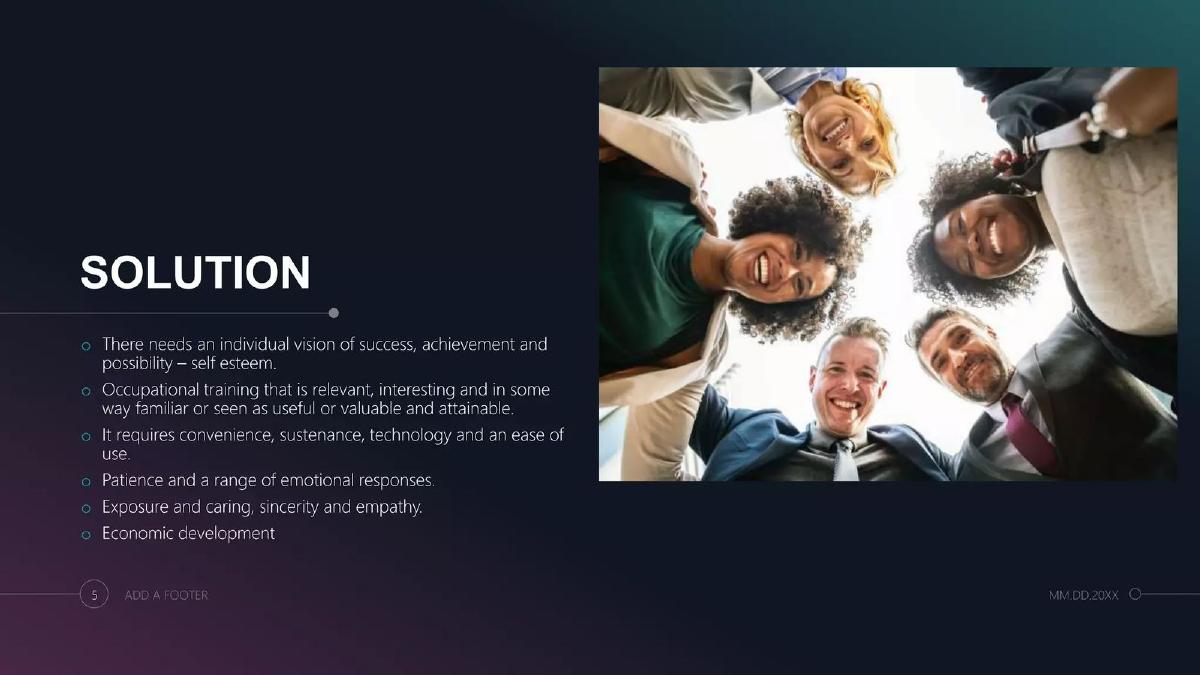
Slide 5: The Solution
The 'Solution' slide moves away from history and toward social and economic goals. It lists six bullet points, including 'Occupational training that is relevant,' 'Economic development,' and the need for 'self esteem.' The slide is somewhat abstract, focusing on 'Patience and a range of emotional responses' and 'Exposure and caring.' While these are noble social goals, they are not explicitly tied to a business mechanism on this slide, leaving the reader to wonder how these outcomes are manufactured.
Slide 7: The Culture Factory Concept
Slide 7 introduces the core concept: 'A cross generational culture factory.' It segments the users of the space into four categories: Locals (gaining skills), Visitors (tourism), Professionals (networking and training), and Investors . The phrase 'Like nothing you have seen before' is used as a header. The visual includes a monitor displaying a tea set, which feels disconnected from the 'factory' or 'studio' theme mentioned in the text.
Slide 9: The Four-Stage Business Model
This is the most critical slide for understanding the company's operations. It breaks the artist's journey into four steps:
1. Recording artist arrives: Artists pay a '5-figure fee' for 15 hours of studio time. Notably, the slide states they 'must bring all the personnel necessary for their creative work,' meaning the fee covers the facility and time, not necessarily the session musicians or engineers. · 2. Production, performance: Includes live recording, wardrobe, photography, and music video production. · 3. Marketing and merch: Covers social media setup, merchandising (t-shirts, hats), and booking a local concert. · 4. Distribution and graduation: The artist leaves with a completed 'album, wardrobe, merch, social media, website, press release, photography, music video, interview.'
This model suggests a high-margin service business where the facility acts as a one-stop-shop for independent artists with significant capital.
Slide 11: Market Opportunity
The deck attempts to quantify the opportunity by citing three massive figures:
$9.8 Billion for Music Recording. · $328.7 Billion for the Apparel Industry. · $2.6 Trillion for the Entire entertainment and media Industry.
The text claims the cooperative has a 'stable financial foundation' because it operates in five different markets. However, these are Top-Down market figures that do not reflect the actual addressable market for a single facility. The mention of 'revenue from OTT' (Over-the-Top media) is introduced here without prior explanation of their streaming capabilities.
Slide 13: Competition Matrix
The competition slide uses a standard four-quadrant graph with 'Convenience' on the Y-axis and 'Price' on the X-axis. The Calloway Cooperative is placed in the extreme top-right corner (More Convenient / Less Expensive). It compares itself against 'Recording on your own,' 'Recording studio,' and 'Live performance.' The placement of 'Recording on your own' as more expensive and less convenient than a five-figure studio fee is a bold claim that likely requires more justification than the slide provides.
Slide 21: Summary and Closing
The summary slide (numbered 21, suggesting several slides were omitted in the provided set) features a vintage advertisement of Cab Calloway for Rheingold Beer. The text reiterates the goal to 'prevent continued decline' by providing a 'clear career path' for creatives. It ends on a philosophical note: 'We use the platform provided by the past to project ourselves into the future.' The date on the slide is 08.26.2019 , providing a timestamp for the deck's creation.
What Works
Strong Branding: The use of the Calloway name and vintage imagery creates a unique 'vibe' that differentiates this from generic co-working or studio spaces. It feels like a destination rather than just a service.
Comprehensive Service Loop: The four-stage model on Slide 9 is a smart way to show how the business captures value beyond just 'renting a room.' By including merch, marketing, and distribution, they position themselves as a mini-label for hire.
What is Missing
The Ask: There is no slide indicating how much money is being raised, the valuation, or what the investor receives in return. This is the most significant hurdle for a pitch deck.
Unit Economics: While a '5-figure fee' is mentioned, there is no breakdown of the costs to deliver those services. If the artist brings their own personnel, what are the facility's overhead costs? How many artists per year are needed to break even?
Management Team: Aside from the historical figure of Camay Calloway Murphy, there are no bios for the people who will actually run the studio, manage the marketing, or handle the 'culture factory' operations. Investors invest in people, and those people are invisible here.
Real Estate Details: For a 'House' or 'Center,' the physical location and status of the property (owned, leased, or yet to be acquired) are vital. The deck is silent on where this facility actually exists or will exist.
Founder Takeaways
Avoid 'Trillion Dollar' Market Slides: Citing the $2.6 trillion global media market does not help an investor understand your business. It is better to show the number of independent artists in your specific city who can afford a $15,000–$50,000 production fee.
Clarify the 'Cooperative' Aspect: The deck uses the word 'Cooperative' frequently, but the business model (artists paying high fees) looks like a standard B2C service model. If there is a true cooperative element (profit sharing, membership rights), it needs to be explicitly defined.
Show, Don't Just Tell, Convenience: The competitive matrix claims the facility is 'Less Expensive' than recording on one's own. Since DIY recording is often done for the cost of a laptop and a microphone, the deck needs to explain why a five-figure fee is actually a 'saving' (perhaps by totaling the cost of hiring separate photographers, web designers, and PR agents).
Frequently asked questions
- What is the primary revenue stream for the Calloway House?
- According to slide 9, the primary revenue comes from recording artists who pay a '5-figure fee' for a package that includes 15 hours of studio time. The model also mentions revenue from merchandising, apparel, and digital marketing, though the specific price points for these secondary streams are not disclosed in the provided slides.
- Who is the target audience for this facility?
- Slide 7 identifies four distinct groups: locals seeking skills in a safe place, visitors attracted to unique cultural features, professionals looking to train and network, and investors interested in influencing the future of the arts. The business model specifically targets recording artists who have the capital to afford high-end production services.
- How does the deck define its competitive advantage?
- On slide 13, the 'Calloway Cooperative' is placed in the top-right quadrant of a competitive matrix, labeled as both 'More Convenient' and 'Less Expensive' than alternatives like traditional recording studios, live performance broadcasts, or independent marketing efforts. It suggests that by providing a 'clear career path,' they reduce risk for creatives.
- What specific services are included in the artist package?
- Slide 9 outlines a comprehensive 'graduation' path. After the initial recording, the facility assists with wardrobe, photography, music video production, press releases, social media setup, and merchandising (swag like t-shirts and hats). The process culminates in the arrangement and sale of the artist's first concert.
- Is there a clear funding request in the deck?
- No. The provided slides do not include a 'The Ask' slide. There is no mention of the total capital required, the equity or debt structure offered, or how the funds will be allocated across construction, operations, or marketing. This is a significant omission for a document labeled as a 'Pitch Deck'.