Music Business Model Slides: 7 Real Pitch Deck Examples
How music startups explain how they make money in a pitch deck: per-session profit, studio fees, a cut of funds raised, fan memberships.
Music Business Model Slide: Show Who Pays, How Much and How Often
Music is a hard place to make money, and investors know it. Streaming pays artists fractions of a cent, labels take most of the income from a hit, and fans have learned to expect music for free. That makes the business model slide one of the most closely read pages in a music startup's deck. An investor wants to know who pays, how much they pay, how often, and what it costs to serve them. The six slides below come from music startups. They range from a slide that works out profit per session in one line to slides that never mention a price. Reading them side by side shows what makes a music business model believable.
TL;DR
Name who pays you, what they pay for, the price and how often they pay, and if you can, what each sale costs you. BrainRap's slide does this in one line: an average of $4,000 spent per session plus $150 in premium services, less a $2,000 base cost, for $2,150 profit per transaction. Listin shows four plans from free to $15 a month. Slides that describe what the company does without a price, such as Music Coco and musicHUB, leave investors unable to judge the business.
Music business model slides from real pitch decks
Each example shows the exact stored slide above its analysis and links to the full teardown. Slides with prices come first; weaker ones follow for contrast. Claims are as shown on the slides; comments are ours.
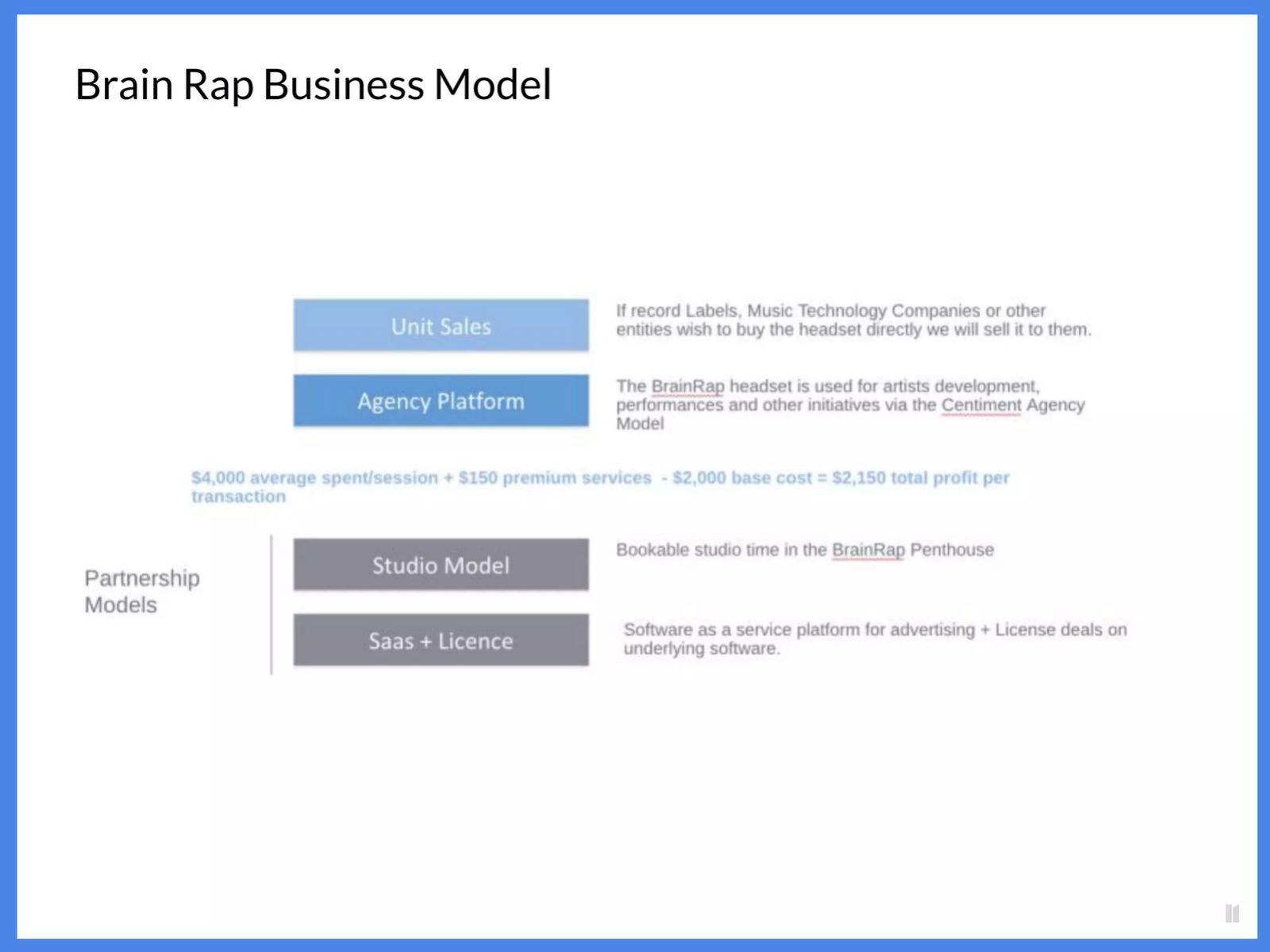
BrainRap business model slide — slide 10
AI lyric assistant that listens to an artist freestyling and suggests words, using a brainwave headset. Slide titled "Brain Rap Business Model".
BrainRap deck, slide 10. Exact stored slide matched to this analysis.
Our analysis: It argues that each session earns more than it costs, and that the headset and software can earn in three other ways.
Evidence and limitation: Claimed; no source for the session price or cost. BrainRap emerged from an MIT hackathon and joined Abbey Road Studios' Abbey Road Red incubator in October 2021, according to Abbey Road.
What a founder can adapt: Say which model the $2,150 belongs to, which model comes first, and how many sessions you expect in a year.
Supporting analysis
What the deck claims: Unit Sales: headset sold directly to record labels, music technology companies or others. Agency Platform: headset used for artist development and performances via the Centiment agency model. "$4,000 average spent/session + $150 premium services - $2,000 base cost = $2,150 total profit per transaction." Partnership models: Studio Model (bookable studio time in the BrainRap Penthouse) and SaaS plus licence (advertising platform and licence deals on its software).
Presentation choice: It is the only slide here that works out profit on one sale, so every number can be questioned.
When it does not fit: Listing four models with equal weight; investors want to know which one carries the business.
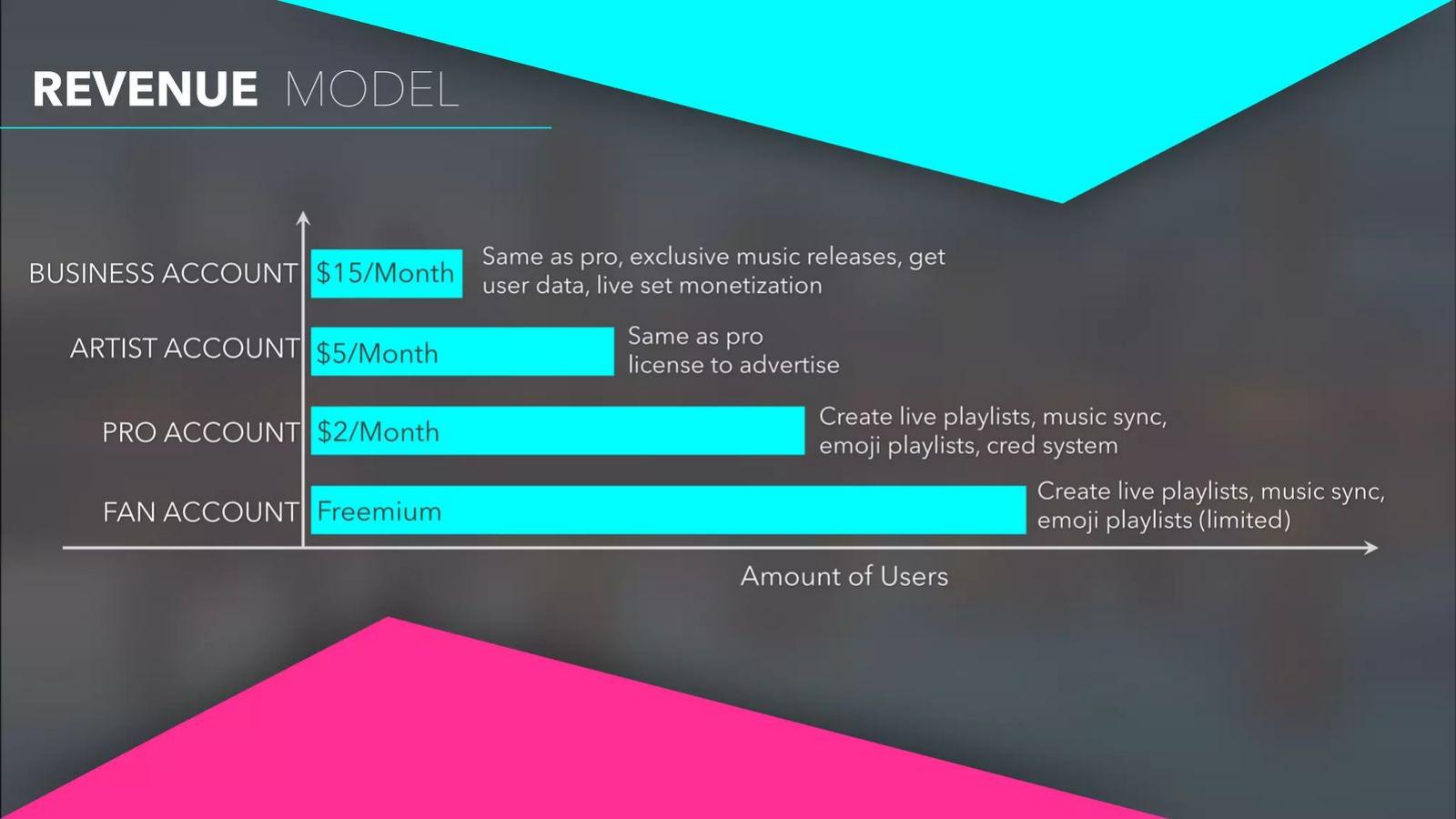
Canadian social playlist app founded in 2016. Slide titled "Revenue Model".
Listin deck, slide 8. Exact stored slide matched to this analysis.
Our analysis: It argues that most users will stay free, while smaller groups of fans, artists and businesses pay rising monthly prices.
Evidence and limitation: Prices as shown. Outcome unknown; we found no public record of the company's later results.
What a founder can adapt: Add the share of users you expect on each paid plan and one early figure from testing.
Supporting analysis
What the deck claims: Bars sized by "Amount of Users": Business Account $15/month (same as pro, exclusive music releases, user data, live set monetization); Artist Account $5/month (same as pro, licence to advertise); Pro Account $2/month (live playlists, music sync, emoji playlists, cred system); Fan Account Freemium (the same features, limited).
Presentation choice: Each tier names who it is for, what it adds and its monthly price, and the bar lengths show where most users sit.
When it does not fit: A free plan with no expected upgrade rate; it leaves revenue impossible to estimate.
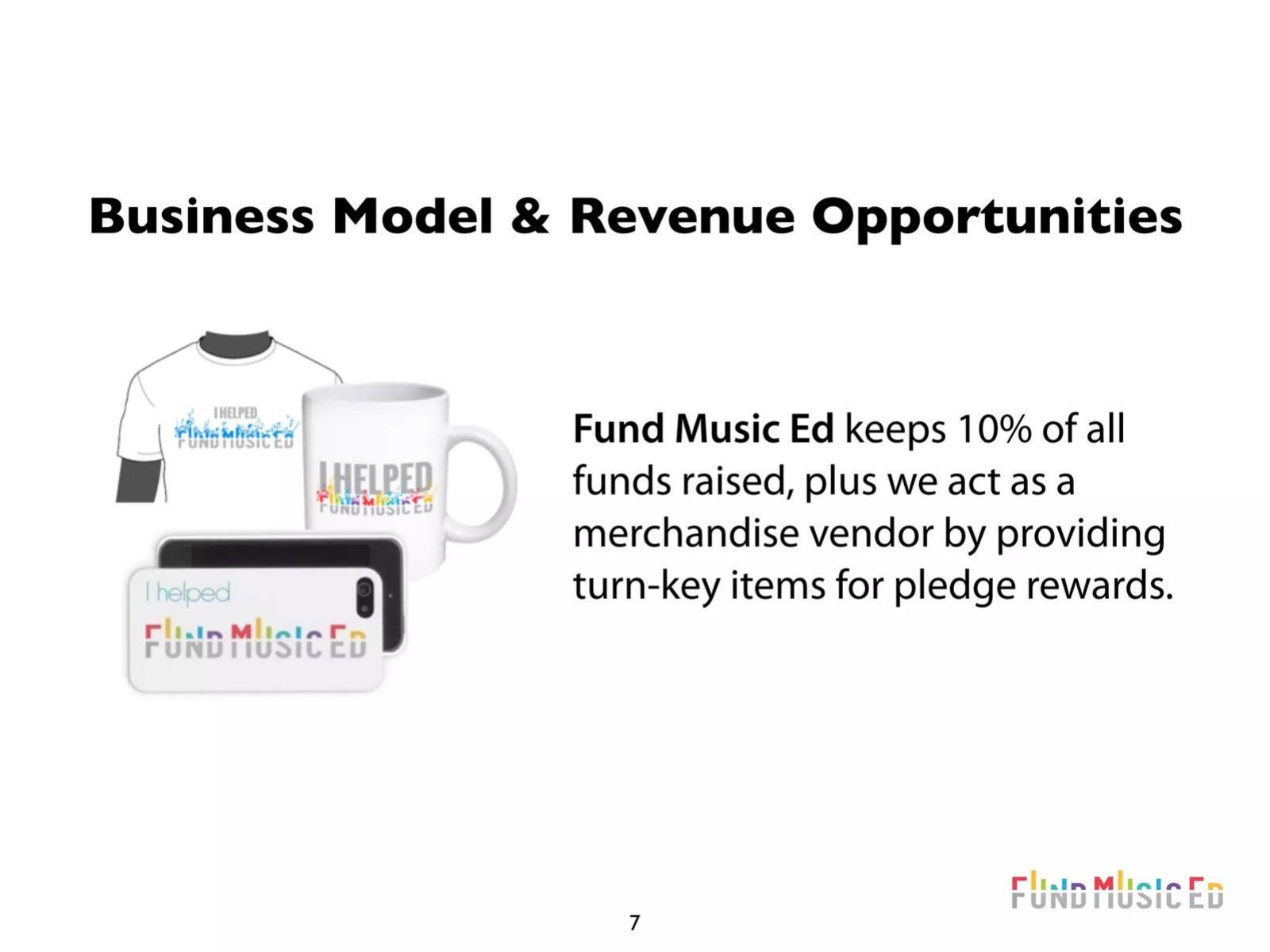
Online fundraising platform for school music programs, 2014 seed deck. Slide titled "Business Model & Revenue Opportunities".
Fund Music Ed deck, slide 7. Exact stored slide matched to this analysis.
Our analysis: It argues that the company earns a commission on every campaign and a margin on reward merchandise.
Evidence and limitation: Fee as stated. The deck elsewhere reports an alpha pilot that raised $8,200 for schools; we found no record of the company after that.
What a founder can adapt: Add the average campaign size and number of campaigns, so a reader can work out what 10% is worth.
Supporting analysis
What the deck claims: "Fund Music Ed keeps 10% of all funds raised, plus we act as a merchandise vendor by providing turn-key items for pledge rewards." Images of a T-shirt, mug and phone case reading "I helped Fund Music Ed".
Presentation choice: One clear charge, stated in one sentence, with the payer obvious.
When it does not fit: A percentage with no base; 10% of a small campaign is a small sum.
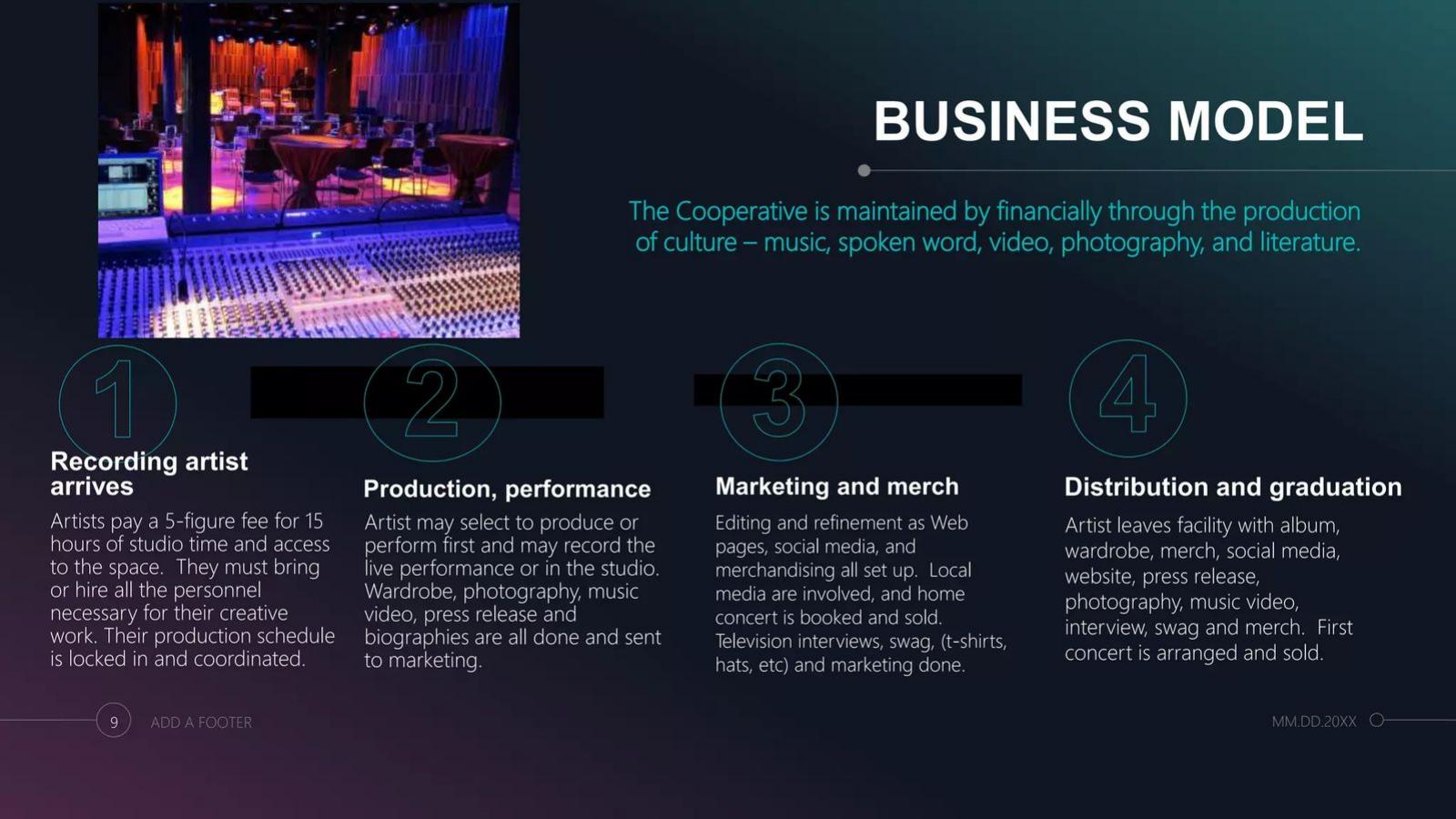
Planned music and culture cooperative named for Cab and Blanche Calloway, 2019 deck. Slide titled "Business Model".
Calloway Center deck, slide 9. Exact stored slide matched to this analysis.
Our analysis: It argues that artists will pay a large fee for a full package that takes them from recording to a first concert.
Evidence and limitation: Claimed; no exact fee. Outcome unknown; we found no public record that the cooperative opened.
What a founder can adapt: Give the actual fee, the number of artists a year the space can take, and who keeps concert and merch income.
Supporting analysis
What the deck claims: "The Cooperative is maintained by financially through the production of culture." Four steps: recording artist arrives ("Artists pay a 5-figure fee for 15 hours of studio time and access to the space"); production and performance; marketing and merch; distribution and graduation, when the artist leaves with album, wardrobe, merch, website, press release, photography, music video and a first concert arranged and sold.
Presentation choice: The four steps make it clear what the artist gets for the money.
When it does not fit: "5-figure" as a price; it could mean $10,000 or $99,000.
Music data company in Lagos, Nigeria. Slide titled "Business Model".
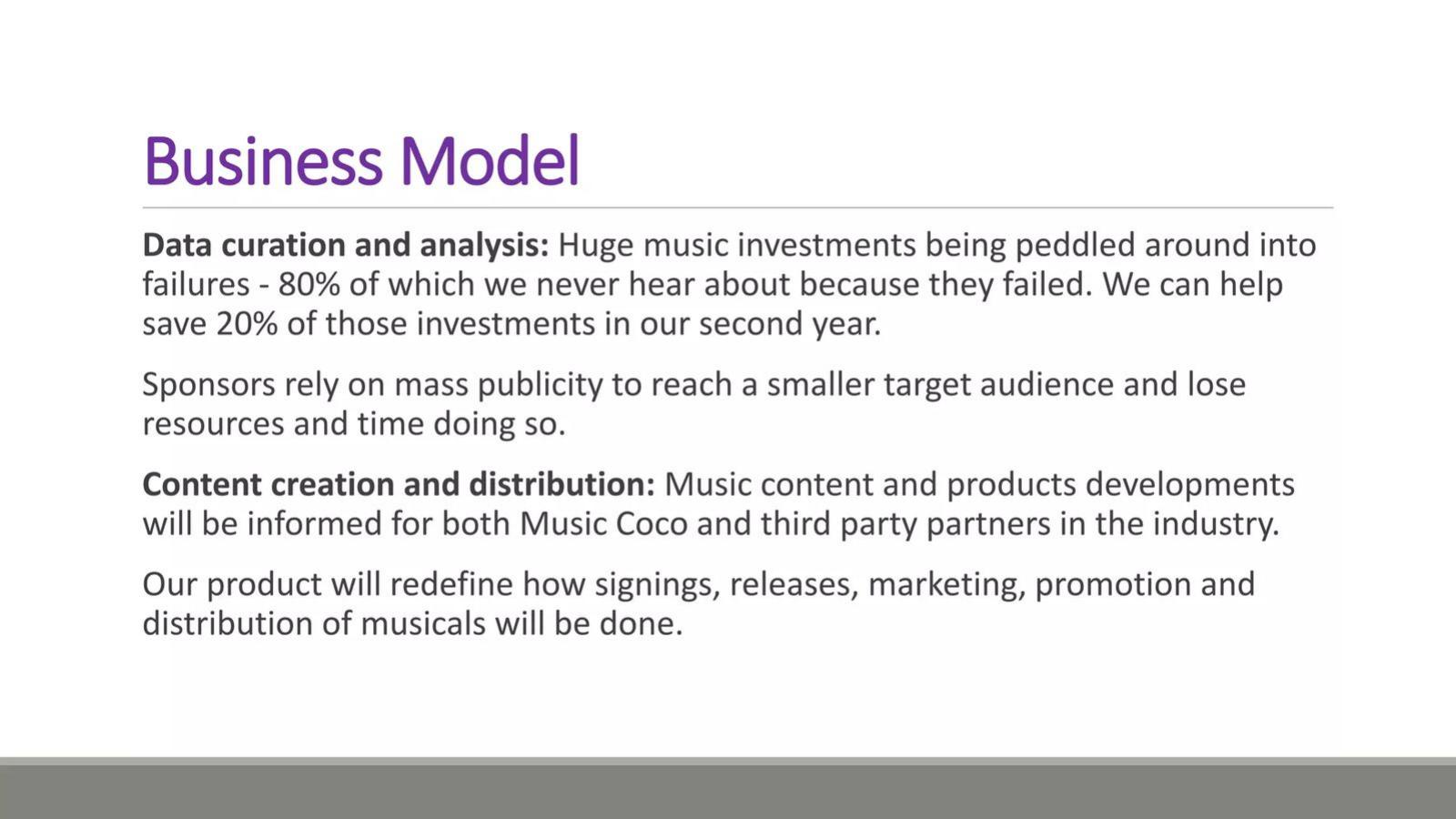
Music Coco deck, slide 10. Exact stored slide matched to this analysis.
Our analysis: It argues that music data can reduce failed investments, but never says who would pay for it.
Evidence and limitation: Claimed; no source for the 80% figure and no price. Crunchbase appears to list the company as closed (seen in search results; its page blocked direct checks).
What a founder can adapt: Name the customer (a label, an investor or a sponsor), the price and how often they pay.
Supporting analysis
What the deck claims: Data curation and analysis: "Huge music investments being peddled around into failures - 80% of which we never hear about because they failed. We can help save 20% of those investments in our second year." Sponsors "rely on mass publicity". Content creation and distribution informed for Music Coco and third-party partners. "Our product will redefine how signings, releases, marketing, promotion and distribution of musicals will be done."
Presentation choice: Shown for contrast: the slide describes the product and the problem, not the income.
When it does not fit: A business model slide with no customer and no price.
Chilean music startup. Slide titled "Business Model".
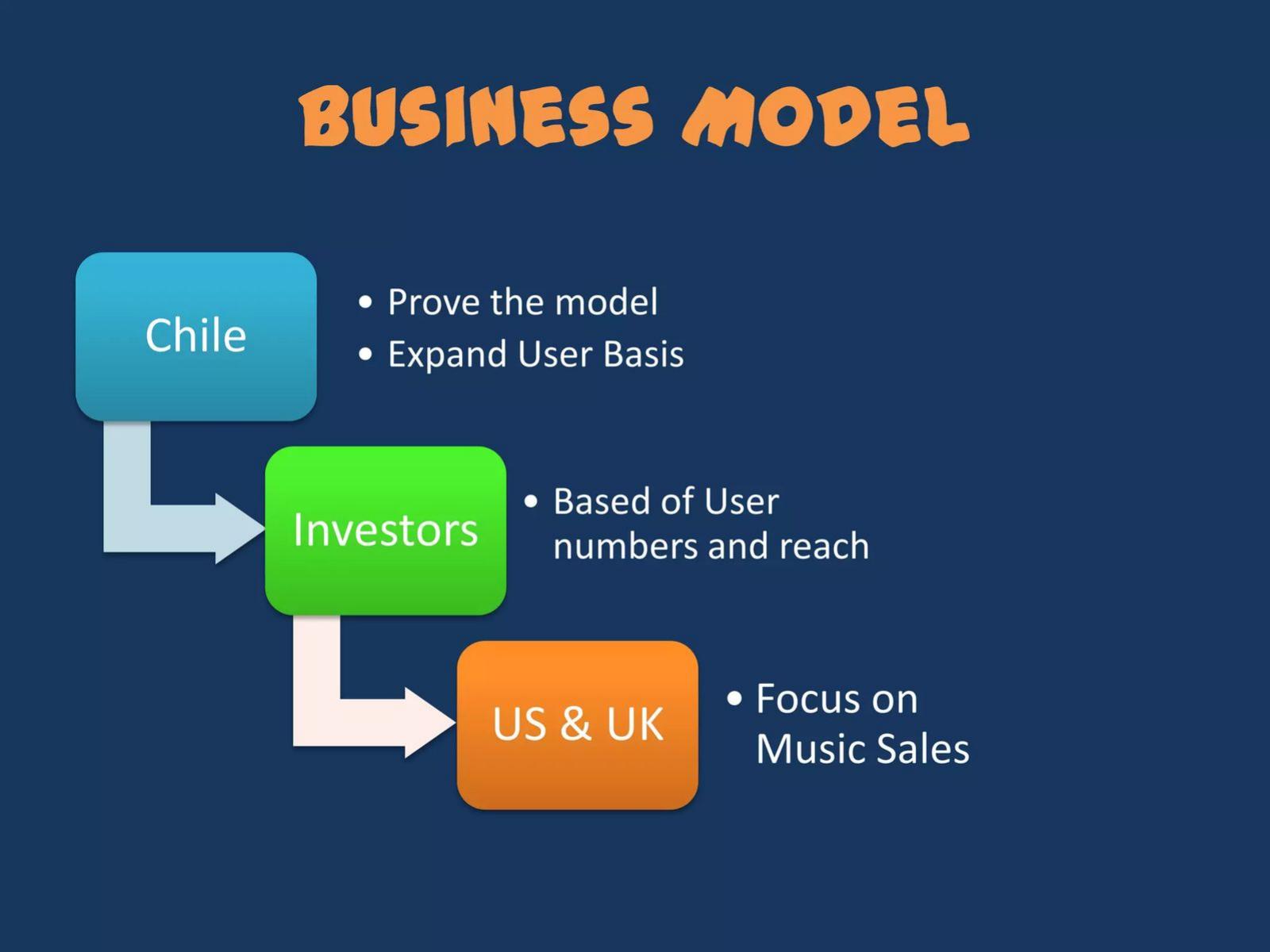
musicHUB deck, slide 7. Exact stored slide matched to this analysis.
Our analysis: It argues that success in Chile will attract investors and fund expansion into music sales in the US and UK.
Evidence and limitation: No figures. Outcome unknown; it is not the German company of the same name.
What a founder can adapt: Move the expansion plan to its own slide and use this one for who pays, how much and how often.
Supporting analysis
What the deck claims: Three boxes joined by arrows: Chile ("Prove the model", "Expand User Basis"); Investors ("Based of User numbers and reach"); US and UK ("Focus on Music Sales").
Presentation choice: Shown for contrast: it is a growth plan, and the only sign of income is "Music Sales" in the last box.
When it does not fit: Putting fundraising steps where the revenue model should be.
Whether each slide names who pays, gives a price and shows a cost.
Example
Who pays
Price given
Cost shown
BrainRap
Partly (labels, sessions)
Yes ($4,000 a session)
Yes ($2,000)
Listin
Yes (fans, artists, businesses)
Yes ($2 to $15 a month)
No
Fund Music Ed
Yes (campaigns)
Yes (10%)
No
Calloway Center
Yes (artists)
Partly ("5-figure")
No
Music Coco
No
No
No
musicHUB
No
No
No
Key Takeaways
Say who pays: fans, artists, labels, brands or schools.
Give a price and how often it is paid.
Show what one sale costs you, not only what it earns.
Lead with your main income source; list others after.
A plan for growth is not a business model.
Build your music business model slide
Start from the person who pays and one sale.
Payer. Who pays you: fans, artists, labels, venues, schools or brands?
Price. What do they pay, and is it once, per use or every month?
Cost. What does serving one customer or one sale cost you?
Main source. Which income source will bring in most of the money in the next two years?
Proof. Has anyone paid yet, and how much?
Copyable framework: [Payer] pays [price] [how often] for [what they get]. Each sale costs us [cost], leaving [profit]. In [test], [number] customers paid a total of [amount].
Illustrative example 1 — written by us
Before: Artists pay a 5-figure fee for studio time and access to the space.
After: Artists pay $18,000 for 15 hours of studio time, production and a first concert. Each package costs us $11,000 in staff and studio time. We can take 20 artists a year, and three have paid deposits.
What improved: Our illustrative rewrite; figures are invented for the example. It gives an exact price, a cost and a capacity a reader can test.
What this guide adds
The general business model guide covers any kind of company. Music has problems of its own. Many people in the chain can pay: fans, artists, labels, venues, brands and advertisers. Prices are often small, so a startup needs very large numbers of buyers or a few high-value ones. And the people a music startup serves, especially artists, often have little money. A music business model slide has to show that someone with money will pay, and that the price covers the cost.
Here we look only at how each slide explains income: who pays, what they pay for, the price, how often, and whether costs appear. The examples run from 2012 to around 2021, so the prices are those of their time. We judge each slide against its own time and market.
How we read each slide
We quote the text on the stored slide images, read at full size. We have not checked any price, fee, cost or profit shown on the slides. "Claimed" means the company states something on the slide without a source. Where we checked what happened to a company after its deck, we say what we found and where; where we found nothing, we say the outcome is unknown.
One slide, Calloway Center's, comes from a deck built on a template, and its footer still reads "ADD A FOOTER" and "MM.DD.20XX". The business model text itself is complete, so we use it, but founders should note how much an unfinished footer can distract a reader.
Five ways the slides explain income
A worked unit calculation (BrainRap) puts price, cost and profit in a single line. A priced plan list (Listin) shows each tier with its monthly price and what it includes. A single fee or commission (Fund Music Ed, Calloway Center) names one charge and who pays it. A description or growth plan (Music Coco, musicHUB) explains what the company will do, with no price.
Whatever the format, a reader needs four things: who pays, the price, how often, and the cost of serving them. Four of the six slides name who pays. Three give at least one firm price or rate. Only BrainRap shows a cost next to its price.
Work out one sale from price to profit
BrainRap's slide is the only one here that does the full sum. Its middle line reads: "$4,000 average spent/session + $150 premium services - $2,000 base cost = $2,150 total profit per transaction." Around it, the slide lists four ways to earn: selling the headset outright to record labels and music technology companies, an agency platform where the headset is used for artist development and performances, bookable studio time in the "BrainRap Penthouse", and a software-as-a-service platform for advertising plus licence deals on its software.
The calculation is the strongest part of the slide because an investor can question each number: what a session includes, who spends $4,000 on it, and what the $2,000 base cost covers. The weakness is that the slide lists four models without saying which one the calculation belongs to or which comes first. A reader assumes the $2,150 applies to the agency platform, but the slide doesn't say so.
If your business has a unit, such as a session, a booking, a release or a ticket, put the same line on your slide: price, plus extras, minus cost, equals profit. Then say how many units you expect to sell in a year.
Show priced plans and who each one is for
Listin, a Canadian social playlist app, shows four accounts as bars of different lengths, with the longest bar for the most users. A Fan Account is "Freemium" with limited live playlists, music sync and emoji playlists. A Pro Account is $2 a month and adds a "cred system". An Artist Account is $5 a month and adds a licence to advertise. A Business Account is $15 a month and adds exclusive music releases, user data and live set monetization.
This works because each tier names who it is for and what they get for the extra money. The bar chart also tells investors something useful: most users will be on the free plan, and the paying tiers get smaller as the price rises. What it doesn't give is any number of users or the share expected to pay. A free plan only makes sense if enough people upgrade, so a line such as "we expect 3% of fans to choose Pro" would let an investor work out revenue.
Name one clear fee
Fund Music Ed's slide is a single sentence: "Fund Music Ed keeps 10% of all funds raised, plus we act as a merchandise vendor by providing turn-key items for pledge rewards." Beside it are pictures of a T-shirt, a mug and a phone case printed with "I helped Fund Music Ed". It is easy to read and states the main charge plainly. A reader knows the company takes a commission on school music fundraising and also sells reward items.
What it leaves out is size. Ten percent of a $2,000 school campaign is $200, so the business depends on how many campaigns run and how large they are. The slide gives no average campaign size, number of schools or margin on merchandise. The company's deck elsewhere reports an alpha pilot that raised $8,200 for schools; putting that figure on this slide would show the fee in action.
Calloway Center's slide also names one fee: "Artists pay a 5-figure fee for 15 hours of studio time and access to the space." It then lays out four stages of an artist's path: arrival, production and performance, marketing and merch, and distribution and graduation, where the artist leaves with an album, wardrobe, merchandise, website, press release, photography, music video and a first concert arranged and sold. The four steps make it clear what the artist gets for the fee.
The weakness is "5-figure", which could mean $10,000 or $99,000. An investor can't work out income without the actual price, and can't judge whether artists will pay it. The slide also mentions a home concert that is "booked and sold" and merchandise, but doesn't say whether that income goes to the cooperative or to the artist.
Descriptions and growth plans are not business models
Music Coco, a music data company in Lagos, Nigeria, titles its slide "Business Model" and describes two activities: data curation and analysis, and content creation and distribution. It claims that 80% of music investments fail without anyone hearing about them and that "We can help save 20% of those investments in our second year." It never says who would pay Music Coco, how much, or how often. Labels, investors and sponsors are all mentioned, but none is named as a customer.
Crunchbase appears to list Music Coco as closed, based on search results; its page blocked us, so we could not confirm this directly. We make no claim that its slide caused that. The lesson is narrower: a slide titled business model that describes the product leaves investors to guess where the money comes from.
musicHUB, a Chilean music startup, shows three boxes joined by arrows: Chile ("Prove the model", "Expand User Basis"), Investors ("Based of User numbers and reach") and US and UK ("Focus on Music Sales"). This is a plan for growth and fundraising, not a business model. The only hint of income is "Music Sales" in the last box, with no price, share or customer. A founder in this position should split the slide in two: one slide for how the company earns money today, and one for where it plans to expand.
Questions investors ask about a music business model slide
Who pays? Fans, artists, labels, venues and brands have very different budgets. Name the one that pays most.
How much, and how often? A one-off $10 fee and a $10 monthly plan are different businesses. Say which yours is.
What does each sale cost you? Studio time, royalties, payment fees and staff all come out of the price. BrainRap shows its cost; most slides don't.
Why will they keep paying? Music income is often seasonal or tied to releases. Explain what brings a customer back.
Mistakes music slides make most often
The first is a price range so wide it means nothing, such as Calloway Center's "5-figure fee". Give the actual price, or the price for a typical customer.
The second is listing many income sources without ranking them. BrainRap lists several, but doesn't say which one carries the business.
The third is a slide titled business model that never mentions money. Music Coco describes its product and musicHUB describes its expansion; neither tells an investor who pays.
Common mistakes
Vague price. Calloway Center says "5-figure fee" instead of a number.
No customer. Music Coco never says who would pay.
Growth plan as model. musicHUB shows expansion steps, not income.
No upgrade rate. Listin shows a free plan but not how many will pay.
Percentage with no base. Fund Music Ed's 10% needs a campaign size.
Diagnostic checklist
Names who pays.
Gives a price for each income source.
Says how often each customer pays.
Shows the cost of one sale.
Ranks income sources by expected size.
Keeps growth plans on a separate slide.
Includes any money already received.
Frequently asked questions
What should a music startup put on its business model slide?
Who pays, the price, how often and what each sale costs. BrainRap works out profit per session in one line: $4,000 spent plus $150 in extras, less $2,000 in cost.
Is it fine to list many income sources?
Yes, but rank them. Investors want to know which one carries the business. A list with no order leaves that question open.
Should a music app show a free plan?
If you have one, yes, along with the share of users you expect to pay. Listin shows four plans from free to $15 a month, but not how many users will upgrade.
Can I put my expansion plan on the business model slide?
Keep it separate. musicHUB's slide shows Chile, then investors, then the US and UK, but never says how the company earns money.
How we chose these examples
Corpus: published pitch deck teardowns on StartupFundraising.com. Founder-uploaded private decks are excluded.
Selection (2026-10-01): we searched extracted slide text across the full corpus for business model and revenue model wording in music decks. Candidates were viewed at full size; seven music business model slides that no other guide uses were kept. v2 (2026-10-05) removed Hannah Chapplain because a page of her deck carries a restriction notice, leaving six.
Not used: Magroove p19 (a roadmap, not a business model); Meetem (deck file unavailable).
Status checks (2026-10-01): Abbey Road for BrainRap; Crunchbase for Music Coco (search result only; the page returned 403 on 2026-10-01). No public outcome was found for Listin, Fund Music Ed, Calloway Center or musicHUB.
Review: stored slide text and images were checked on 2026-10-01 against company, deck and slide number (editorial model review). No person has yet completed an editorial review of this page. We make no claim that any slide caused a fundraising outcome.